Inspiration
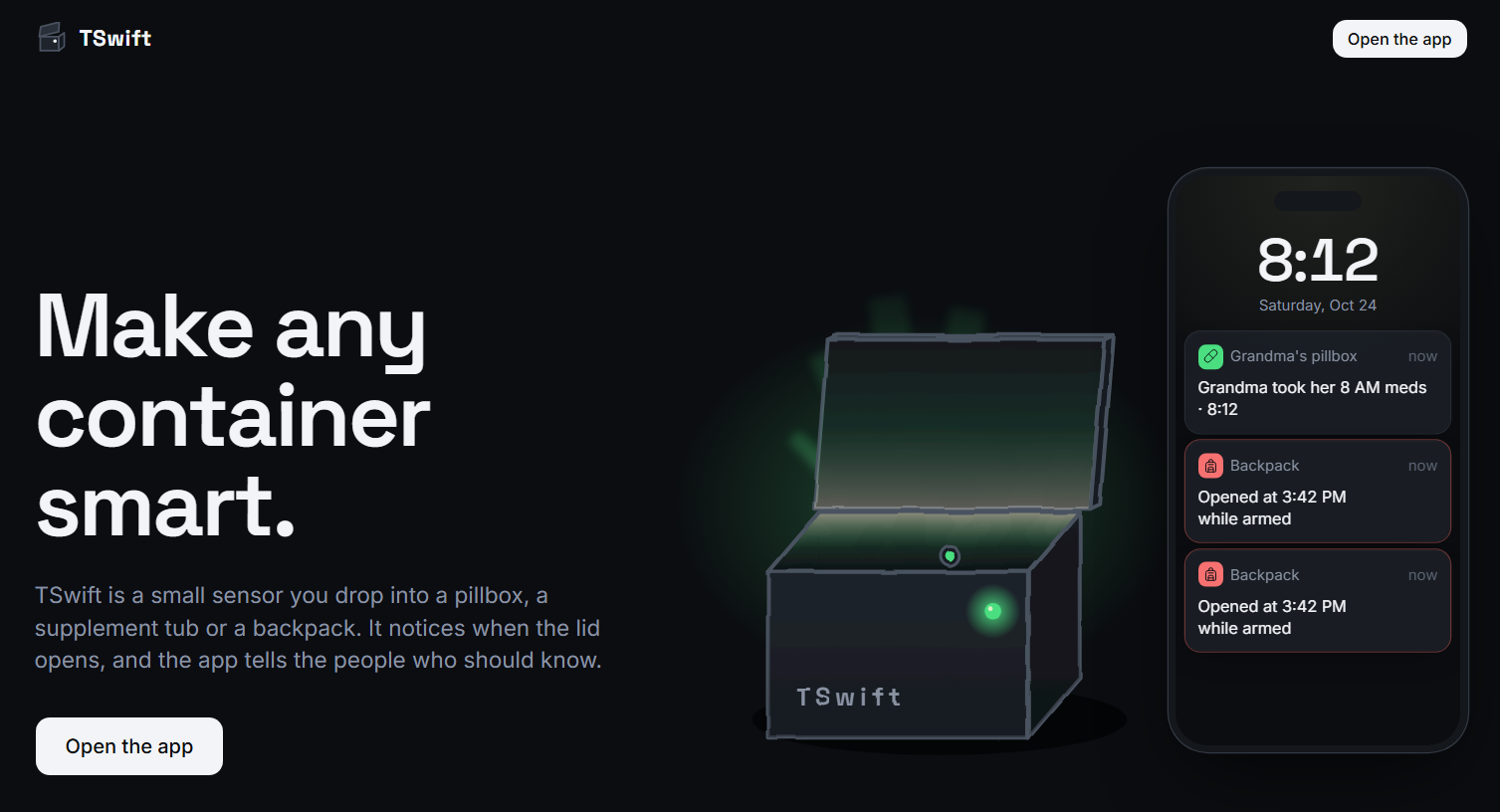
Daily medication impacts the lives of our entire group's grandparents. However, without them living in our homes, grandparents forget to take their medication, leading to unnecessary stress for family members living far away. Our goal with TSWIFT is to form and maintain the daily habit of taking medication so that patients stay healthy and others involved are stress-free.
What it does
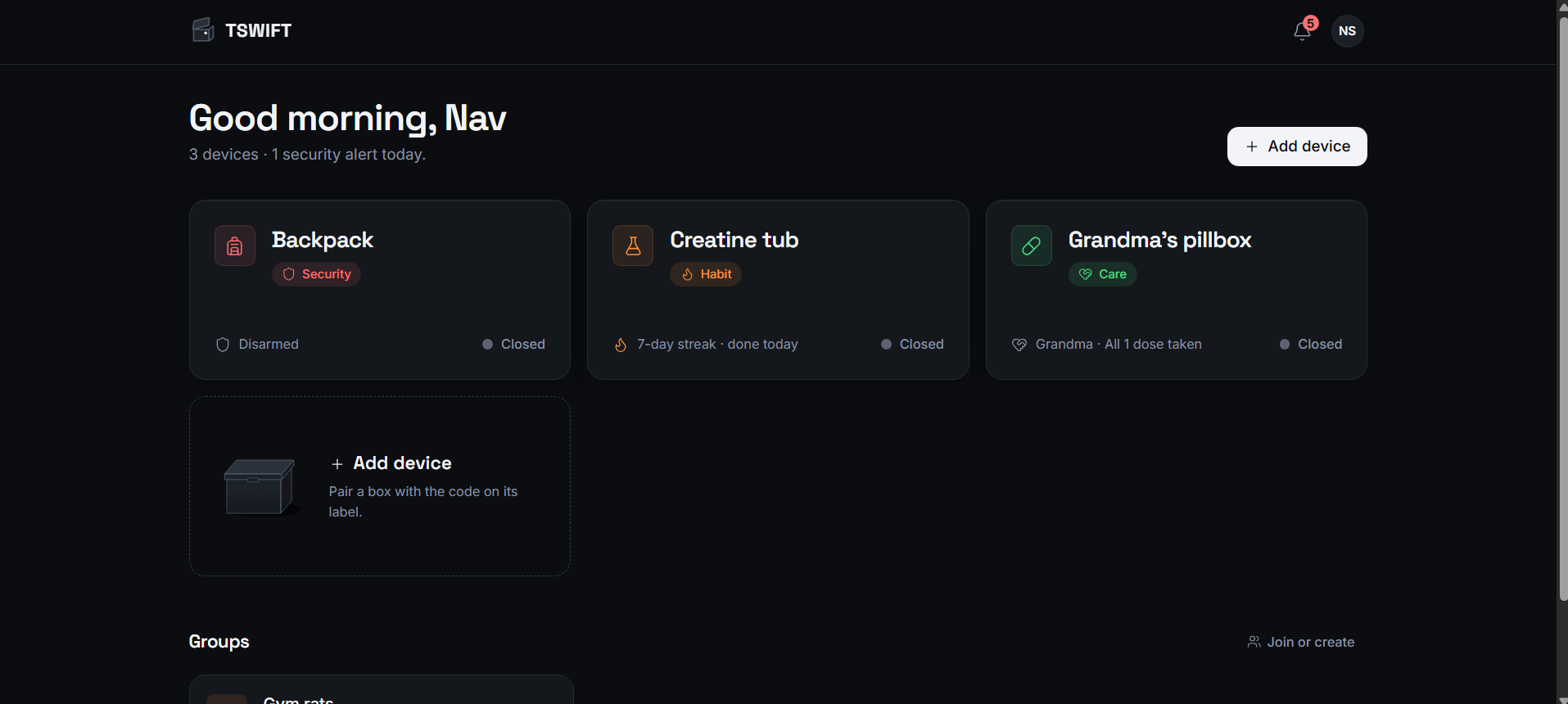
TSWIFT implements the photoresistor, a sensor that detects light, to see whether the box has been opened or not. As we built TSWIFT, we discovered that we could also use TSWIFT for tracking other habits, such as taking creatine, and for security, where TSWIFT can detect whether a container with important objects has been opened. Whenever TSWIFT is triggered, the data is sent through WiFi to the TSWIFT website, where the specific habit/action is logged. From there, the data can be used in a variety of ways, such as a habit tracker, summary, or for notifications.
How we built it
A TI LaunchPad reads its onboard light sensor. The firmware calibrates a baseline for darkness to send open and close messages, which it sends as simple text lines over UART through the board's USB connection. A Node.js bridge on the laptop forwards those events to our Express backend on Render, which runs an automation for each unique mode (Care, Habit, Security) for a device. Supabase provides a database with security, authentication, and Realtime that pushes to our website within about a second of the box opening. Meta's Muse Spark turns natural language routines into schedules and writes caregiver updates and security summaries from facts, so the AI explains real data instead of guessing.
Challenges we ran into
- Lack of hardware due to limited supplies at the hardware lab.
- Making a light sensor reliable as a lid sensor with inconsistent lighting conditions
- No Wi-Fi on the board, leading to a protocol and bridge so the server can send out data.
Accomplishments that we're proud of
- A full pipeline from a light sensor to a website notification in about a second, with a fully fleshed-out dashboard for actionable data that multiple users can use.
- Despite multiple setbacks, our team innovated and worked with what we had. We used the photoresistor on a Texas Instruments Development Kit board and used KiCad to envision how we would set up TSWIFT if we had more hardware available.
What we learned
None of us had written firmware before. Only some of us had experience in software engineering. No one had any experience in making an idea from scratch. We learned that some of the best solutions come from sharing similar experiences and pure simplicity.
What's next for TSWIFT
A custom PCB has already been designed for TSWIFT, so the next step would be to go into manufacturing. The PCB will be smaller, more power-efficient, and have actual WiFi capabilities compared to our prototype. Furthermore, we can add a custom type where the user describes any rule in plain English, and the AI builds it, integrating SMS and email alerts as well.
Built With
- c
- express.js
- java
- meta-model-api
- muse
- node.js
- postgresql
- react
- recharts
- render
- supabase
- tailwindcss
- ti-launchpad
- uart
- vercel
- vite


Log in or sign up for Devpost to join the conversation.