-
-
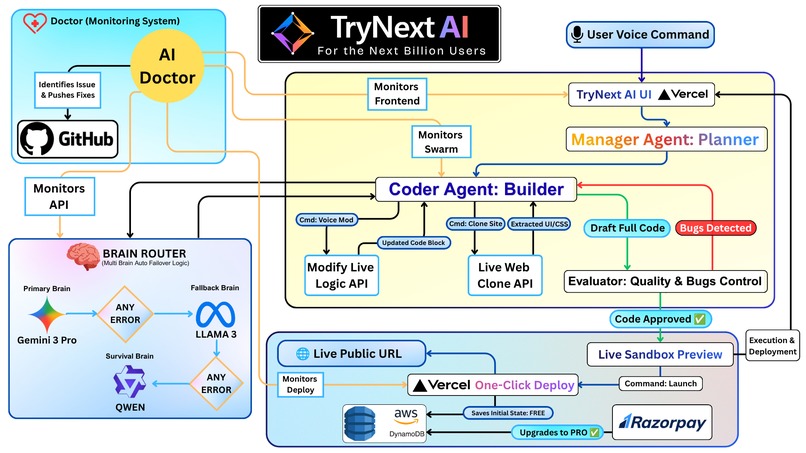
Architecture Diagram
-
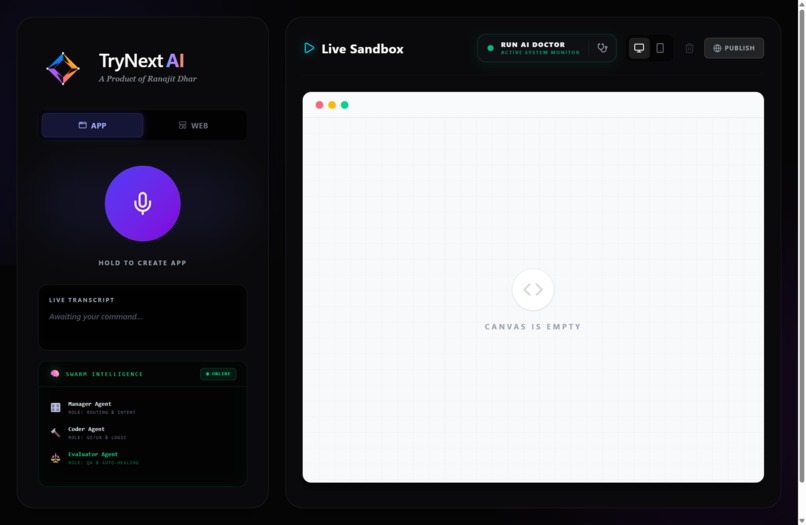
UI
-
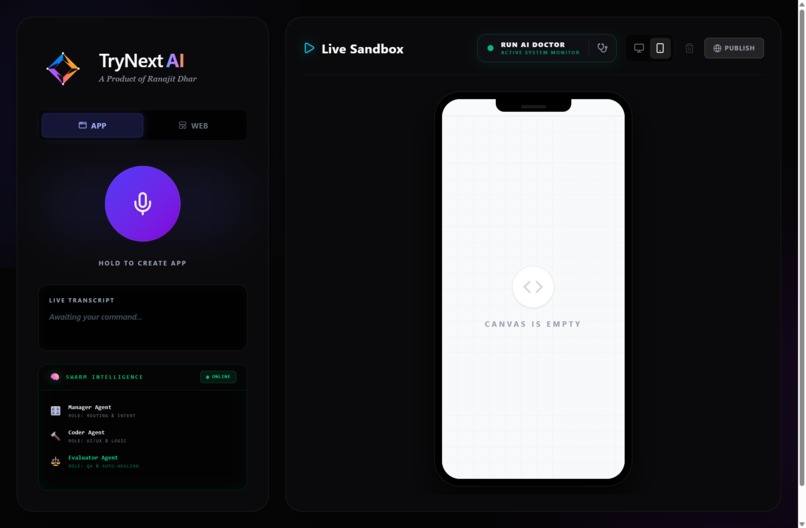
UI
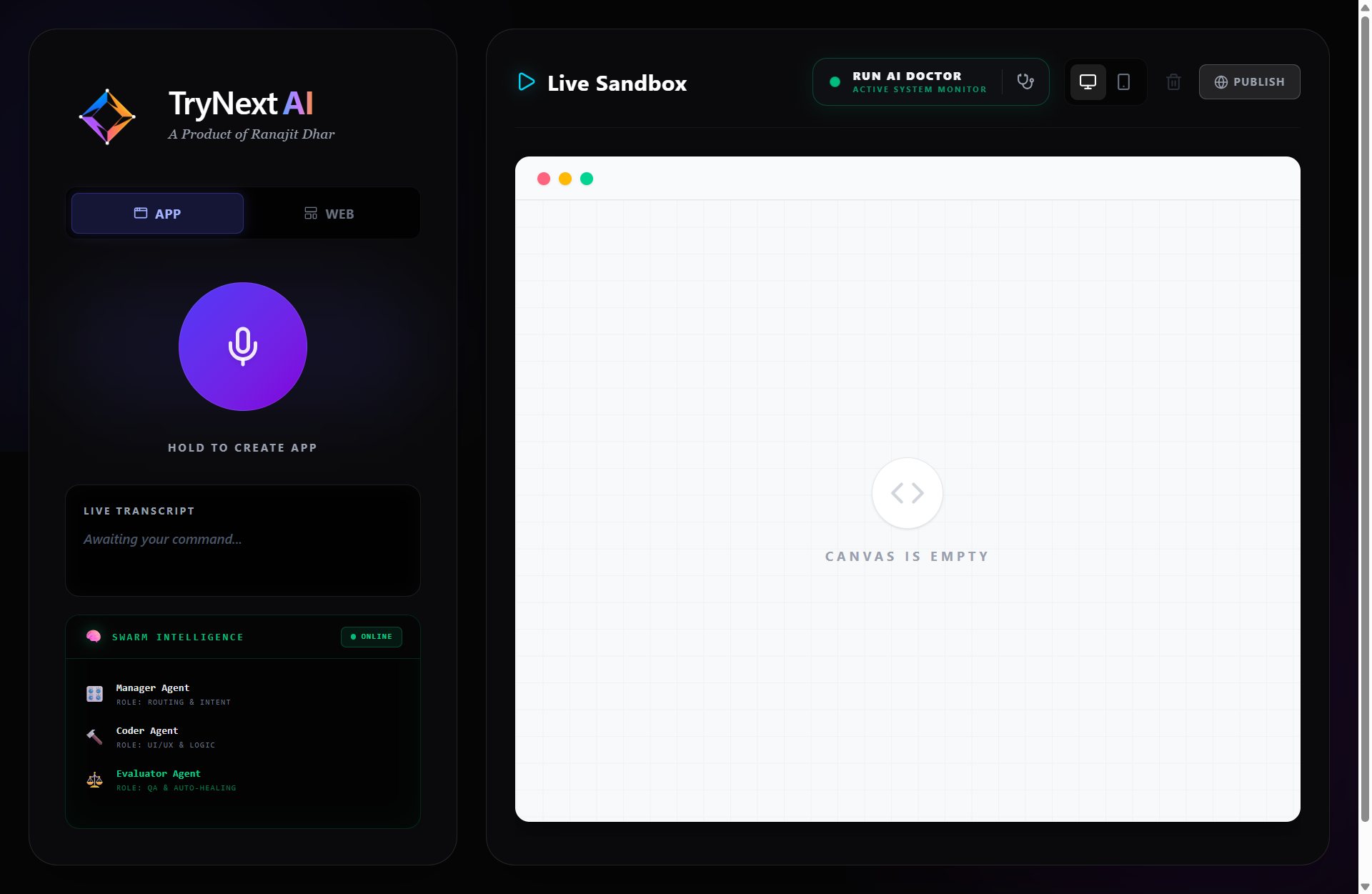
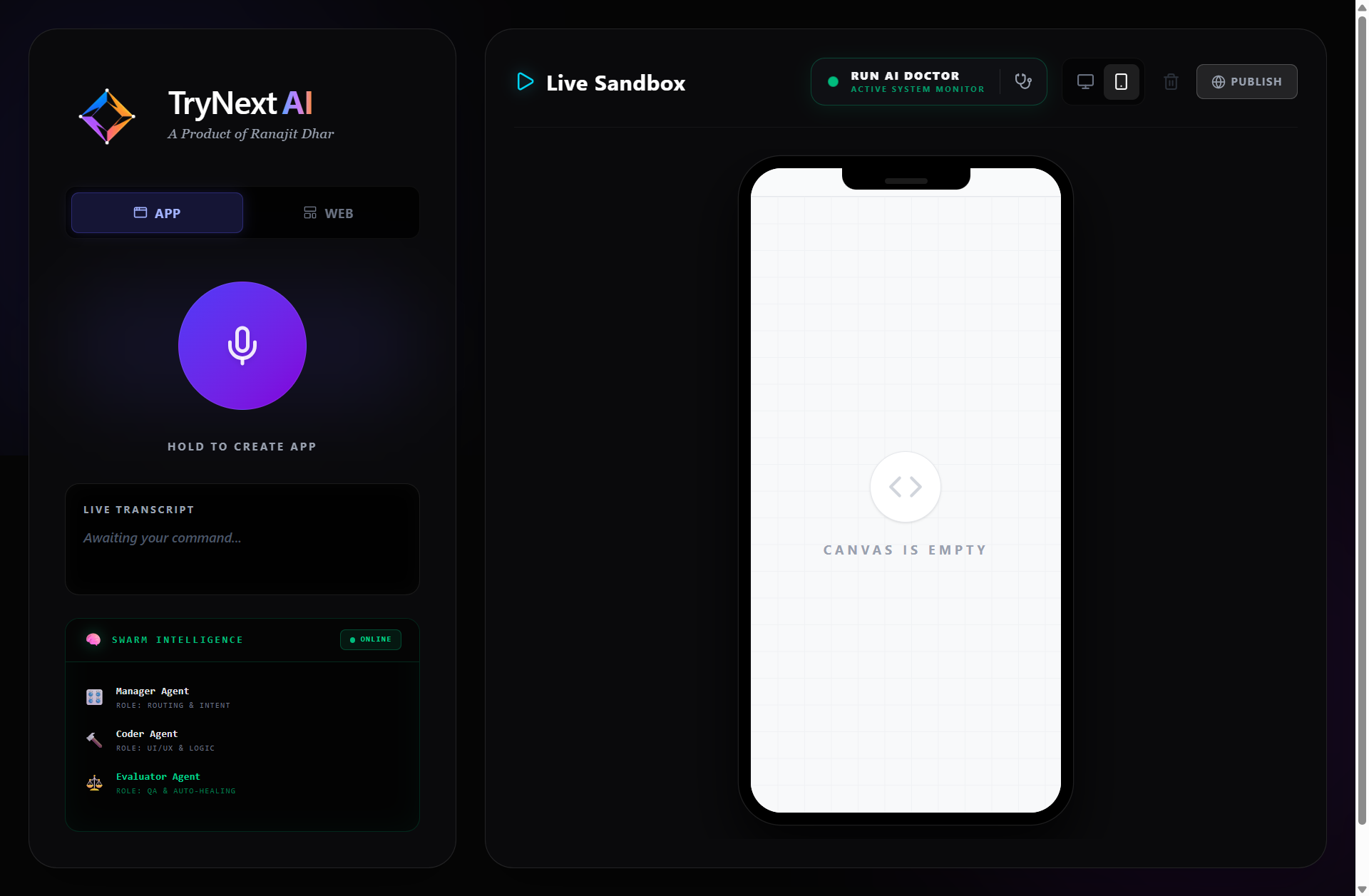
💡 Inspiration
"Imagine millions of people with brilliant ideas for apps and websites, but no practical way to build them. Coding is difficult, hiring developers is expensive, and for many people, language itself becomes a barrier to innovation."
Coming from a non-technical commerce background, I experienced this challenge firsthand. And even after software is built, maintaining a codebase remains a constant challenge.
So I asked myself a simple question...
💭 What if building software was as easy as sending a voice note... and what if the platform itself could continuously improve after deployment?
That question became TryNext AI.
🌍 Built for the Next Billion Users, TryNext AI is a digital equalizer that removes language barriers, eliminates technical complexity, and empowers anyone to build software using their native language.
🎙️ If you can describe your idea, TryNext AI can help bring it to life.
⚙️ What it does
TryNext AI is not just another code generator. It is an autonomous, self-healing software factory. We are lowering the barrier to entry for the next billion users by turning natural voice commands into enterprise-grade web applications.
Here is what makes TryNext AI an absolute game-changer:
- 🌍 Massive ROI (The Next Billion Users): A digital equalizer that eliminates the need for expensive dev agencies or CS degrees. Zero coding required—just your voice and a vision.
- 🎙️ Voice-to-App & Live Modification: Speak your idea to build the UI/Logic in real-time, and seamlessly modify the live application purely via continuous voice commands.
- 🌍 Multilingual Intelligence: TryNext AI supports 100+ local languages. You don't need to know English to build software; speak in your native tongue, and the AI understands the architectural intent.
- 🌐 Live Web Clone Engine: Command the AI to search the live web, inspect popular website architectures, and instantly clone/copy their UI patterns into your project as per your voice prompt.
- 💎 The "AI Doctor" (Self-Healing): Continuous live system monitoring that scans your codebase, optimizes logic, and automatically generates direct GitHub Pull Requests (PRs) without breaking core functionality.
- 🧠 Live Brain View & Voice Interaction: It’s not a silent process. The system provides real-time "Brain View" of the Swarm logic, and once the task is completed, it speaks back to the user with a human-like persona to confirm execution and gather feedback.
- 🚀 One-Click Public Launch (Powered by Vercel): Instantly push your generated application from the local sandbox directly to a live, public URL with a single click. We leverage Vercel's edge network to give users a production-ready link in seconds.
- 💾 Zero Stack Data Persistence (AWS DynamoDB): Built explicitly for the "Hack the Zero Stack" philosophy. Every deployed app's state, premium tier status, and metadata are seamlessly persisted and managed in real-time using AWS DynamoDB, bypassing complex backend provisioning.
🏗️ How we built it
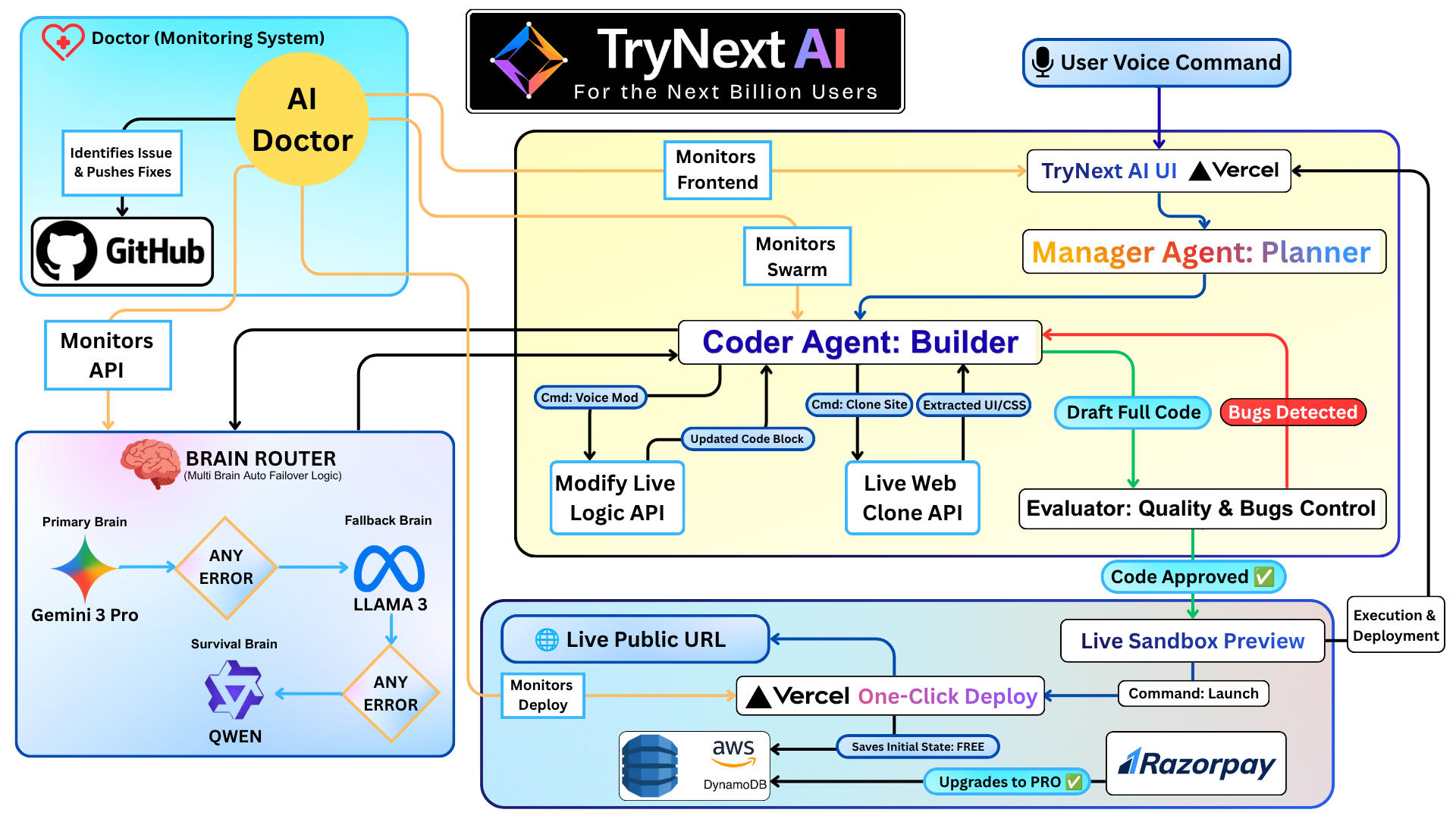
I engineered a sophisticated Swarm Intelligence architecture consisting of three core agents working in perfect sync to eliminate hallucinations:
- 🧠 Manager Agent (Planner): Analyzes the multi-lingual voice transcript to extract the core architectural blueprint.
- 👨💻 Coder Agent (Builder): Writes the Next.js 15 + Tailwind CSS code and actively controls the Live Web Clone API and Modify API.
- 🕵️♂️ Evaluator Agent (QA): The strict gatekeeper. It doesn't just review the layout; it rigorously audits the application's overall quality and scans for deep architectural bugs in an isolated loop. If any compilation error, visual breakage, or logic flaw is detected, it instantly rejects the build and flings it back to the Coder Agent for an automatic rewrite—guaranteeing that only flawless, production-ready code ever reaches the user sandbox.
🛡️ The Unbreakable Circuit Breaker: To guarantee 100% uptime, I built an Auto-Failover system. All Coder inference requests hit Gemini 3 Pro first. If it hits a rate limit, the system instantly auto-routes to Groq Llama 3.3 or HuggingFace Qwen 2.5 with zero user interruption.
🚧 Challenges we ran into
- The Whisper Hallucinations: While supporting 100+ languages, our speech-to-text engine initially struggled when users mixed native languages with English tech words (like "dark theme"). We resolved this by engineering a custom "Universal Tech Vocabulary" prompt that forces absolute accuracy without breaking auto-detect.
- API Limits & Swarm Crashes: Heavy testing caused massive token consumption, completely crashing our primary LLMs. This forced the creation of the 3-tier Auto-Failover Circuit Breaker, turning a major failure point into our strongest resilience feature.
- Zero-Stack State Management: Orchestrating dynamic deployment states and payment webhooks without a traditional backend server was highly complex. AWS DynamoDB integrated directly with Vercel Edge functions provided the ultimate serverless solution.
🏆 Accomplishments that we're proud of
- Successfully engineering a true Zero-Stack architecture that flawlessly unites Vercel's edge capabilities with AWS databases.
- Creating the AI Doctor, turning a static code generator into a living, self-maintaining ecosystem that pushes its own GitHub PRs.
- Shattering the language barrier. Watching the Swarm seamlessly understand a complex architectural prompt spoken entirely in a local Bengali or Hindi dialect is pure magic.
🧠 What we learned
Building TryNext AI taught us that true AI integration is no longer just about calling an LLM for text generation; it's about Agentic Orchestration and Observability.
- The Power of the Swarm: We learned how to orchestrate multiple LLM "brains" to act as a cohesive team rather than isolated bots, ensuring that the
CoderandEvaluatorkeep each other in check to eliminate hallucinations. - Resilience is Key: Building the Auto-Failover circuit breaker taught us that API rate limits and server crashes aren't roadblocks—they are opportunities to engineer a globally resilient architecture.
- Serverless Mastery: We significantly deepened our expertise in serverless NoSQL data modeling by seamlessly marrying Vercel Edge functions with AWS DynamoDB, proving that a true Zero-Stack application is highly scalable and lightning-fast.
🛣️ What's next for TryNext AI: The Self-Healing Software Factory
TryNext AI is currently a frontend powerhouse with zero-stack deployment capabilities, but the ultimate vision is a Zero-Touch Full-Stack Factory paired with a revolutionary, privacy-first business ecosystem.
- 💰 Privacy-First Monetization & Hash Renewals: We deliberately avoided clunky traditional user accounts. TryNext AI offers free prototyping, but to unlock 'PRO Auto-Scaling' and secure continuous edge deployment, users pay a highly accessible subscription of just ₹10 per month per app. In our upcoming release, every app will be assigned a secure, cryptographically unique Deployment Hash. Users will simply enter their Hash to securely renew their app's monthly validity, maintaining 100% privacy without forcing them to create accounts.
- 🗄️ TryNext BaaS (Backend-as-a-Service): Empowering the end-user's data. We are building an infrastructure where the AI will autonomously provision isolated AWS DynamoDB instances for every single generated app. This will provide our users with a unified dashboard to manage their own customers' data securely, without writing a single line of backend code.
- 📱 Native App Compilation: Expanding the Swarm to compile voice commands directly into production-ready iOS and Android binaries (
.apk/.ipa) via React Native. - 🎨 Reverse Engineering (Code-to-Figma): Flipping the industry standard. Instead of designing first and coding later, TryNext AI will generate pixel-perfect Figma design files directly from the voice-generated live code.
Built With
- aws-dynamodb
- framer-motion
- gemini-3-pro
- gemini-api
- github-api
- groq
- huggingface
- llama-3
- next.js
- qwen
- qwen-2.5
- razorpay
- react
- serverless
- tailwind.css
- typescript
- vercel
- whisper-ai


Log in or sign up for Devpost to join the conversation.