TruthScan — Because the Truth Should Still Be Traceable
Inspiration
We are entering an era where seeing is no longer believing.
AI can now generate realistic images, clone human voices, manipulate videos, and create convincing text within seconds. At the same time, misinformation spreads across social media faster than most people can verify it. The challenge is no longer just identifying a fake image or a false headline—the challenge is understanding whether the digital content we consume can be trusted at all.
Existing verification tools are often fragmented. A user may need one platform for AI-generated content detection, another for fact-checking, another for image forensics, and yet another for content comparison. Many of these tools also present technical results that are difficult for everyday users to understand.
This inspired us to build TruthScan.
Our vision was to create a unified digital investigation platform where anyone—from a student or journalist to a researcher or everyday internet user—could analyze suspicious content and receive clear, understandable insights.
We asked ourselves one question:
What if verifying digital content could be as easy as uploading it?
That question became the foundation of TruthScan.
What it does
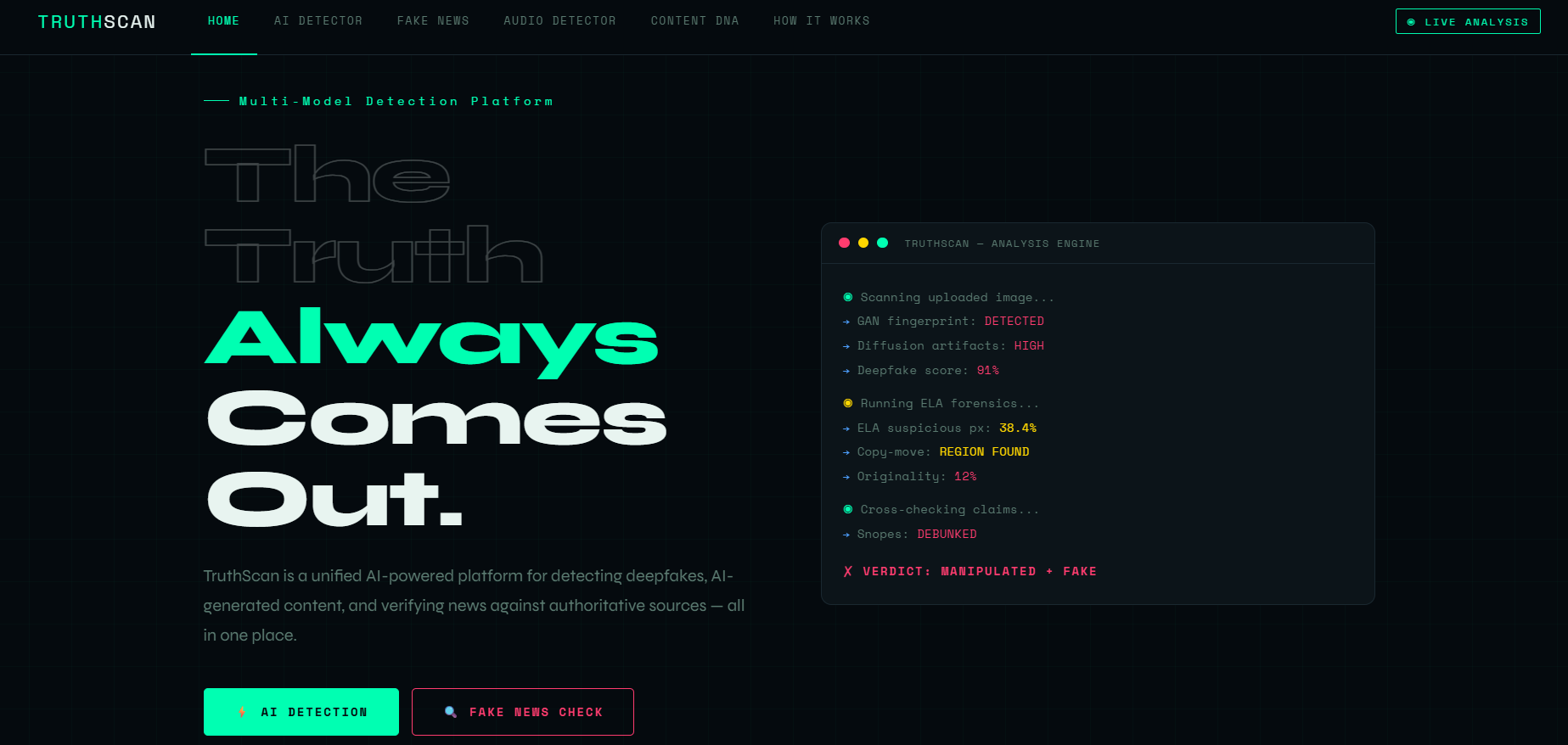
TruthScan is an AI-powered digital content verification and forensic analysis platform that brings multiple layers of digital investigation into one unified experience.
🤖 AI & Deepfake Detection
Users can upload supported digital content for analysis. TruthScan examines signals that may indicate AI generation or digital manipulation and presents the findings through an easy-to-understand, confidence-based analysis.
Rather than overwhelming users with technical information, the goal is to make potential authenticity signals understandable and actionable.
📰 Fake News & Claim Verification
A real image can still be paired with a false caption, and a professionally written article can still contain misleading claims.
TruthScan allows users to submit suspicious claims or content for analysis. The platform identifies key claims, evaluates available evidence, and presents a verdict such as true, false, misleading, or unverified, together with supporting context.
Our goal is not simply to provide another AI-generated answer, but to move toward an evidence-first verification experience.
🔬 Image Forensics
TruthScan includes an image-forensics module designed to investigate possible signs of editing and manipulation.
The platform can examine forensic signals such as:
- Image metadata
- Compression inconsistencies
- Error Level Analysis
- Suspicious visual regions
- Other potential indicators of digital modification
The findings are transformed into an accessible forensic report so that users do not need to be digital-forensics experts to understand the results.
🧬 Content DNA
One of the most distinctive concepts in TruthScan is Content DNA.
Online content rarely remains unchanged. Images are downloaded, cropped, compressed, edited, and reposted across different platforms.
Content DNA creates a digital fingerprint for media, enabling content comparison and helping identify identical, similar, or potentially modified versions.
Our long-term vision is to help users investigate not only:
“Is this content suspicious?”
but also:
“How might this content have changed?”
🎙️ Audio Authenticity
As AI voice cloning becomes increasingly realistic, verifying audio is becoming another major challenge.
TruthScan explores audio-authenticity analysis to help investigate potential signs of synthetic voices, voice cloning, and audio manipulation as part of the same unified verification workflow.
🔍 One Platform, Multiple Layers of Verification
TruthScan brings together:
AI Detection + Claim Verification + Image Forensics + Content Fingerprinting + Audio Analysis
Instead of forcing users to switch between multiple disconnected tools, TruthScan provides a single starting point for investigating suspicious digital content.
How we built it
We built TruthScan as a modern web-based platform with a strong focus on three principles:
Accessibility, transparency, and modularity.
The application was designed around a modular architecture, allowing different verification tools to operate as individual analysis modules while remaining part of one unified user experience.
The workflow follows a simple structure:
User Input → Content Analysis → Signal Extraction → AI-Assisted Interpretation → Structured Results
For AI-assisted analysis and explanation, we integrated multimodal AI capabilities to help interpret content and transform complex results into understandable insights.
For image investigation, we explored browser-based and programmatic forensic techniques, including metadata inspection, compression analysis, Error Level Analysis, and content fingerprinting.
For claim verification, the system is designed to break content into meaningful claims and provide structured analysis rather than returning an unorganized block of AI-generated text.
On the frontend, we focused heavily on creating a visual identity inspired by digital investigation and cybersecurity while keeping the actual workflow simple:
Upload → Analyze → Understand
The project was also designed with extensibility in mind. Each analysis capability can evolve independently as better detection models, forensic techniques, and verification sources become available.
Challenges we ran into
1. Making complex forensic concepts understandable
One of our biggest challenges was not simply performing analysis—it was explaining the results.
Terms such as compression artifacts, metadata inconsistencies, confidence scores, and Error Level Analysis can be confusing to users without a technical background.
We had to think carefully about how to transform technical signals into visual and understandable information without oversimplifying the results.
2. Avoiding false certainty
Digital-content verification is not always binary.
A confidence score is not absolute proof, and no AI detector is perfect. We therefore had to design TruthScan around the idea of assistance rather than unquestionable judgment.
Instead of claiming that the platform can determine truth with 100% certainty, we focus on presenting signals, evidence, and context that can support better human decision-making.
3. Unifying different types of analysis
Images, text, news claims, audio, and content fingerprints require very different processing workflows.
Bringing these different capabilities together while maintaining a consistent user experience was a major product and engineering challenge.
4. Building within a hackathon timeframe
The vision for TruthScan is much larger than what can be completed during a single hackathon.
We had to prioritize the core experience, create a modular foundation, and demonstrate the larger potential of the platform without losing focus on a functional and understandable MVP.
Accomplishments that we're proud of
We are proud that TruthScan is more than a single-purpose detection tool.
Instead of solving only one part of the digital-trust problem, we created the foundation for a broader digital investigation workspace.
We are especially proud of:
- Bringing multiple verification capabilities into one unified platform
- Creating an intuitive workflow for complex digital-forensics concepts
- Developing the Content DNA concept for content fingerprinting and comparison
- Combining AI-assisted interpretation with forensic analysis
- Designing a polished and cohesive user experience
- Building the project with a modular architecture that can grow over time
- Focusing on transparency rather than presenting AI as an unquestionable source of truth
Most importantly, we are proud of the philosophy behind the project:
TruthScan does not ask users to blindly trust AI. It uses technology to help users investigate more intelligently.
What we learned
Building TruthScan taught us that developing an AI-powered product is not simply about connecting an application to an AI model.
The real challenge is designing the entire system around the intelligence.
We learned how important it is to:
- Structure AI inputs and outputs carefully
- Communicate uncertainty clearly
- Design interfaces around user understanding
- Transform technical analysis into meaningful insights
- Build modular systems that can evolve as technology improves
We also learned an important lesson about responsible AI.
In a field as complex as misinformation and synthetic-media detection, the goal should not be to replace human judgment. The goal should be to give people better tools, better evidence, and better context.
From a technical perspective, the project helped us strengthen our skills in AI integration, frontend development, content analysis, digital forensics, system design, debugging, and building a complete product within a limited timeframe.
What's next for TruthScan
TruthScan is only the beginning.
Our long-term vision is to transform it into a complete digital trust and content investigation platform.
Future developments include:
🎥 Advanced Video Forensics
Frame-by-frame analysis for detecting potential manipulation and synthetic video content.
🎙️ Improved Audio Verification
More advanced analysis of AI-generated speech, voice cloning, and audio tampering.
🌐 Browser Extension
Allow users to investigate suspicious images, claims, and online content directly while browsing the web.
🔗 Content Provenance
Help users better understand where digital content originated and how it may have changed over time.
🧬 Expanded Content DNA
Build stronger similarity detection and content-evolution tracking across modified media.
⚡ Real-Time Verification
Provide faster analysis of viral content and emerging misinformation.
📊 Investigation Dashboard
Allow journalists, researchers, and organizations to organize multiple pieces of evidence into structured investigations.
🔌 Developer API
Enable other applications and platforms to integrate TruthScan's verification capabilities into their own workflows.
Our Vision
The internet is entering a new era.
The ability to create synthetic content is becoming accessible to everyone. Soon, the question will not simply be whether AI-generated content exists—it will be how society learns to navigate a world where authentic and synthetic media exist side by side.
We believe the future of digital trust cannot depend on a single detector or a single AI-generated verdict.
It requires multiple signals.
It requires evidence.
It requires transparency.
And it requires tools that ordinary people can actually use.
TruthScan is our step toward that future.

Log in or sign up for Devpost to join the conversation.