Inspiration
Every company wiki ends up disagreeing with itself. One page says the meal limit is $50 a day, another says $75, and both look official. Tools that flag "stale" pages go by age, but a page edited last week can still be wrong, and an old page can still be right. The real problem is contradiction, and it matters more now that AI agents answer questions from these pages.
What it does
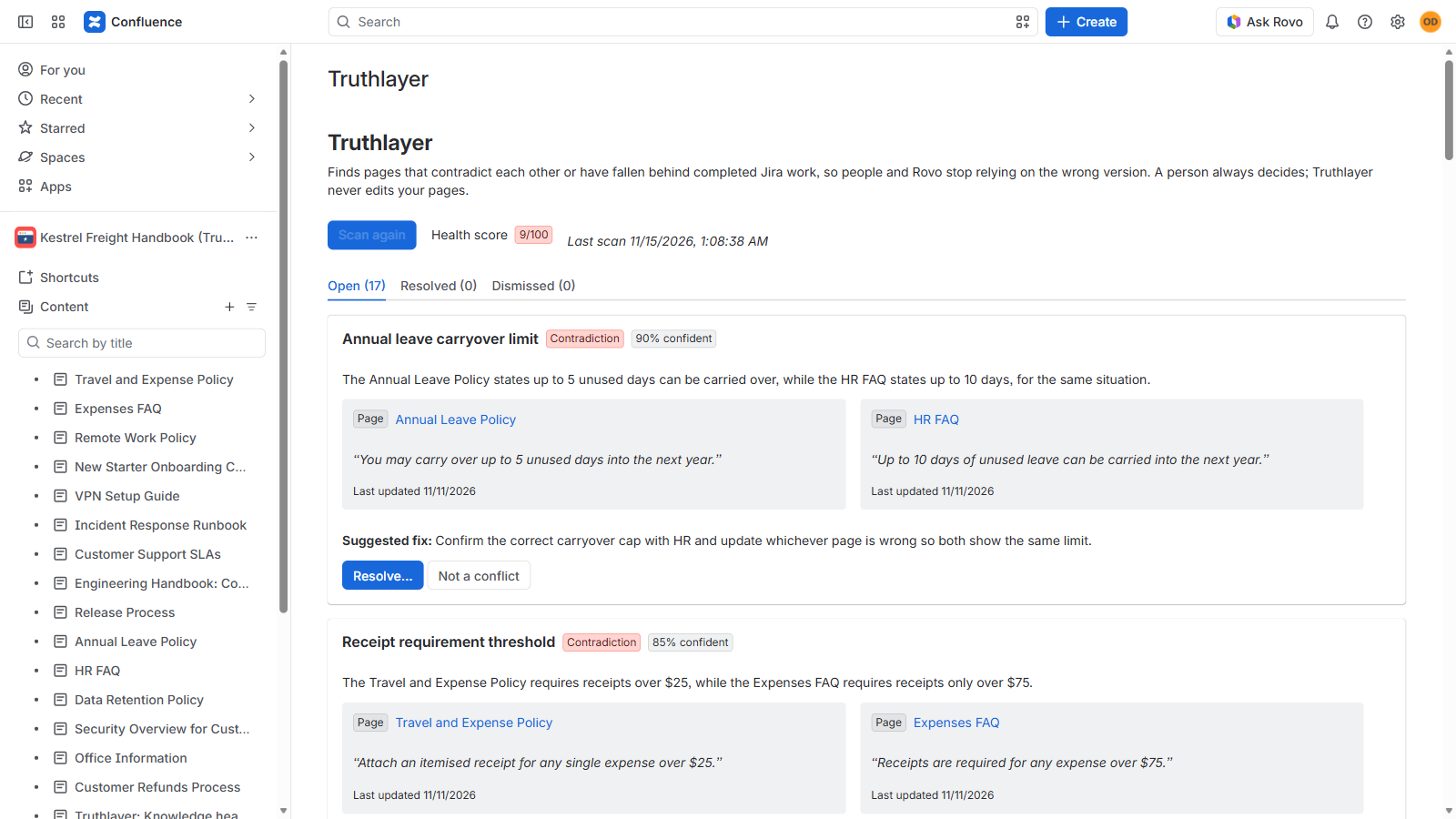
- Scans a space and extracts the checkable facts on each page. Every fact keeps the exact sentence it came from, and that sentence must exist word for word in the page.
- Compares related pages and lists conflicts side by side with both quotes, a confidence level and a suggested fix.
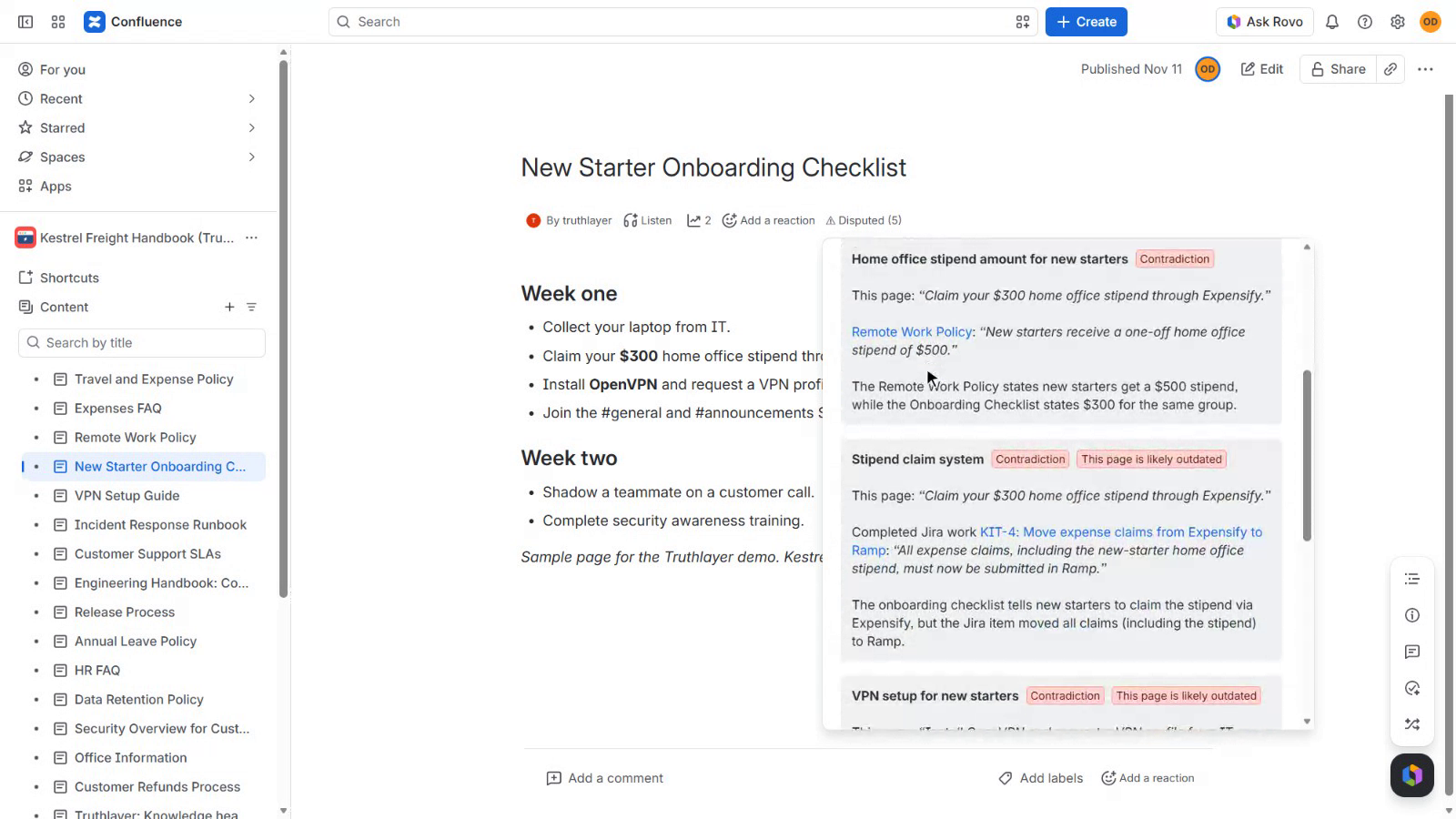
- Uses completed Jira work as evidence. If a done work item says a VPN tool was retired, a page that still tells people to install it is marked likely outdated.
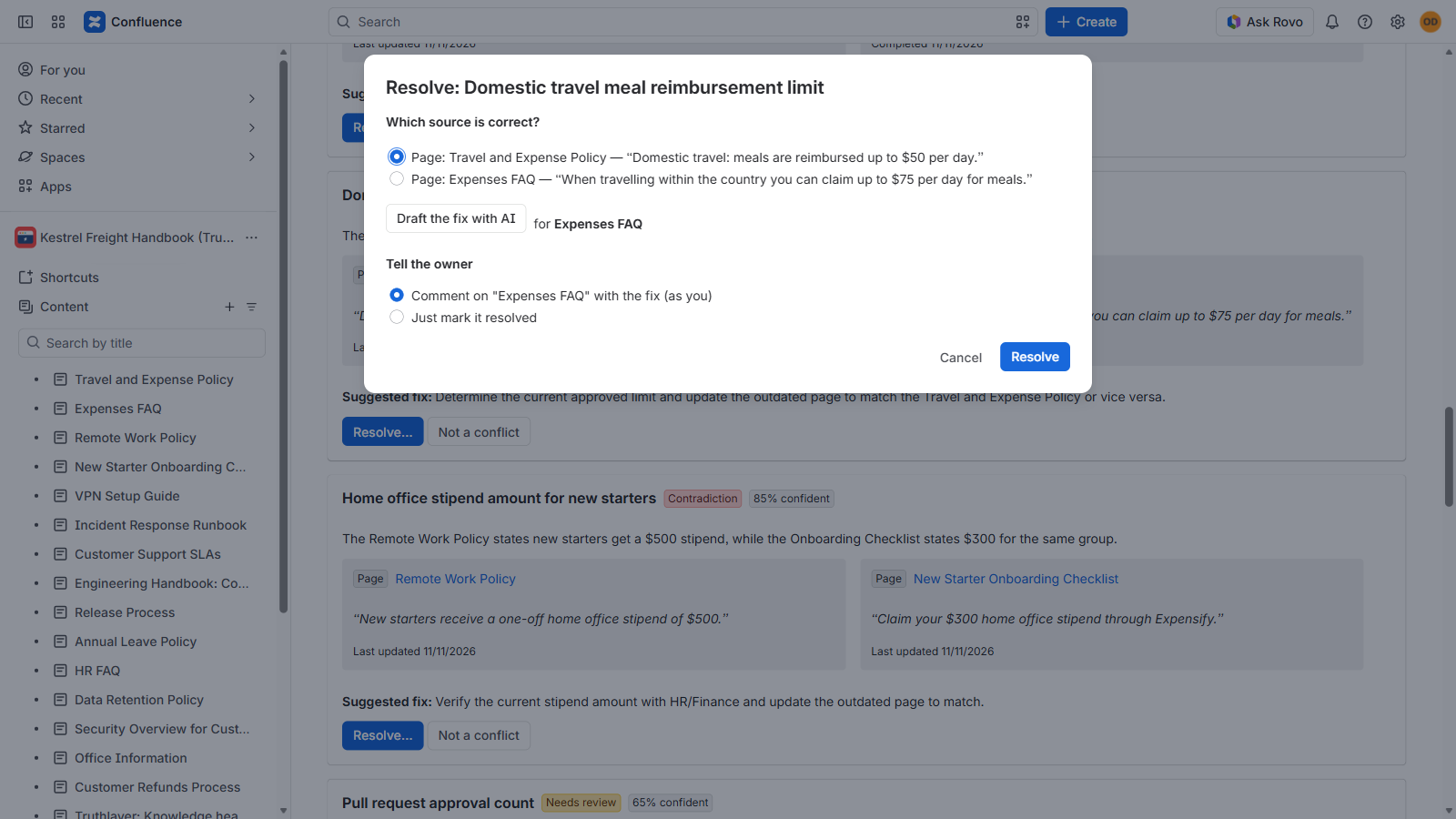
- Helps fix it. A person picks the correct side, Truthlayer drafts the corrected wording, and the fix goes to the page owner as a comment or a Jira task. Truthlayer never edits a page itself.
- Warns readers. Each page shows "Disputed" or "no known conflicts" in its byline, with the details one click away. Owners can mark a page as the source of truth.
- Checks edits. When someone publishes a change that conflicts with another page, Truthlayer comments on the page about a minute later.
- Reports. A knowledge health dashboard across spaces and a weekly report page that mentions the owners with fixes waiting.
- Rovo agent, skill and MCP tools. The Truthlayer agent checks its sources before it answers and quotes both sides when they disagree. The same check is packaged as a reusable Rovo skill and as tools on the Atlassian MCP server.
Results respect permissions: a person only sees a conflict when they can read the pages or work items involved.
How we built it
Truthlayer is a Forge app, built with UI Kit, that integrates with Confluence, Jira and Rovo.
- Confluence modules:
confluence:spacePage(scan and review),confluence:globalPage(dashboard),confluence:globalSettings(admin settings) andconfluence:contentBylineItemwith dynamic properties (page status). - Rovo modules:
rovo:agent,rovo:skill(verify-before-quoting), twoactionmodules (check-sources, find-disputed-facts) androvo:mcpexposing the same two tools. - Events and schedules: a
triggeron page created and updated events, and a weeklyscheduledTrigger. - Processing: a Forge async events queue runs the scan as a chain of steps (collect, extract, Jira, compare, finalise) so large spaces stay inside function time limits.
- Storage: Forge key-value storage holds extracted facts (cached per page version), conflicts, history and settings.
- AI: Forge LLMs (Atlassian-hosted models) do the extraction and comparison. The app has no external egress and is eligible for Runs on Atlassian.
- APIs: Confluence REST v2 and Jira REST, called as the user wherever results are shown, so the products enforce permissions.
Challenges we ran into
- False alarms. A contradiction finder that cries wolf is useless. Requiring a verbatim quote for every fact, and separating "contradiction" from "needs review", brought false alarms on the test space to zero.
- Scope traps. "$50 domestic" and "$100 international" on the same page are not a conflict. The comparison step checks scope first.
- Platform limits. Scans are split into queued steps with a time budget, and extracted facts are cached per page version so rescans are cheap.
Accomplishments that we're proud of
On a seeded demo space with planted conflicts and deliberate traps, Truthlayer found every clear conflict and flagged none of the traps. Installed through its sharing link on a brand-new site, the first scan found both test conflicts in under a minute.
What we learned
Showing both quotes side by side matters more than the verdict. People trust a conflict they can read for themselves, and the quote requirement is what keeps the model honest.
What's next for Truthlayer
A Marketplace listing, Teamwork Graph connections, and more evidence sources such as Jira Service Management knowledge bases.
