-
-
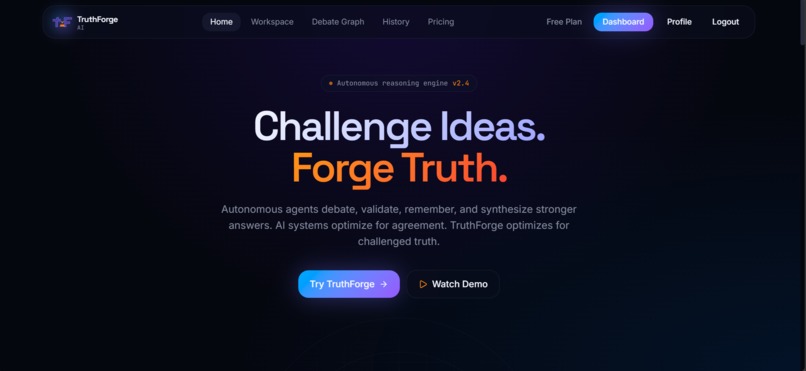
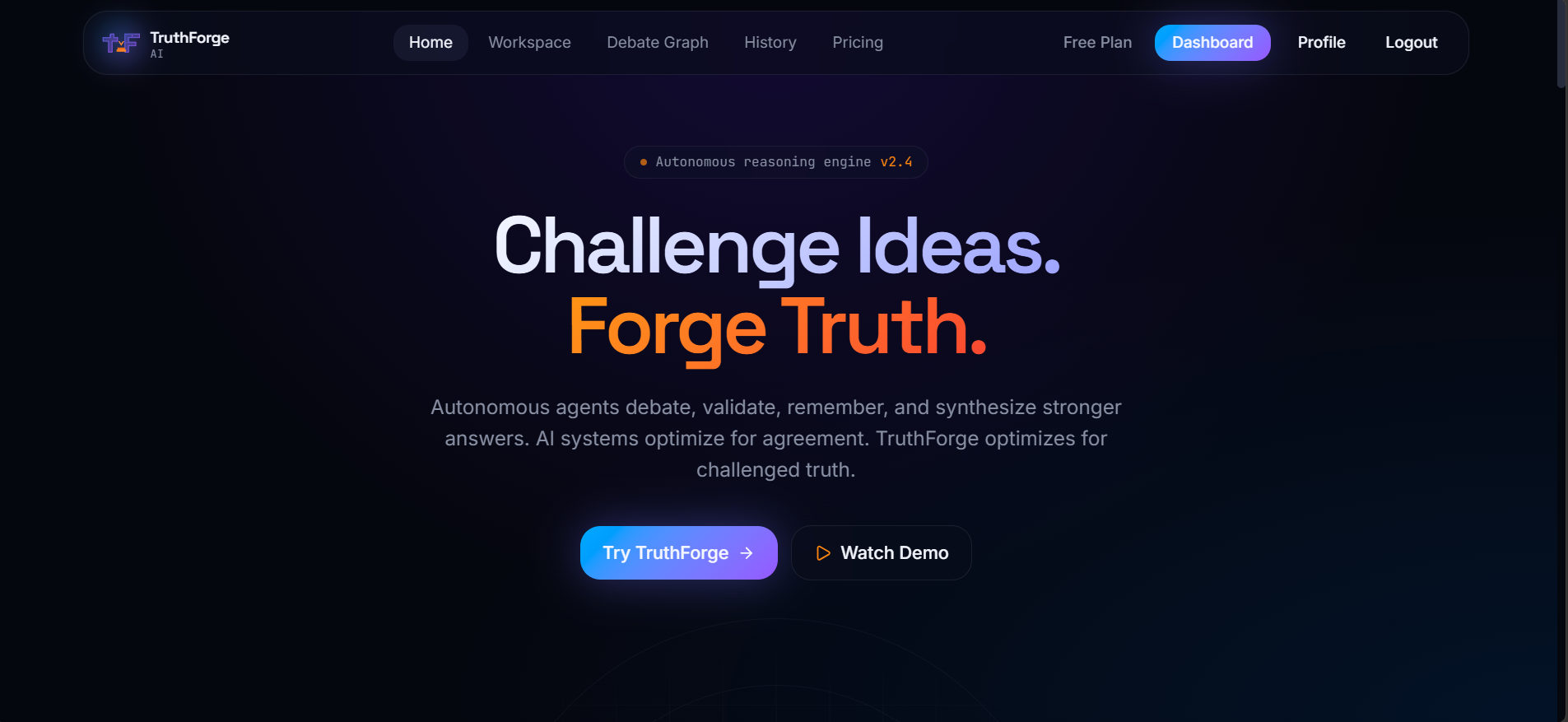
Landing page of TruthForge
-

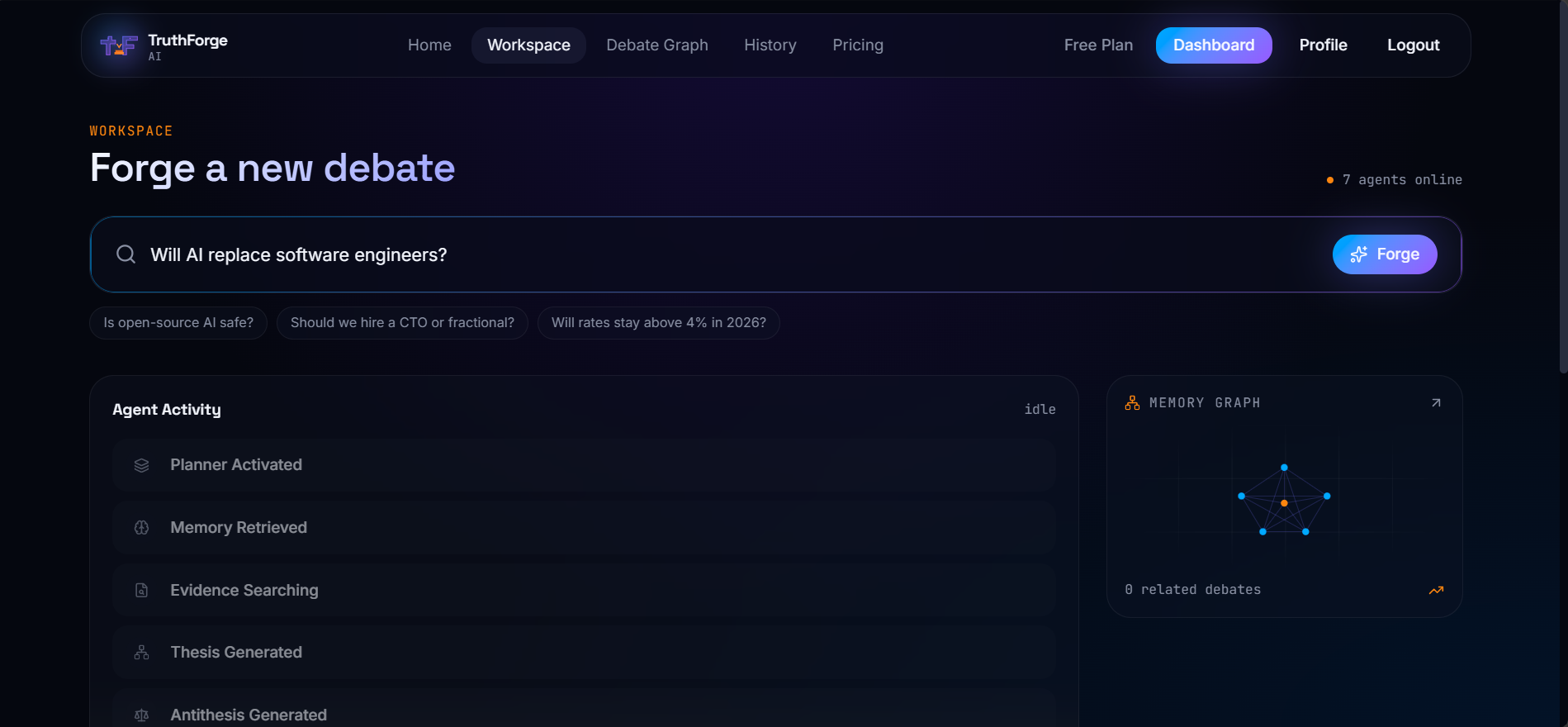
Workspace where Agent works
Inspiration
Most AI systems today generate a single answer and optimize for agreement. While powerful, this often results in shallow reasoning, bias, and overconfident responses. We wondered:
What if AI could challenge itself before answering?
That question became the foundation of TruthForge AI. We wanted to build a system where AI agents debate, retrieve context, challenge assumptions, evaluate evidence, and collaboratively construct stronger conclusions. Instead of instant answers, we envisioned AI that reasons before responding.
What it does
TruthForge AI is an autonomous multi-agent reasoning platform that challenges ideas before generating conclusions.
Instead of a single AI response, a user question flows through multiple specialized agents:
- Planner Agent → breaks down the problem and orchestrates execution
- Memory Agent → retrieves related historical context
- Thesis Agent → generates supporting viewpoints
- Antithesis Agent → actively challenges assumptions
- Evidence Agent → gathers supporting signals
- Referee Agent → evaluates logic and argument quality
- Synthesis Agent → forges a final balanced conclusion
This creates a system that debates internally before answering.
Our vision:
Challenge Ideas. Forge Truth.
How we built it
We built TruthForge AI using Jac as the core intelligence layer, making it a true agentic application rather than a simple API wrapper.
Frontend
- React
- TypeScript
- TailwindCSS
- SaaS-inspired UI with glassmorphism design
Backend
- Jac agent workflows
- Express API server
- SQLite persistence
- Graph-based memory architecture
AI Layer
- Gemini APIs
- Multi-agent orchestration
- Dynamic execution pipelines
We also created persistent storage for:
- debates
- claims
- evidence
- verdicts
- memory relationships
Confidence scoring follows:
$$ Confidence = 0.4(LogicalStrength) + 0.4(EvidenceStrength) + 0.2(AssumptionValidity) $$
Challenges we ran into
The biggest challenge was ensuring TruthForge behaved like a real agent ecosystem, not just multiple prompts wrapped around an API.
Early versions had issues like:
- hardcoded execution logs
- fake confidence values
- placeholder evidence
- generic responses
- routing failures
- orchestration bugs
- broken authentication flows
We spent significant time debugging agent communication, execution pipelines, memory retrieval, and workflow coordination.
Turning "AI theater" into actual autonomous behavior was our biggest challenge.
Accomplishments that we're proud of
We're proud that TruthForge evolved beyond a traditional chatbot into a genuine multi-agent system.
Key accomplishments:
- Built autonomous agent orchestration using Jac
- Implemented memory and graph-style reasoning
- Created Planner → Thesis → Antithesis → Referee workflows
- Designed a SaaS-style user experience
- Added persistent debate storage and retrieval
- Built a system that demonstrates planning, memory, tool use, and reasoning
Most importantly, we built an AI that challenges ideas instead of blindly agreeing with them.
What we learned
TruthForge taught us that building agent systems is very different from building standard AI apps.
We learned:
- Orchestration matters more than raw model calls
- Memory creates richer context
- Disagreement improves reasoning quality
- Graph structures enable better intelligence
- Agent systems require coordination, not just generation
Most importantly:
AI should not simply answer questions.
It should think, challenge, and reason.
What's next for TruthForge
This is only the beginning.
Future plans include:
- Live web evidence retrieval
- Team-based collaborative reasoning
- Shared memory graphs
- Source verification and citation systems
- Real-time debate visualizations
- Multi-model agent collaboration
- Enterprise APIs for decision support systems
Long term, we envision TruthForge becoming a platform where AI acts as a collaborative reasoning partner rather than an autocomplete engine.
TruthForge AI — Challenge Ideas. Forge Truth.
Built With
- api
- architecture
- authentication
- css
- express.js
- gemini
- github
- graph
- jac
- javascript
- jwt
- memory
- multi-agent
- node.js
- react
- rest
- sqlite
- tailwind
- typescript
- vite


Log in or sign up for Devpost to join the conversation.