-
-
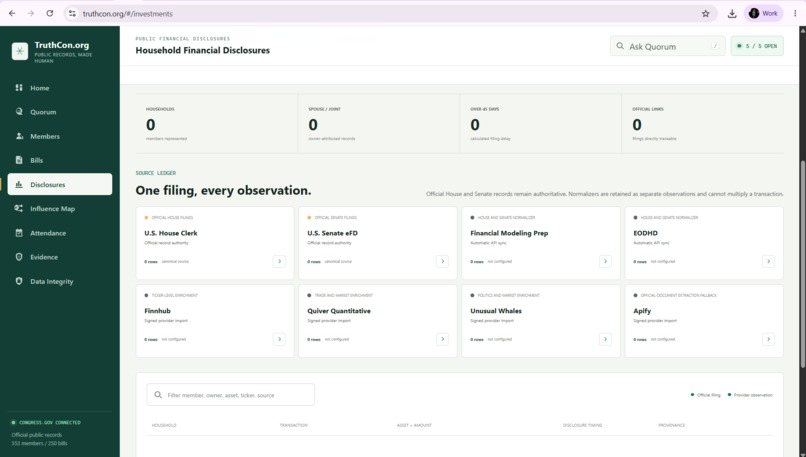
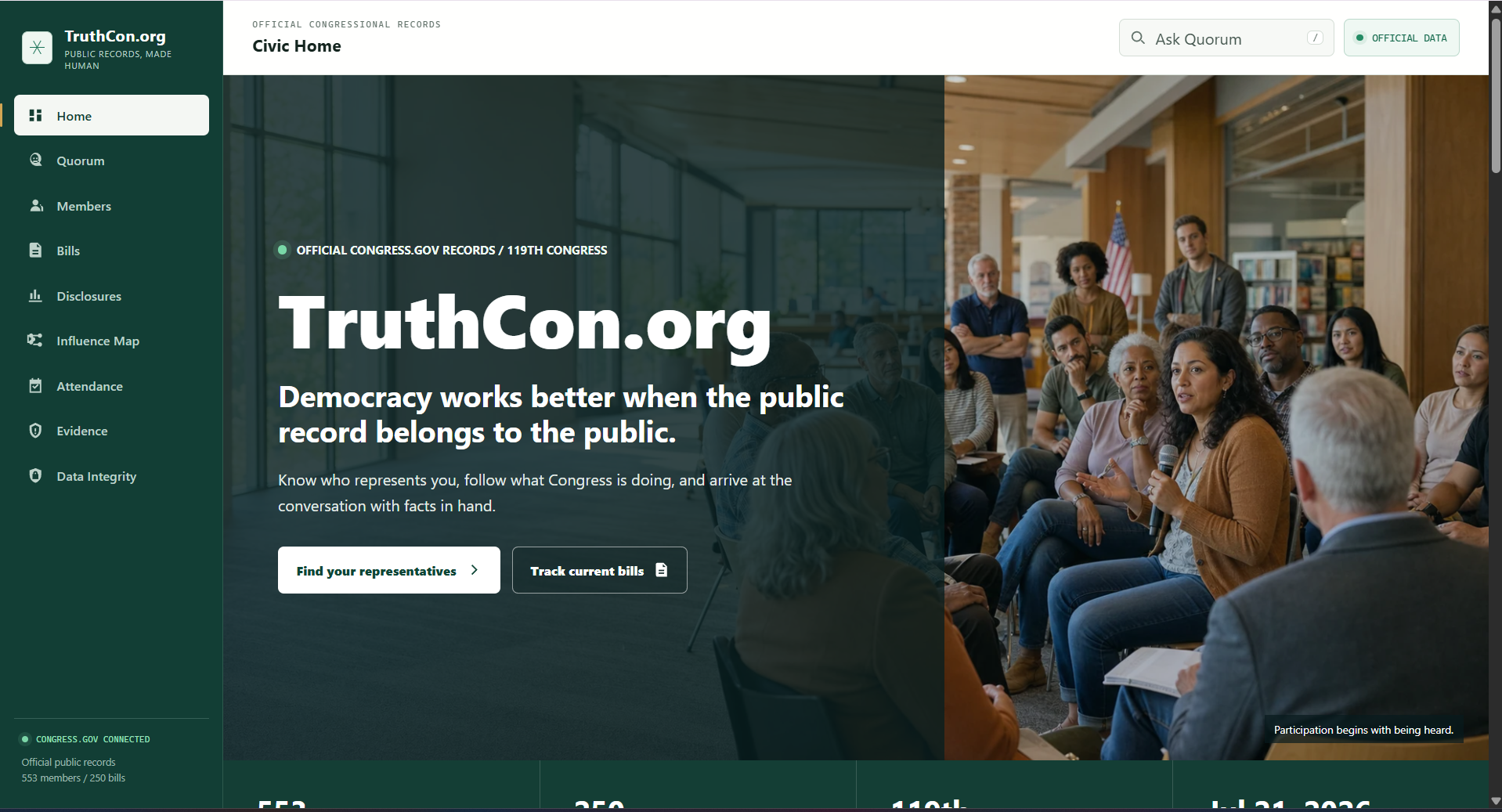
Transforms complex government data into a clear 3-step civic workflow: identify leaders, track legislation, and cite official sources.
-
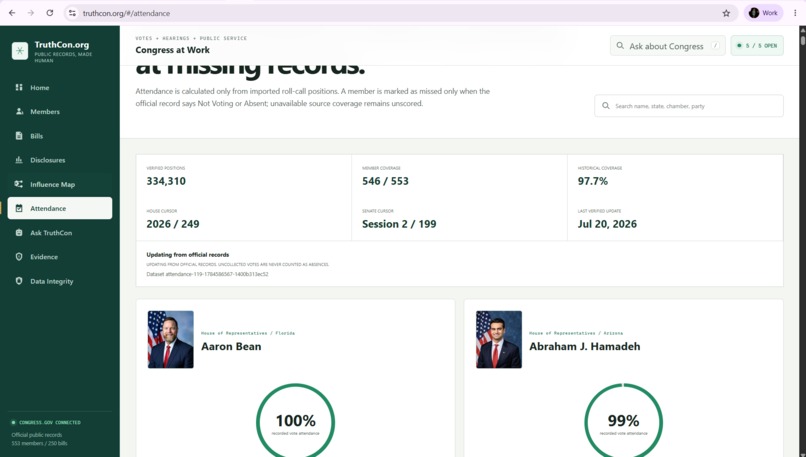
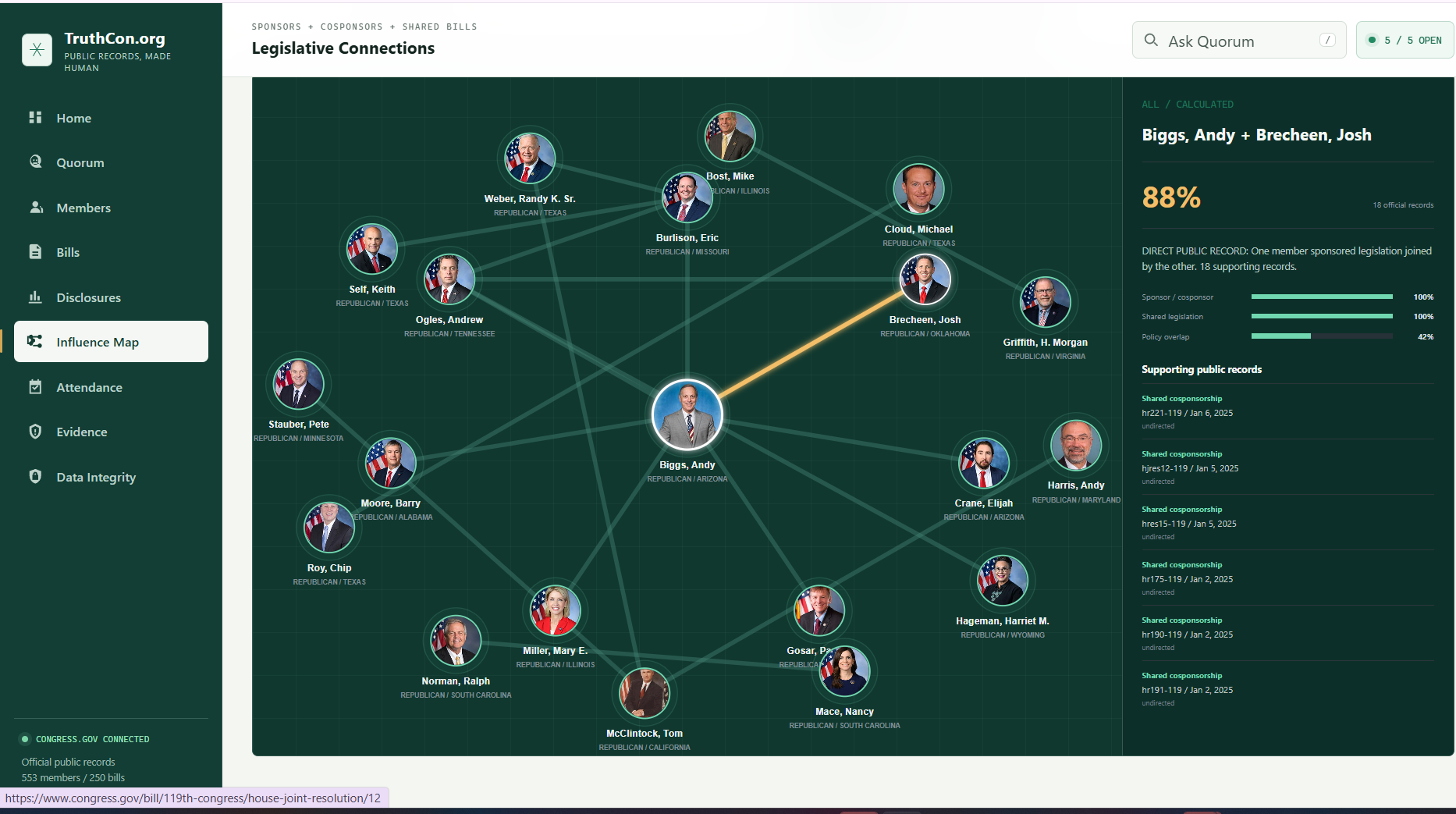
Empirical correlation scorecards tracking co-sponsor overlap and shared voting patterns, explicitly labeled as descriptive, not causal.
-
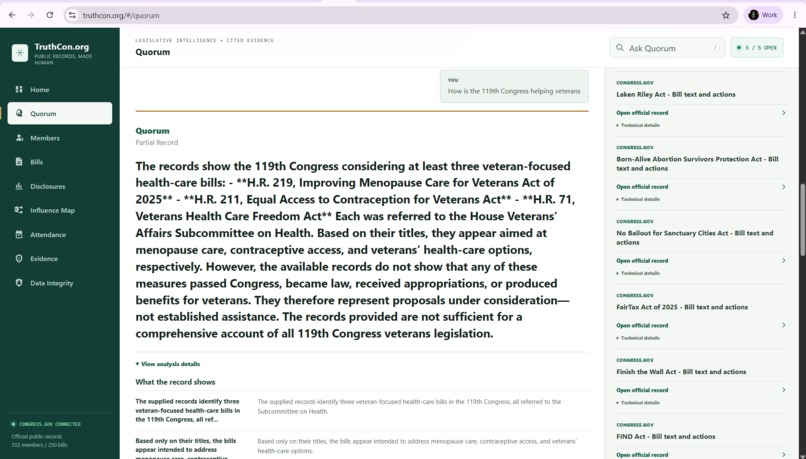
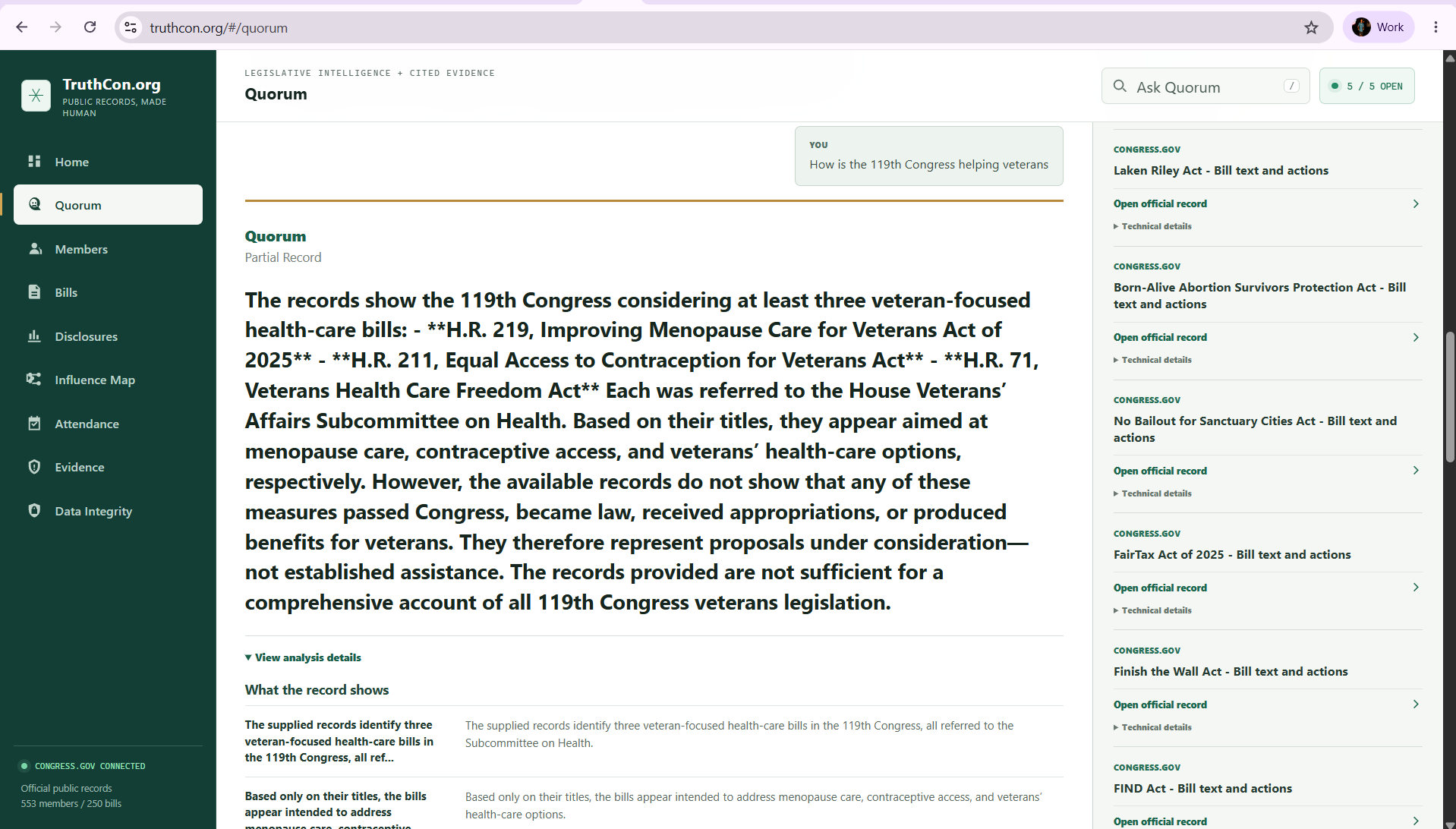
Quorum AI separates verified facts ("What the record shows") from missing data ("What remains uncertain") to prevent hallucinations.
-
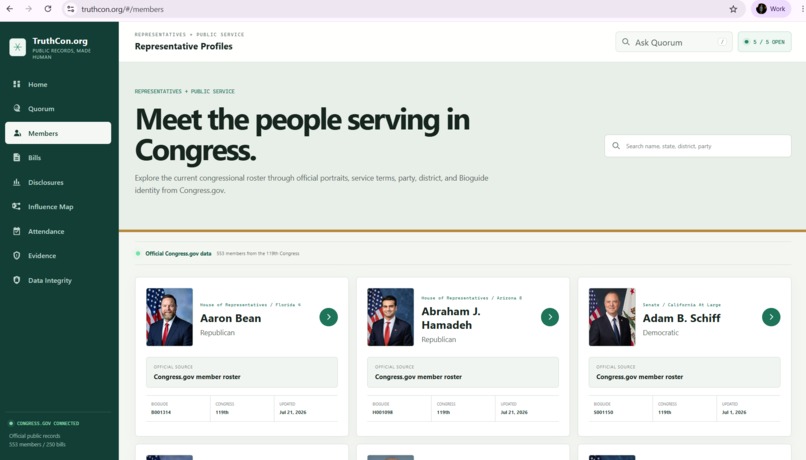
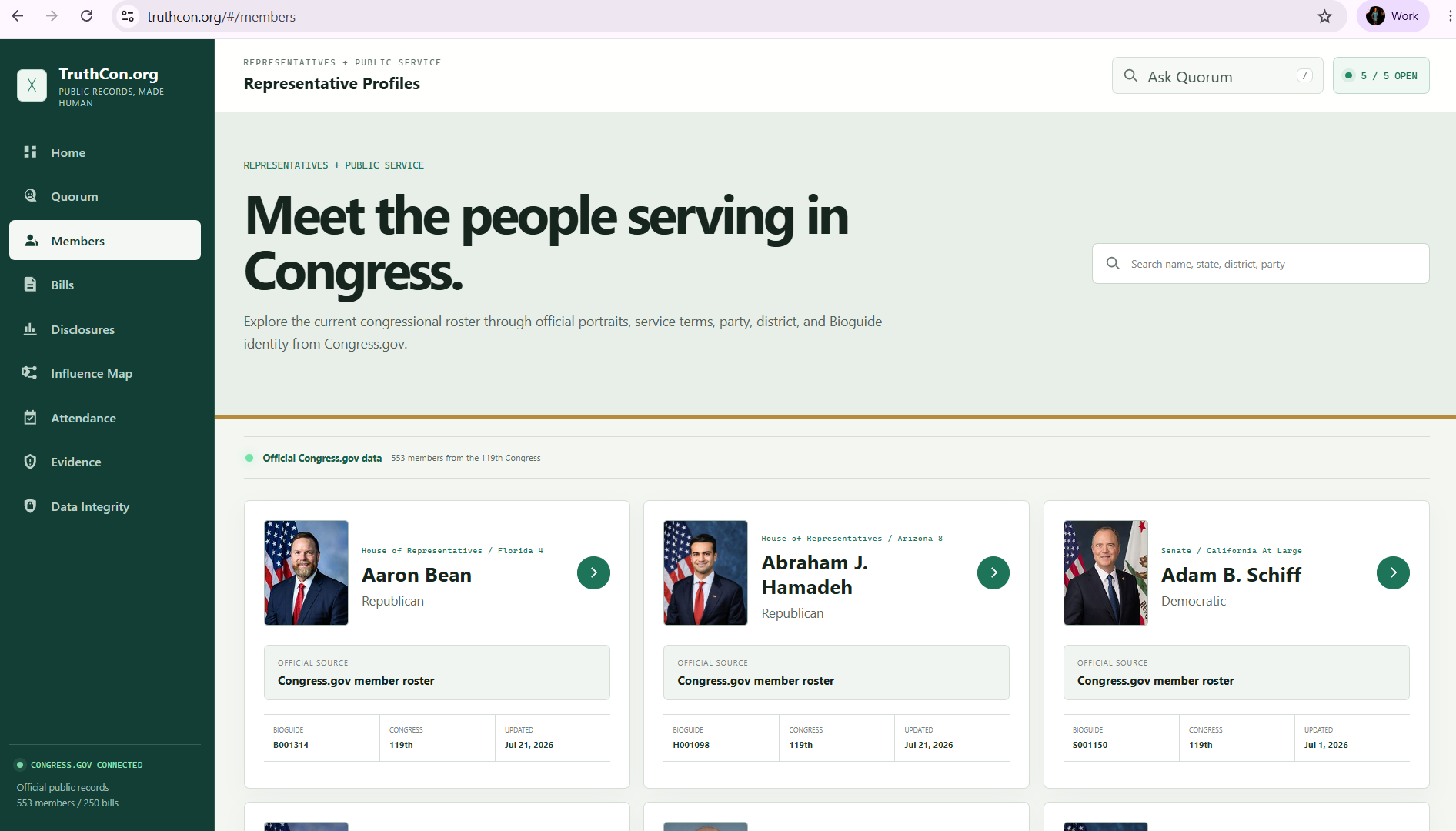
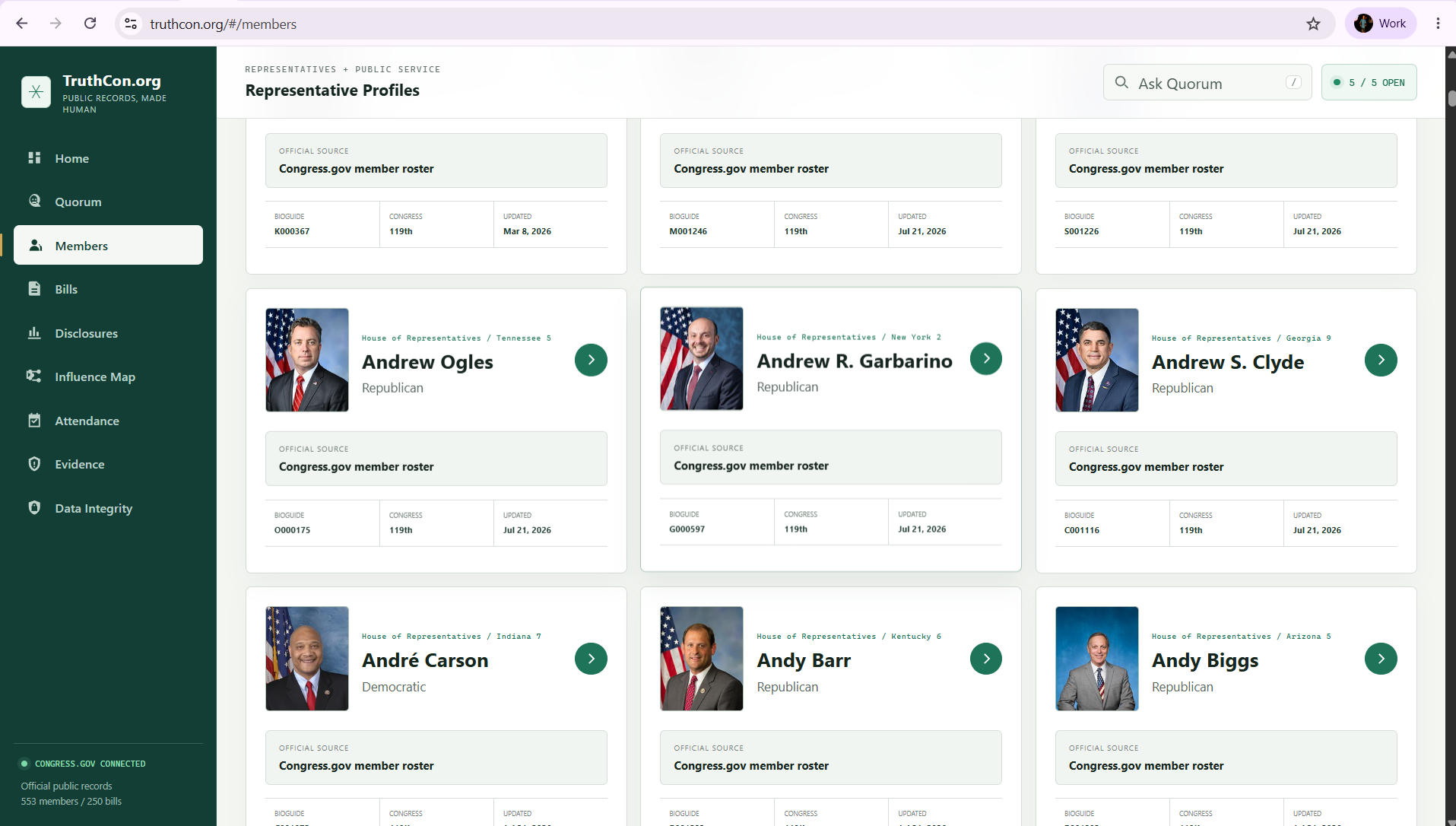
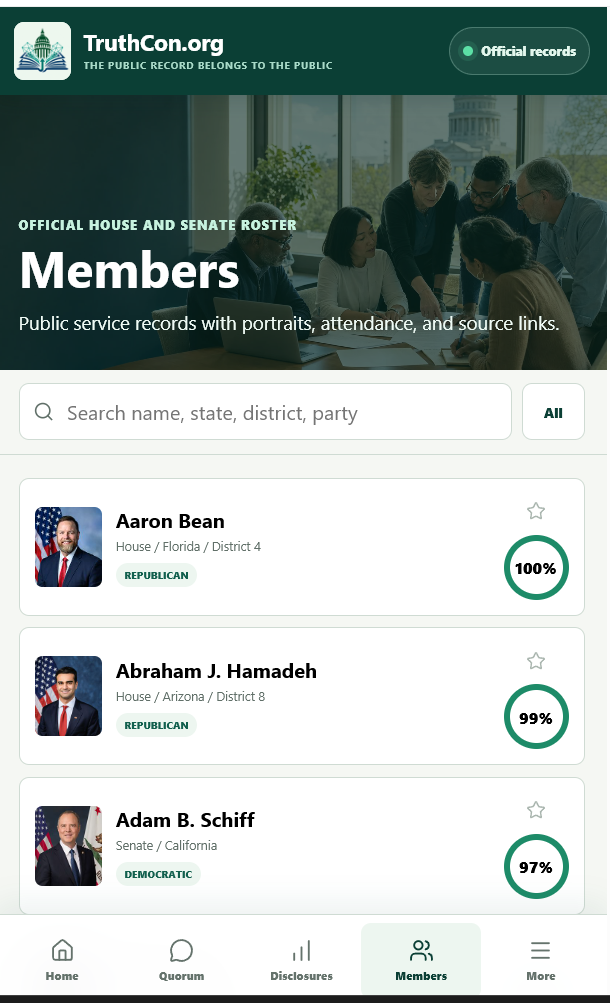
Canonical legislator directory indexed directly from Congress.gov, providing verified service terms, party affiliation, and bioguides.
-
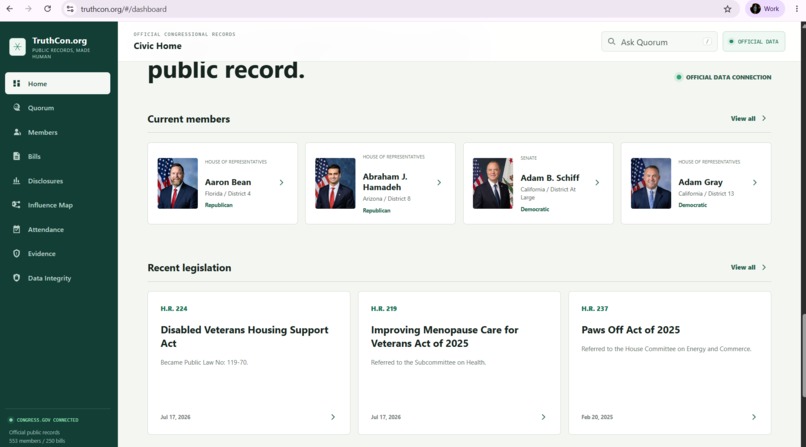
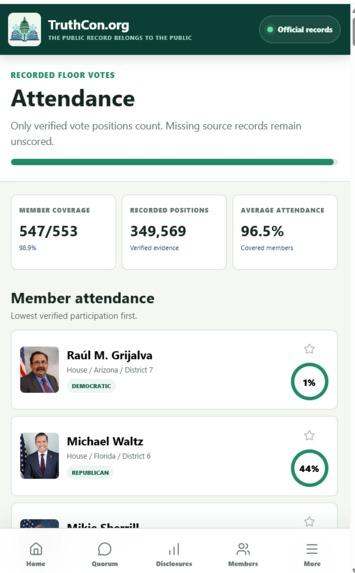
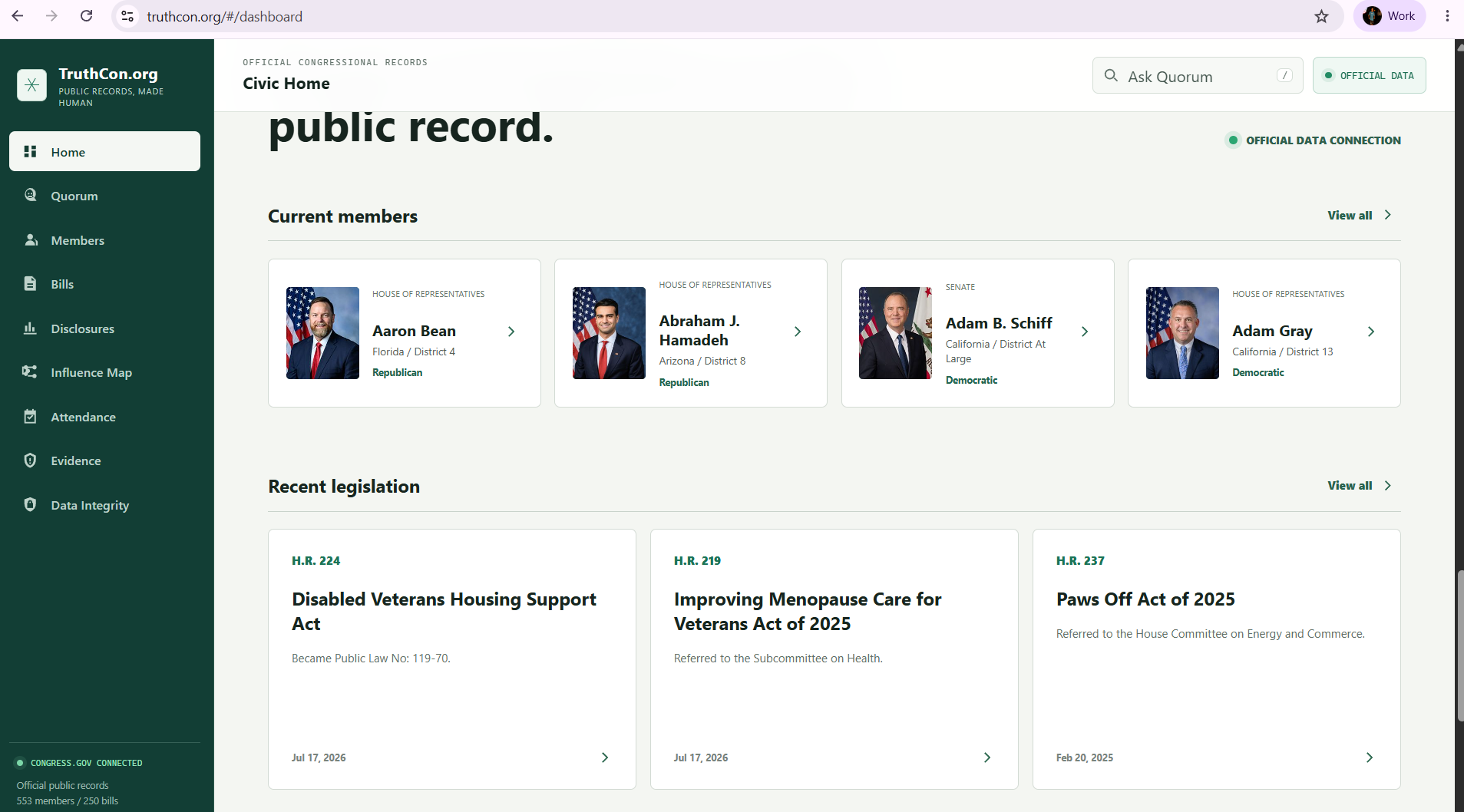
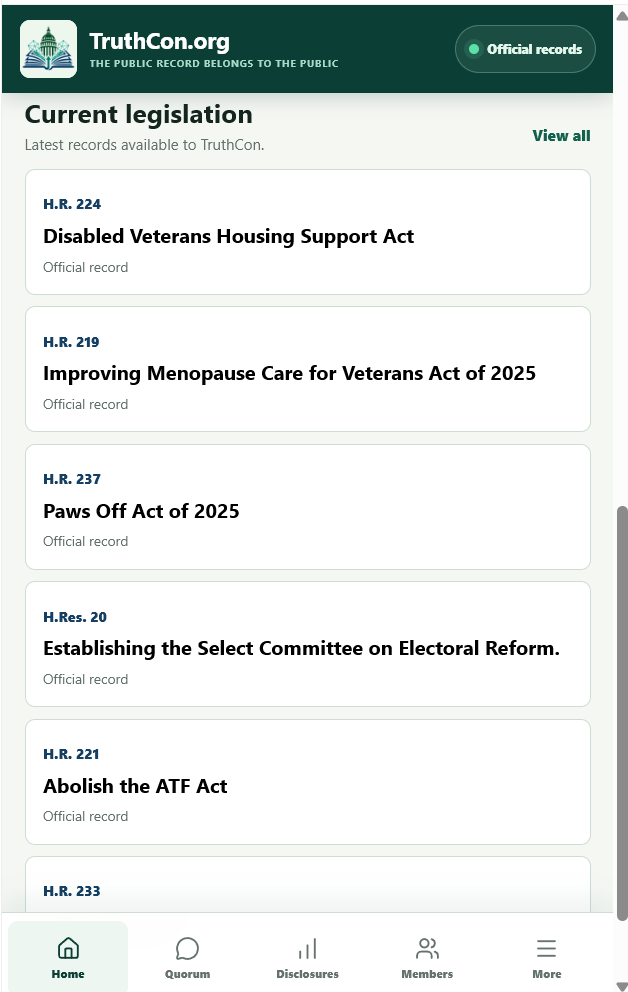
Live dashboard tracking real-time legislative momentum, newly introduced bills, and current member activity without AI speculation.
-
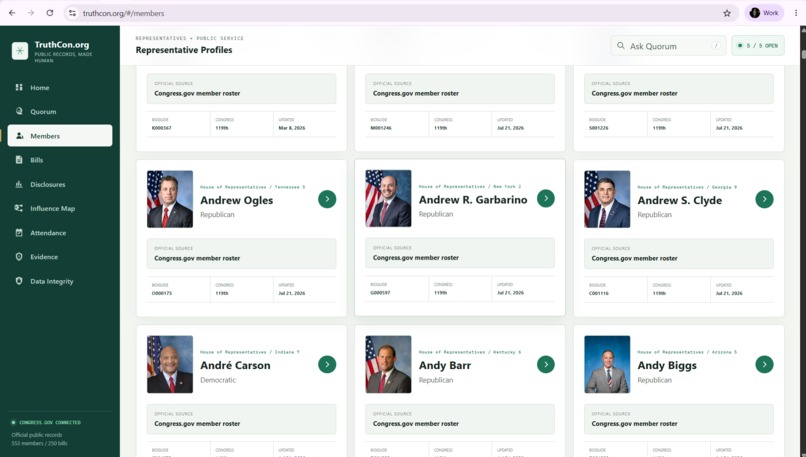
Interactive member profiles connecting lawmakers directly to their voting records, sponsored legislation, and official source data.
-
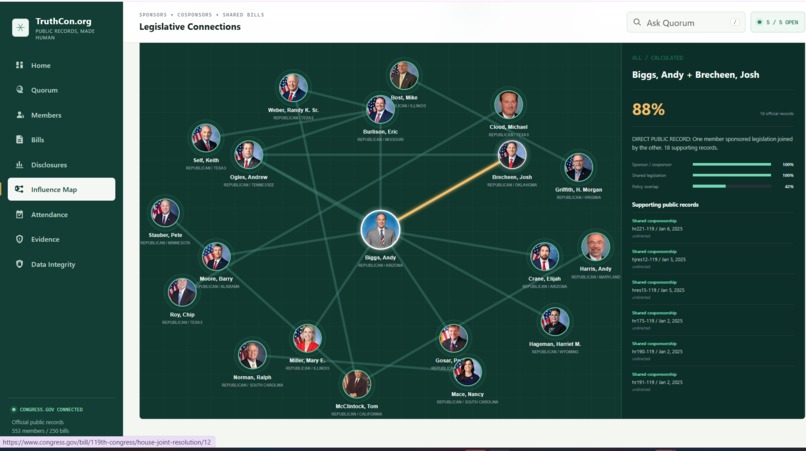
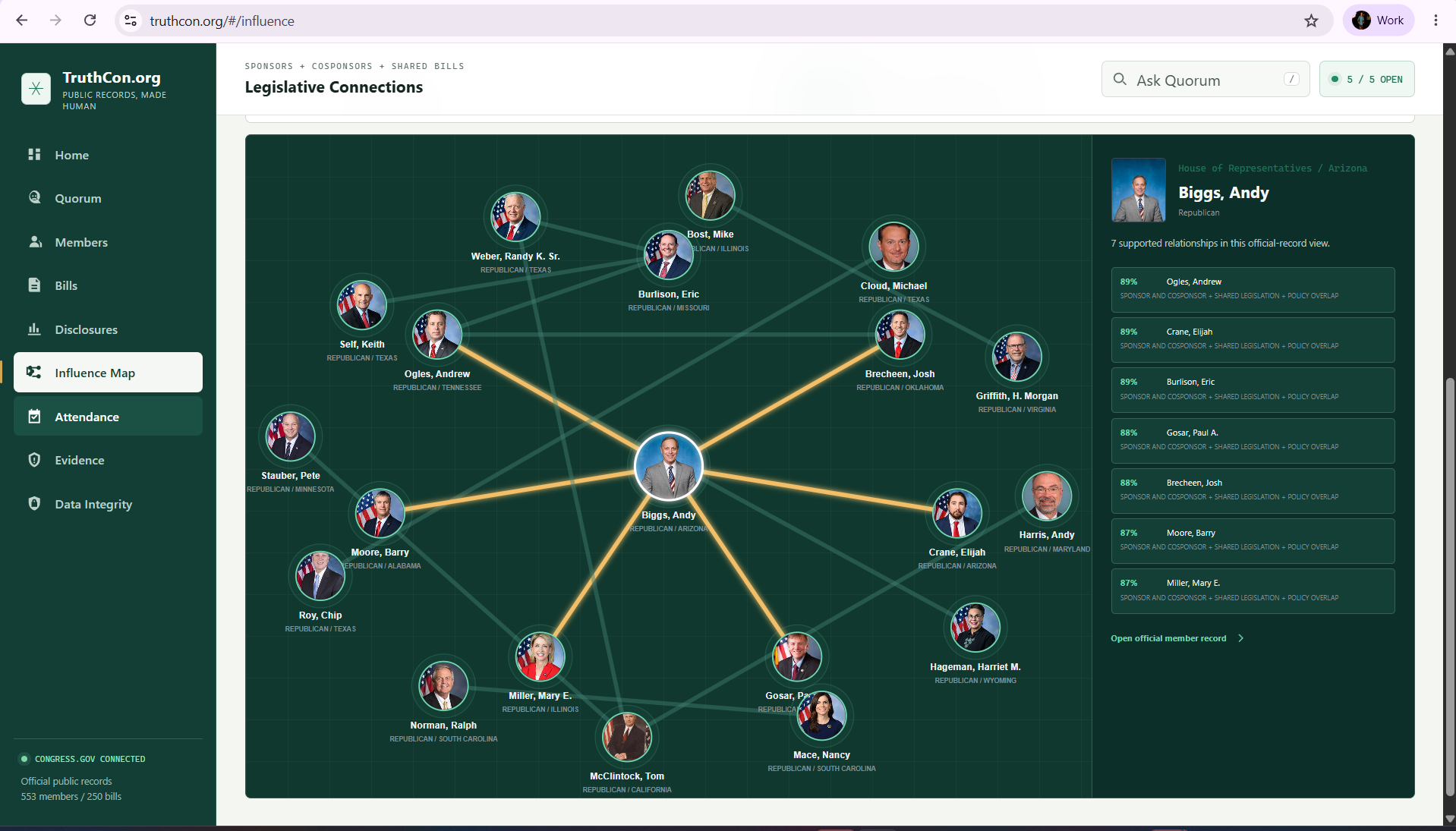
Recursive network analysis mapping hidden connections between legislators, committees, campaign finance, and lobbying relationships.
-
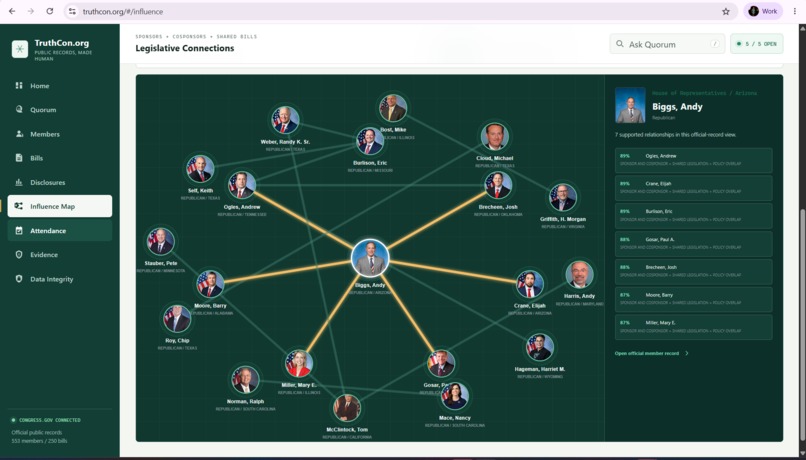
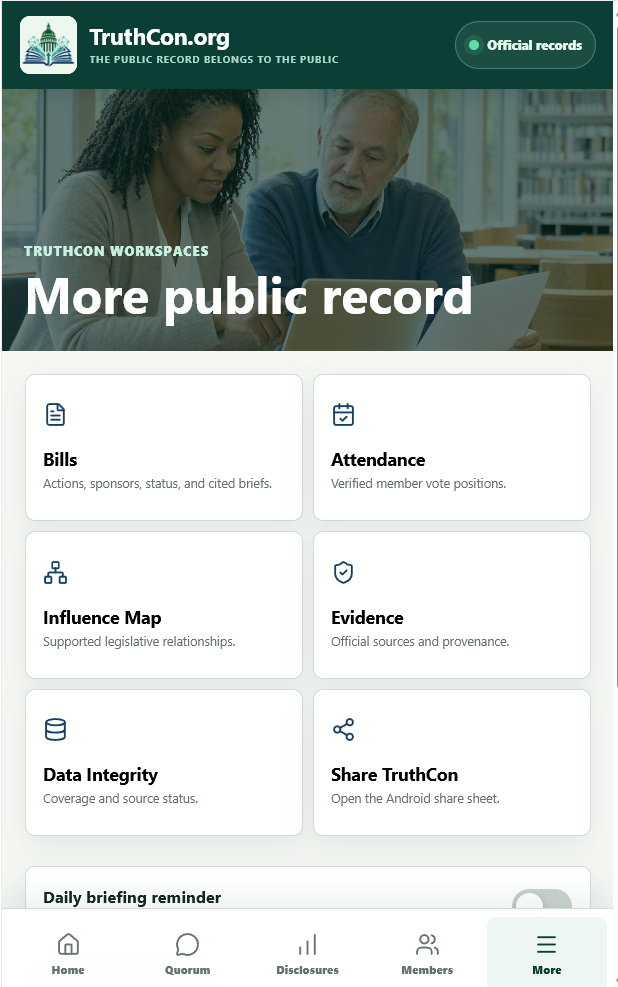
Interactive evidence mapping that allows advocacy groups to visualize political alignment and legislative coalitions in real time.
-
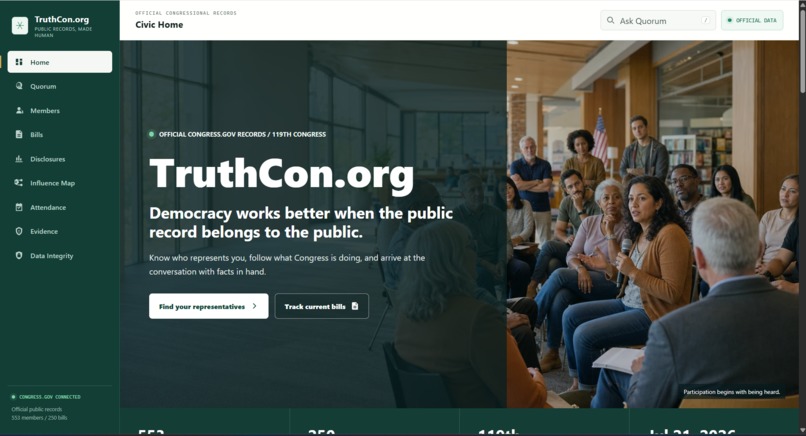
TruthCon Civic Home: A predictive intelligence engine built to give citizens and advocacy groups executive-grade legislative clarity.
-
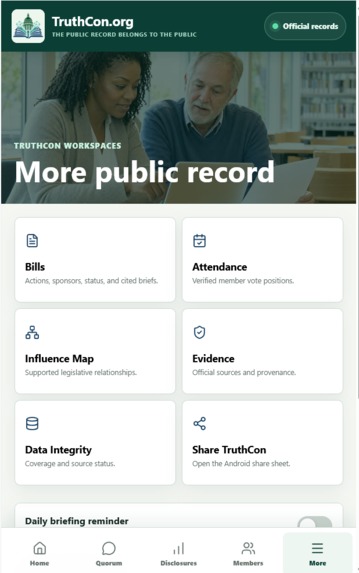
Android app completed in repo
-
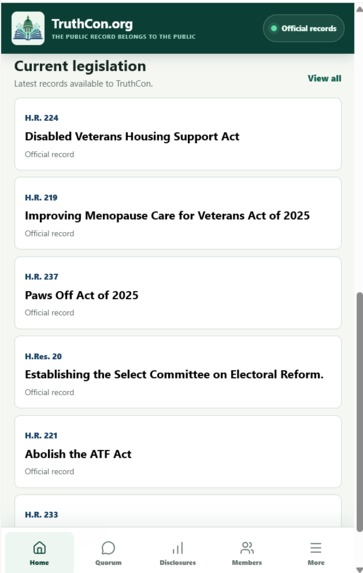
iOS App completed in repo
-
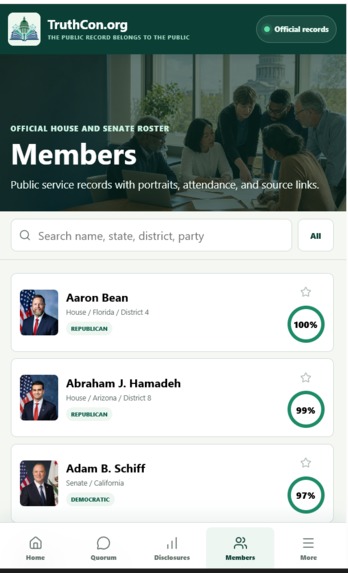
Full mobile builds being hardened
-
Built by Sol
Inspiration
From Idea to Live Deployment in Four Days
Although the original concept dates back to the early 2000s, the implementation of TruthCon began on July 18, 2026.
Between July 18 and July 21, 2026, the project progressed from an initial concept to a live, publicly deployed Congressional Intelligence Engine through an intensive AI-assisted development process using GPT-5.6 and Codex.
During those four days, we:
- Designed the overall system architecture.
- Built the Rust-based analytical engines.
- Developed the backend APIs and frontend application.
- Integrated official congressional data sources.
- Implemented progressive indexing for large public datasets.
- Built Quorum, the congressional intelligence assistant.
- Iteratively debugged local and production deployments.
- Deployed the application for public access.
The rapid development was made possible by combining domain expertise from years of military service, nonprofit leadership, and congressional advocacy with GPT-5.6's ability to accelerate software design, implementation, debugging, and refinement.
While the idea itself has existed for many years, the production system shown here was designed, built, tested, and deployed over the four-day period leading up to this submission.
TruthCon is a predictive Congressional Intelligence Engine built to reduce the two greatest operational constraints facing advocacy organizations: time and accuracy.
It converts fragmented congressional records into continuously updated intelligence that organizations can use to monitor legislation, understand member behavior, identify emerging relationships, and decide where attention is required.
Rather than operating as a conventional bill tracker, TruthCon combines official records, deterministic data engineering, artificial intelligence, and a user-facing predictive mathematical engine.
The system connects:
- bills and amendments
- legislative actions
- sponsors and committees
- roll-call votes
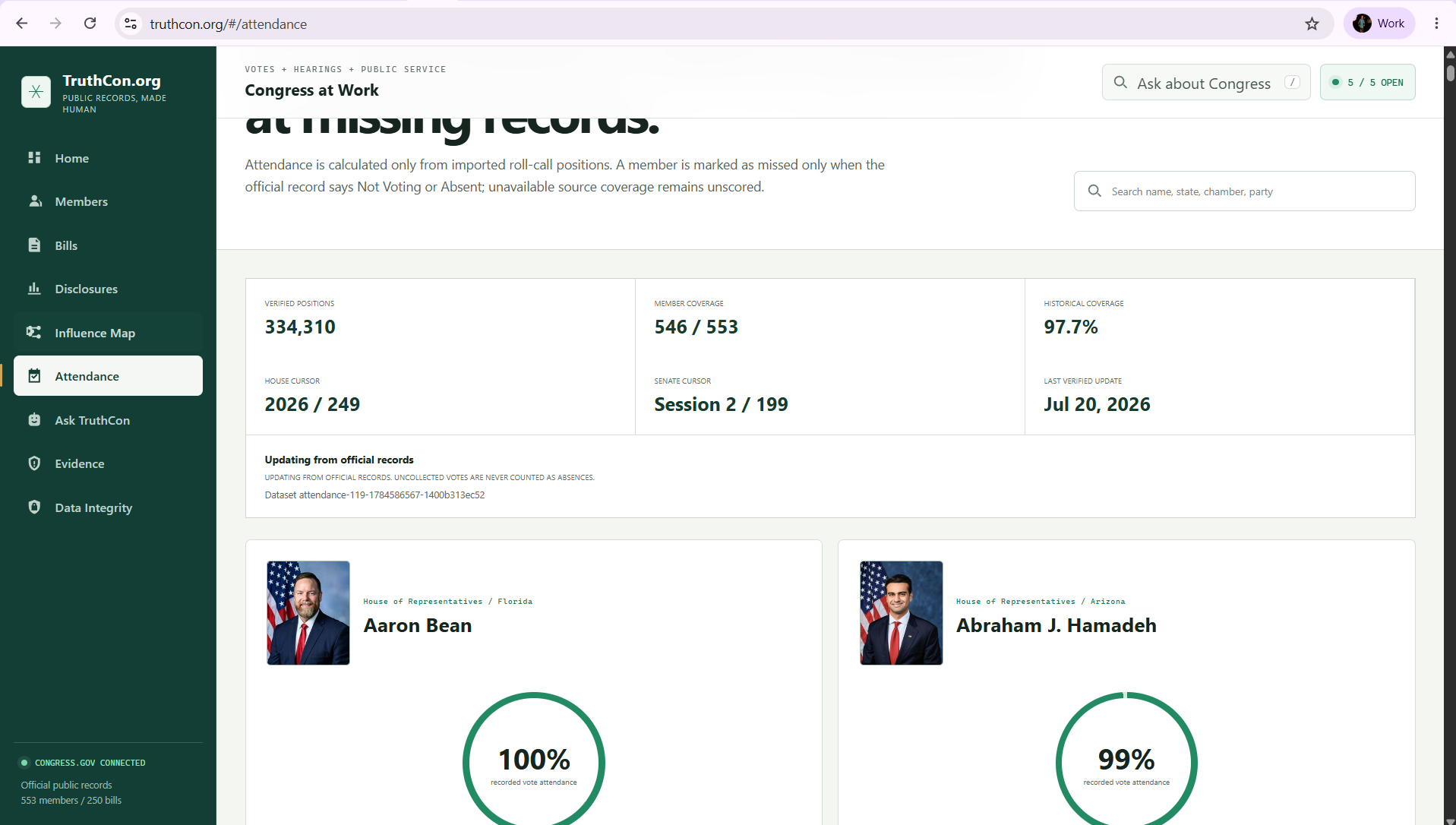
- attendance
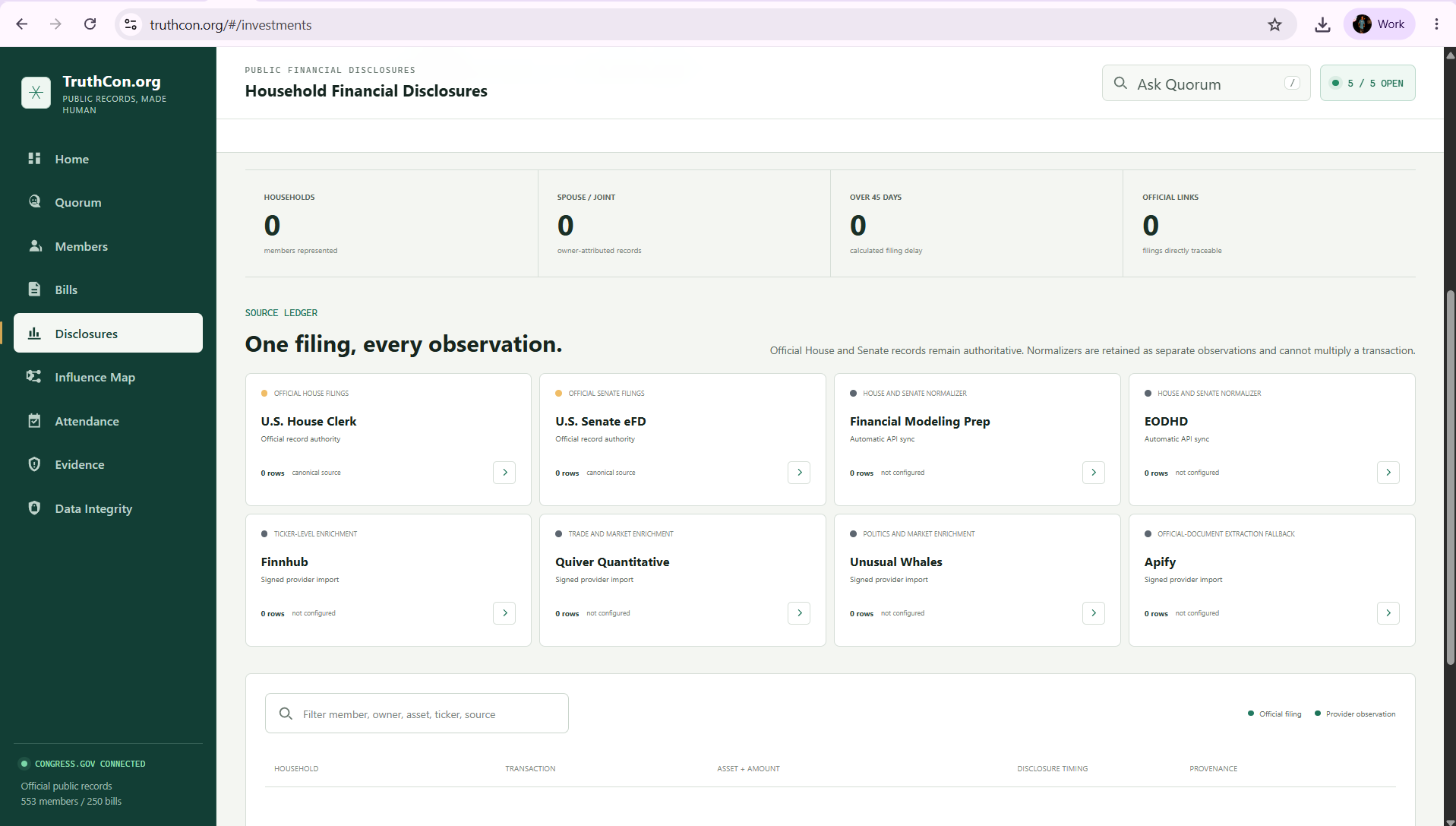
- financial disclosures
- lobbying
- campaign finance
- beneficiaries
- historical patterns
- legislative timing
- organizational priorities
TruthCon then uses those relationships to calculate bill momentum, detect behavioral and financial correlations, compare competing explanations, and continuously update the probability that legislation will pass, fail, stall, or materially change.
What it does
TruthCon is a predictive Congressional Intelligence Engine built to reduce the two greatest operational constraints facing advocacy organizations, journalists, researchers, and engaged citizens: time and accuracy.
Instead of forcing users to search dozens of disconnected government websites, TruthCon continuously collects, organizes, analyzes, and explains congressional activity within a single evidence-driven platform.
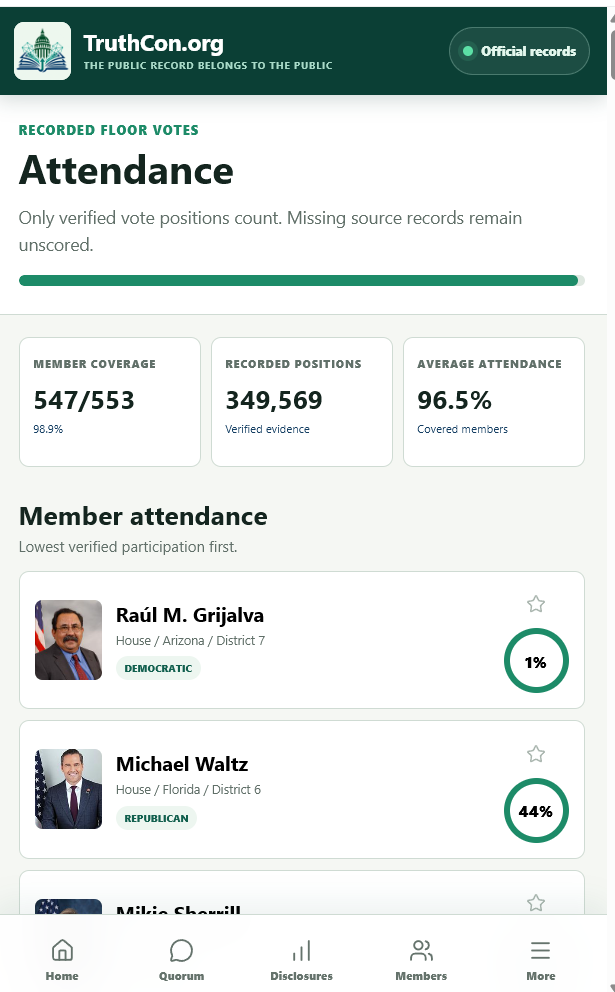
The system connects legislation, amendments, committee activity, sponsorship, roll-call votes, member attendance, financial disclosures, lobbying records, campaign finance, and legislative timing into one continuously updating intelligence environment.
At the center of the platform is Quorum, an AI-powered congressional research assistant that retrieves official congressional evidence before generating an explanation. Rather than relying on AI memory alone, Quorum grounds its responses in structured legislative data, allowing users to inspect the evidence supporting each answer.
TruthCon also introduces what we believe is the first user-facing predictive congressional intelligence engine that combines legislative momentum, voting behavior, attendance, financial disclosures, lobbying, campaign finance, beneficiary analysis, recursive relationship analysis, and quantitative prediction within a single public platform.
Rather than simply showing users what happened, TruthCon continuously evaluates what is happening now, why it matters, and what is most likely to happen next based on evolving congressional evidence.
How we built it
Although the original concept dates back to the early 2000s, the implementation of TruthCon began late on July 18, 2026, and reached a live public deployment for submission on July 21, 2026.
TruthCon was ideated, architected, engineered, tested, debugged, and deployed through GPT-5.6 and Codex in collaboration with my domain experience in military service, congressional advocacy, nonprofit leadership, and software design.
The platform combines multiple technologies into one architecture.
Official congressional information is continuously collected from public government sources including Congress.gov, House Clerk records, Senate records, roll-call votes, committee information, member information, legislative actions, and public financial disclosures.
Those records are normalized into canonical entities including legislators, bills, votes, committees, organizations, industries, financial transactions, and evidence relationships.
The analytical engine was written in Rust to provide deterministic calculations for legislative momentum, attendance, financial exposure, vote alignment, lobbying relationships, campaign finance, committee influence, historical behavior, recursive network analysis, anomaly detection, and competing hypothesis modeling.
The frontend provides an interactive intelligence platform where users can explore legislation, ask questions through Quorum, inspect supporting evidence, and monitor congressional activity in real time.
TruthCon uses progressive indexing so verified information becomes available immediately while historical records continue synchronizing in the background, allowing the platform to remain useful throughout large data imports.
The completed system was containerized, deployed, and made publicly accessible during the development period.
Challenges we ran into
The largest challenge was not writing software—it was connecting fragmented government information into a coherent intelligence system.
Congressional information exists across numerous independent systems with different identifiers, formats, update schedules, and publication methods. The same legislator, committee, bill, vote, or disclosure can appear differently depending on its source.
Building TruthCon required creating a canonical data architecture capable of connecting those records without losing their original provenance.
Another major challenge involved designing an AI system that users could trust. We wanted Quorum to explain legislation without allowing generated text to replace verifiable evidence. That required separating deterministic retrieval, quantitative analysis, and language generation into distinct stages.
Large historical datasets also introduced practical deployment challenges. Attempting to index every historical record before displaying data left users waiting on incomplete systems. Progressive indexing solved this problem by allowing verified information to appear immediately while additional records continued processing in the background.
Finally, the implementation itself occurred within approximately four days. During that period we simultaneously designed the architecture, wrote the analytical engines, built the frontend, connected official data, solved deployment issues, corrected production bugs, refined the user experience, and launched the public application.
Accomplishments that we're proud of
TruthCon represents the realization of an idea I first envisioned more than twenty years ago while working in military advocacy.
During my Air Force career I served in leadership roles within the Air Force Sergeants Association, advocating for military members during the effort to pass the Post-9/11 GI Bill. I was honored as the 2008 AFSA International Member of the Year for those efforts, in addition to receiving multiple USAFE and installation-level leadership awards.
Later, as Center Manager for the Pat Tillman USO at Bagram Airfield, Afghanistan, I managed programs supporting approximately 40,000 assigned personnel and more than 50,000 monthly center visits. Those experiences reinforced how critical timely and accurate legislative information is for organizations serving military members and veterans.
TruthCon transforms those experiences into working technology.
One accomplishment we are particularly proud of is moving from concept to production deployment between July 18 and July 21, 2026. GPT-5.6 and Codex enabled us to translate a decades-old idea into a functioning Congressional Intelligence Engine within just a few days.
We are also proud that the live beta has already been shared with leadership within the Air Force Sergeants Association, the American Legion, and the Veterans of Foreign Wars for discussion as a potential legislative intelligence platform.
These organizations all face the same operational challenge: they must monitor enormous amounts of congressional activity while making timely, evidence-based decisions with limited staff and resources.
TruthCon was designed specifically to reduce those burdens by improving both speed and accuracy.
Finally, we are proud of creating a new category of civic technology. TruthCon combines deterministic government data, artificial intelligence, quantitative mathematics, and predictive legislative modeling into a single public intelligence platform that allows users to inspect both the evidence and the reasoning behind each conclusion.
What we learned
The biggest lesson from this project is that trustworthy AI begins long before a language model generates an answer.
Reliable public intelligence depends on clean data engineering, canonical entity resolution, transparent analytical methods, reproducible calculations, and continuous validation of official records.
We also learned that congressional data becomes dramatically more valuable once relationships between bills, votes, committees, disclosures, lobbying activity, campaign finance, and historical behavior can be analyzed together rather than viewed separately.
Another important lesson was that prediction should not be hidden behind a black box.
If a system predicts that legislation is gaining momentum or identifies a strong relationship within congressional activity, users should be able to inspect the supporting evidence, understand the mathematical factors involved, evaluate competing explanations, and determine for themselves whether the conclusion is persuasive.
Finally, this project demonstrated how dramatically modern AI development has evolved. GPT-5.6 and Codex enabled the complete lifecycle of software development—from architecture and implementation through debugging and deployment—while allowing decades of professional experience to be translated into a working public platform in an extraordinarily compressed timeframe.
What's next for TruthCon: The Congressional Intelligence Engine
Our immediate priority is working with organizations such as the Air Force Sergeants Association, the American Legion, and the Veterans of Foreign Wars as they evaluate TruthCon's potential role in their legislative advocacy efforts.
The objective is simple: reduce the time required to understand Congress while increasing confidence in the underlying evidence.
Future development will expand historical financial-disclosure indexing, deepen relationship analysis across congressional activity, improve predictive legislative modeling, and provide richer visualizations that allow users to explore congressional relationships interactively.
We also plan to expand organizational workspaces that allow advocacy groups, journalists, researchers, educators, and civic organizations to monitor priority legislation, create legislative watchlists, generate evidence-backed briefings, receive intelligent alerts, and collaborate around shared congressional research.
Quorum will continue evolving into a full congressional research partner capable of maintaining long-term conversational context, comparing legislators, explaining legislation, exploring historical voting behavior, identifying emerging patterns, and helping users navigate increasingly complex congressional activity.
The long-term vision is larger than a bill tracker or research assistant.
TruthCon aims to become a continuously operating Congressional Intelligence Engine that transforms public records into transparent, evidence-driven intelligence, helping organizations and citizens spend less time searching for information and more time acting on it.


Log in or sign up for Devpost to join the conversation.