-
-
The complete project presentation (PPT) is available in the Google Drive link provided below.
-
The complete project presentation (PPT) is available in the Google Drive link provided below.
-
The complete project presentation (PPT) is available in the Google Drive link provided below.
-
The complete project presentation (PPT) is available in the Google Drive link provided below.
-
The complete project presentation (PPT) is available in the Google Drive link provided below.
THE STORY BEHIND TRUTHCLUSTER AI
Over the last year, I started noticing something that was becoming very common on the internet — fake and misleading news spreading very quickly.
Many times, when I saw a news post or video online, I believed it was real because it looked convincing. The problem was that I didn't always have an easy way to verify it.
One example that caught my attention was a viral claim about Bhavani to Dubai for ₹10,000. When I first saw the information, I thought it was genuine. Later, I came across information suggesting that the claim was misleading or AI-generated content. That made me ask myself:
“If I believed this was real, how many other people might believe it too?”
The bigger problem is that fake information does not always come from an unknown page.
Sometimes, the same claim can appear across multiple news pages or social media accounts. When people see the same information repeatedly, they may naturally assume that it must be true.
But repetition is not verification.
Even a large or popular news channel reporting something does not automatically prove that every detail of the claim is correct.
At the same time, the information needed to verify one claim is usually scattered across the internet.
One source may support part of the claim.
Another source may contradict it.
Another source may provide important context.
And another source may contain the original statement.
So the real problem is not simply:
“Can AI classify this news as fake or real?”
The bigger question is:
“Can we collect the available evidence, organize it, compare different sources, and help a person understand what the evidence actually says?”
That question became the motivation behind my project:
TruthCluster AI
TruthCluster AI is a real-time news and claim verification system.
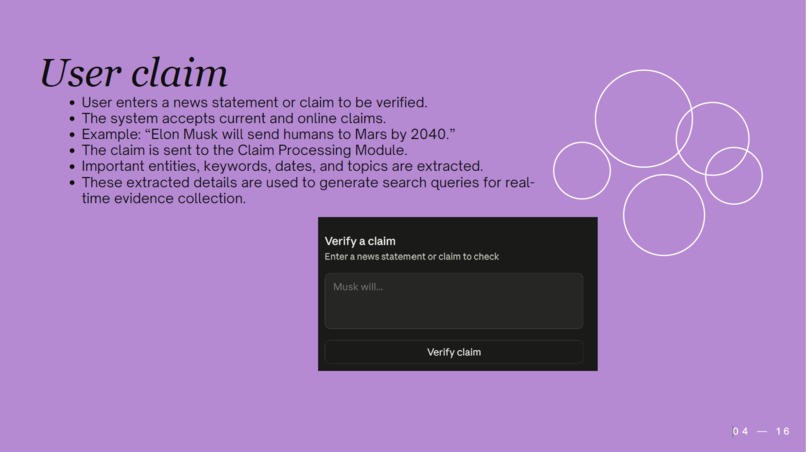
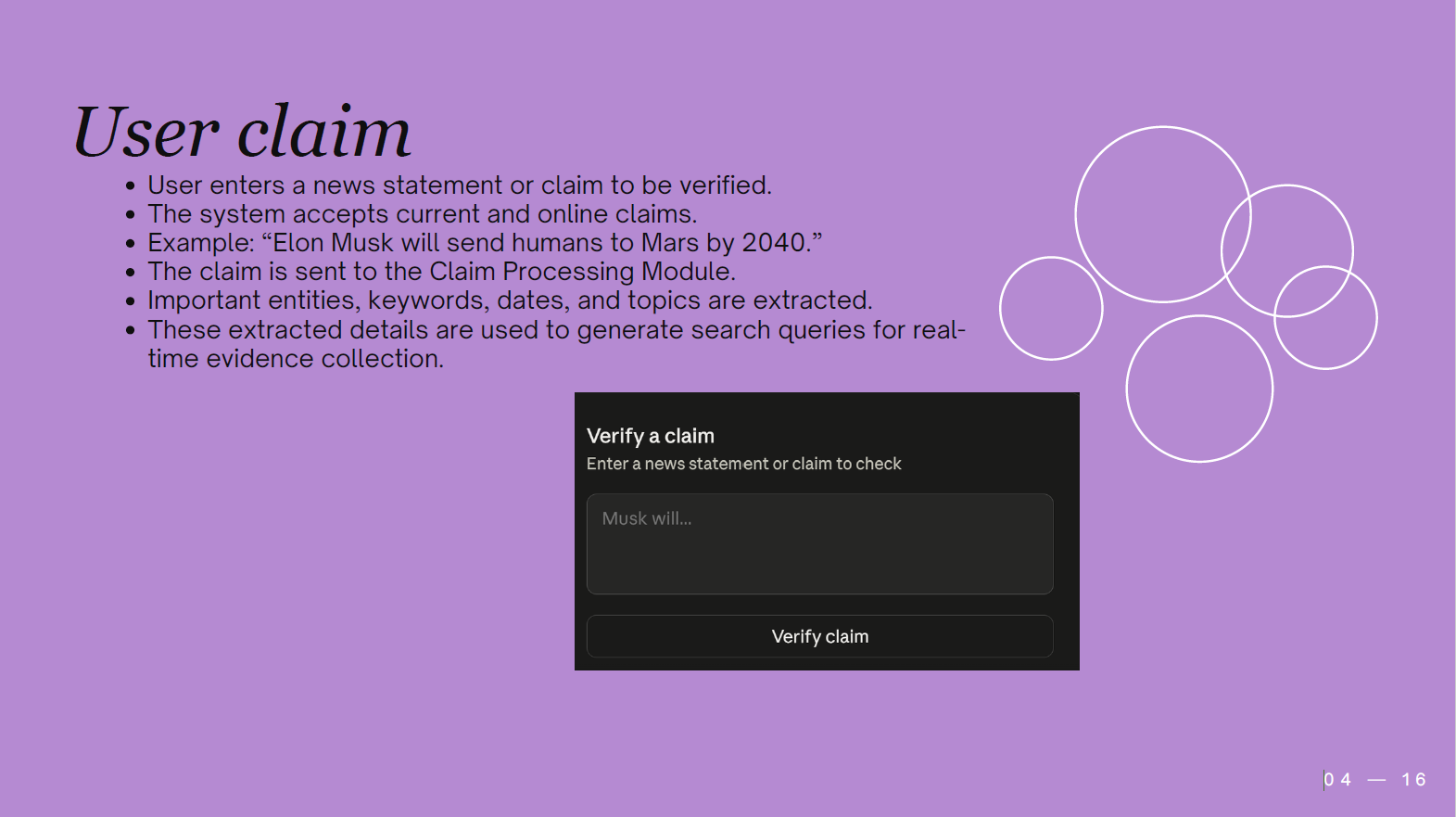
A user enters a claim they want to verify.
For example:
“Elon Musk will send humans to Mars by 2040.”
Instead of immediately asking an AI whether the claim is true or fake, our system first breaks down the claim into important information such as entities, topics, keywords, and dates.
Then it searches current online sources using GDELT and collects multiple pieces of evidence.
The retrieved articles are cleaned, duplicates and irrelevant information are removed, and a dynamic evidence dataset is created for that specific claim.
This is where the important part of our project begins.
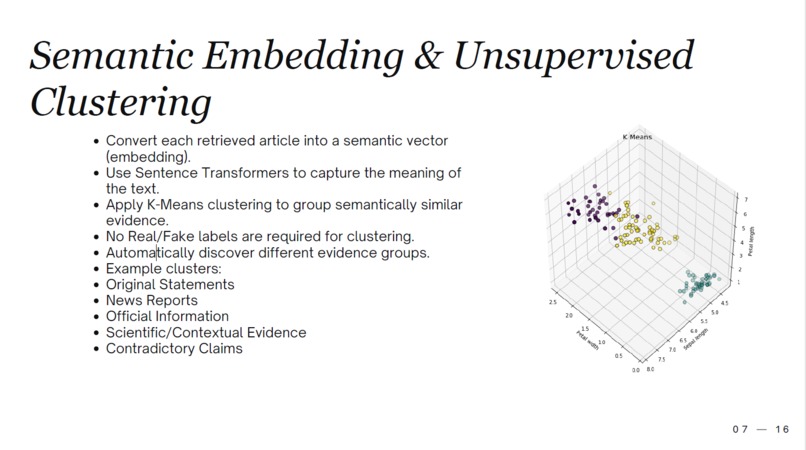
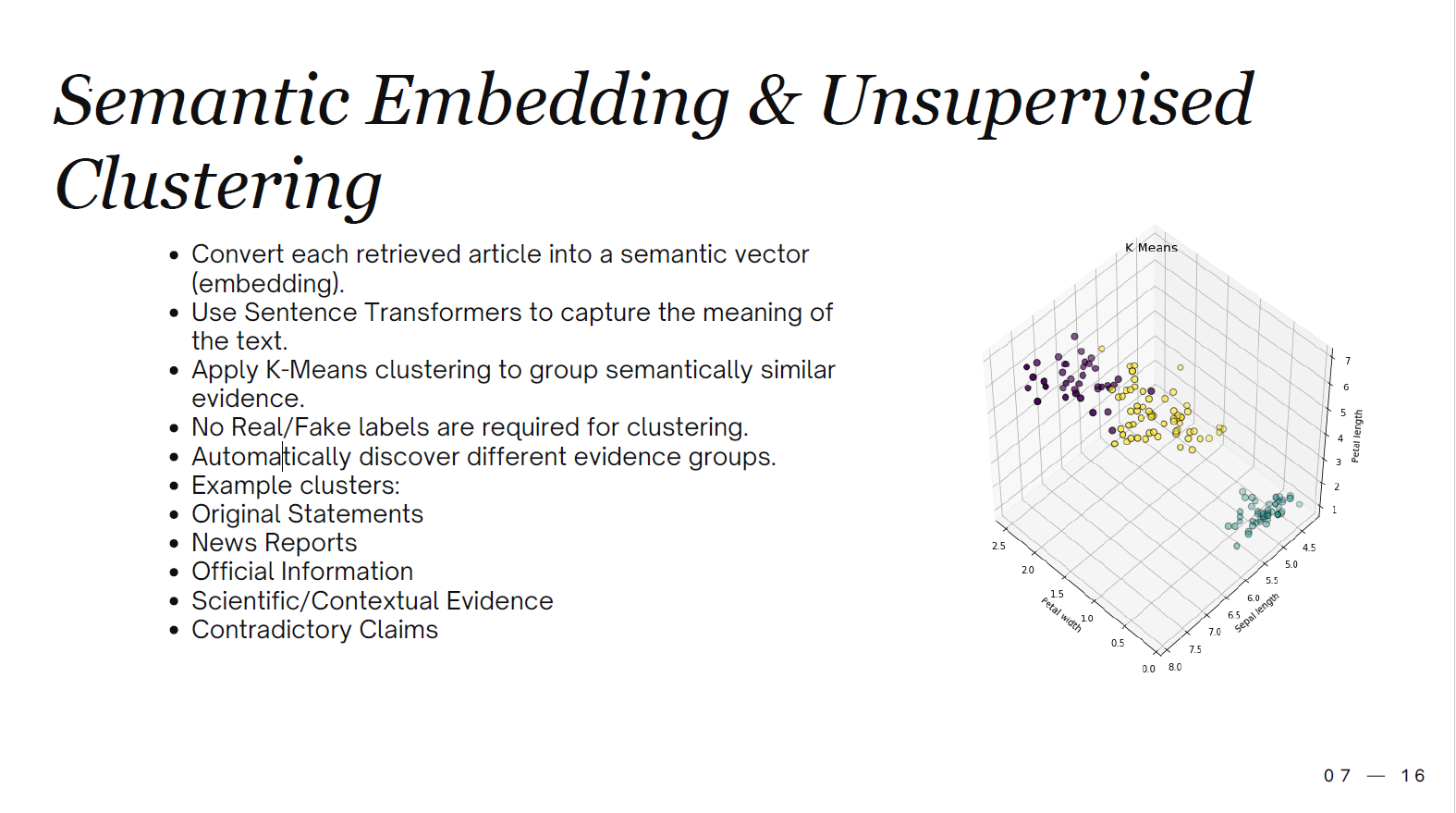
We convert the retrieved articles into semantic embeddings using Sentence Transformers.
Then we apply K-Means unsupervised clustering to automatically group semantically similar evidence.
For example, the system may discover groups such as:
- Original Statements
- News Reports
- Official Information
- Scientific or Contextual Evidence
- Contradictory Claims
The important point is that we do not provide the system with Real/Fake labels during clustering. The algorithm discovers the structure of the evidence by itself.
But clustering itself does not decide whether something is true or false.
It simply helps us organize the evidence.
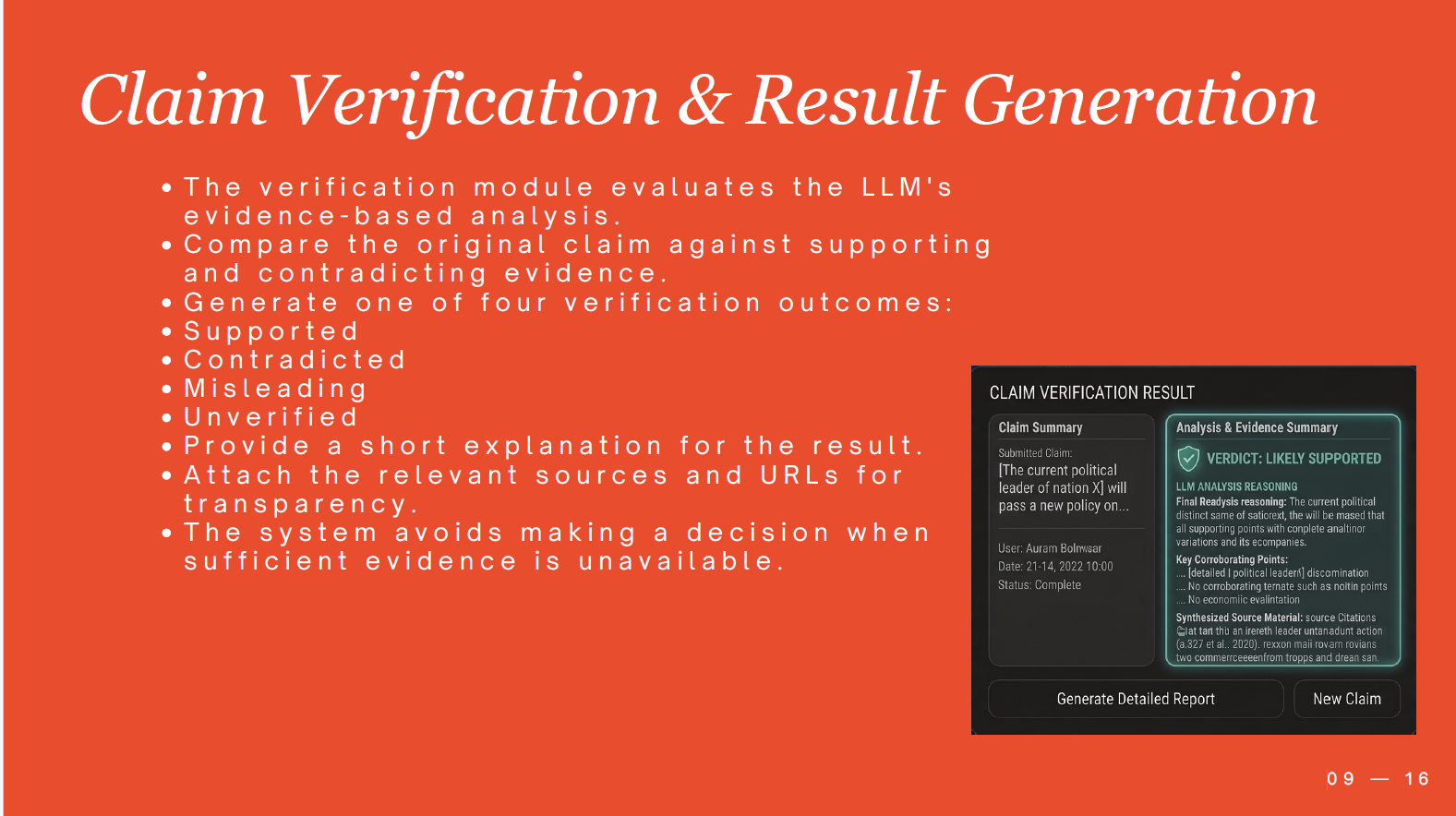
After that, an LLM reasoning layer compares the original claim with the different evidence groups.
It looks for:
- Supporting evidence
- Contradicting evidence
- Missing context
- Inconsistencies
- Potentially misleading information
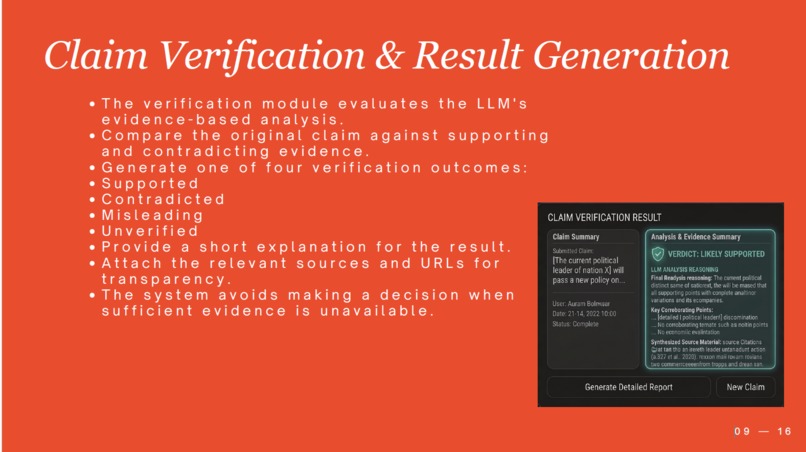
Then the verification module produces one of four outcomes:
Supported
Contradicted
Misleading
Unverified
The system also provides an explanation and relevant sources instead of giving only a simple “True” or “Fake” answer. If there is not enough evidence, the system can return Unverified rather than forcing a decision.
WHY THIS MATTERS
The goal of TruthCluster AI is not to tell people what they should believe.
The goal is to help people see the evidence behind a claim.
Because today, the challenge is not only that fake news exists.
The challenge is that:
Information is everywhere, but reliable context is scattered.
TruthCluster AI tries to bring that scattered evidence together, organize it using unsupervised learning, and use LLM reasoning to make the verification process more understandable and transparent.
THE CORE IDEA
Don't simply ask AI: “Is this news fake?”
Instead:
Find the evidence → Organize the evidence → Compare the evidence → Explain the evidence.
That is the idea behind TruthCluster AI.
Built With
- canva
- chatgpt
- google-flow
- google-omni


Log in or sign up for Devpost to join the conversation.