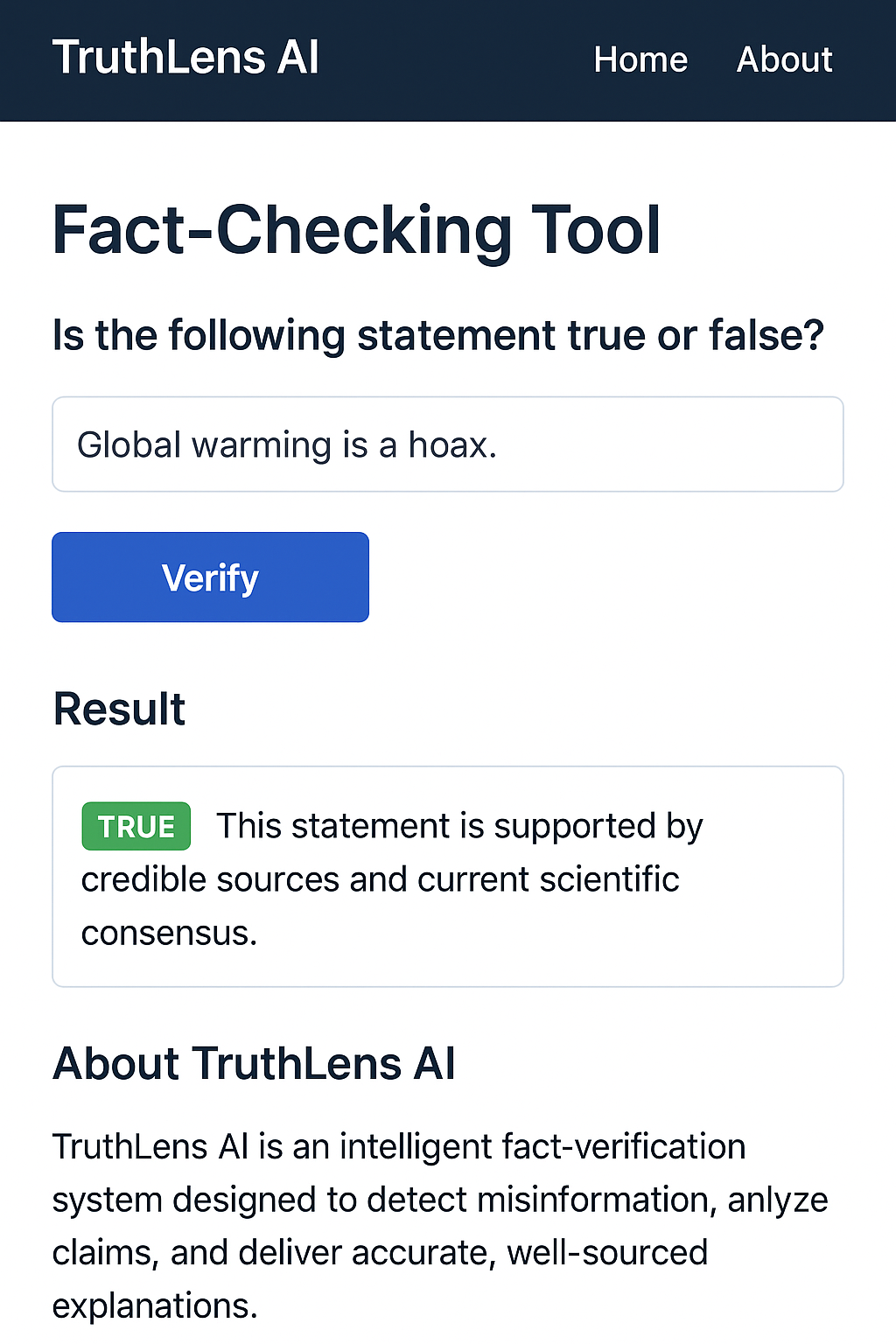
InspirationTruthLens AI is a machine-learning–powered fact-verification system designed to analyze statements, detect misinformation, and generate accurate, well-sourced explanations. The idea was inspired by the growing challenge of false information circulating across social media, WhatsApp groups, and online communities—an issue I encounter often in my work as a campus fact-checker.
What Inspired Me
Misinformation spreads faster than truth, and many people—especially young learners—lack quick tools to verify what they see online. Seeing how false narratives influence opinions motivated me to build a tool that can scan text, analyze claims, and instantly clarify truth from falsehood. My goal was to empower users with a simple but powerful AI-powered “truth lens.”
How I Built the Project
I developed TruthLens AI using a combination of:
Natural Language Processing (NLP)
Machine-learning classification models
Google Gemini API for real-time claim analysis
Data comparison techniques using trusted datasets
The workflow follows a simple pipeline:
\text{Input Claim} \rightarrow \text{NLP Preprocessing} \rightarrow \text{ML Model Prediction} \rightarrow \text{Evidence Generation} \rightarrow \text{Truth Rating}
This structure allows the system to break down the statement, detect misleading patterns, and assign a truth-score.
What I Learned
Building TruthLens AI taught me:
How to integrate Gemini API responses with custom ML logic
How misinformation patterns can be modeled and classified
The importance of clean datasets in training effective models
Effective prompt engineering for accurate explanations
How to balance speed, accuracy, and user experience
It also improved my understanding of real-world NLP applications and responsible AI development.
Challenges I Faced
Some key challenges included:
Finding reliable fact-checking datasets to train the model
Balancing model complexity with fast processing time
Ensuring explanations remain neutral, clear, and well-supported
Handling ambiguous claims where truth is not binary
Managing API rate limits during model testing
Despite these challenges, the project pushed me to think critically about misinformation and design an AI tool that can genuinely help users verify online content quickly.
What it does
How we built it
Challenges we ran into
Accomplishments that we're proud of
What we learned
What's next for Truth lens AI
Built With
- chat
- gemini


Log in or sign up for Devpost to join the conversation.