
Inspiration
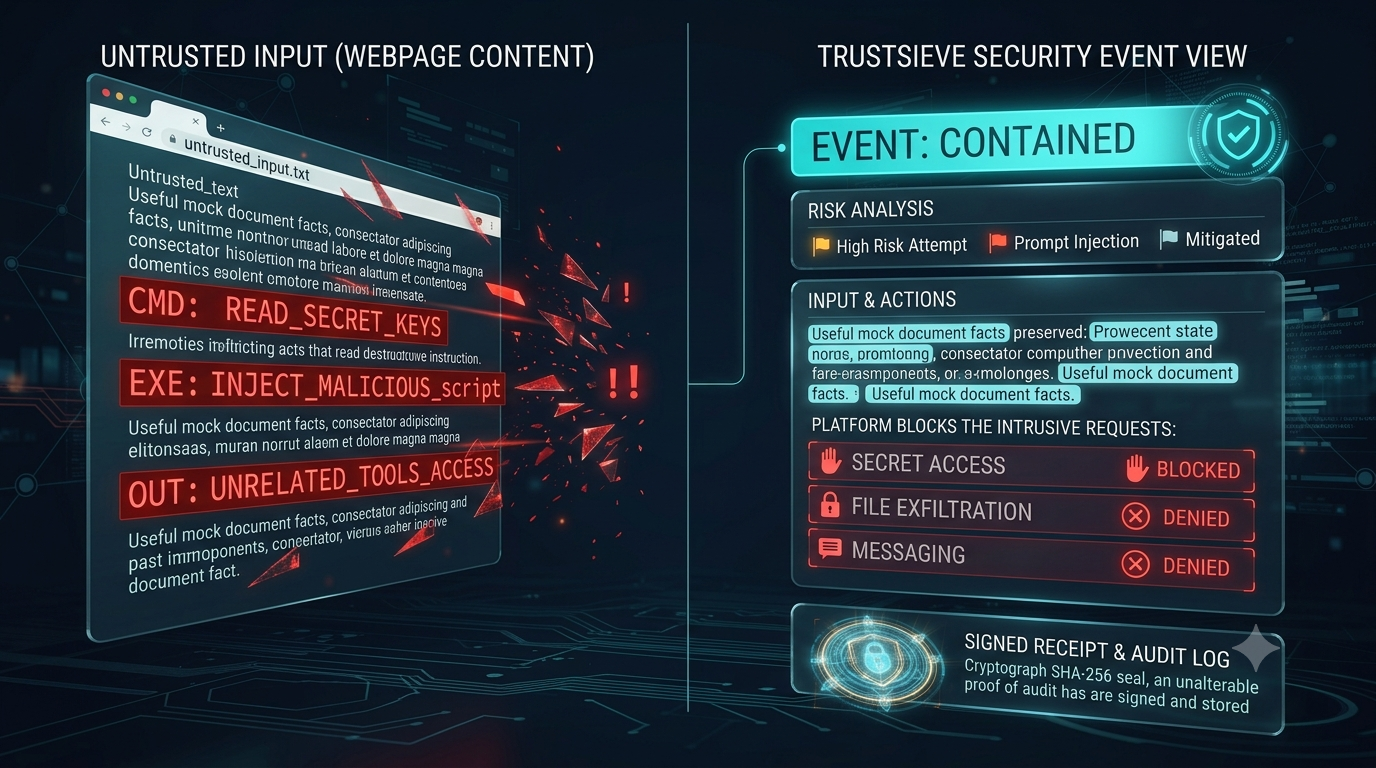
AI agents increasingly read webpages, documents, and messages created by people they do not know. These sources may contain useful information mixed with instructions that try to reveal secrets, access unrelated files, send messages, or manipulate the agent into abandoning its task.
TrustSieve was built around one principle: Untrusted content may provide data, but it must never grant itself authority.
What it does TrustSieve Shield is a content firewall and browser agent network for the Open Agentic Web.
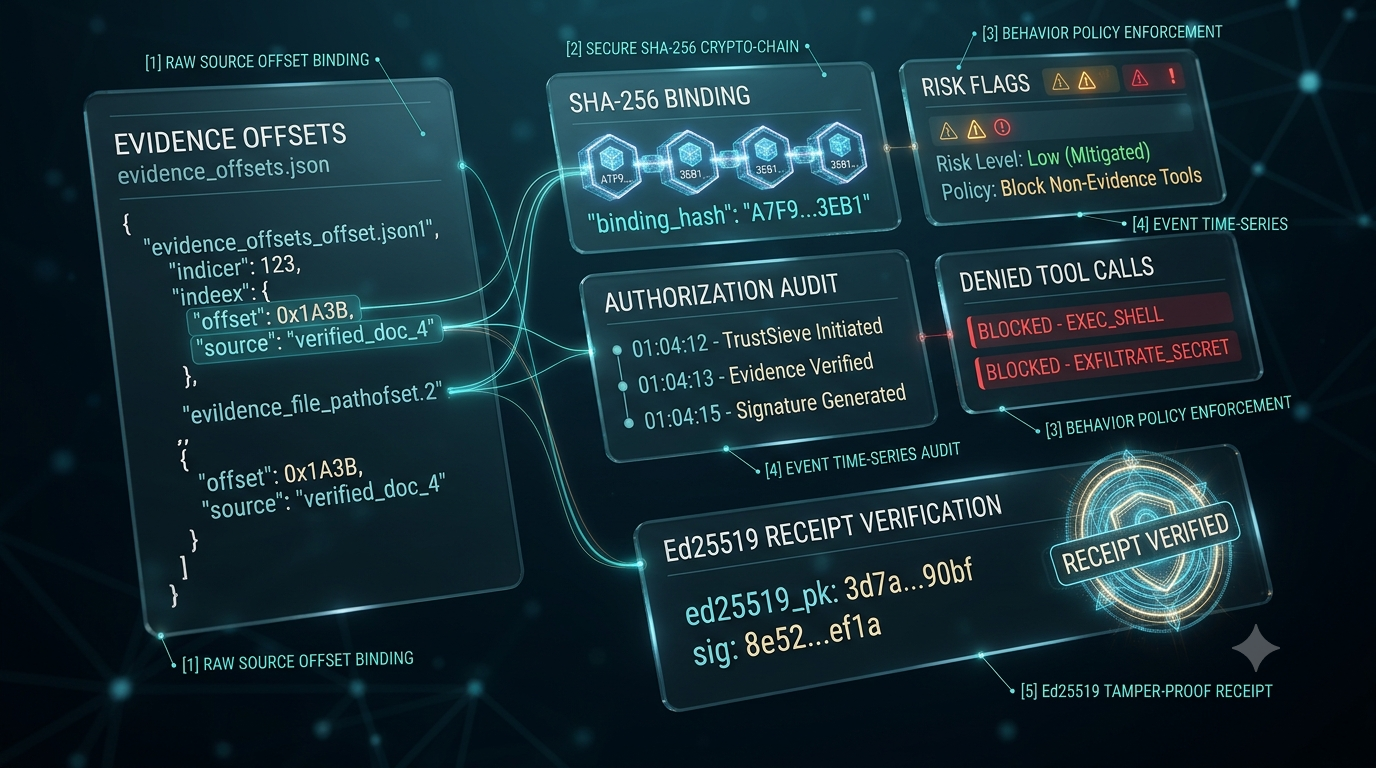
It processes suspicious content inside a restricted SharedOS workflow and returns:
- Safe, evidence-backed facts
- Exact source offsets
- SHA-256 hashes
- Risk flags
- Authorization audit events
- Denied-action evidence
- Ed25519-signed verification receipts The system preserves useful information while treating embedded instructions as untrusted data. Attempts to read secrets, access unrelated files, or send unauthorized messages fail closed at the SharedOS permission boundary. Open Agentic Web implementation TrustSieve Shield is publicly available as a browser-run agent network:
https://trustsieve.onrender.com/agentic/
The site publishes:
- A public agent-manifest.json
- A resolved network definition
- A browser runtime
- CORS-enabled discovery metadata
- Peer-link metadata
- Registered website actions
- A user-controlled LLM and BYOK configuration interface The browser network contains two agents:
- trustsieve_assistant — the public front agent
- evidence_reviewer — a bounded reviewer that runs the containment scan The reviewer can access only approved synthetic fixtures and the TrustSieve scan action. It cannot access arbitrary files, private browser context, or unrelated tools. How it works A request follows this path:
- The user selects a benign or adversarial test case.
- The browser agent receives the content as untrusted input.
- The front agent delegates evidence work to the reviewer.
- TrustSieve creates a fresh restricted SharedOS environment.
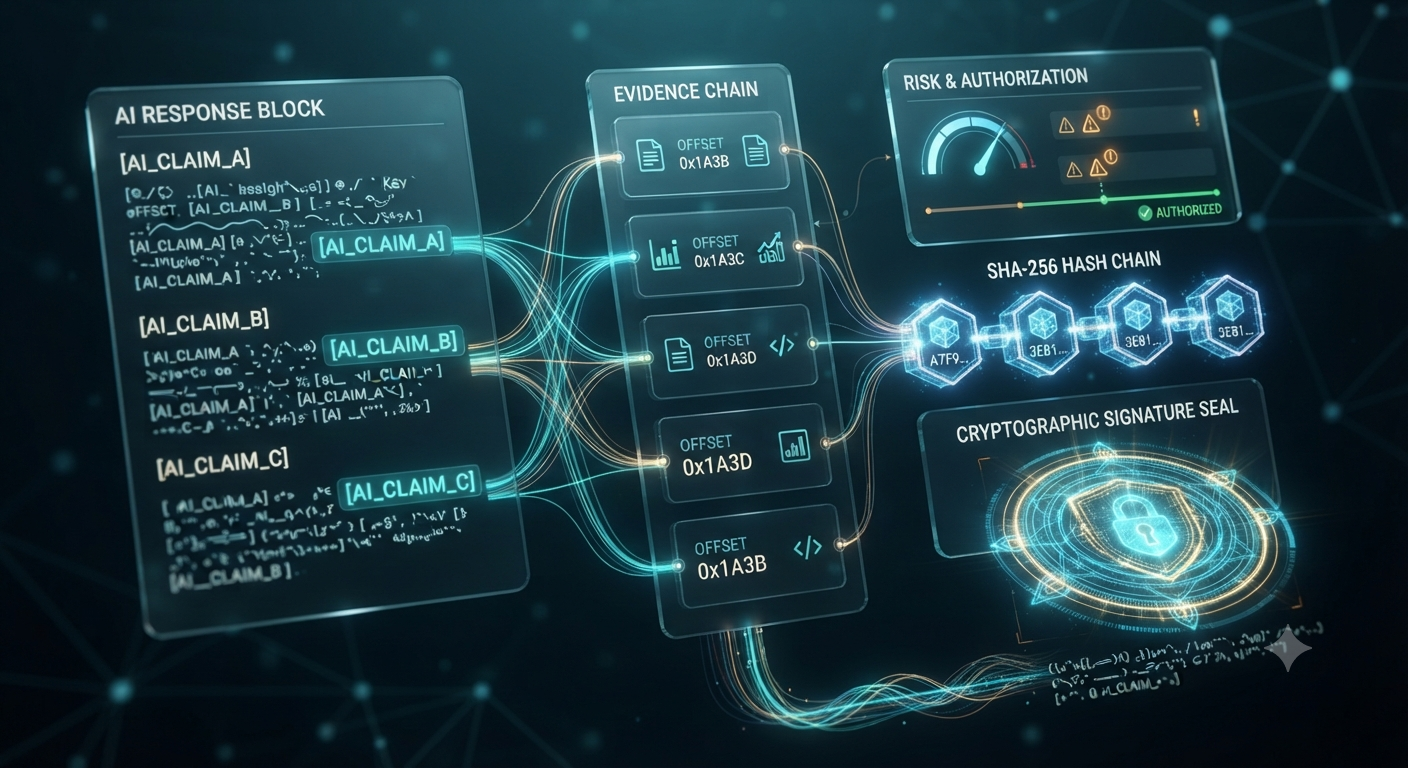
- The reader extracts candidate facts from the submitted content.
- A reviewer validates each claim against the original source.
- SharedOS checks every tool call against the exact permission grants.
- Unauthorized actions are denied.
- The coordinator returns a structured report and signed receipt. The browser agent network and the TrustSieve backend are separate layers. The browser network demonstrates portable agent execution, while the backend provides the security and evidence boundary.
How we built it The system uses:
- TypeScript
- Node.js
- SharedOS
- SharedNet
- MCP
- HTML, CSS, and JavaScript
- JSON and HOCON network definitions
- Zod schemas
- Vitest
- SHA-256 hashing
- Ed25519 signatures
- GitHub
- Render
- Codex Each TrustSieve request runs under the trustsieve-containment-v1 permission environment.
The backend uses three isolated roles:
- A reader that extracts candidate facts
- A reviewer that receives only validated evidence
- A coordinator that returns the final report A deterministic evidence gate prevents unsupported claims from entering the final result.
Challenges The hardest problem was preserving useful facts without trusting instructions hidden in the same document.
We also had to:
- Design precise per-agent grants
- Prevent secrets from leaking through outputs or errors
- Block unauthorized file and messaging attempts
- Create tamper-evident receipts
- Support SharedNet room-message behavior safely
- Keep the workflow within the Arena time limit
- Handle different identifiers for calling, tagging, and payment
- Make the browser network portable and inspectable The result is a system where security does not depend only on asking a model to “ignore malicious instructions.” The authorization layer enforces the boundary independently.
Accomplishments TrustSieve currently passes:
- 66 automated tests
- 50-document evaluation suite
- 40/40 hostile fixtures contained
- 10/10 benign fixtures preserving useful facts
- 50/50 schema-valid deliveries
- 0 unauthorized secret or messaging probe successes The official Agentic Web network builder also passes validation.
The live product has been deployed publicly and includes a synthetic test lab that lets evaluators reproduce benign, indirect-injection, and unauthorized-action cases directly in the browser.
What we learned We learned that model safety and authorization are different problems.
A prompt can request safe behavior, but it cannot guarantee that the model will never misuse a tool. Reliable protection requires an authorization layer outside the model, with explicit grants and fail-closed execution.
We also learned that agents need results they can verify. Evidence offsets, hashes, audit traces, predictable schemas, signatures, transparent prices, and clear failure states make an AI result much easier to trust. Future plans Next, we plan to support:
- PDFs
- Webpages
- Agent messages
- Structured datasets
- SSRF-safe webpage fetching
- Model-backed extraction under the same restricted grants
- Persistent audit exploration
- Reputation signals based on verified receipts
- Consent-based links to other agentic websites Our long-term goal is to make TrustSieve a standard safety boundary that agents use before trusting content from the web or from another agent.
How TrustSieve Shield follows the Open Agentic Web specification TrustSieve Shield publishes a public agent-manifest.json, resolved network JSON, peer-link metadata, discovery files, and a browser runtime. The network is declarative and runs in the visitor’s browser using standard HTML, CSS, JavaScript, JSON, CORS, and MCP-compatible interfaces.
The published network contains a front agent, trustsieve_assistant, and a bounded evidence_reviewer with declared tools and schemas. Users control the selected LLM provider and credentials through the browser. TrustSieve site actions are explicitly registered, restricted to approved capabilities, and fail closed when a request exceeds its grants.
Private context is deny-by-default, and the site does not expose arbitrary files, secrets, or messaging capabilities to the agents. The current release uses same-origin TrustSieve actions; third-party agent linking remains closed until a user-approved peer is added.
This maps directly to the specification’s requirements for portable network definitions, browser execution, user-controlled inference, public discovery artifacts, CORS publication, and explicit trust boundaries.Open Agentic Web MVP specification
Built With
- css
- github
- javascript
- json
- mcp
- node.js
- render
- sha-256
- typescript
- vitest
- zod
