-
TrustRoute AI Thumbnail
-
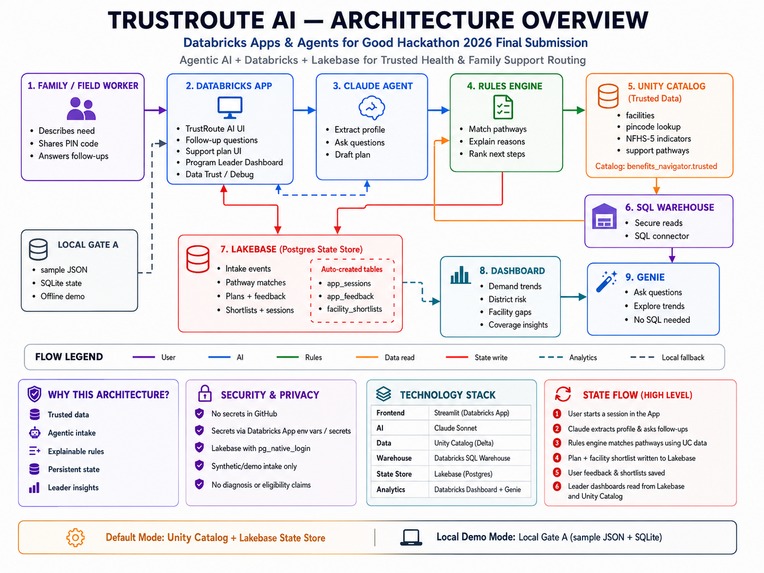
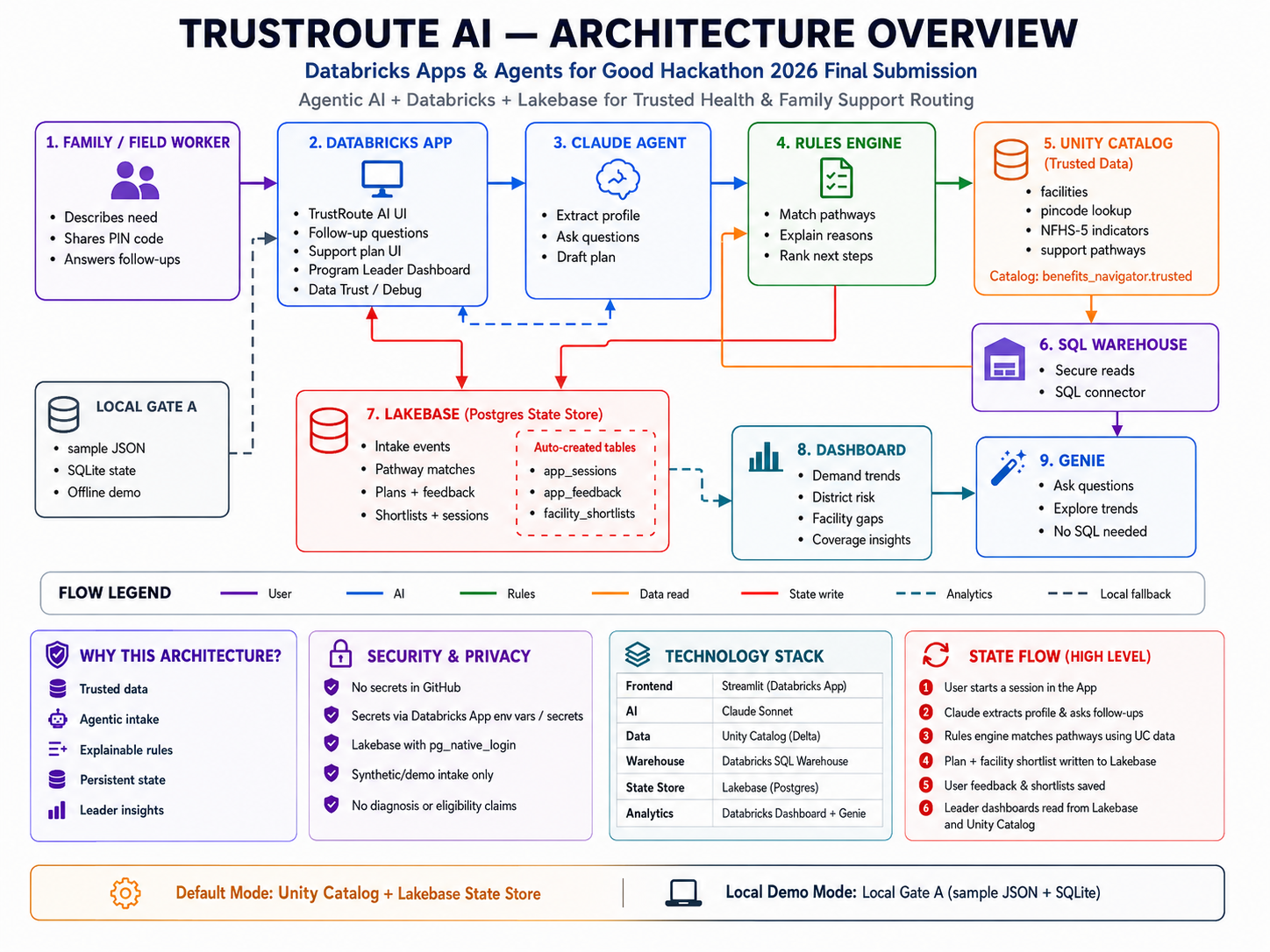
Architecture Overview Diagram
-
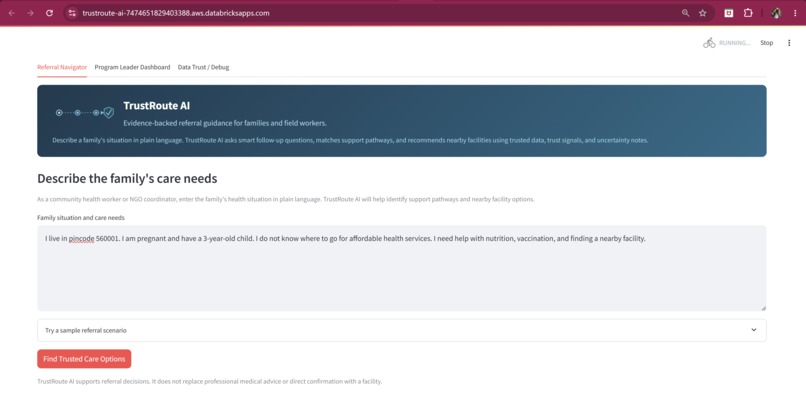
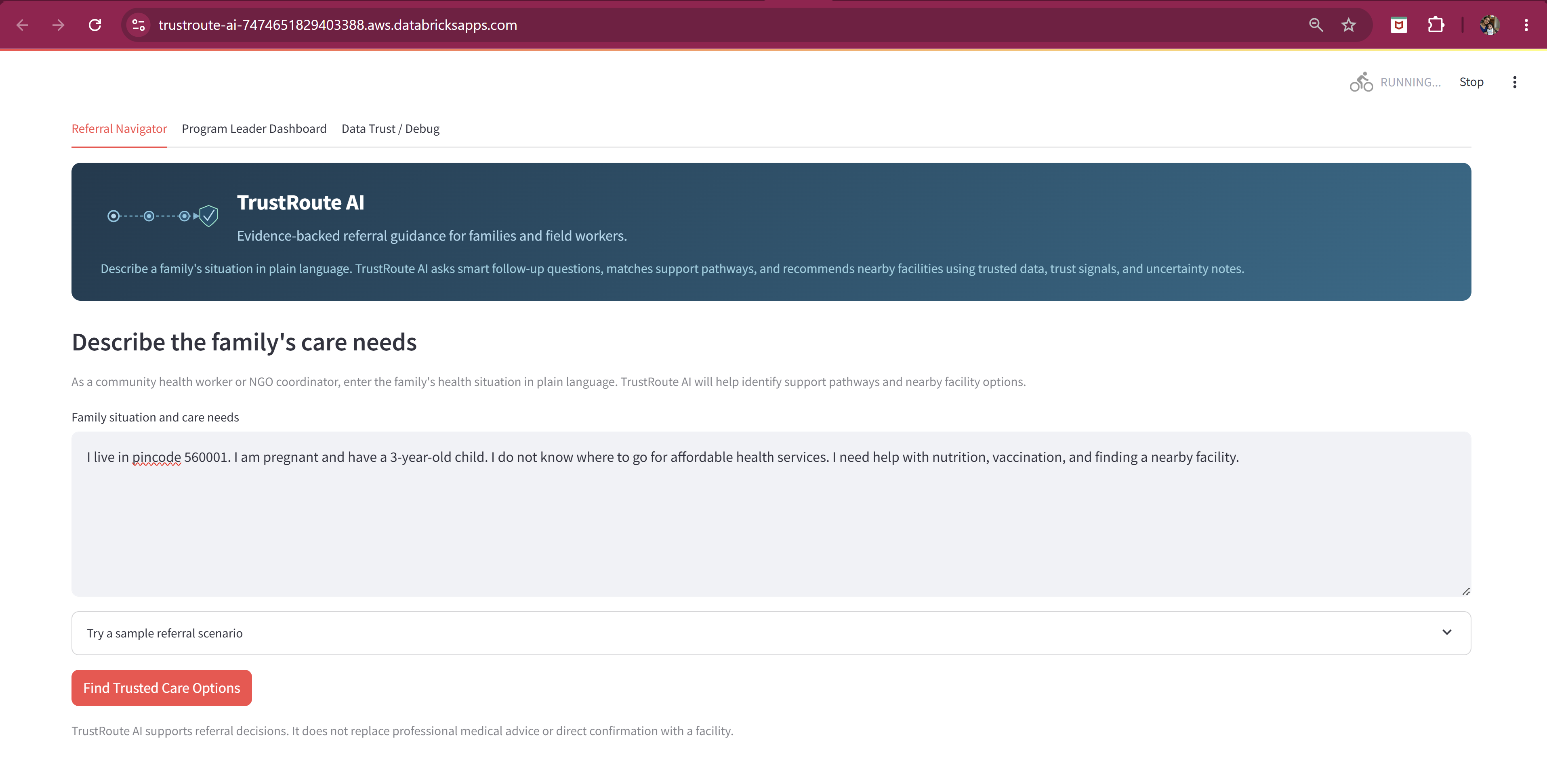
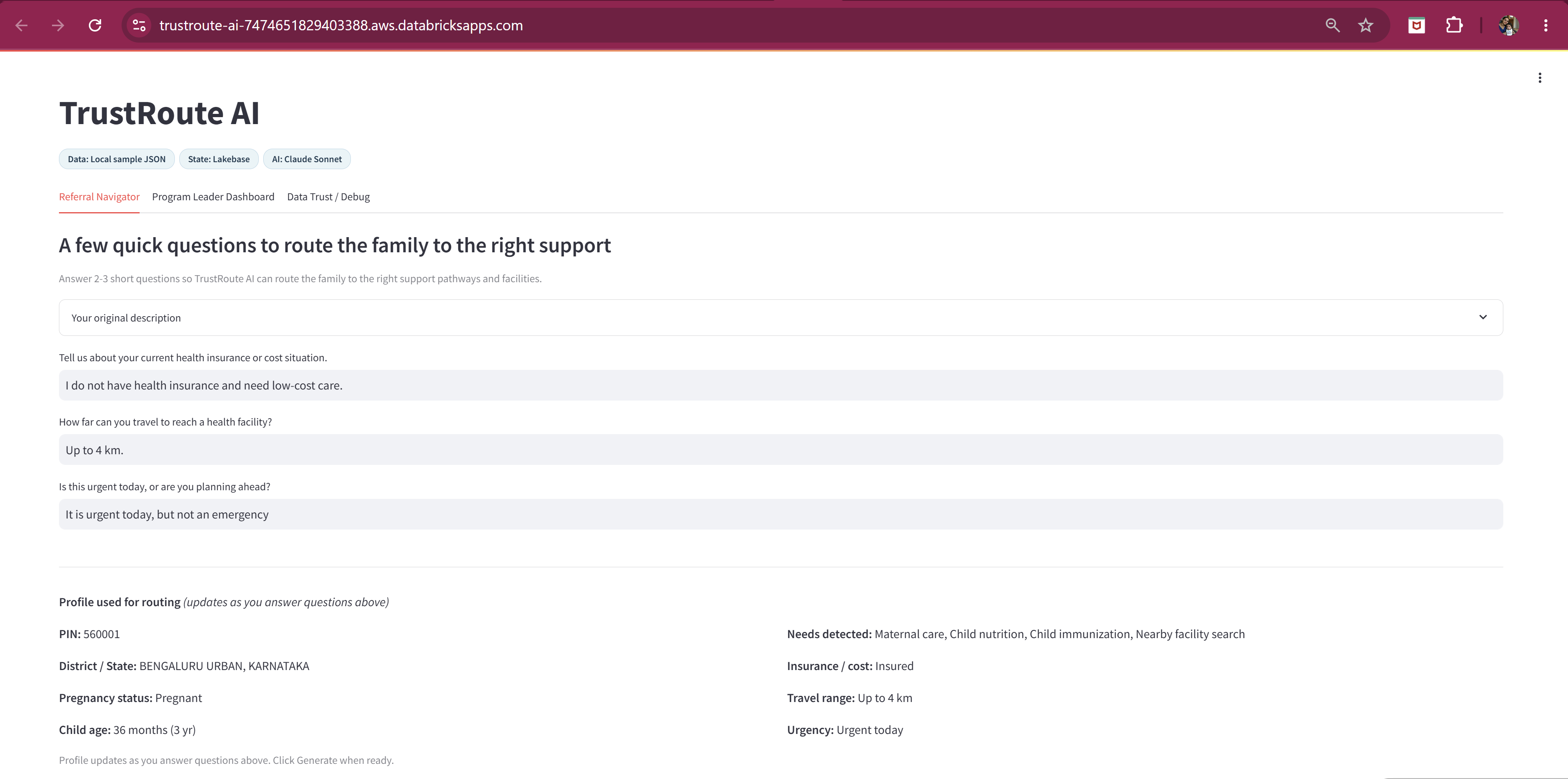
Referral Navigator Main Screen
-
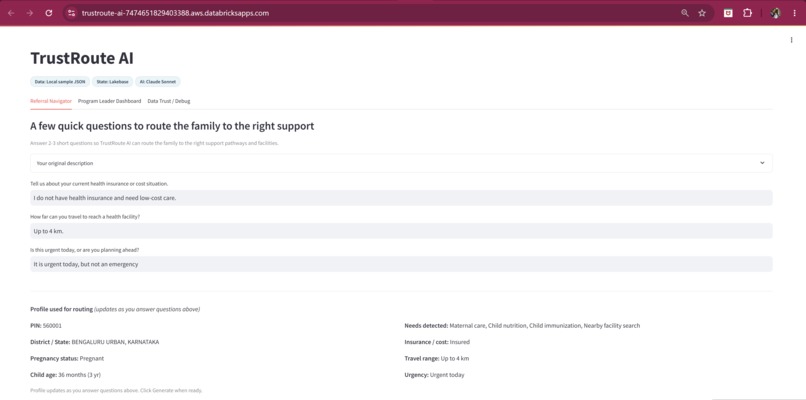
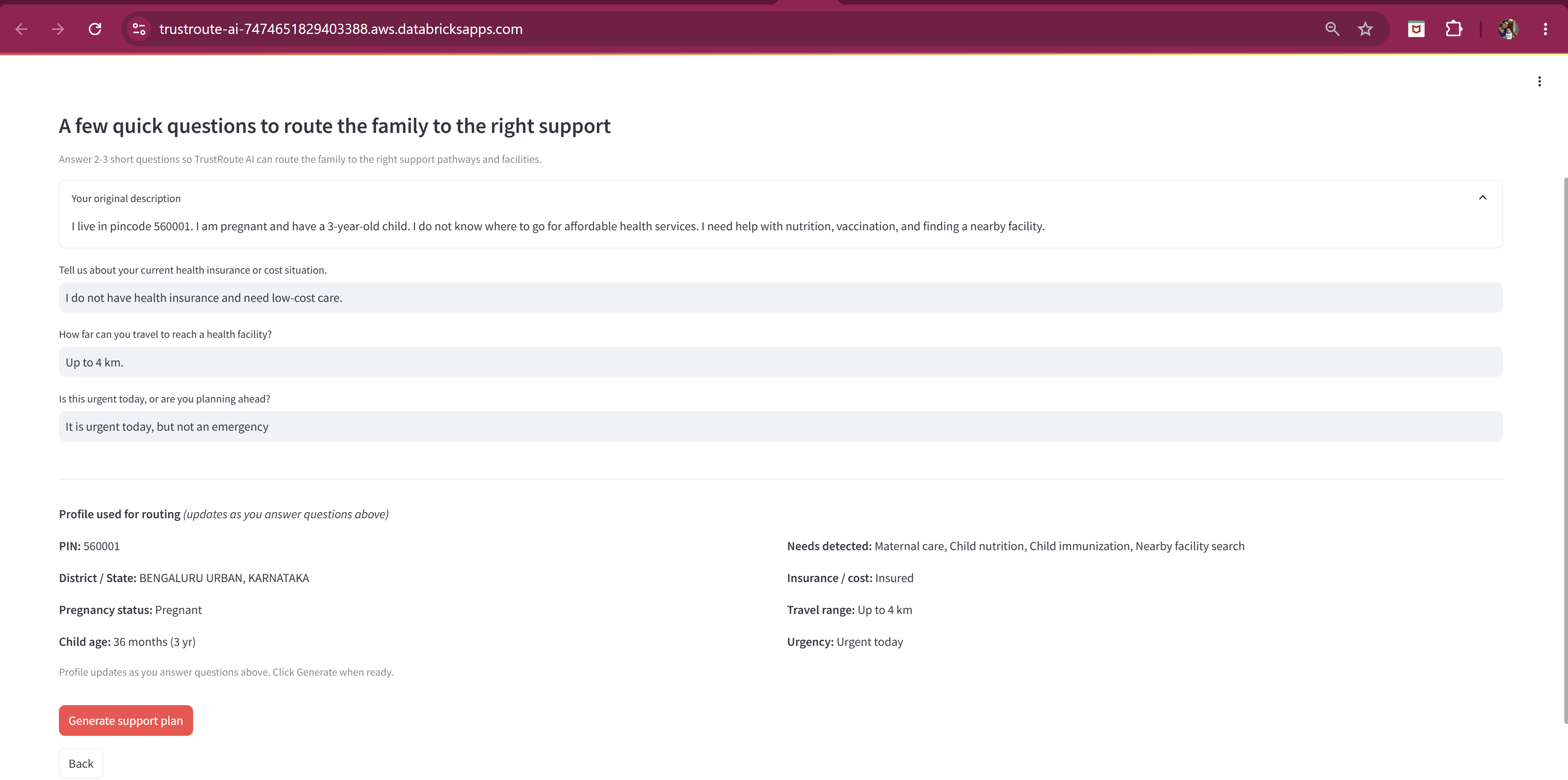
Referral Navigator Screen1
-
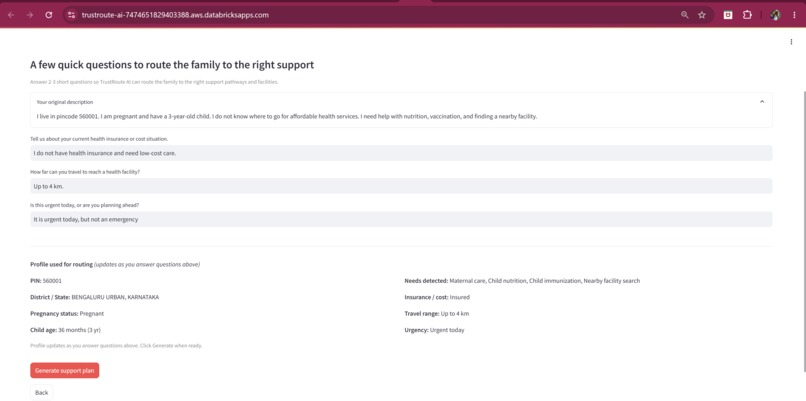
Referral Navigator Screen2
-
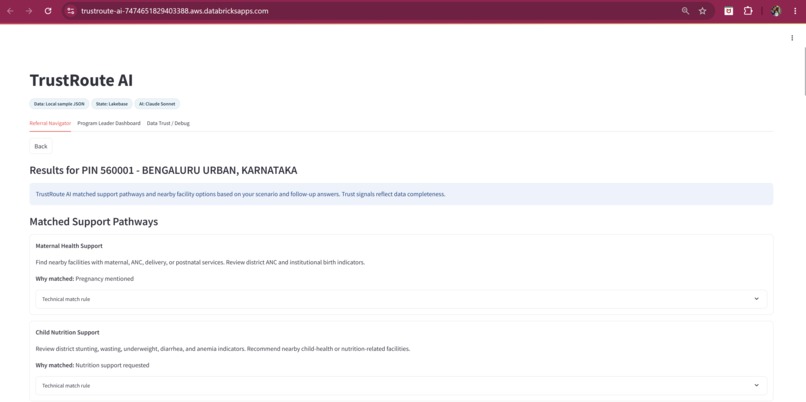
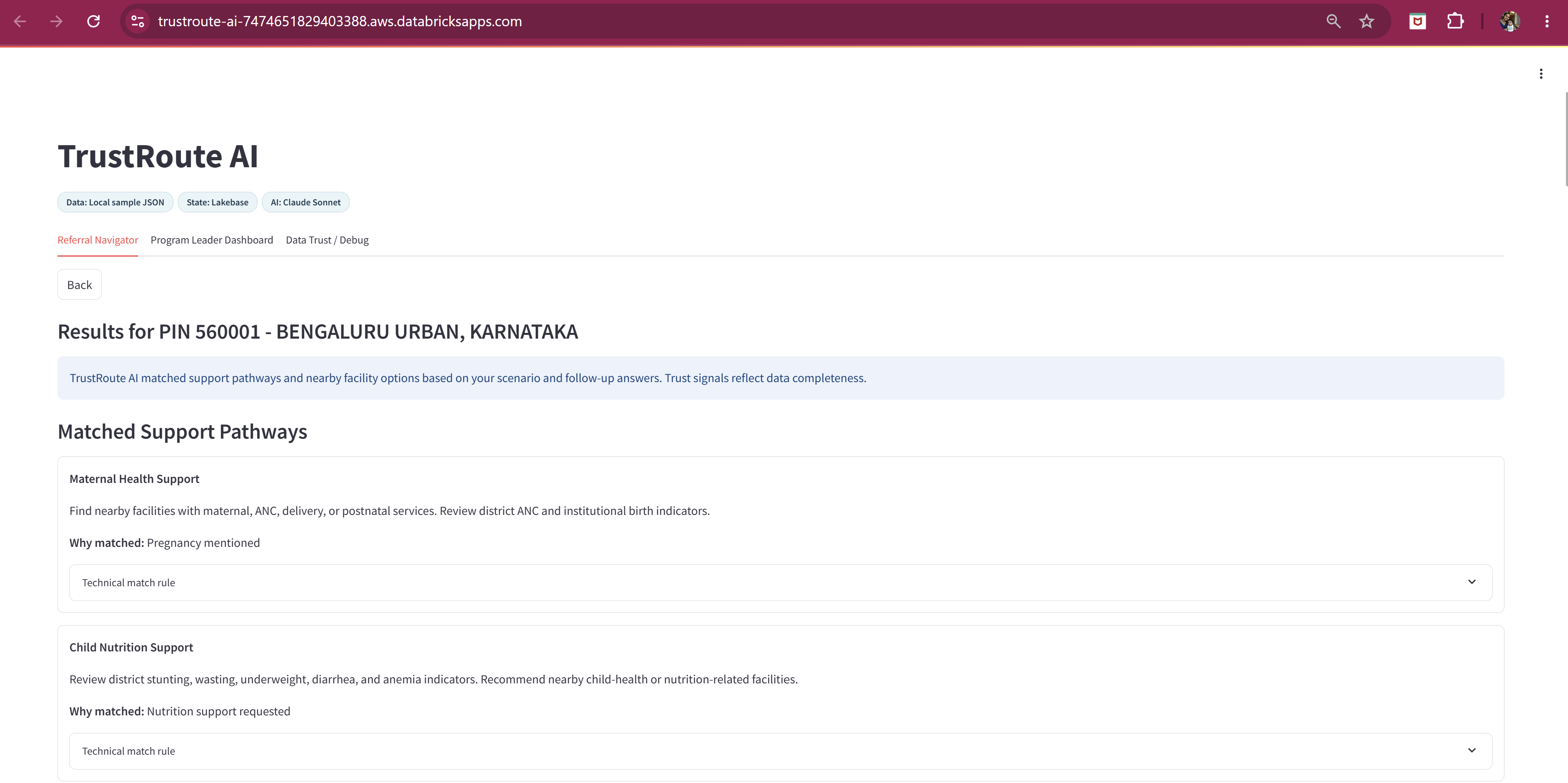
Referral Navigator Matched Supported Pathway 1
-
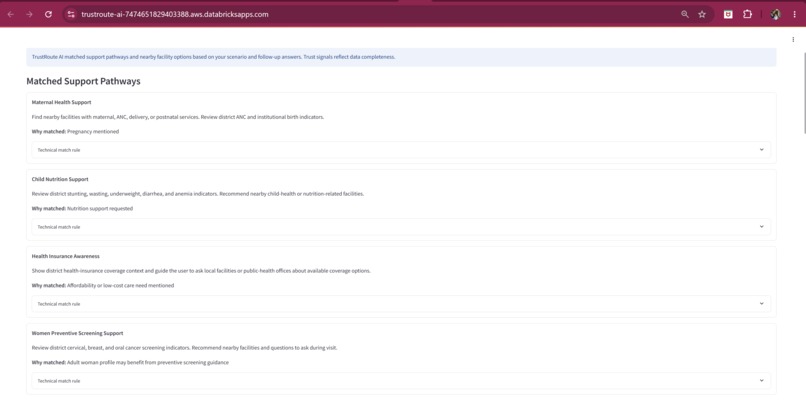
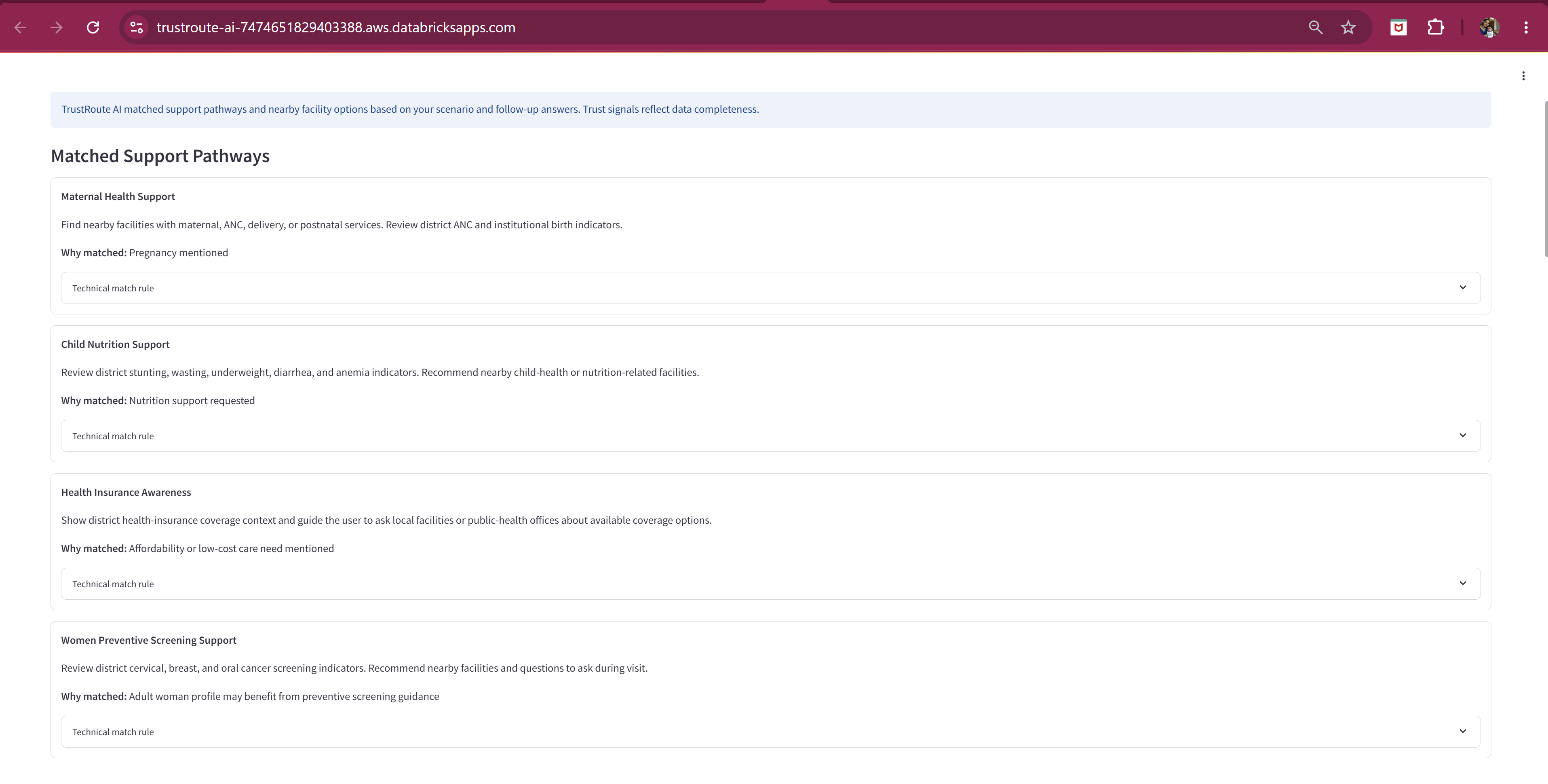
Referral Navigator Matched Supported Pathway 2
-
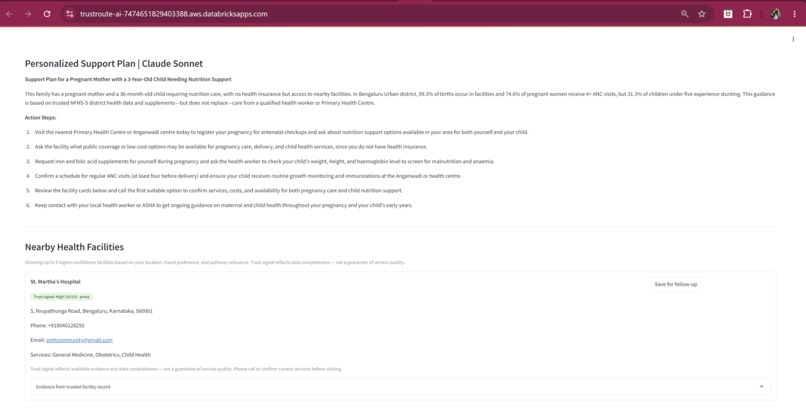
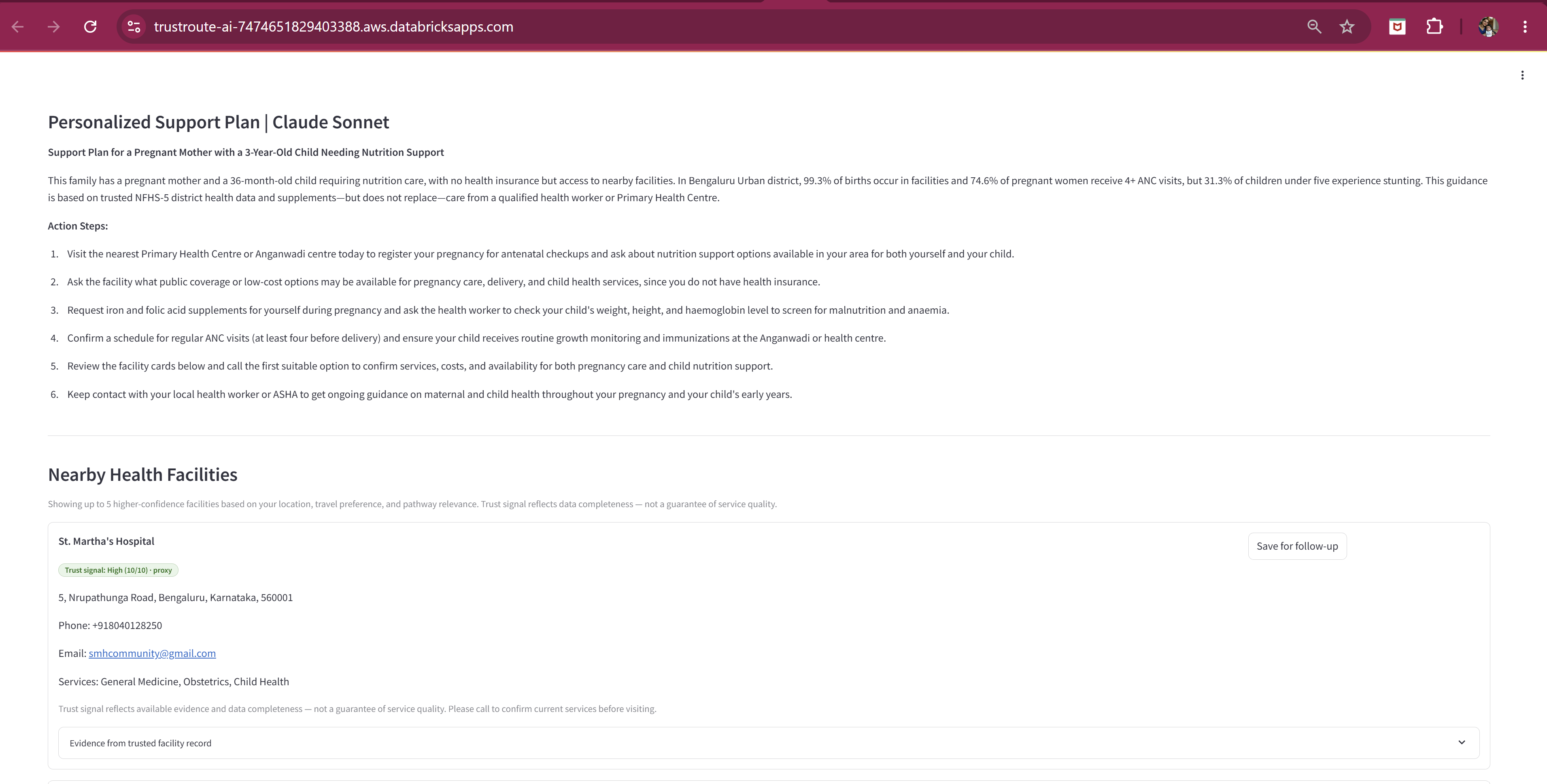
Referral Navigator personalized Support Plan
-
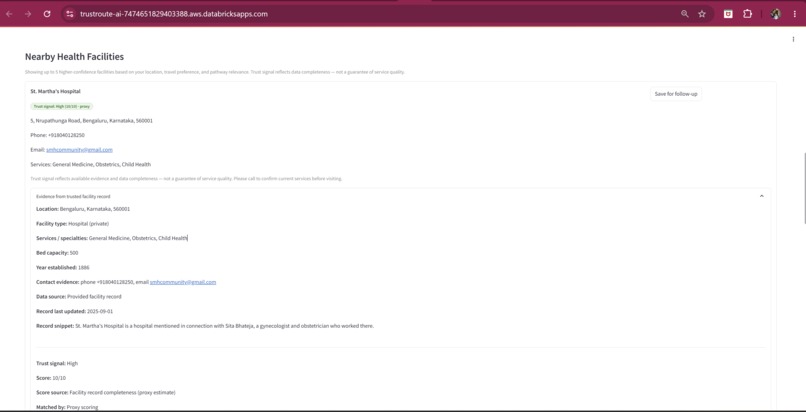
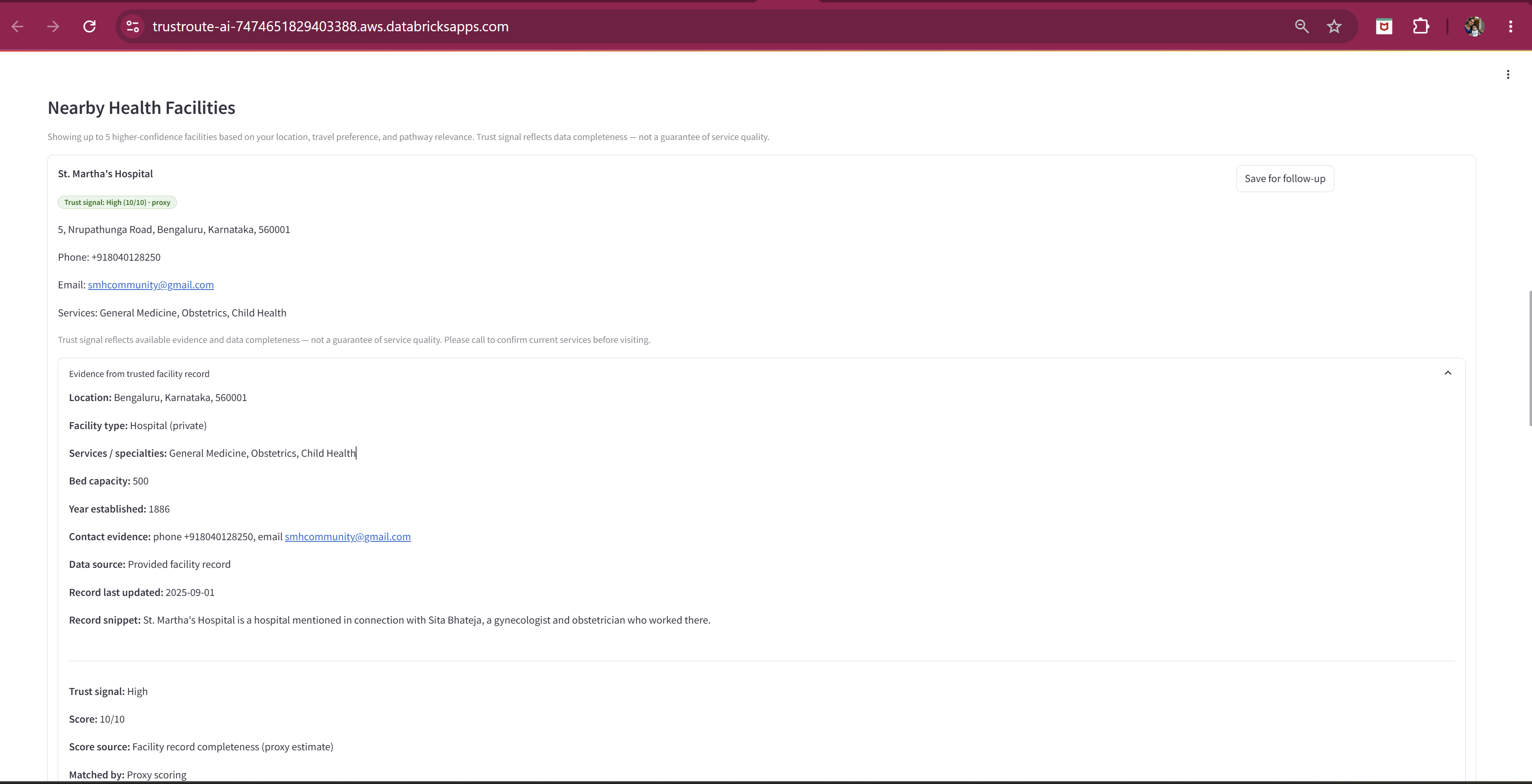
Referral Navigator Near By Health Facilities 1
-
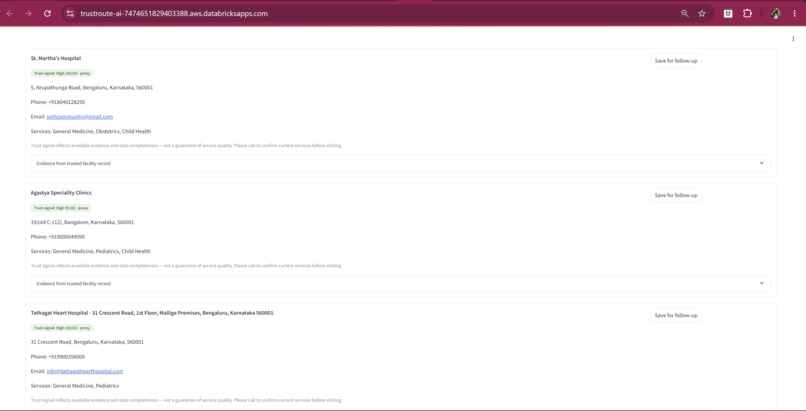
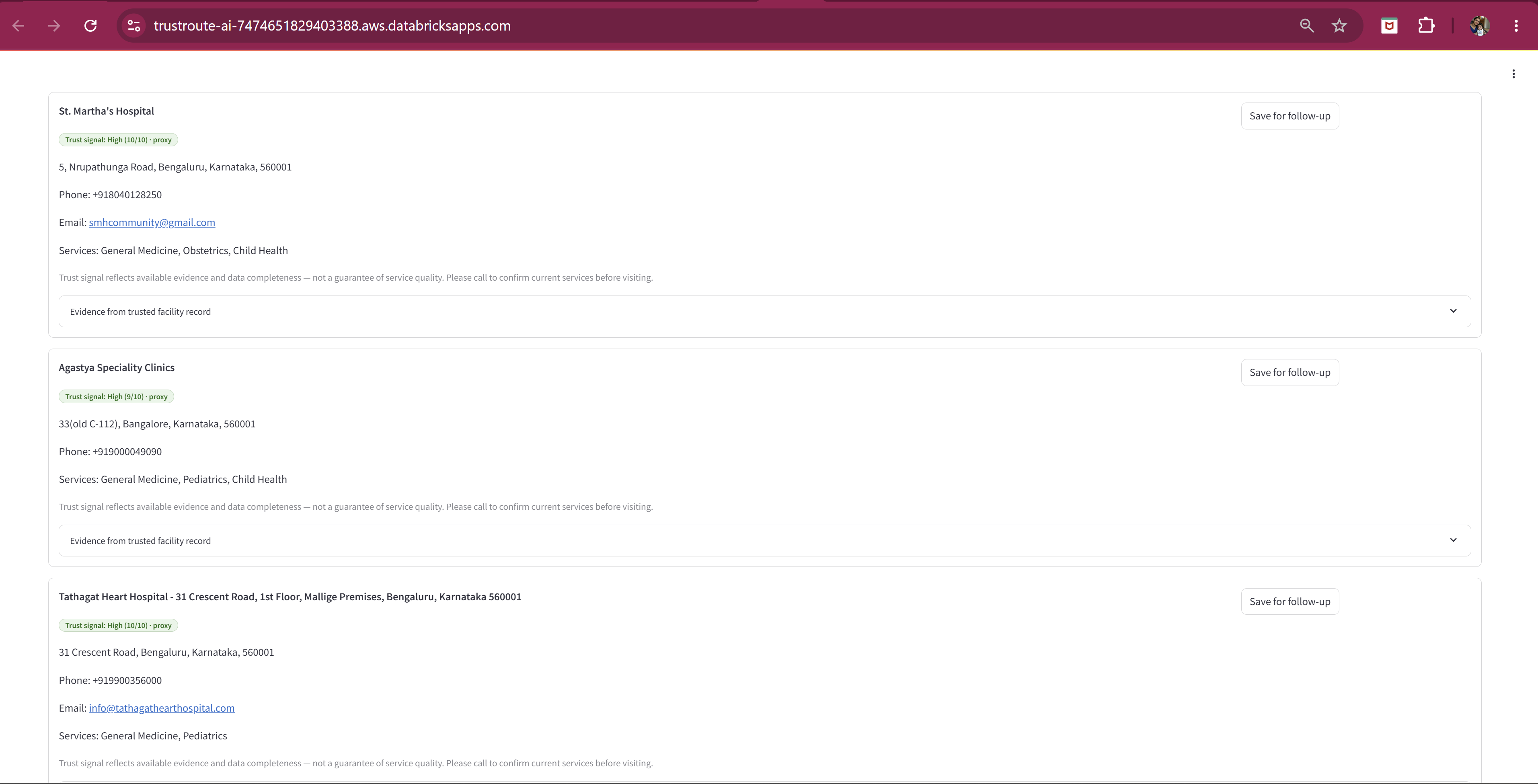
Referral Navigator Near By Health Facilities 2
-
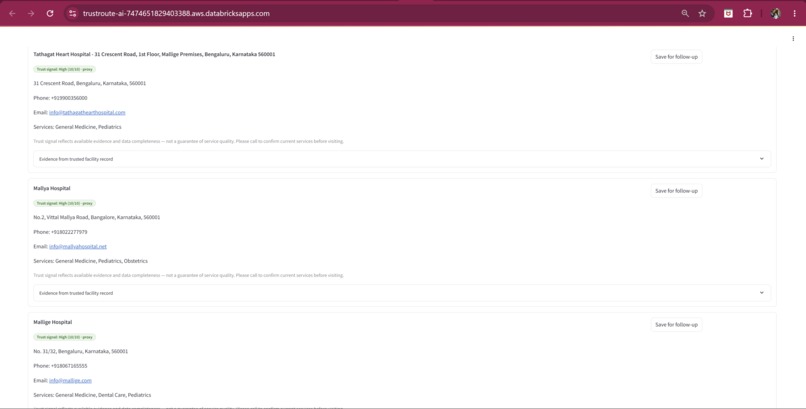
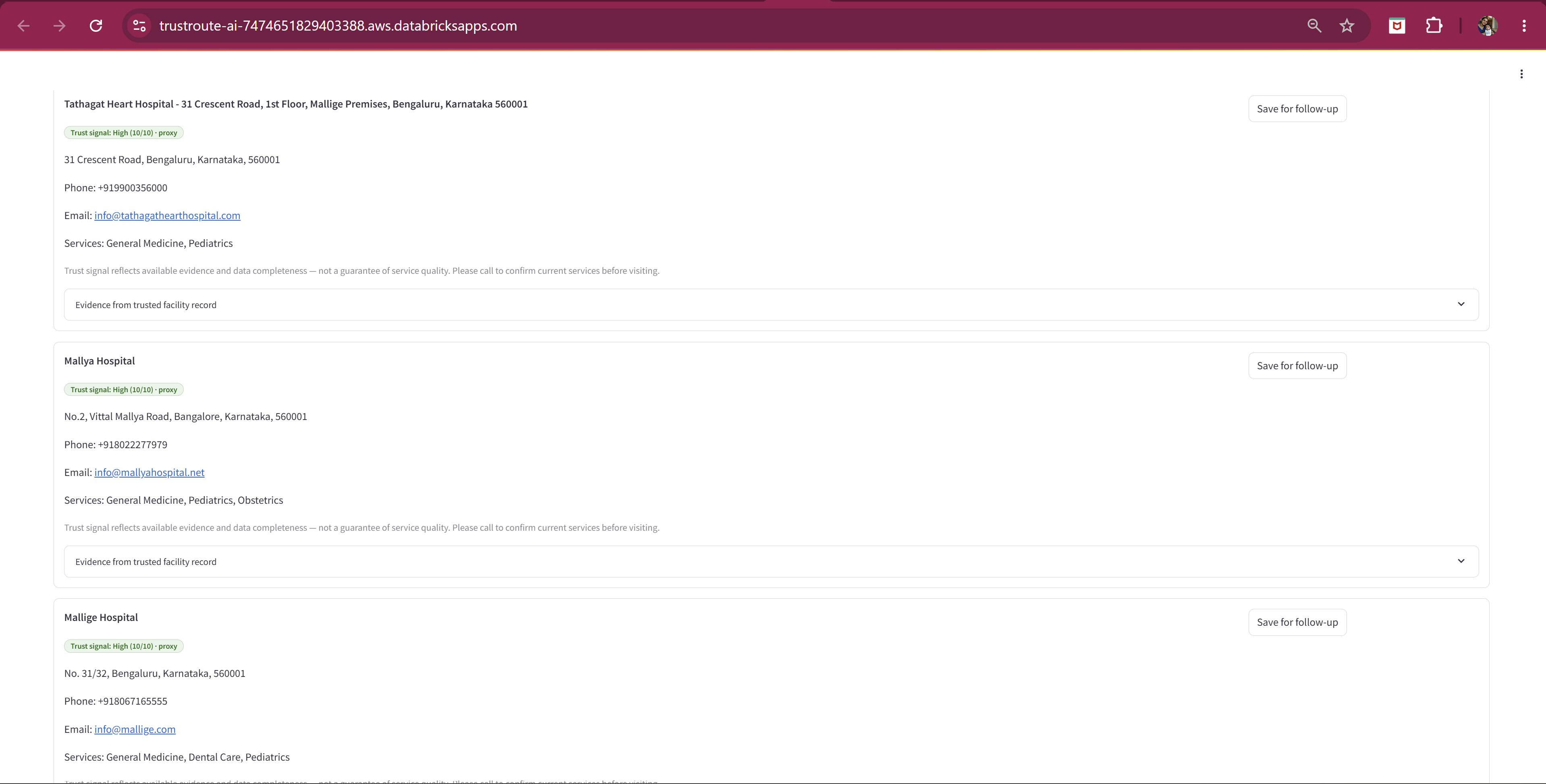
Referral Navigator Near By Health Facilities 3
-
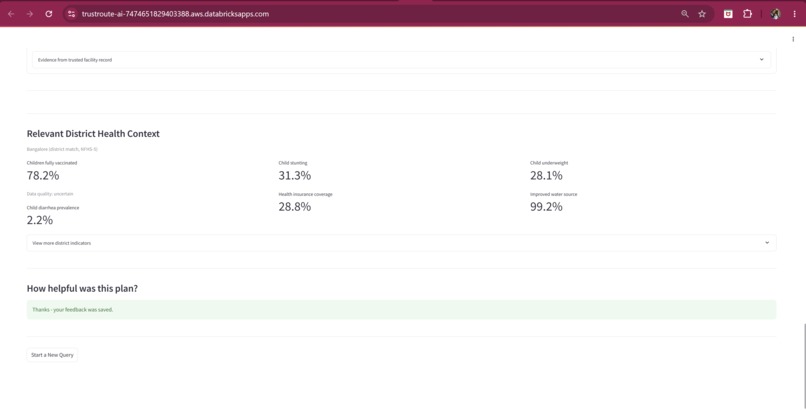
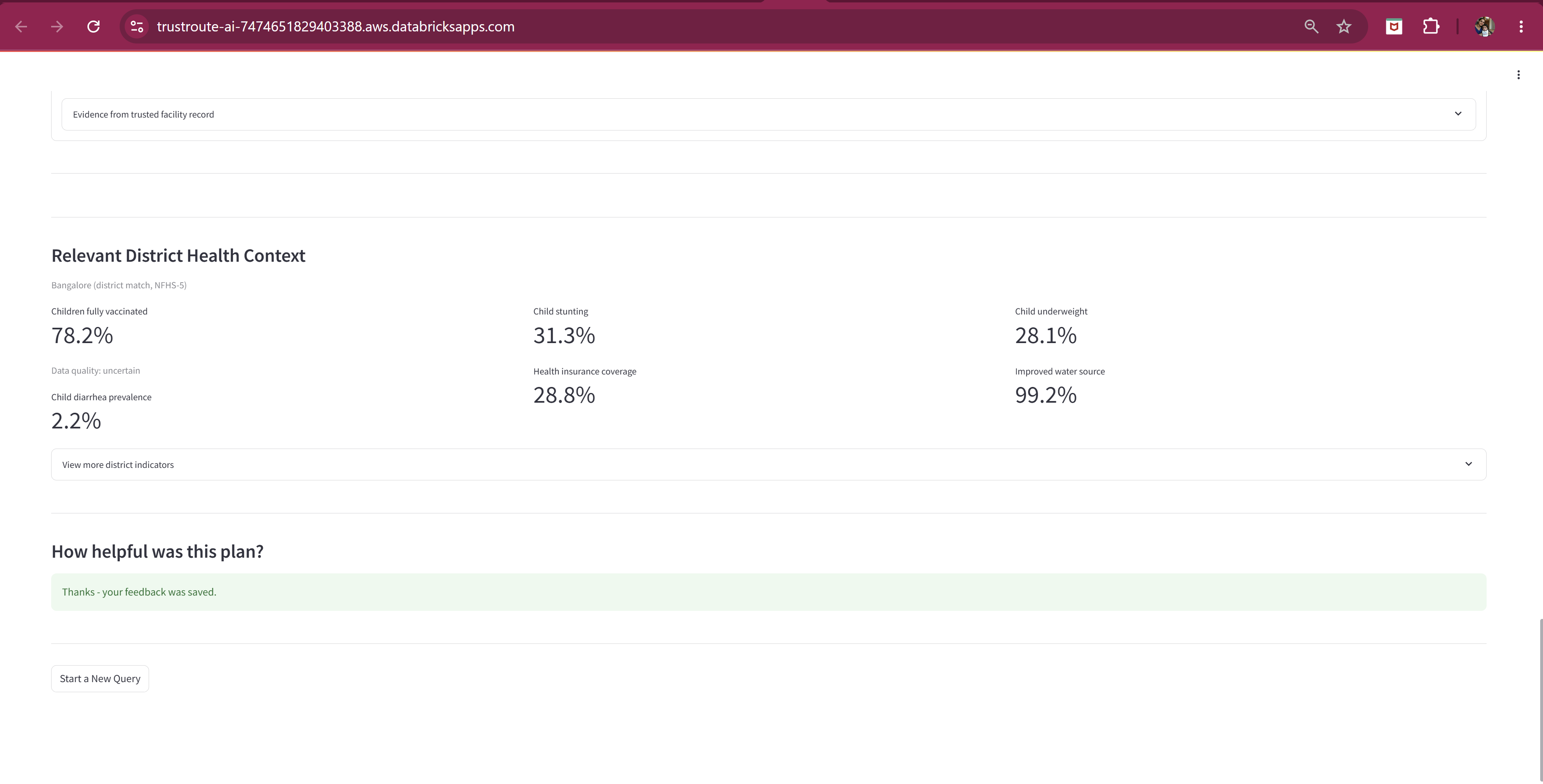
Referral Navigator Relevant District Health Context
-
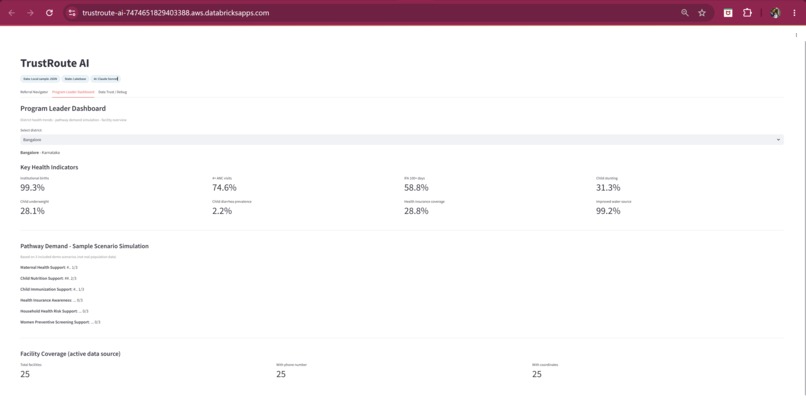
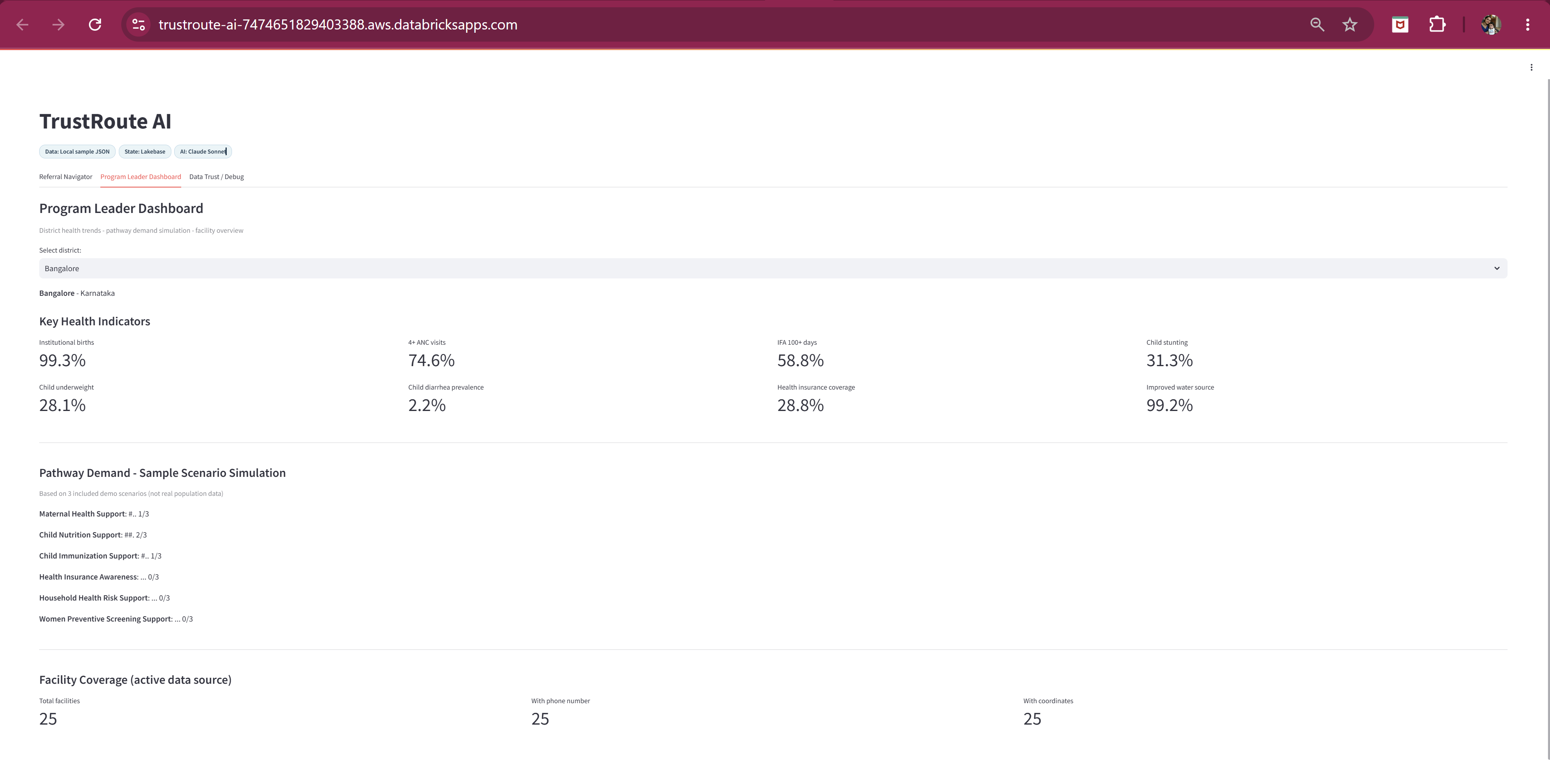
Program Leadership Dashboard
-
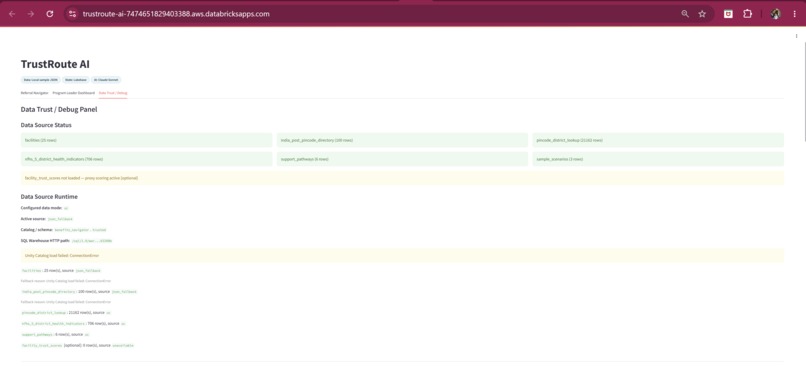
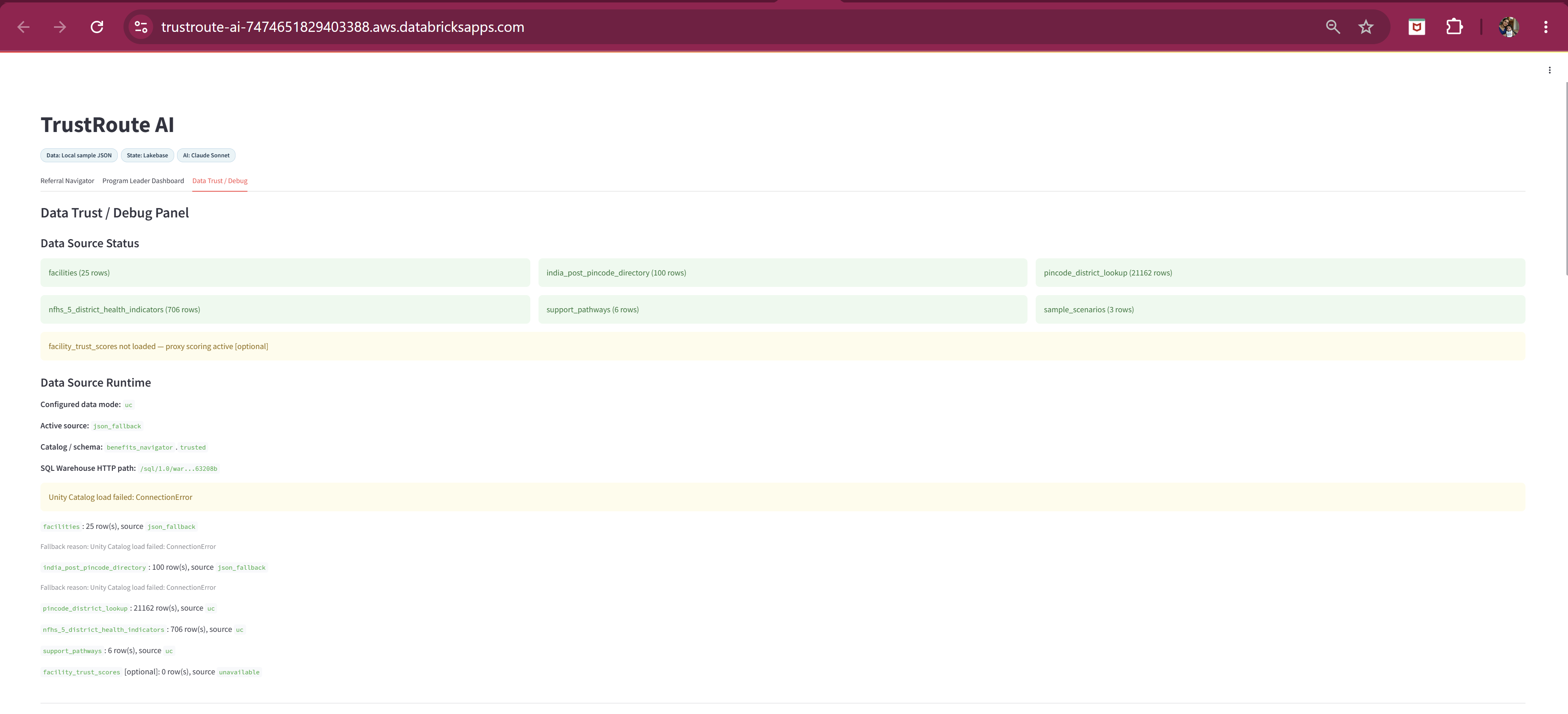
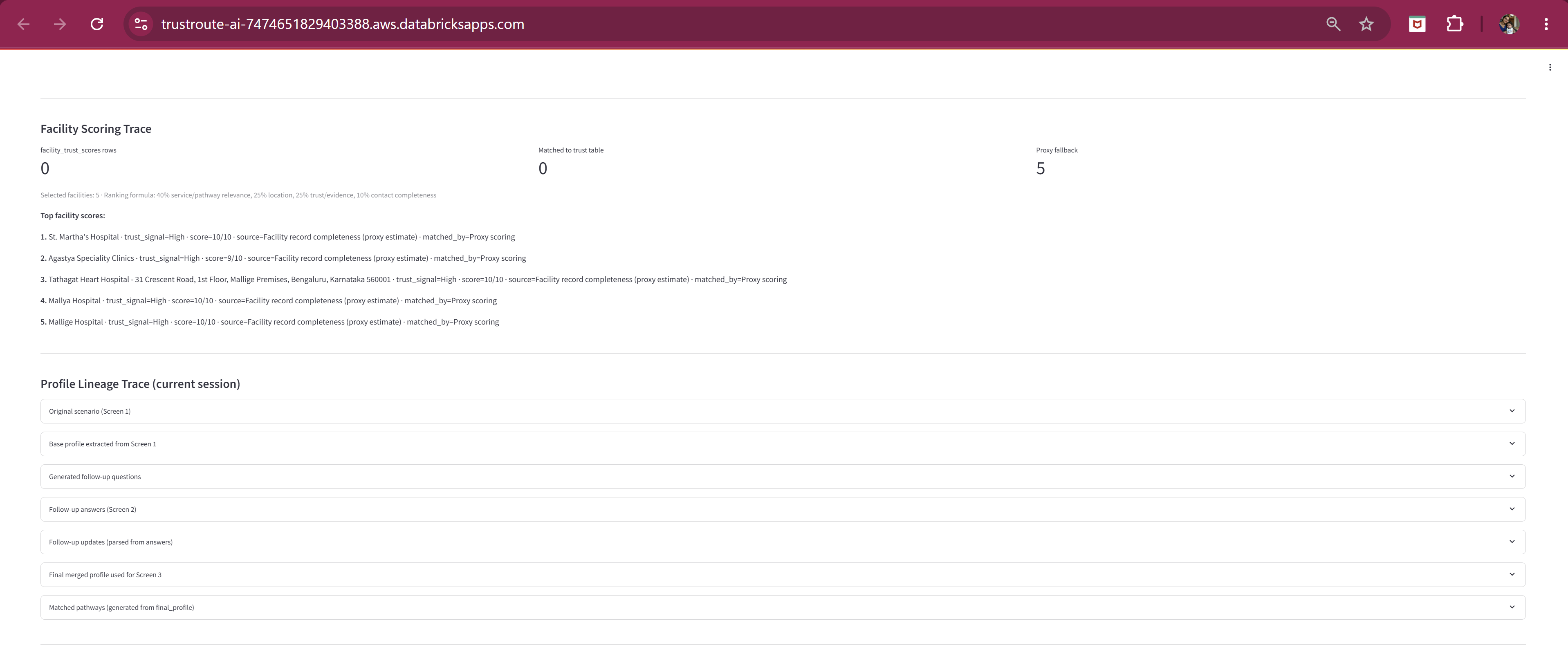
Data Trust/Debug Screen 1
-
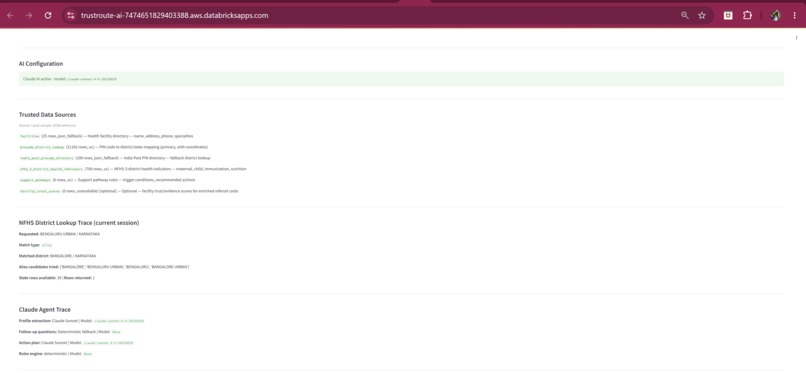
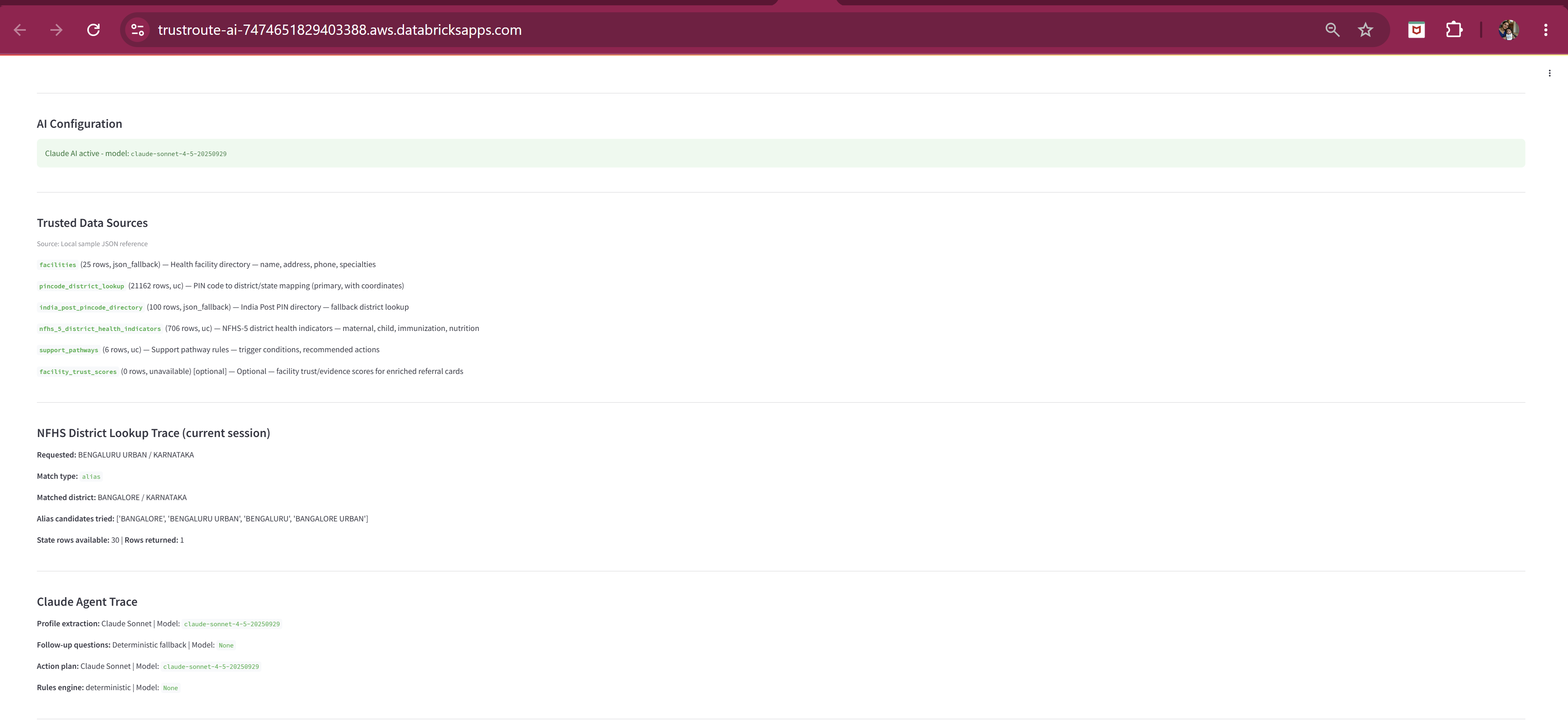
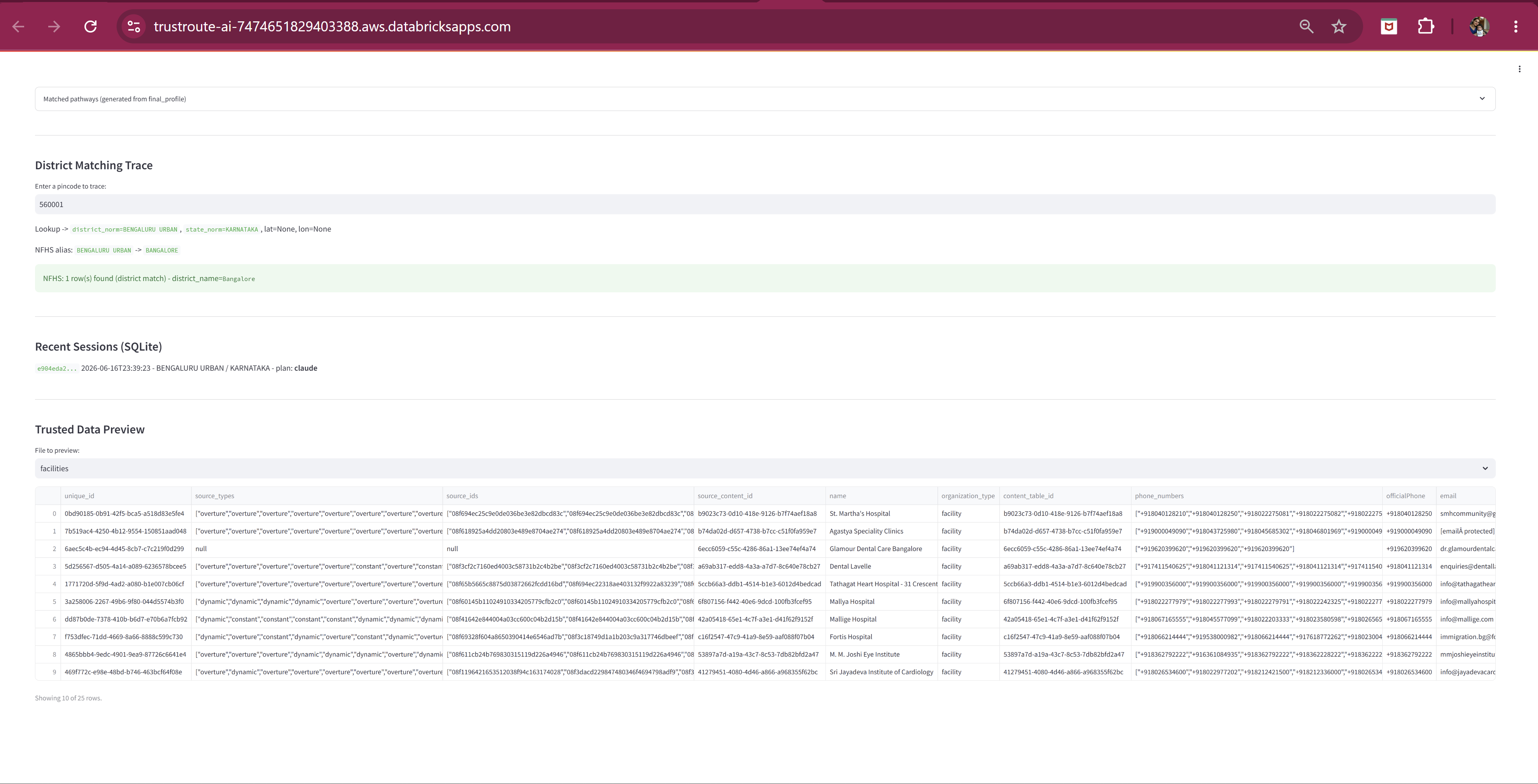
Data Trust/Debug Screen 2
-
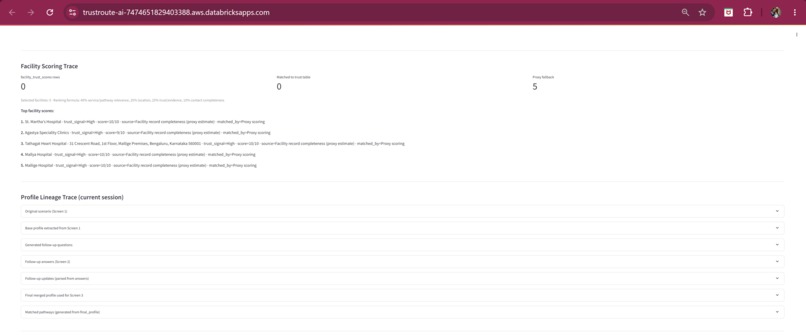
Data Trust/Debug Screen 3
-
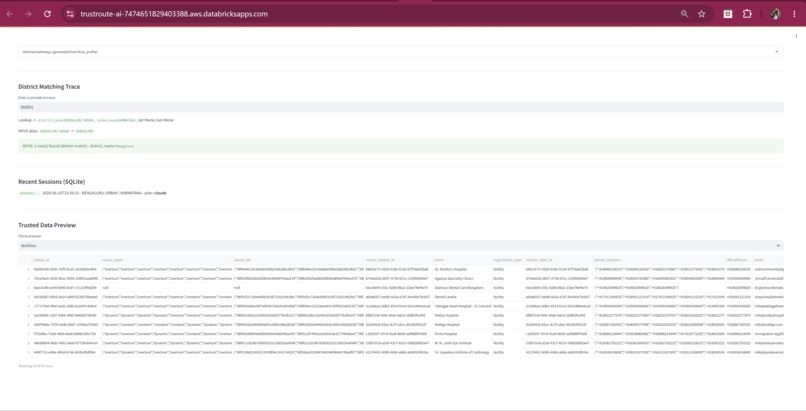
Data Trust/Debug Screen 4
Inspiration
Families often know what they need, but they may not know where to go or what information to trust. A pregnant mother with a young child may need nutrition support, vaccination guidance, affordable care, and a nearby facility — but the path from “I need help” to “here are the next steps” is often confusing.
Field workers and NGO coordinators face the same challenge at scale. They need to quickly understand a family’s situation, ask the right follow-up questions, find relevant support pathways, and recommend facilities while being honest about uncertainty in the data.
TrustRoute AI was inspired by that gap. The goal is to help field workers move families from uncertainty to trusted care using grounded data, clear reasoning, and persistent follow-up.
What it does
TrustRoute AI is an evidence-backed referral navigator for families and field workers.
A user can enter a plain-language scenario such as:
“I live in pincode 560001. I am pregnant and have a 3-year-old child. I need help with nutrition, vaccination, and finding a nearby facility.”
The app then:
- Extracts a structured family profile using Claude Sonnet.
- Asks smart follow-up questions about cost, travel distance, and urgency.
- Resolves the PIN code to district and state.
- Looks up trusted NFHS-5 district health indicators.
- Matches relevant support pathways using deterministic rules.
- Recommends nearby facilities using trusted facility records.
- Shows facility trust signals, score source, evidence details, and uncertainty notes.
- Generates a practical support plan.
- Lets the field worker save facilities for follow-up.
- Persists sessions, feedback, and shortlists in Lakebase.
- Gives program leaders a dashboard for demand trends, district context, and facility coverage.
The app does not claim diagnosis, guaranteed eligibility, or guaranteed facility quality. It gives practical referral guidance and tells users to confirm current services before visiting.
How we built it
TrustRoute AI is built as a Databricks-native application.
The user interface runs as a Databricks App using Streamlit. Trusted data lives in Unity Catalog and is queried through a Databricks SQL Warehouse. The app uses Claude Sonnet for natural-language understanding, profile extraction, follow-up questions, and support-plan generation.
The core matching logic is deterministic and explainable. A rules engine matches support pathways such as maternal health, child nutrition, child immunization, health insurance / low-cost care awareness, and preventive screening. Each pathway includes a human-readable reason and a technical trace for judges and reviewers.
Facility recommendations are enriched with trust signals. The app uses a Unity Catalog facility_trust_scores table when available and falls back to a proxy evidence score based on facility record completeness. Facility cards show the score, score source, contact evidence, service evidence, and an uncertainty note.
For persistence, the deployed app uses Lakebase as a Postgres-backed state store. Lakebase stores sessions, feedback, and saved facility shortlists. Local development also supports SQLite and JSON fallbacks for resilience.
The app includes a Program Leader Dashboard and a Data Trust / Debug Panel so judges can see not only the user workflow, but also the data source, state store, AI status, district matching, and facility scoring trace.
Challenges we ran into
The biggest challenge was making the app honest and reliable with imperfect real-world data.
Public health and facility datasets are messy. District names may differ across sources. Facility records may have missing coordinates, incomplete contact fields, noisy descriptions, or inconsistent service details. NFHS indicators may contain unavailable or suppressed values. A simple AI-only answer would be too risky because it could overstate confidence or invent unsupported guidance.
We solved this by combining AI with deterministic guardrails. Claude helps understand the family’s scenario and write the final support plan, while the rules engine controls pathway matching. Unity Catalog provides trusted data. Facility trust scoring communicates evidence strength. Data Trust / Debug makes the reasoning visible.
Another challenge was building a robust demo path. The app needed to run locally, against Unity Catalog, and finally as a deployed Databricks App with Lakebase. To support this, we implemented three gates: local JSON + SQLite, Unity Catalog + SQLite, and final Databricks App + Unity Catalog + Lakebase.
Accomplishments that we're proud of
We are proud that TrustRoute AI is more than a chatbot. It is a working data application with a clear workflow, trusted data, explainable rules, facility trust scoring, persistent state, and program-level analytics.
Key accomplishments include:
- Built a deployed Databricks App with a non-technical field-worker workflow.
- Integrated Unity Catalog trusted tables for facilities, PIN codes, NFHS-5 indicators, support pathways, and facility trust scores.
- Added Claude Sonnet for profile extraction, follow-up questions, and grounded support-plan generation.
- Built deterministic support-pathway matching to avoid unsupported eligibility claims.
- Added facility trust signals with score source and uncertainty notes.
- Persisted sessions, feedback, and facility shortlists in Lakebase.
- Created a Program Leader Dashboard for demand and coverage visibility.
- Created a Data Trust / Debug Panel to make data source, AI behavior, and state persistence transparent.
- Added local fallback paths so the app remains demo-resilient.
Most importantly, the app keeps the family and field worker experience simple while still showing judges the technical depth behind the scenes.
What we learned
We learned that useful AI applications need more than a good model. They need trusted data, careful workflow design, deterministic guardrails, state persistence, and transparent uncertainty.
We also learned that uncertainty should not be hidden. In a referral workflow, saying “please call to confirm current services” is not a weakness — it is a safety feature. TrustRoute AI is designed to be helpful without overclaiming.
From a Databricks perspective, we learned how Databricks Apps, Unity Catalog, Databricks SQL Warehouse, and Lakebase can work together as an end-to-end application platform: governed data, interactive app experience, AI reasoning, operational state, and analytics in one architecture.
What's next for TrustRoute AI
Next, TrustRoute AI could expand in several directions:
- Add multilingual intake for field workers and families.
- Add richer facility verification workflows.
- Add case-worker notes and follow-up task tracking.
- Add stronger geospatial distance calculations where coordinates are reliable.
- Expand Program Leader Dashboard insights across districts and support categories.
- Add natural-language analytics for program leaders to ask questions about demand, facility gaps, and outreach priorities.
- Improve facility trust scoring with more verified evidence sources.
- Support more care scenarios beyond maternal health, child nutrition, immunization, and affordable-care navigation.
The long-term vision is to help field workers and community organizations route families to the right support faster, with better data, clearer reasoning, and more accountable follow-up.
Built With
- anthropic-api
- claude-sonnet
- databricks-apps
- databricks-sql-warehouse
- deterministic-rules-engine
- facility-trust-scoring
- lakebase
- nfhs-5-district-health-data
- python
- sqlite-fallback
- streamlit
- unity-catalog

Log in or sign up for Devpost to join the conversation.