-
-

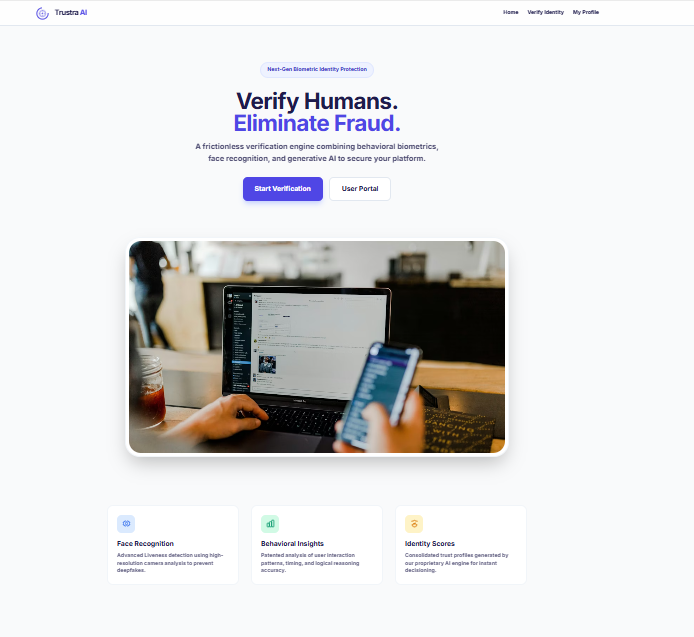
Home page
-
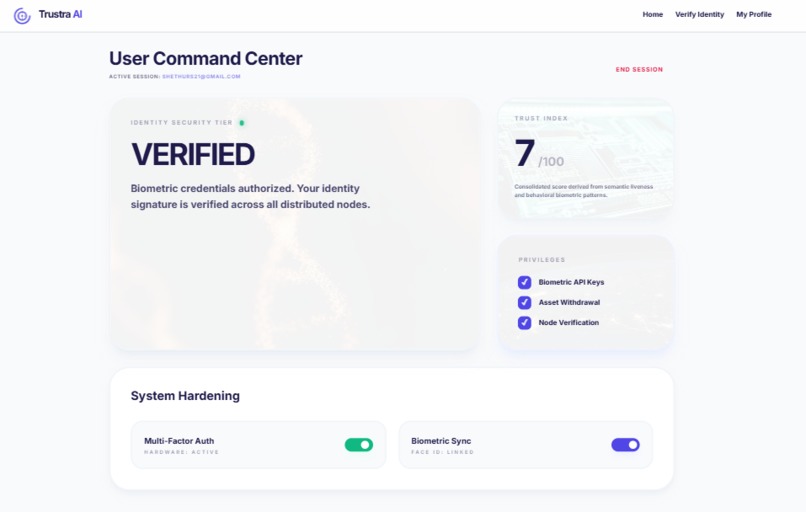
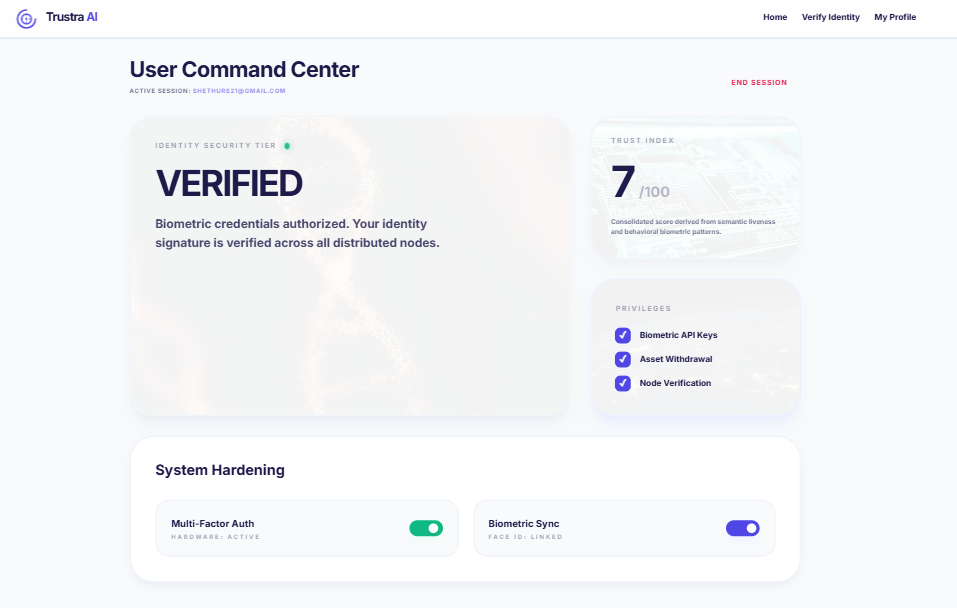
User dashboard
-
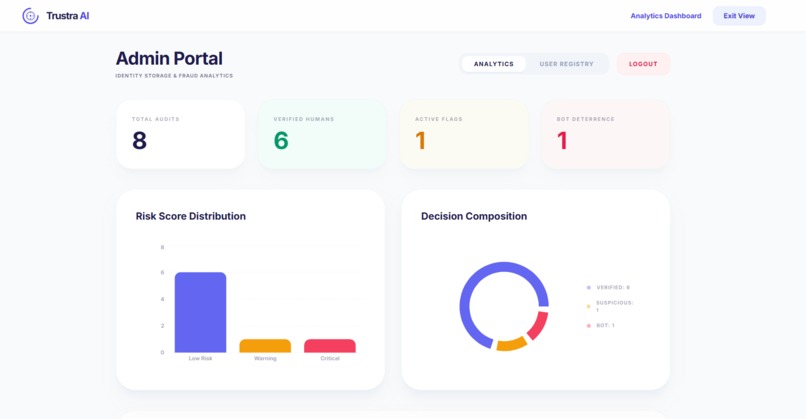
Admin portal
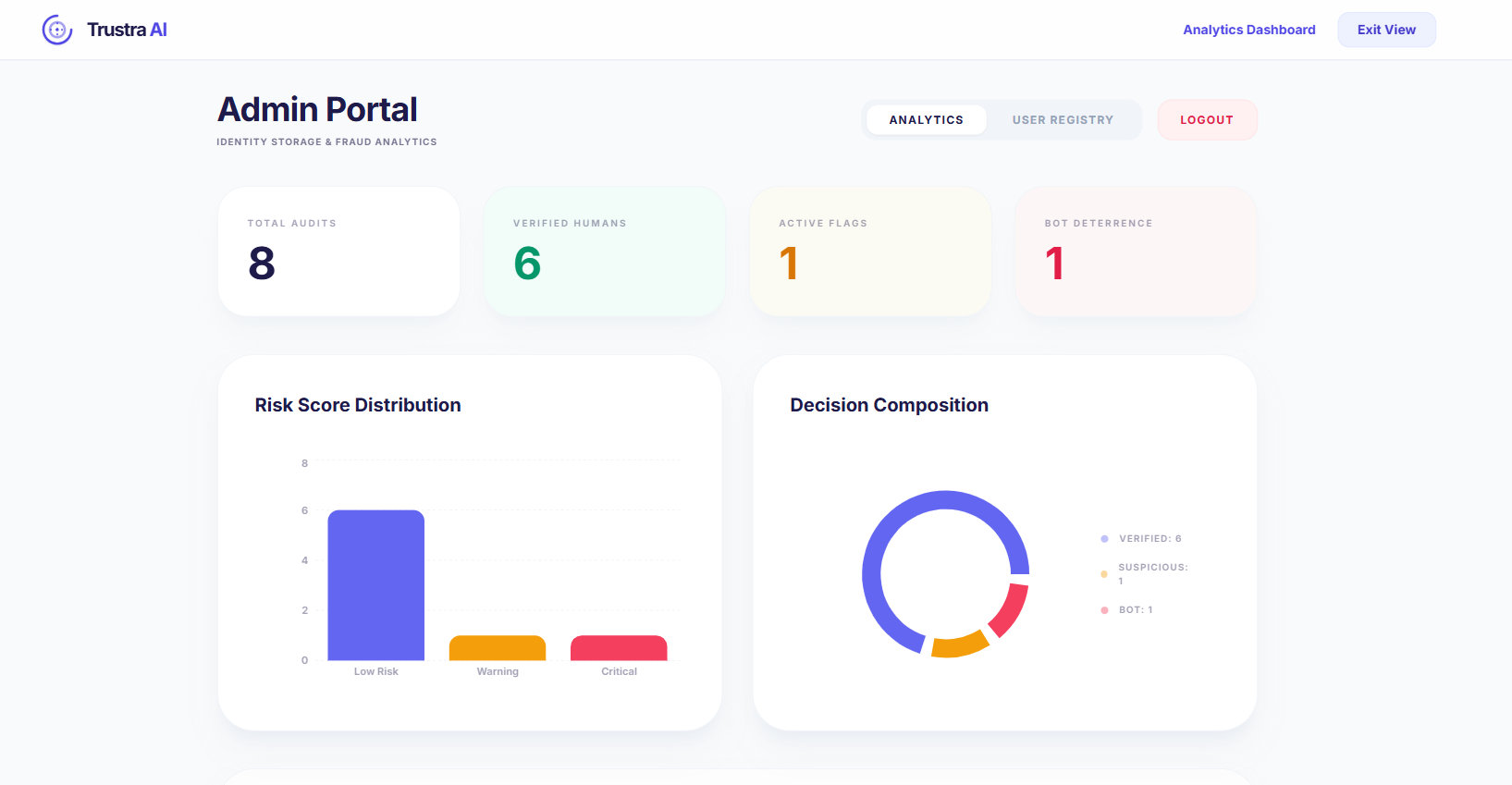
Trustra AI: Cognitive-Behavioral Identity Verification Platform Inspiration Traditional network perimeters and fraud prevention systems are breaking down under the rise of highly accessible Generative AI and automated agents. Traditional CAPTCHAs—which rely on static challenges, image selection, or text readability—are now trivial for computer vision and LLM-powered scrapers to bypass. We set out to build a human-centric identity verification check that distinguishes human users from automated machines not by what they know or see, but by how they think, behave, and physicalize their choices in real-time. What it does Trustra AI is a behavioral-cognitive liveness and risk scoring client-server network. It runs users through a swift, three-part authentication protocol: Biometric Face Liveness Check: Captures spatial and structural liveness coordinates using clean browser camera interfaces to prevent static photo or basic deepfake replay attacks. Subjective Reasoning Test: Presents unique, non-factual, philosophical challenges (e.g., sensory descriptions) that cannot be completed using pre-compiled database scripts or direct query logic. Behavioral Telemetry Audit: Invisibly tracks high-resolution interaction metadata, monitoring response delay, typing speed, backspace frequency, and navigational mouse telemetry. The Mathematics of Behavioral Risk The platform translates high-fidelity inputs into a normalized Risk Score, . The evaluation is defined by a dynamic weighted function: Where: represents normalized behavioral telemetry dimensions, calculated from real-time events: Thinking Latency ( ): Evaluates early-stage cognitive processing. Typing Cadence ( ): Identifies robotic typing speeds that exceed human motor boundaries. Correction Cadence ( ): Captures human self-correction ratios, where a lack of typos signals programmed input behavior. represents the statically calibrated heuristic weight vector for each behavioral stream: represents the linguistic subjectivity score generated dynamically by the Gemini engine based on semantic evaluation of the cognitive prompt response. How we built it(Vibe coding methodology) Core Architecture: Engineered the front-end using React 19 and TypeScript, configured with Vite for rapid execution and optimized bundle sizes. Intelligent Framework: Integrated the modern Google Gemini API (@google/genai TypeScript SDK) on the back-end to handle real-time generation of custom cognitive challenges and parse subjective text answers with a strict JSON format schema structure. Telemetry Monitoring & Capture: Designed a non-intrusive metadata logger using lightweight telemetry handlers within the browser window to monitor keystroke intervals and pointer actions at an extremely high sampling rate without compromising app performance. Data Visualization: Built the interactive administrative metrics and distribution graphics with Recharts and Tailwind CSS. Deployment Pipe: Deployed the application infrastructure directly to Vercel configured with standard SPA rewrites inside a structured vercel.json architecture. Challenges we ran into Browser-Level Telemetry Consistency: Standardizing millisecond-level DOM event timing measurements across varying browsers and diverse hardware components without introducing lag to the typing area. Network Latency Fail-Safes: Implementing highly secure, functional fallback logic that preserves site usability and defends the biometric check even during standard connection delays or cloud API congestion. We engineered synchronized local validation heuristics to prevent application stalling. Flexible Face Analysis Capture: Accessing camera resources and extracting optimized frames correctly across mobile and desktop environments under standard sandboxed iframe limitations. Accomplishments that we're proud of Dynamic AI-Driven Prompts: Crafting unique, sensory-driven prompts that are highly natural for humans to answer creatively but highly difficult for automated scripts which process prompts purely logically. Zero-Friction Authentication: Developing an advanced verification funnel that completely bypasses rigid, outdated security challenges, replacing them with a fast, engaging 10-second interaction. Modern Interface Aesthetics: Successfully crafting a design aesthetic with smooth transitions, modern styling, and high contrast that keeps users engaged while verifying humanity. What we learned The Security Potential of Typos: Human imperfection is our greatest digital signature. The minor mistakes we make—tracked through our backspace usage—provide highly predictive and secure identity verification footprints. Real-time LLM Schema Execution: Mastering the generation of strict, low-temperature structural JSON responses with LLMs under low-latency constraints to protect user experience. Browser Video Management: Structuring cross-platform media stream constraints and canvas capture interfaces to optimize client-side performance during active frame rendering. What's next for Trustra AI Decentralized Edge Analytics: Moving standard keystroke dynamic classification patterns into a localized client model utilizing WebAssembly to protect user privacy. Banking API SDKs: Creating plug-and-play SDKs for standard banking systems to integrate "Step-Up Frictionless Authentication" directly within low-trust cash transfers. Continuous Behavioral Verification: Establishing an ongoing threat detection paradigm that acts as a secure, passive background observer throughout active enterprise browser sessions.
Built With
- css3
- google-gemini-api
- html5
- javascript
- react
- recharts
- tailwind-css
- typescript
- vercel
- vite
- web


Log in or sign up for Devpost to join the conversation.