


Inspiration
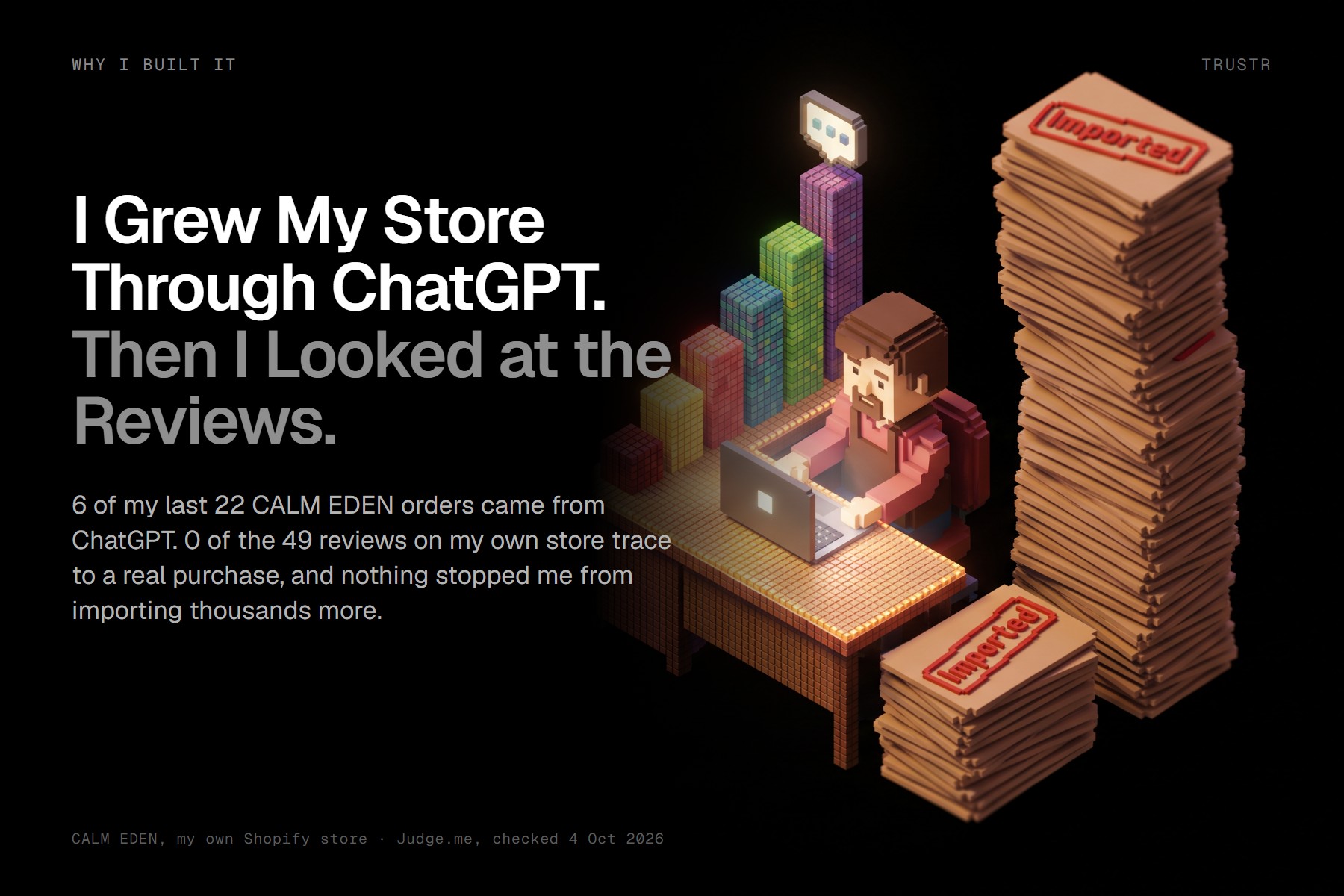
I run a Shopify store, CALM EDEN, and I run it as an experiment: how far can a store grow on organic channels alone, with no paid ads to lean on? Along the way I found a channel that is quietly taking over ecommerce: agentic commerce. ChatGPT, Claude and Copilot now recommend products directly, and 6 of my last 22 orders came from ChatGPT.
Reviews are one of the strongest signals that get a product recommended. But when I looked closely, I realized nothing in the system can tell a review from a real buyer apart from one that was imported, copied or invented. Any store could add thousands, and the agents would rank it higher either way.
AI agents are about to do a ton of buying, and they can't tell a real review from a fake one. Honestly, most humans can't either.
What it does
Trustr makes reviews prove themselves.
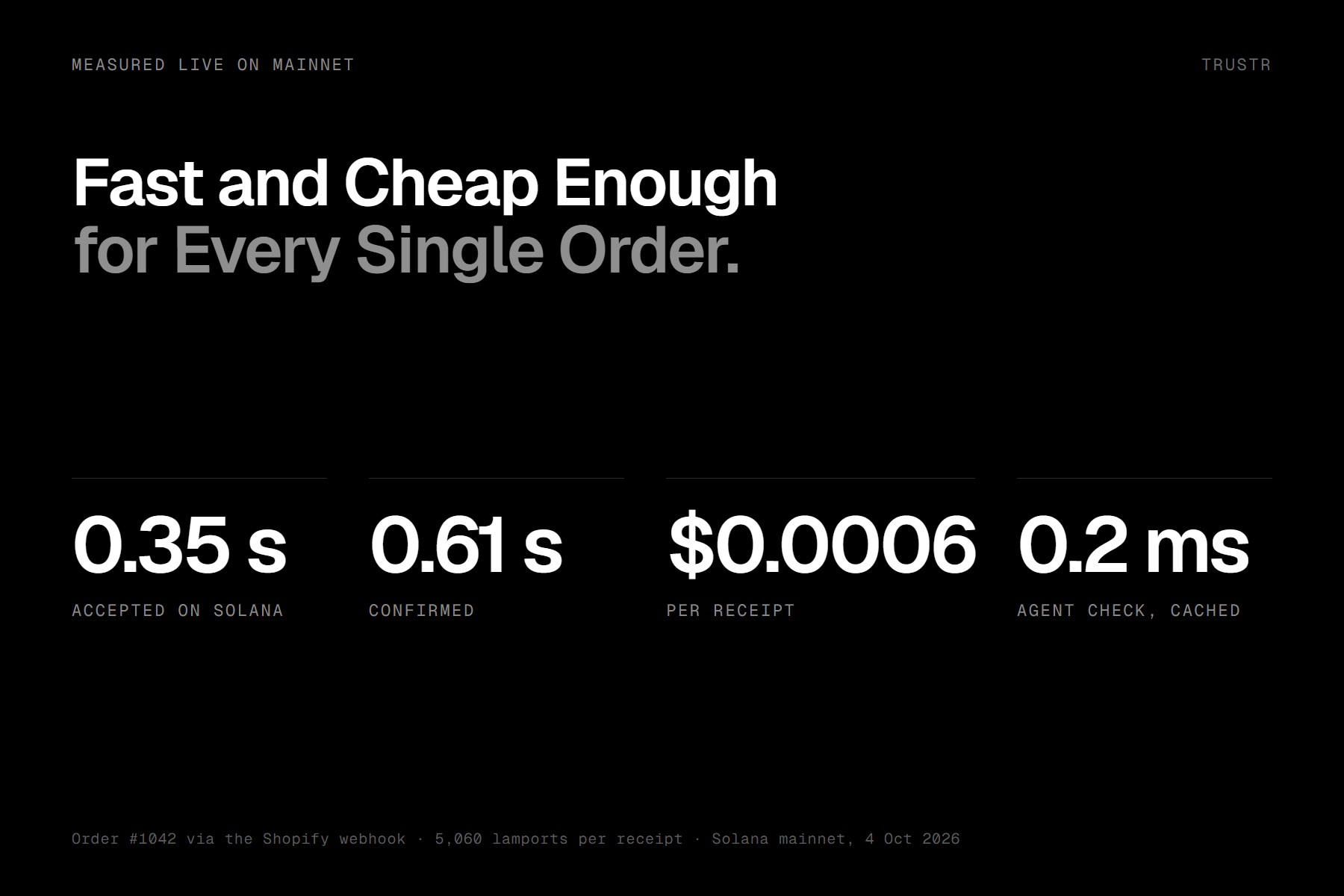
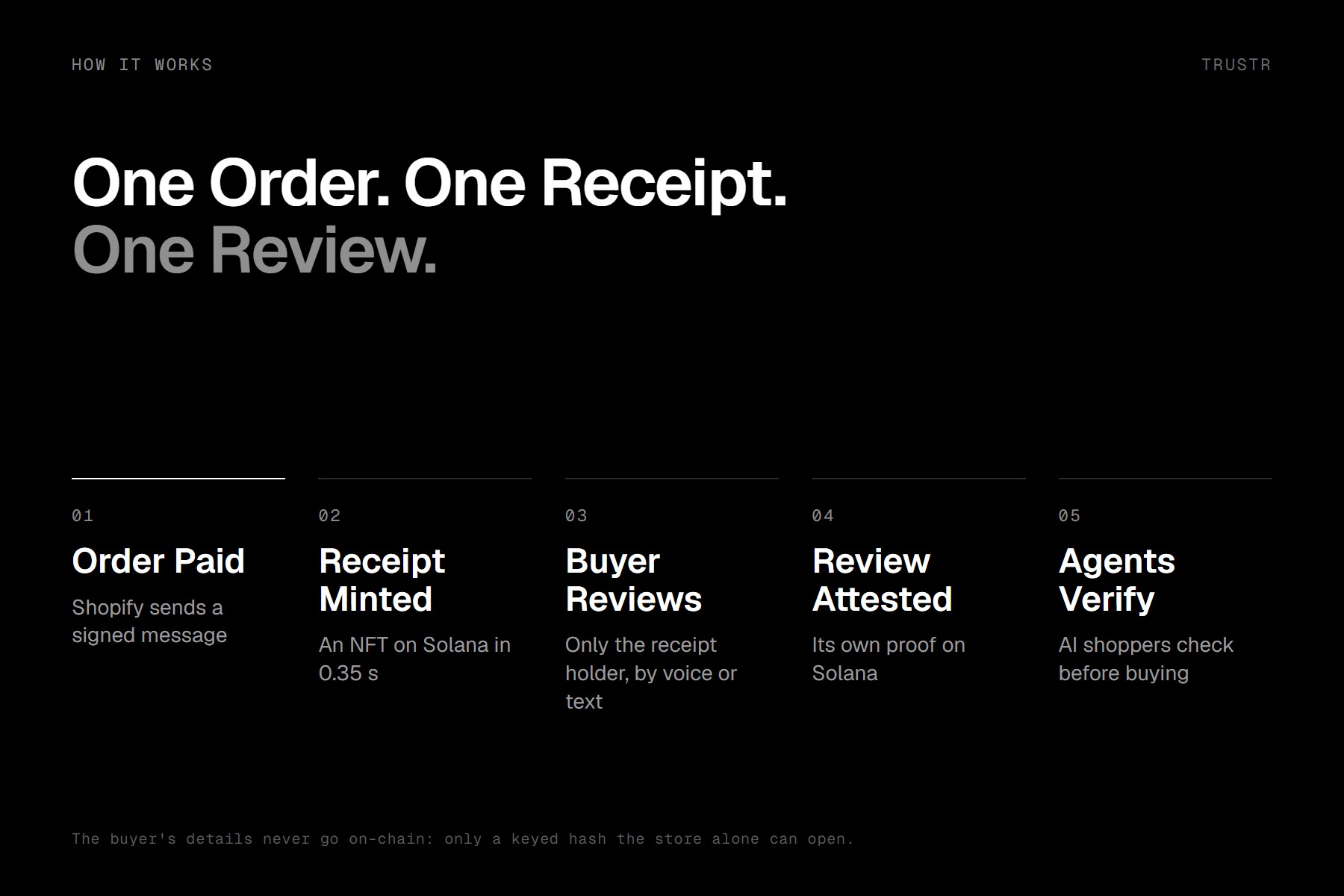
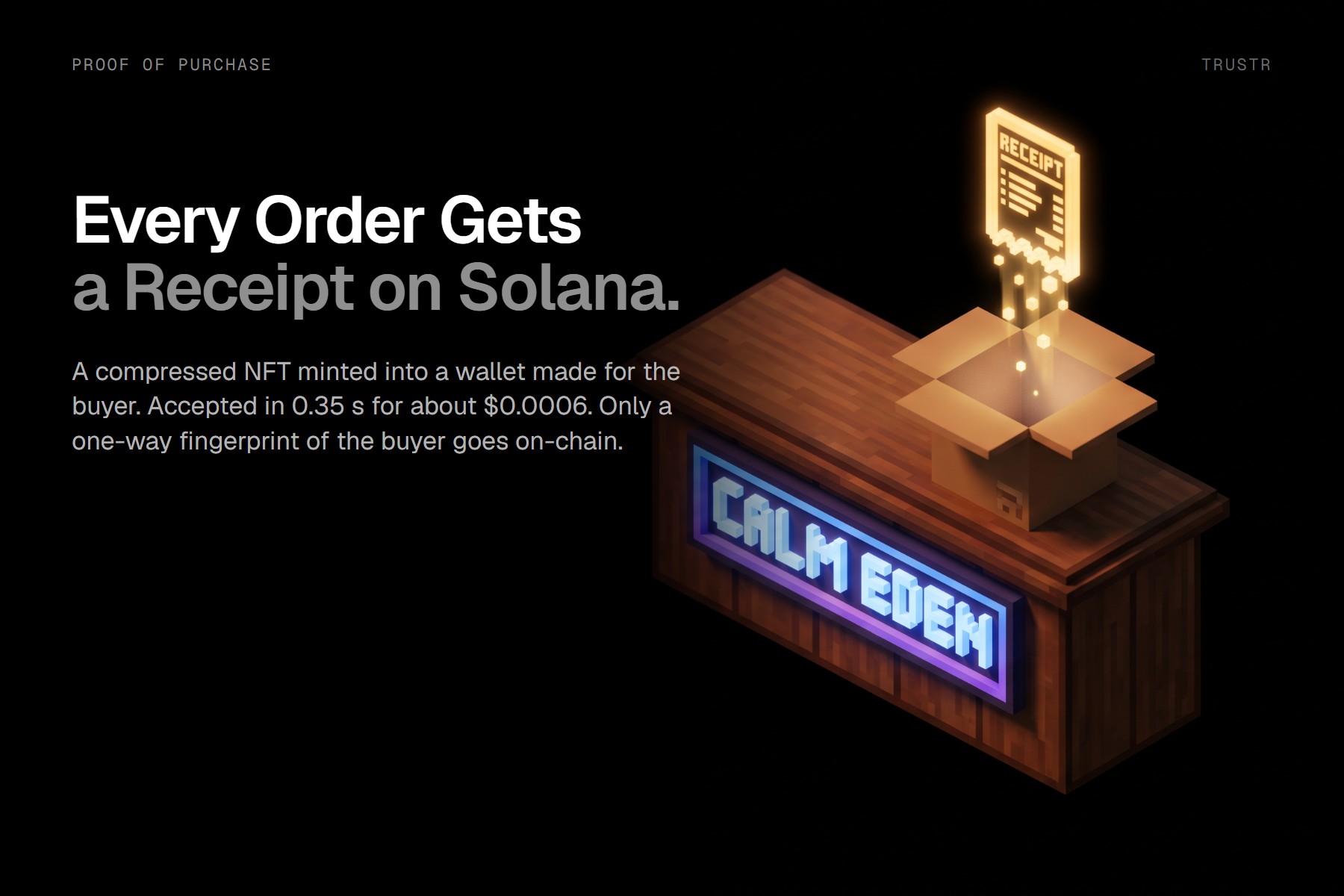
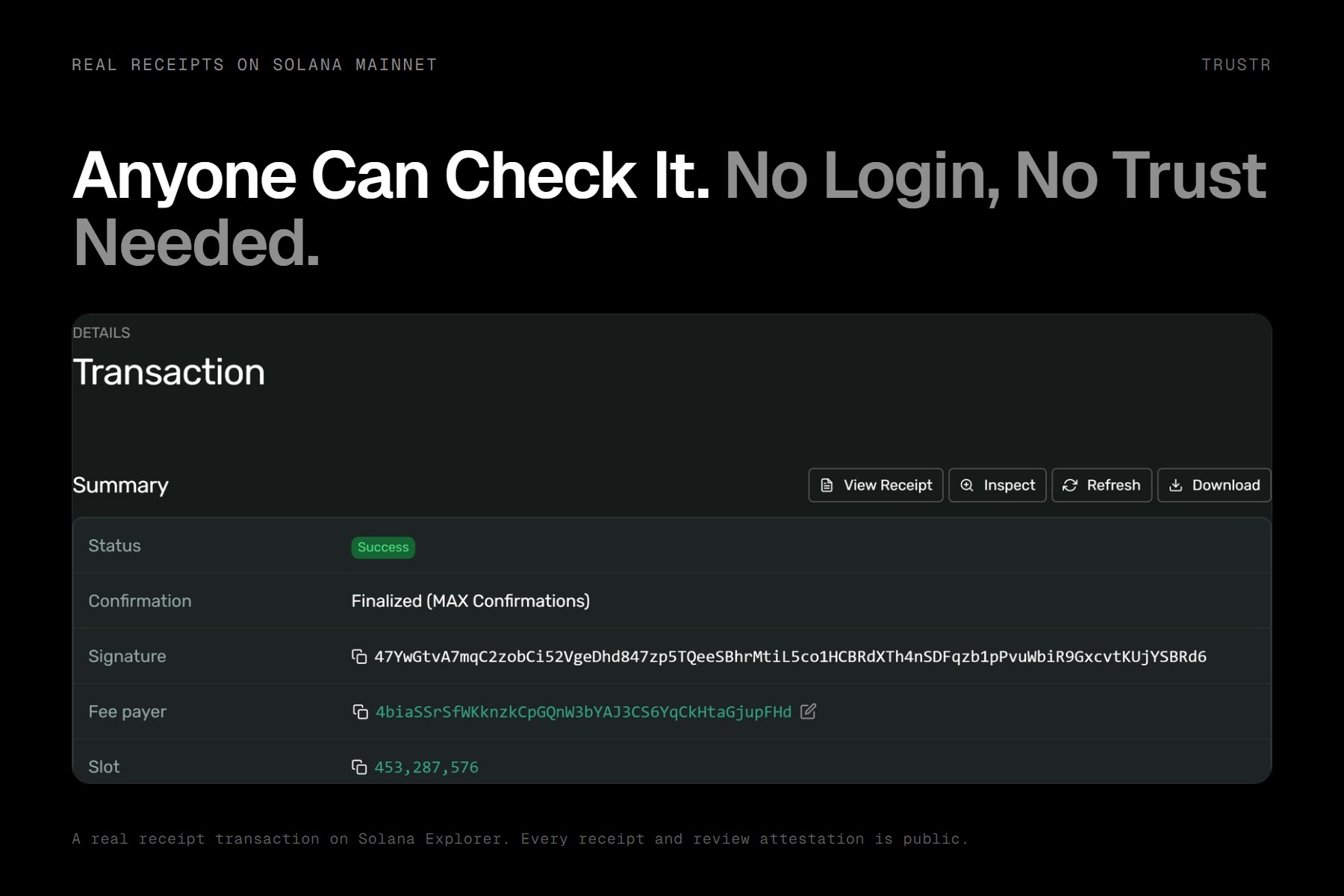
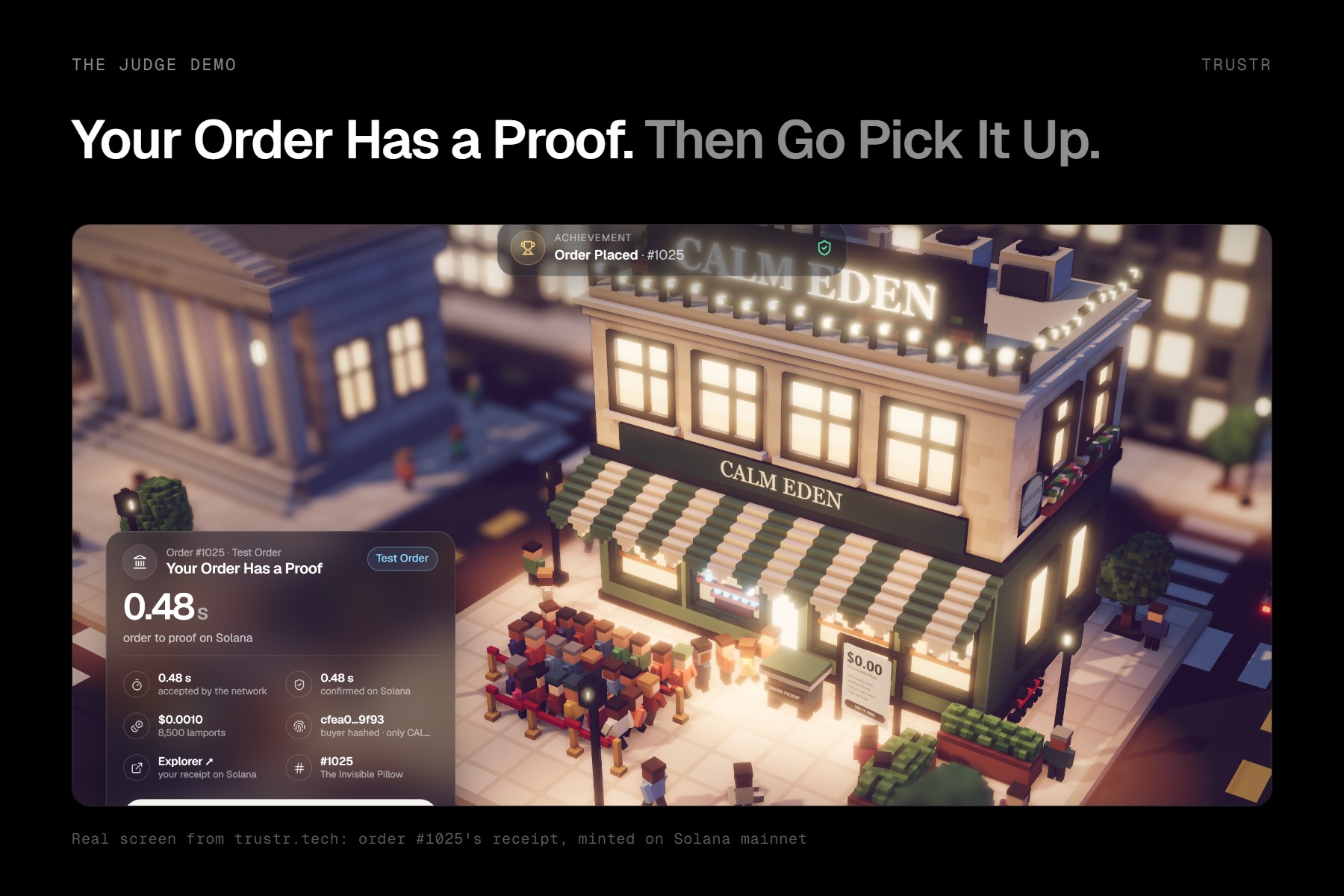
- A real sale becomes a receipt. The moment an order is paid on Shopify, Trustr mints a proof-of-purchase NFT on Solana mainnet. It's accepted in about 0.35 s and costs about 0.0006 USD.
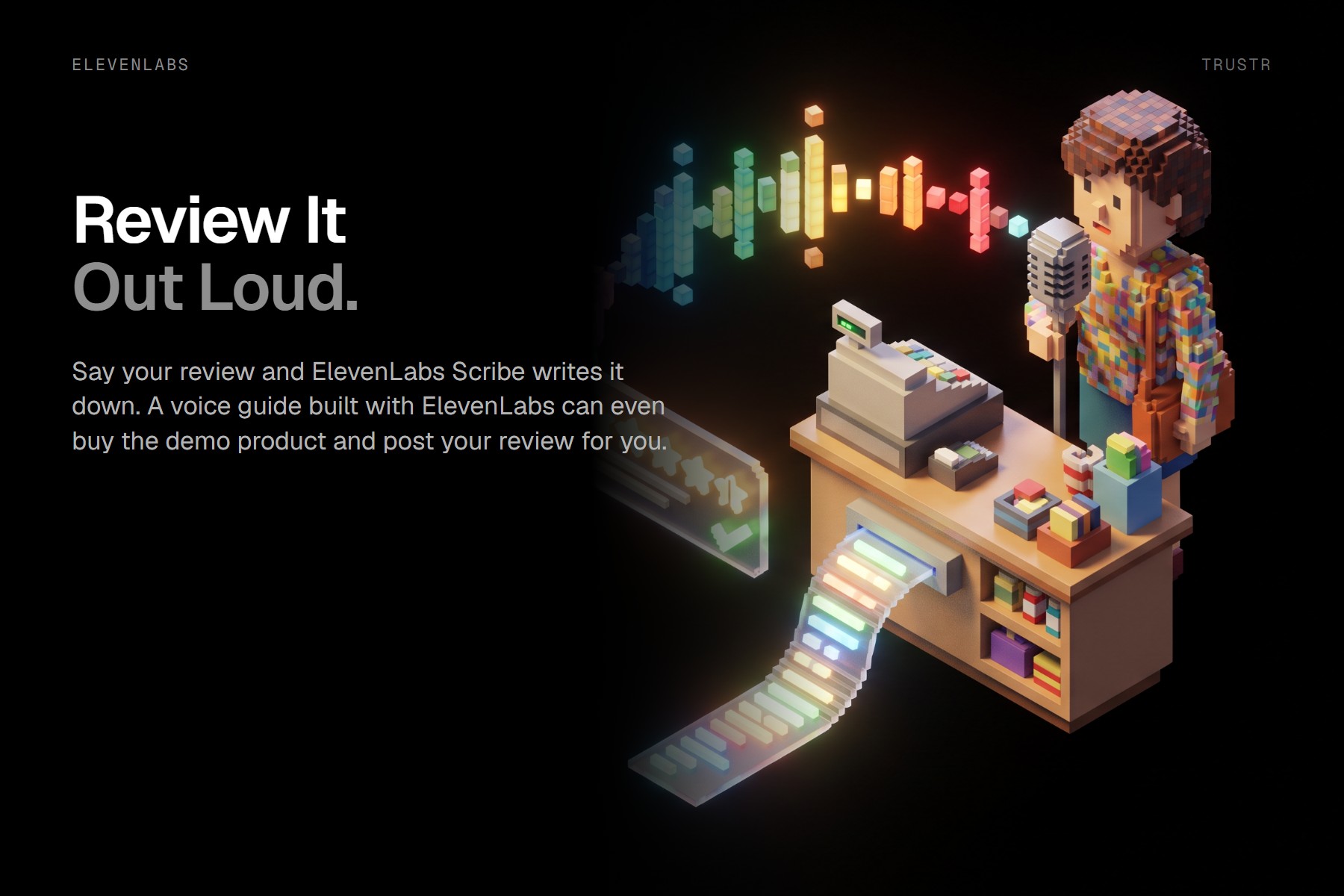
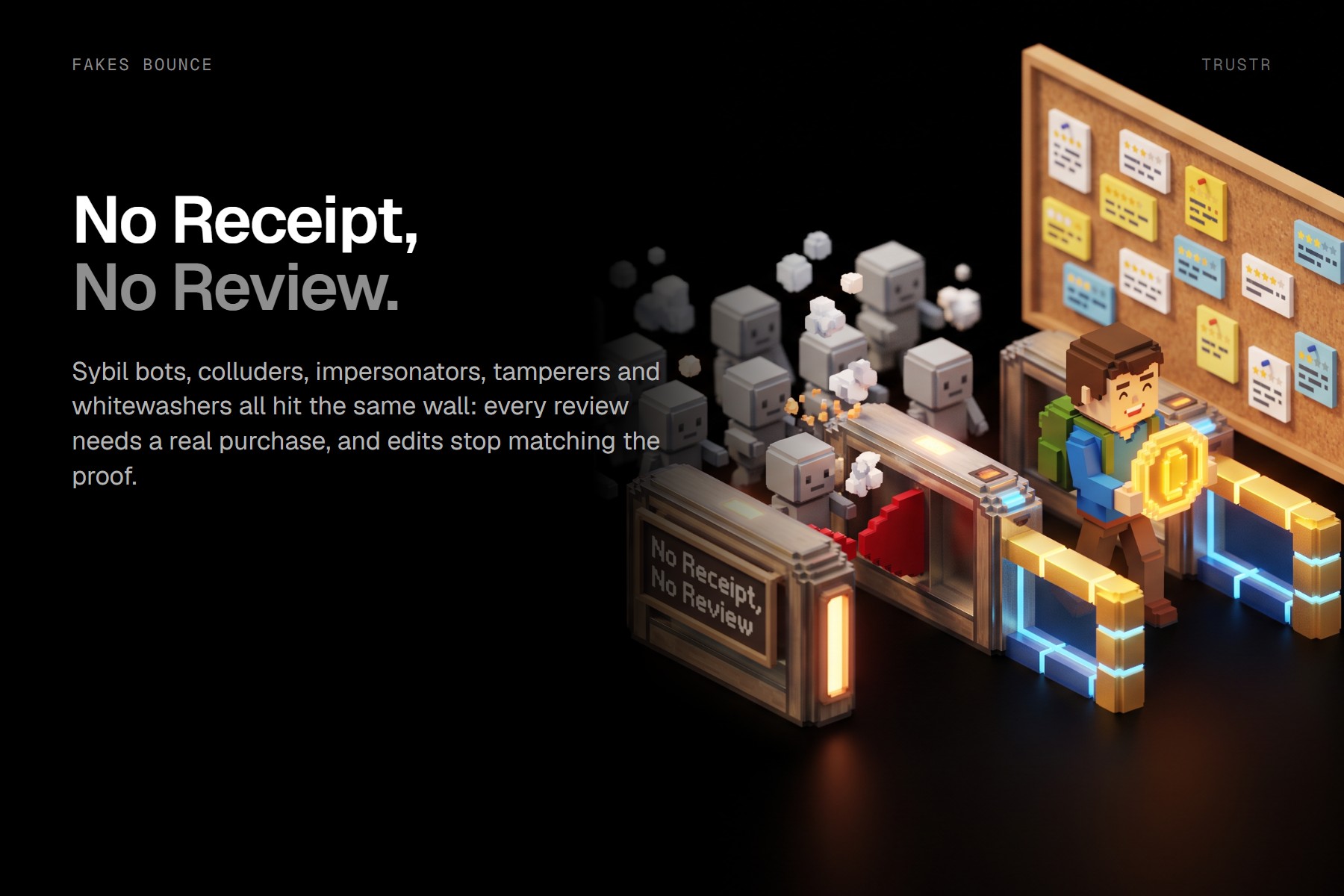
- Only the buyer can review. The receipt holder, and nobody else, can leave a review, by voice or text.
- Every review is sealed. Each review gets its own Solana Attestation Service record tied to its receipt. Change one word later and it stops matching.
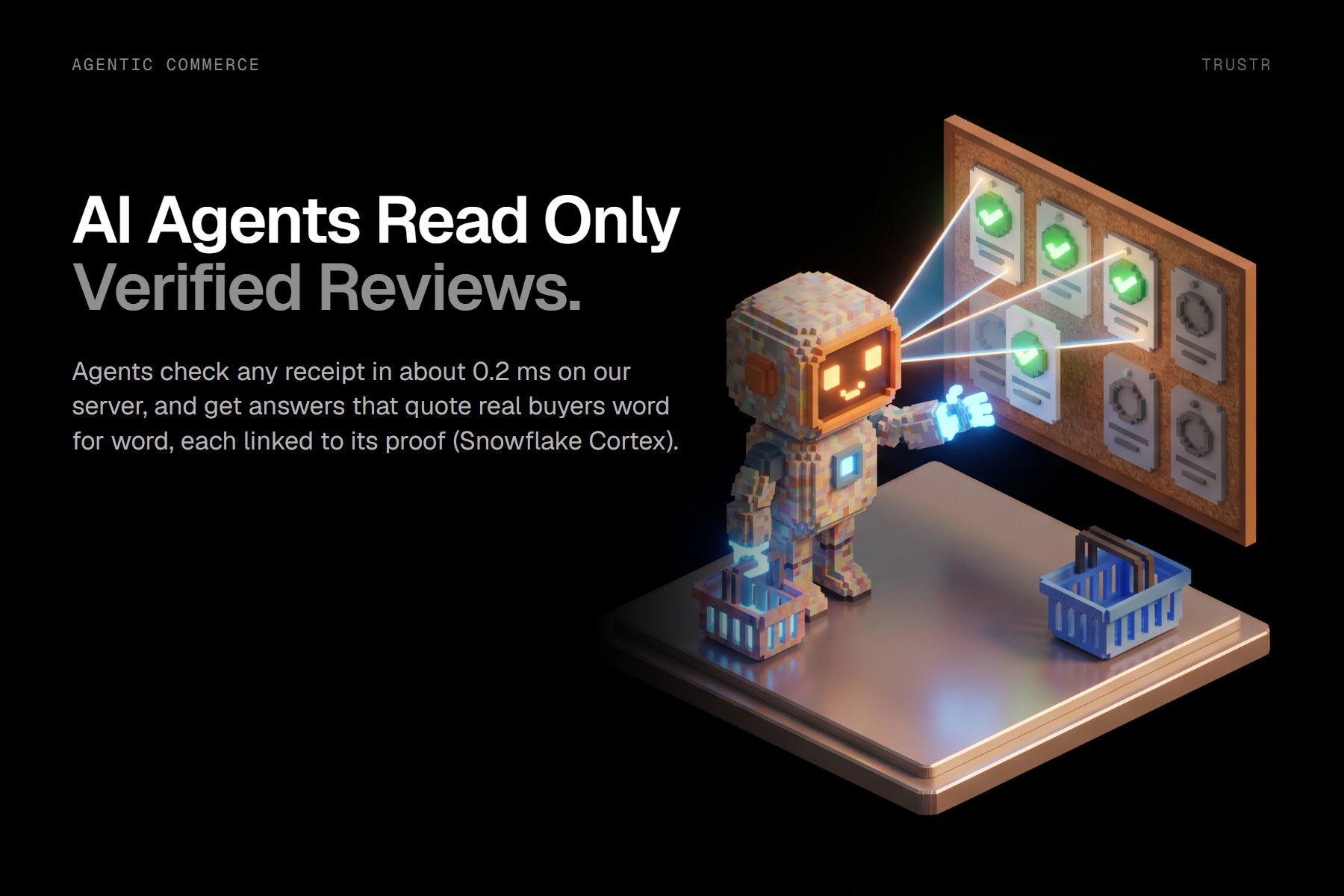
- Agents can check. Any AI shopping agent can verify a receipt in milliseconds, or ask "what do real buyers think?" and get answers quoted only from receipt-backed reviews, each linked to its proof.
- Privacy stays. No name or email ever touches the chain, only a one-way fingerprint that only the store can match:
For an agent, trust is one call:
curl https://trustr.tech/api/agent/receipts/6FkURSsbqL531bWdG7mqCBvqKqRCiYxCn4mCNHipU8fF
# {"verified":true,"orderType":"test","store":"calmeden","checkedMs":0.7, ...}
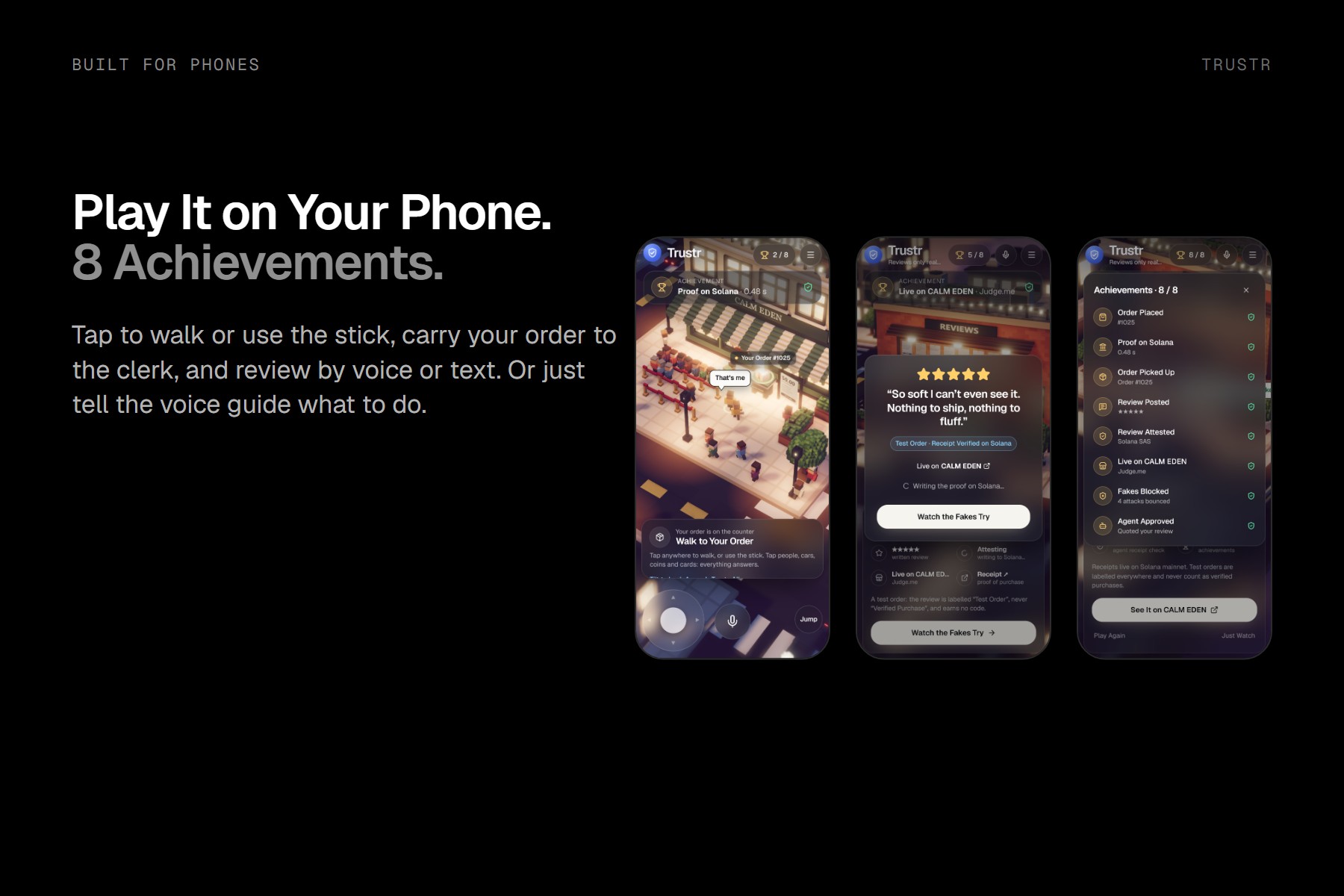
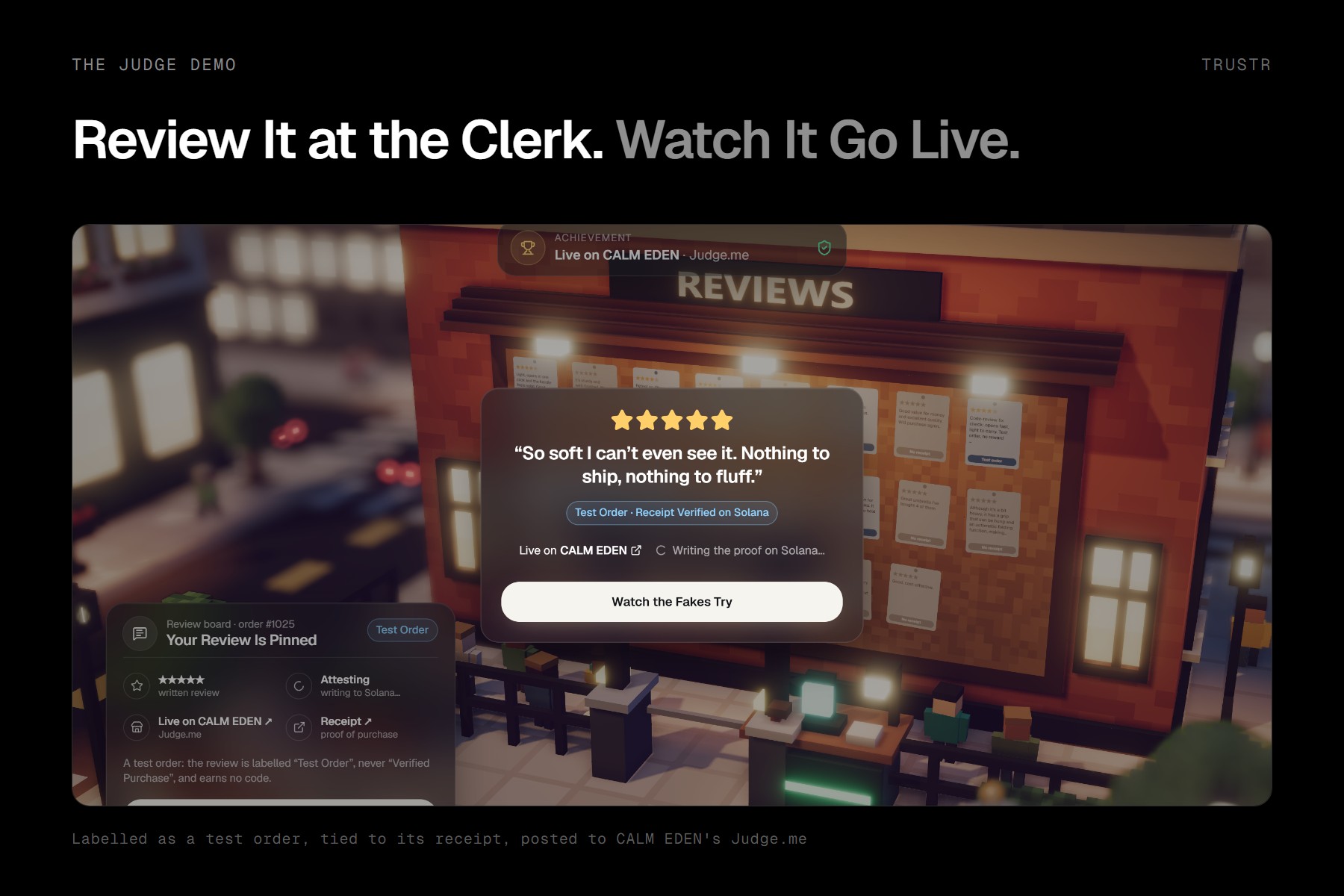
Try it in under a minute: open trustr.tech and tell the voice guide "order the demo product". It buys you The Invisible Pillow on CALM EDEN: free, and so soft you can't see it. Walk your receipt to the clerk in a little voxel town, say your review out loud, and watch it get proven on Solana.
How we built it
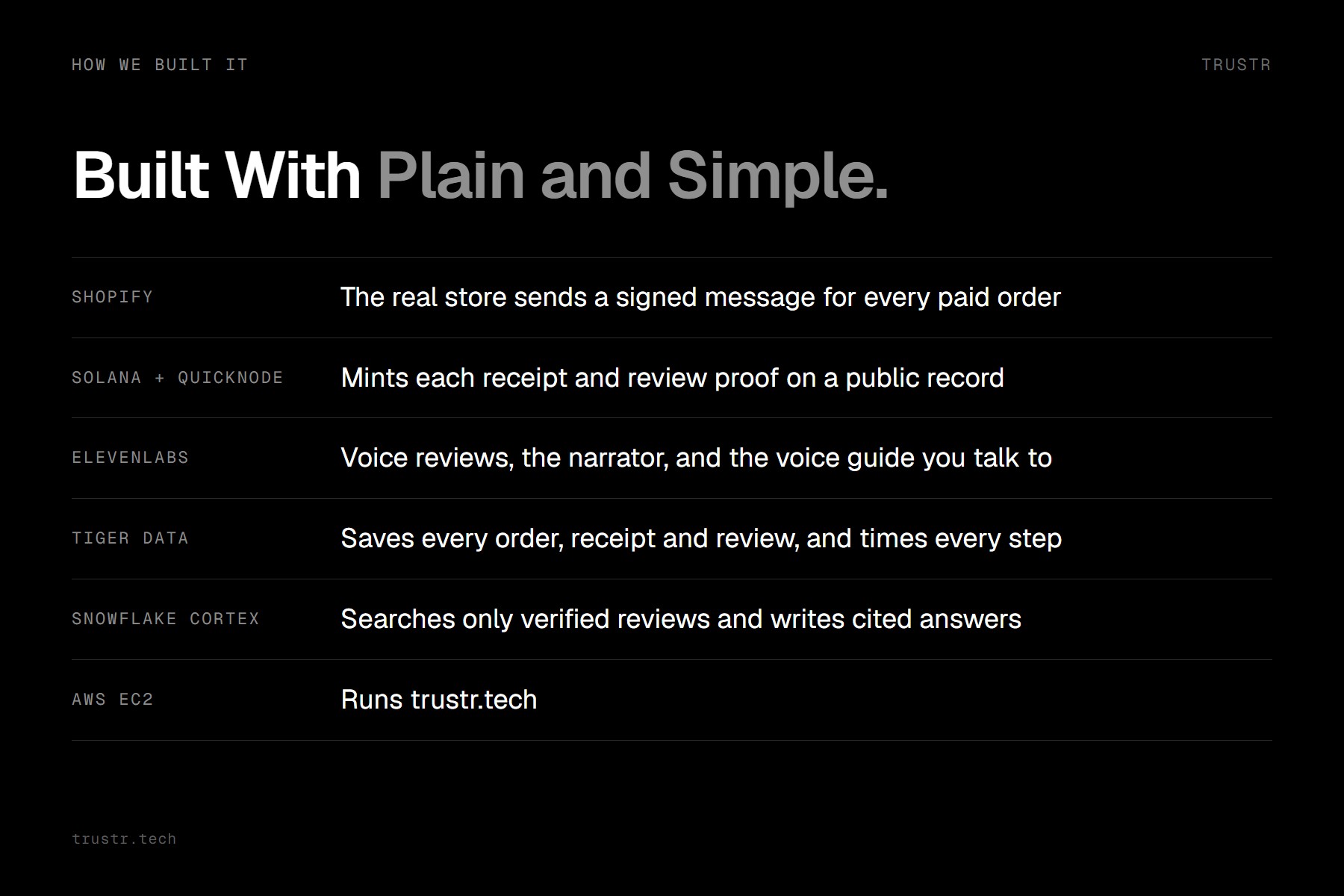
- Shopify: sends us a signed message for every paid order, so checkout itself is never touched.
- Solana + QuickNode: each receipt is a compressed NFT (Metaplex Bubblegum), and each review's proof is a Solana Attestation Service record, on a public ledger anyone can check.
- ElevenLabs:
- Scribe turns spoken reviews into text.
- The eleven_v4 voice narrates.
- A Conversational Agent is the voice guide that shops and reviews for you.
- Tiger Data: our Postgres database. It saves every order, receipt and review, times every step (TimescaleDB), and finds reviews by meaning (pgvector).
- Snowflake Cortex: the brain behind agent answers. It searches only verified reviews, reads their sentiment, and writes answers that quote buyers word for word.
- AWS EC2 runs everything, and three.js draws Trust Town, the playable demo that works on phones and laptops.
Challenges we ran into
Proof was too expensive. A regular NFT for every order would cost over a dollar. Compressed NFTs, plus a priority fee that pays only what the network needs, brought each receipt down to:
$$ \frac{5{,}060\ \text{lamports}}{10^{9}\ \text{lamports per SOL}} \times 122\ \tfrac{\text{USD}}{\text{SOL}} \approx 0.0006\ \text{USD} $$
Batching \(k\) receipts into one transaction can push that toward \(\frac{5000}{k}\) lamports each.
- Proof was too slow. The first receipts took almost 2 seconds to be accepted. Keeping a warm connection to Solana got that down to 0.35 s (0.61 s confirmed).
- Checkout couldn't slow down. We mint after payment, and we "claim" each order first so Shopify's duplicate webhooks can never mint twice.
- The review link had to be ungameable. We use private tokens, an on-chain check that the receipt still sits in the buyer's wallet, one review per receipt, and rate limits that can't be spoofed.
- Privacy on a public, permanent chain. We store only keyed fingerprints, plus an encrypted record that only the store can open.
- Everything is real. It all runs on mainnet against a live store, so every bug costs real money. Our own tests once created real discount codes; we caught it and shut all 8 down before anyone used one.
Accomplishments that we're proud of
- The full loop works live on Solana mainnet: sale → receipt minted → review sealed on-chain → agents verify it.
- 22 real past orders backfilled with receipts.
- 0.35 s and 0.0006 USD per proof, with zero personal data on-chain.
- Anyone can play through it on their phone in under a minute, just by talking.
What we learned
Fake reviews are a provenance problem, not a moderation problem. You can't moderate your way to trust, but you can prove where a review came from.
A receipt doesn't prove an opinion is true. It changes the economics of faking. Before, \(N\) fake reviews cost almost nothing. Now every single one needs a real purchase at price \(p\):
$$ C_{\text{fake}}(N) \ \ge\ N \cdot p $$
That cost lands every time, in public, forever.
What's next for Trustr
- Reviewer reputation that travels with buyers across every store
- One-click Shopify and WooCommerce plugins
- A public API so every shopping agent checks reviews before it buys
- Proof at scale for a fraction of today's cost, by batching receipts and using a much larger receipt tree
Built With
- crypto
- elevenlabs
- nft
- reviews
- snowflake
- solana
- tiger


Log in or sign up for Devpost to join the conversation.