Inspiration
The inspiration for TrustQR came from the rapid growth of digital payments in Kyrgyzstan and the parallel increase in fraud based on social engineering. We observed that many people lose money not because banking systems fail technically, but because they trust messages that appear to come from familiar contacts. Urgent requests for help, emotional pressure, and hacked accounts have become common scenarios. This showed us a clear gap: users lack tools to understand whether a financial request is normal and safe in context.
What it does
TrustQR is an intelligent FinTech platform that helps users evaluate the trustworthiness of money transfer requests between people who know each other. It analyzes behavioral, social, and financial patterns to determine whether a request matches a contact’s usual behavior. The system provides a clear trust score along with explanations and recommendations, helping users make informed decisions instead of reacting emotionally or impulsively.
How we built it
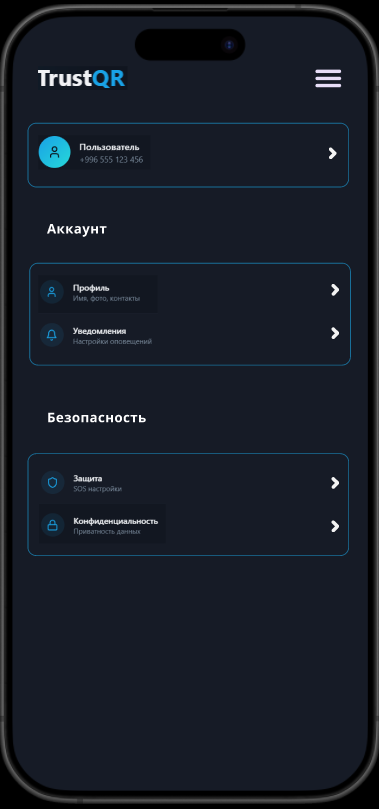
We designed TrustQR as a context-aware layer that complements existing banking systems. Users can add contacts, organize them into trusted circles (family, school, work, friends), and build a digital model of typical financial interactions. The platform evaluates each transfer request using factors such as request frequency, amount deviation, urgency, payment method, and historical behavior. Based on this analysis, TrustQR generates an understandable risk assessment for the user.
Challenges we ran into
One of the main challenges was modeling “normal” financial behavior, since it varies significantly between individuals and social groups. Another difficulty was balancing strong fraud detection with user trust and usability, ensuring that the system provides helpful warnings without creating unnecessary friction or false alarms. We also had to carefully consider privacy and data sensitivity when analyzing personal financial interactions.
Accomplishments that we're proud of
We are proud of creating a solution that focuses on the human factor in financial security rather than only technical protection. The Trusted Circle concept allows for stronger safeguards in vulnerable communities such as families and schools. Most importantly, we developed a system that explains its decisions clearly, helping users understand why a request may be risky instead of simply blocking actions.
What we learned
Through building TrustQR, we learned that financial fraud prevention is as much a behavioral and psychological problem as it is a technical one. User education, transparency, and context awareness are critical for trust. We also learned how important it is to design security tools that support users’ decision-making rather than replacing it entirely.
What's next for TrustQR
Next, we plan to expand TrustQR with deeper behavioral analysis, adaptive learning based on user feedback, and integration with messaging and banking platforms. We also aim to pilot the solution in real communities, refine the trust-scoring model, and contribute to improving financial literacy and digital safety across Kyrgyzstan.
Built With
- ai
- javascript
- ux/ui


Log in or sign up for Devpost to join the conversation.