-
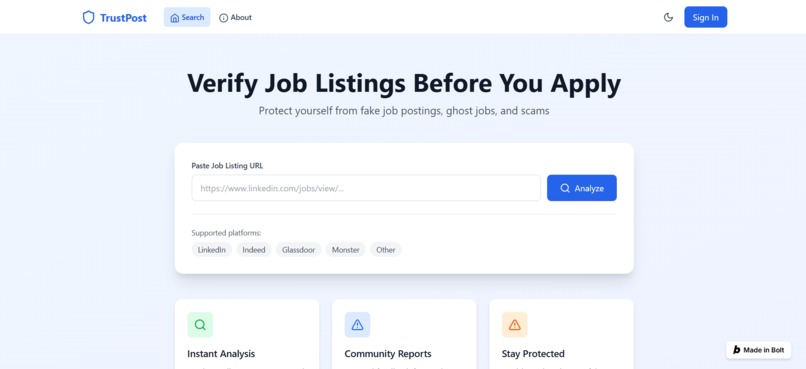
Landing Page
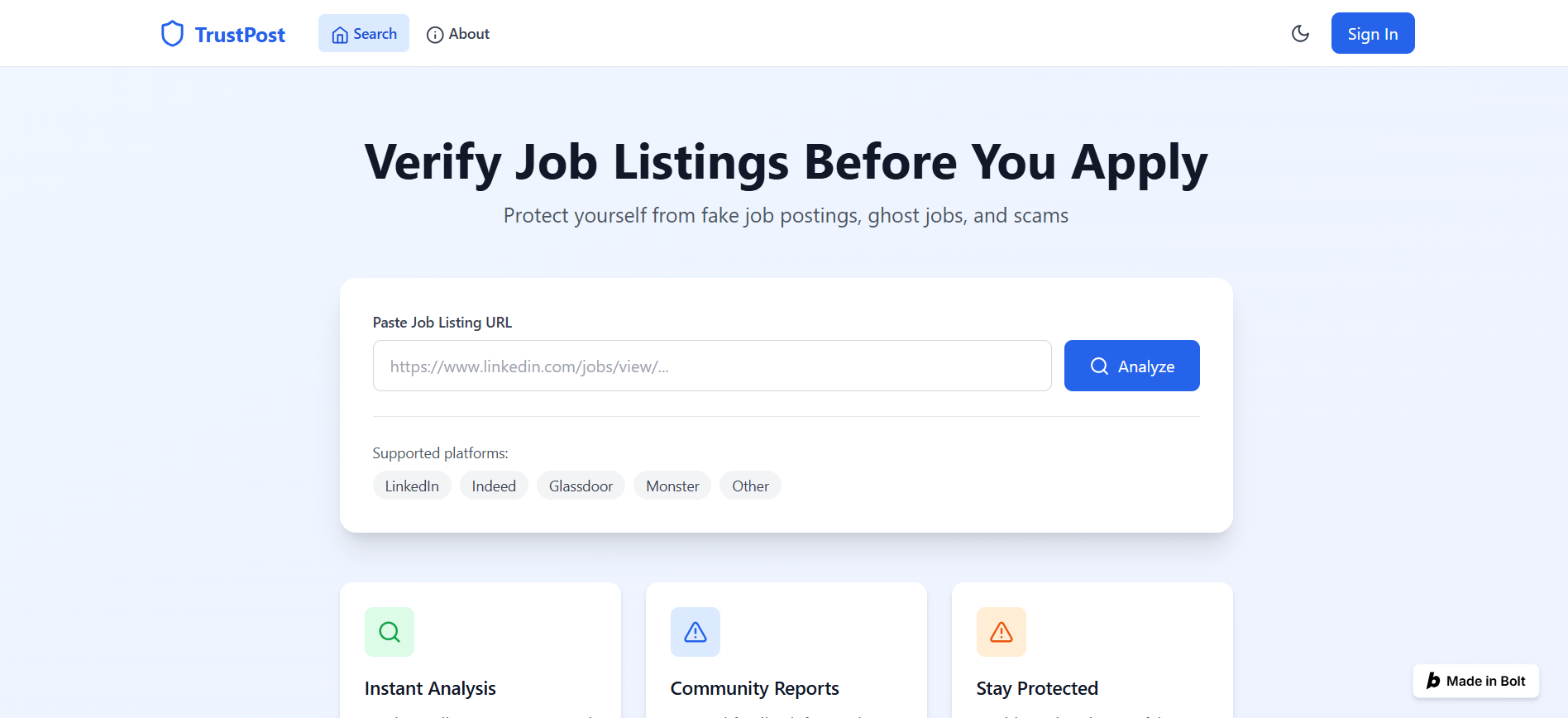
Inspiration
The inspiration for TrustPost came from personal frustration. As a Computer Science student seeking internships, I have spent countless hours tailoring resumes and writing cover letters, only to send them into what felt like a black hole. I watched my classmates go through the same cycle of hope and silence, often not realizing that the job they applied for likely never existed.
What it does
TrustPost acts as a "Trust Layer" for major job boards like LinkedIn and Indeed. It is a browser extension that instantly analyzes a job listing before you apply.
How I built it
I approached this as a solo developer with a focus on rapid prototyping.
Concept & Logic: I started by mapping out the "Trust Score" algorithm, determining how to weigh conflicting signals (e.g., a verified company but an unverified recruiter).
Prototyping: I used Bolt.new to rapidly generate the MVP interface and frontend code. This allowed me to visualize the user flow—from landing on a job post to seeing the "Trust Badge"—without getting bogged down in boilerplate code.
Research: I utilized AI tools (ChatGPT/Gemini) to help brainstorm the data sources and validate the feasibility of accessing public employment data.
Challenges I ran into
Data Access vs. Privacy: The biggest challenge was figuring out how to verify data without violating privacy or terms of service. Platforms like LinkedIn have strict API limits. I had to pivot the architecture to rely on public-facing data and crowdsourced signals rather than deep API integration.
Defining "Fake": It is hard to algorithmically distinguish between a malicious scam and a company that is just slow to hire. I had to design the system to offer a "Probability Score" rather than a definitive judgment to avoid unfairly penalizing legitimate but slow companies.
Accomplishments that I'm proud of
Tangible Solution: Moving from a vague frustration to a concrete blueprint with a working UI prototype.
The "Trust Score" Logic: Developing a balanced scoring system that aggregates multiple weak signals (recruiter profile, date posted, user feedback) into one strong indicator.
User-Centric Design: Designing a solution that doesn't require the user to leave the job board; the extension lives where the friction happens.
What I learned
I learned that the "Ghost Job" problem is much more expensive than I thought, costing job seekers over $220 million in fraud losses in just the first half of 2024. I also learned the importance of "Civic UX" - designing systems that protect users from bureaucratic or systemic failure. Building TrustPost taught me that transparency is not just a feature; it is a necessary layer for the future of the internet.
What's next for TrustPost
The immediate next step is to build the functional Chrome Extension MVP.
Phase 1: I plan to launch a beta with 50 students from my university to seed the "Crowdsourced Pulse" database.
Phase 2: Integrate valid API connections to Crunchbase or Glassdoor to strengthen the company verification data.
Goal: My ultimate goal is to make TrustPost a standard "sanity check" for every student entering the job market, saving millions of hours of wasted time.
Built With
- bolt
- chatgpt
- gemini

Log in or sign up for Devpost to join the conversation.