-
-
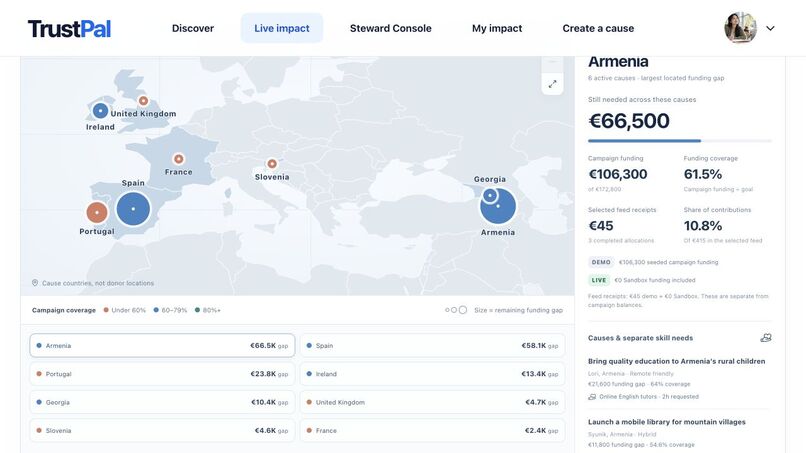
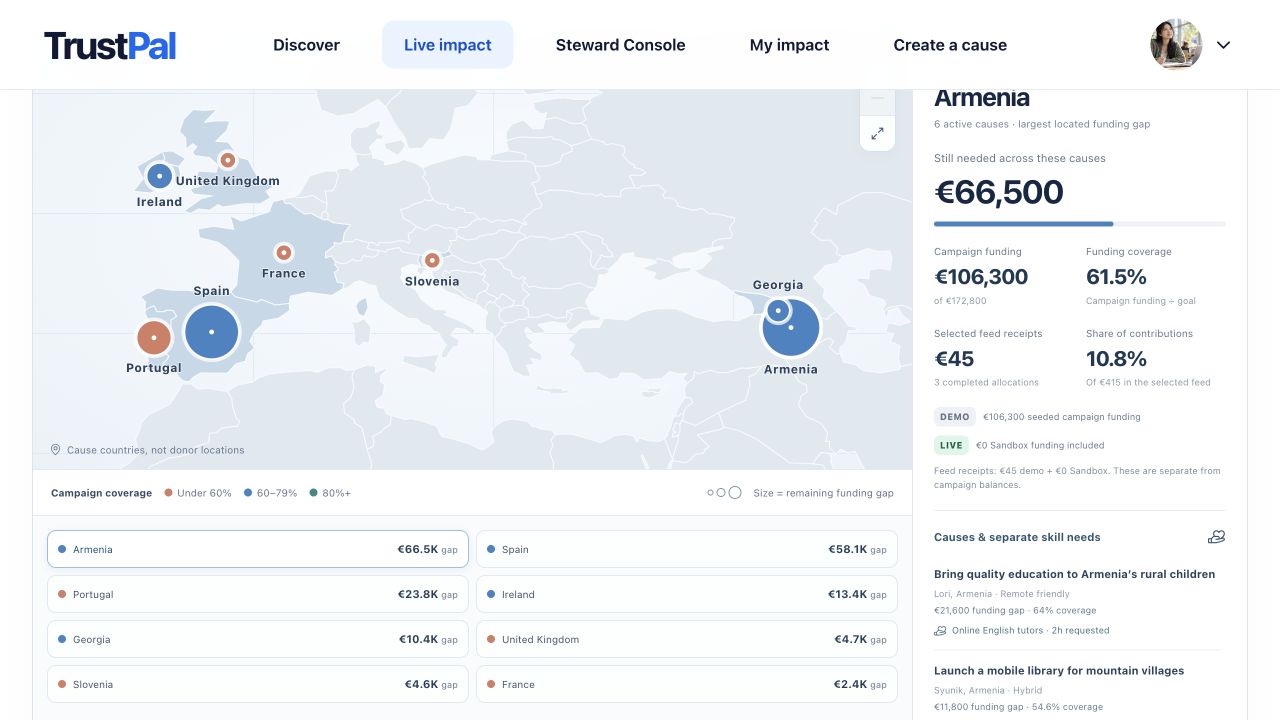
Global Impact Map: fictional demo receipts shown. Funding coverage and contribution share are separate; regions follow cause locations.
Inspiration
We can see what someone spends. We rarely see the full value of what they contribute.
A donation leaves a receipt. Two hours teaching a child, helping a neighbor, or sharing a professional skill can disappear when the moment ends. People who cannot give much money still have something valuable to offer—but those contributions rarely become a recognized history.
TrustPal asks: what if doing good could become a trustworthy, visible contribution history—and open the door to creating something of your own?
What it does
TrustPal connects people with causes that need money, time, and skills. Its contribution-to-creation loop is simple: find a meaningful need → contribute → receive human verification → build Trust Points → unlock Creator Level.
Follow Maya in the demo. She has €10, two hours, and English to share. She tells the AI what she can offer. It recommends rural education in Armenia, explains the match, and creates an editable giving plan. Maya chooses the cause and amount, then approves a PayPal Sandbox payment.
The important moment comes after checkout: the same €10 capture appears as LIVE in the Impact Command Center. It is inspectable alongside clearly labeled fictional demo history, and its allocation is reflected in the Global Impact Map.
Money is only one way to help. Maya can offer teaching hours. AI structures the offer and the evidence needed to review it. The contribution stays pending until a human reviewer acts. In the Steward Console, published rates and evidence make the potential points calculation inspectable: two verified teaching hours would earn 100 Trust Points. AI cannot issue points.
A seeded contributor profile demonstrates Creator Level and the ability to propose an education or community cause. The contributor chooses their own cause; the long-term vision is a portable history of social contribution.
How we built it
PayPal connects an approved payment to an inspectable impact record. The React interface uses PayPal's JavaScript SDK v6. A Node.js server creates and captures Orders v2 payments, keeps secrets server-side, and uses stable capture request IDs. Completed capture results feed the shared impact data. The deployed app enforces Sandbox exclusively. The demonstrated €10 capture is a genuine Sandbox API transaction; no real money is donated.
AI turns intentions into actionable, reviewable plans. Through the Astropods AI Gateway, the application uses the configured model gpt-5-6-terra for cause matching, skill-evidence planning, cause-draft assistance, and a read-only impact analyst. Responses are schema-validated with Zod. The server bounds inputs and output tokens, and limits AI use to 20 requests per visitor per hour. If inference is unavailable, a transparent fallback is labeled rather than presented as live AI.
AG Grid is the operational workspace. The cause explorer connects funding progress with skill needs. The editable giving plan keeps allocation decisions with the donor. The Impact Command Center exposes PayPal captures, campaigns, and a contribution leaderboard; the Steward Console uses a review queue and evidence inspection. Together, these grids connect a need, a decision, a payment, and its reviewable outcome.
The Global Impact Map complements those grids. It aggregates existing causes by cause country, with a locally bundled, public-domain Natural Earth basemap. Marker area represents remaining funding gaps; color represents funding coverage. A region's share of selected contributions is calculated separately from its funding coverage. Demo and Sandbox receipt sources are explicit, missing locations are not invented, and volunteer needs remain separate from money.
The app is built with React, Vite, JavaScript, Node.js, AG Grid, Zod, and custom SVG map interactions, and deployed through Astropods. PayPal integration work used the official PayPal AI Toolkit as a reference.
Challenges and what we learned
The hard part was making contribution records credible. A promise to volunteer is not verified work. A successful Sandbox capture is not a production donation. A region receiving a large share of recent payments can still have a large funding gap.
We made these distinctions visible in the interface and server logic. AI recommends; people choose. Protected review requires an authorized steward. Public judges can rehearse an evidence review without issuing points or changing protected records.
Accomplishments
- A working public prototype with live AI and an end-to-end PayPal Sandbox contribution.
- A traceable capture-to-LIVE-feed-to-map journey, demonstrated in the video.
- Money and non-money needs presented together, with separate measurements.
- Human review and deterministic points calculations, with an honest public rehearsal mode.
- A complete contribution-to-creation product story rather than an isolated payment or AI feature.
What's next
Durable accounts and storage, real organization onboarding, production recipient settlement, accessible evidence submission, and trials with community organizations. We also want to evaluate the points rules with contributors and stewards rather than assume one rate card fits every community.
Prototype boundaries: Causes, recipients, baseline balances, demo history, and sample profiles are fictional. The public Steward Console review is a rehearsal; it issues no points. Shared protected verification is disabled for anonymous users. Demo data is held in memory and resets on restart. The payment flow is a single-merchant Sandbox demonstration with internal cause allocations—not production multi-NGO settlement. Recurring payments, automatic payouts, and portable identity across other services are future work.
TrustPal makes doing good count—and makes that impact trustworthy, visible, and lasting.
Built With
- ag-grid
- astropods
- javascript
- node.js
- paypal
- react
- svg
- vite
- zod
