-
-
TrustOps Agent by Dana_G
Inspiration
TrustOps Agent was built around a simple idea:
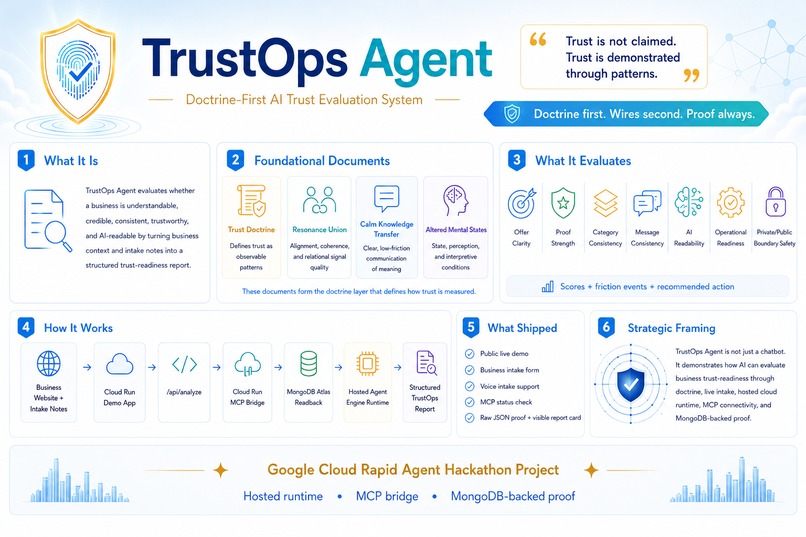
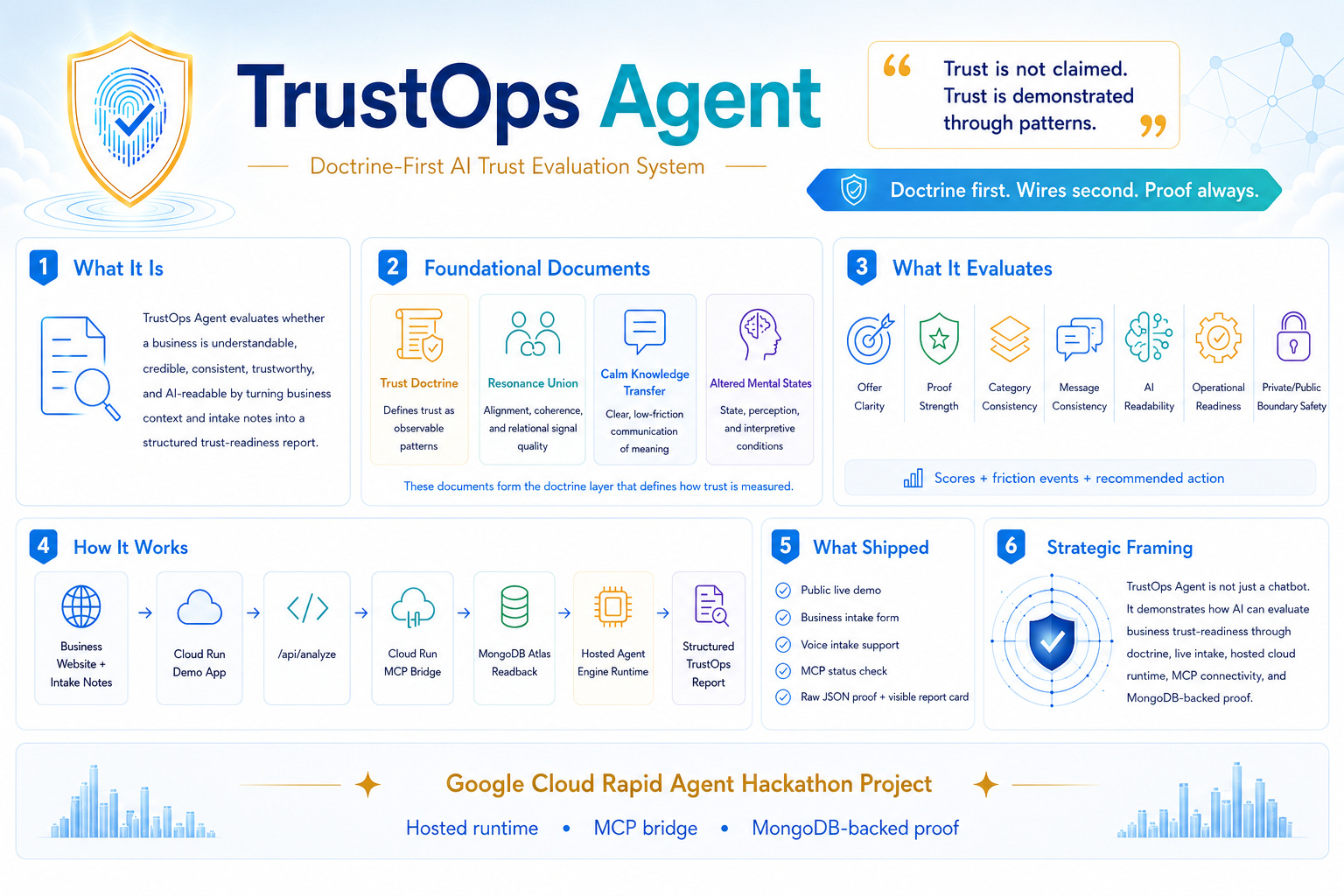
Trust is not claimed. Trust is demonstrated through patterns.
As more businesses are discovered, summarized, and recommended by AI systems, it is no longer enough for a business to sound good only to a human visitor. A business also needs to be clear, consistent, credible, and safe for AI systems to understand.
TrustOps Agent was created to evaluate that trust-readiness.
This project is doctrine-first. Before building the app, I developed Foundational Documents that define how TrustOps understands trust, clarity, proof, message consistency, communication quality, operational readiness, and private/public boundary safety.
Those documents form the judgment layer of the system. The software applies that trust model to business context and produces a structured report.
What it does
TrustOps Agent evaluates whether a business is understandable, credible, consistent, trustworthy, and AI-readable.
The live demo lets a user enter:
- Business name
- Business website
- Intake notes
The system then generates a structured TrustOps report with scores for:
- Offer clarity
- Proof strength
- Category consistency
- Message consistency
- AI readability
- Operational readiness
- Private/public boundary safety
The report also returns friction events, a recommended action, MCP status, hosted runtime reference, timestamp, and raw JSON proof.
The goal is not to produce a generic business review. The goal is to show whether a business is ready to be understood, trusted, recommended, and interpreted by humans and AI systems.
Foundational Documents
The core of TrustOps Agent is its doctrine layer.
The Foundational Documents define how trust is evaluated before the software runs.
Key documents include:
- Trust Doctrine: Defines trust as observable patterns of clarity, consistency, proof, alignment, and safe public interpretation.
- Resonance Union: Supports the model through alignment, coherence, and relational signal quality.
- Calm Knowledge Transfer: Defines clear, low-friction communication of meaning.
- Altered Mental States: Accounts for how state, perception, and interpretation affect how people understand a message.
Without this doctrine layer, TrustOps would be another AI business analyzer.
With the doctrine layer, TrustOps becomes a structured AI trust evaluation system.
How I built it
The final working implementation uses:
- Google Cloud Agent Engine
- Cloud Run
- MCP
- MongoDB Atlas
- Python
- Flask
- GitLab
- Cloud Shell
- Cloud Build
- HTML
- CSS
- JavaScript
- Web Speech API
The working architecture is:
Business intake form
→ Flask Cloud Run demo app
→ /api/analyze TrustOps report endpoint
→ Cloud Run MCP bridge
→ MongoDB Atlas readback
→ Hosted Google Cloud Agent Engine runtime proof
→ Public TrustOps report display
The live demo includes a business intake form, browser-based voice intake support, a dynamic Business Analyzed card, a TrustOps report endpoint, raw JSON proof, and an MCP bridge status check.
Challenges I ran into
The original plan explored a visual Agent Builder / Agent Studio route.
That path was attempted, but MCP and ADK runtime compatibility issues made it unsuitable for the hackathon deadline.
The final implementation pivoted to a lightweight custom Google Cloud Agent Engine runtime connected to a deployed Cloud Run MCP bridge.
That preserved the essential proof path:
Hosted Google Cloud runtime → Live Cloud Run MCP bridge → MongoDB-backed readback
The build changed, but the mission stayed intact.
Accomplishments
I shipped a working public demo with:
- A deployed Cloud Run live demo page
- A business intake form
- Browser-based voice intake support
- Dynamic business context updates
- A
/api/analyzeTrustOps report endpoint - A visible structured report card
- Raw JSON proof
- A live MCP status check
- A deployed Cloud Run MCP bridge
- MongoDB Atlas readback
- Hosted Google Cloud Agent Engine runtime proof
- GitLab proof artifacts and implementation records
The strongest accomplishment is that the project connects doctrine, interface, hosted cloud runtime, MCP connectivity, and database-backed proof into one working submission.
What I learned
This project reinforced that useful agent systems need more than prompts and interfaces.
They need a defined operating doctrine.
The most important lesson was that a useful AI system should not only generate answers. It should apply a clear evaluation framework.
I also learned how important engineering pivots are under deadline pressure. The original visual agent route was not the final path, but the final implementation preserved the core proof requirement and produced a working public demo.
What's next
Planned extensions include:
- Full website crawling
- Deeper automated proof extraction
- External voice-agent ingestion
- Expanded MongoDB session history
- Longitudinal trust-readiness comparisons
- More detailed trust reports for small businesses, wellness brands, consultants, and human-centered service providers
The long-term goal is to help businesses become more understandable, credible, consistent, and AI-readable without exposing private or internal context.
Final frame
TrustOps Agent demonstrates how AI can evaluate business trust-readiness through a structured doctrine, live intake, hosted Google Cloud runtime, MCP connectivity, MongoDB-backed proof, and a visible trust report.
Doctrine first. Wires second. Proof always.


Log in or sign up for Devpost to join the conversation.