-
-

TrustNode Logo
-
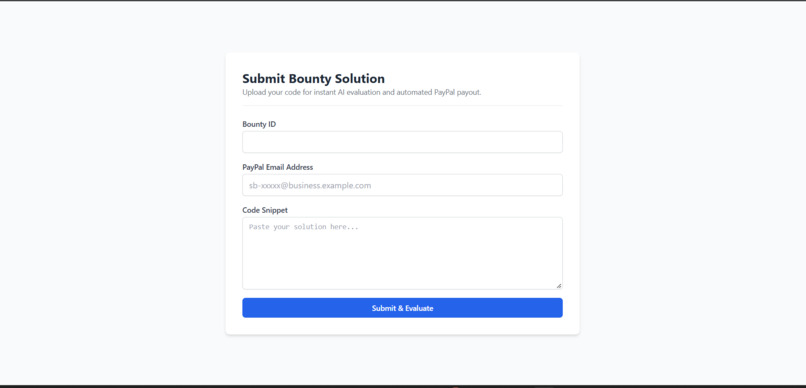
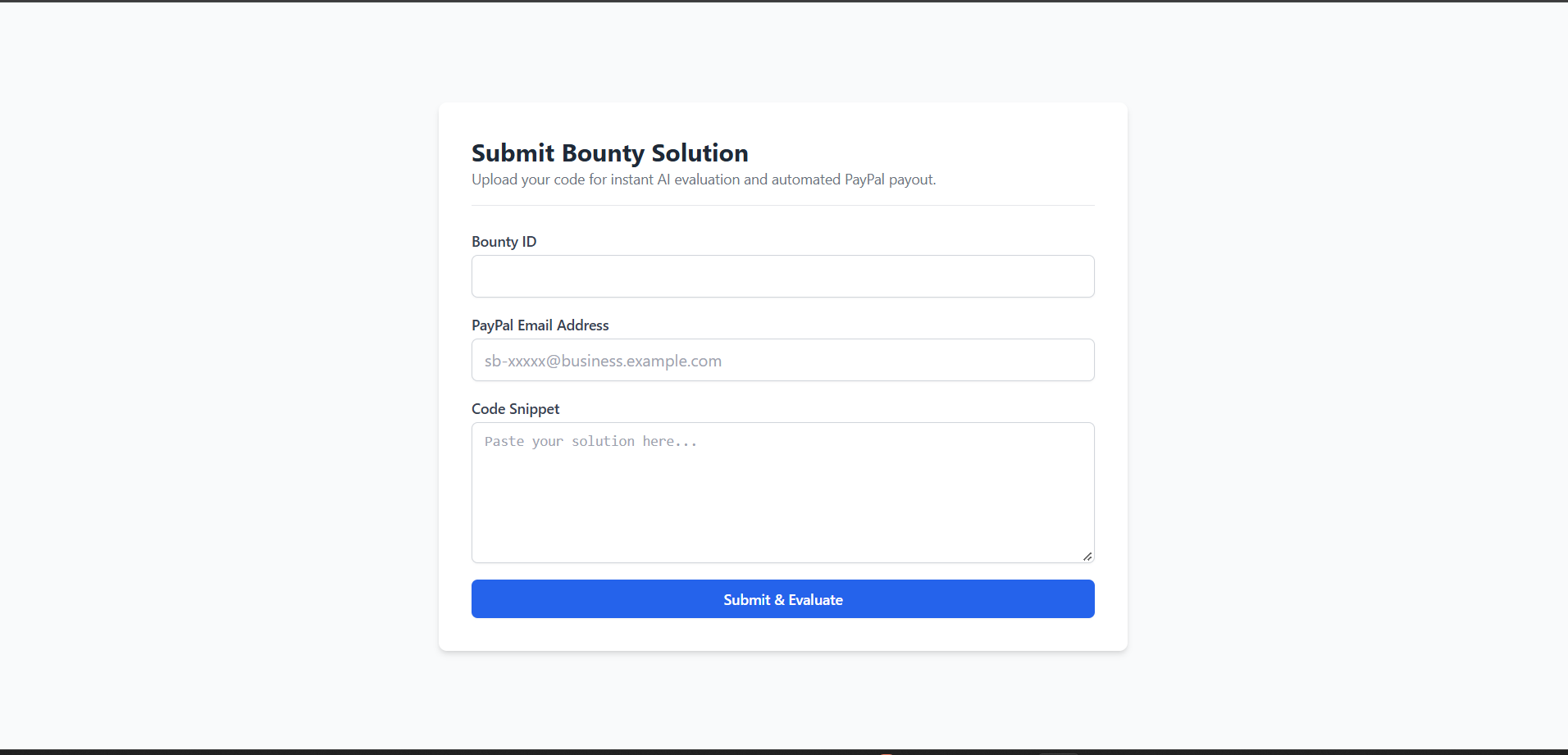
Submission portal
-
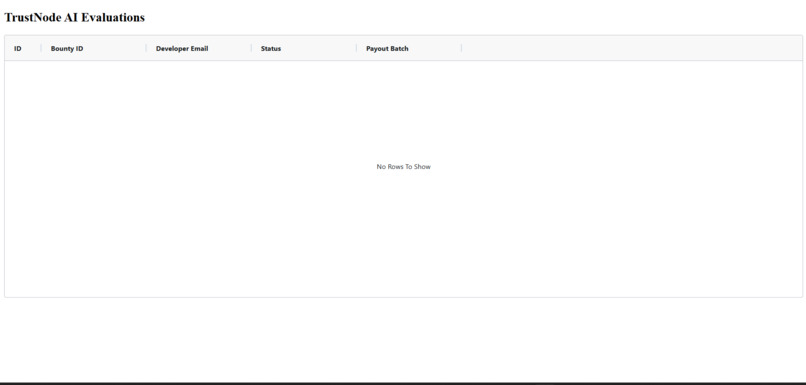
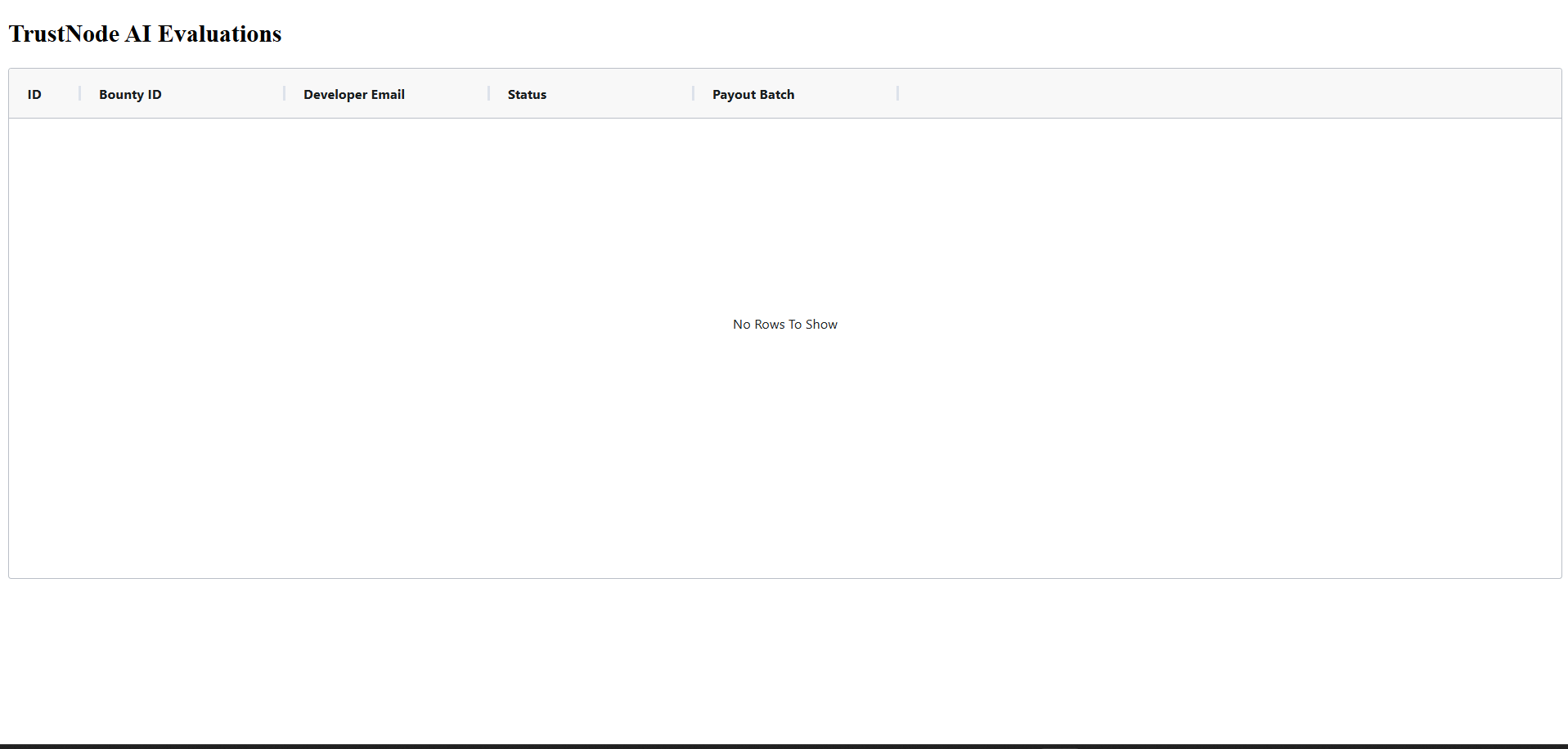
AG Grid portal currently empty caused no data is passed.

Inspiration
In the freelance developer ecosystem, trust and time are the biggest bottlenecks. Sponsors spend countless hours manually reviewing code submissions for bounties, while freelancers often wait days or even weeks for their work to be approved and their payments to clear. We wanted to eliminate this friction by creating a "trustless" escrow agent. By combining the speed of modern AI with automated financial settlement, we envisioned a platform where code is evaluated instantly and funds are released the second the success criteria are met.
What it does
TrustNode is an automated AI-powered escrow and code evaluation platform. It bridges the gap between sponsors and developers through a seamless, zero-intervention pipeline:
For Freelancers: A clean, responsive Tailwind CSS portal where developers submit their Bounty ID, their PayPal email address, and their code solution.
The AI Escrow Agent: The backend instantly routes the submitted code to Groq's LLM, which acts as a strict automated reviewer, evaluating the snippet against the sponsor's predefined success criteria.
Automated Financial Settlement: If the AI approves the code, TrustNode automatically triggers the PayPal Payouts API to securely and instantly disburse the escrowed funds to the developer.
For Sponsors: A real-time AG Grid dashboard that tracks all submissions, AI evaluation statuses, and unique PayPal Payout Batch IDs for complete financial transparency.
How we built it
We built the backend using Django and the Django REST Framework to handle our API endpoints and application logic. The frontend was crafted using Tailwind CSS for the submission portal and AG Grid for handling dynamic sponsor data.
For the core automation, we integrated the Groq AI API for ultra-fast language model inference to parse and evaluate the code. Once the AI returns a passing grade, the backend strictly authenticates with the PayPal Developer Platform to execute the Payouts API. Finally, we containerized and deployed the entire production web service, alongside a PostgreSQL database, onto Render using Gunicorn and WhiteNoise.
Challenges we ran into
Connecting a generative AI model directly to a financial API required strict prompt engineering to ensure the LLM output was deterministic and wouldn't trigger false-positive payouts. We also faced significant hurdles transitioning from our local development environment to a live production server. Configuring the production build pipeline on Render—specifically managing file execution permissions, configuring dj-database-url to swap SQLite for PostgreSQL, and resolving STATIC_ROOT directory errors with WhiteNoise for our CSS assets—took deep debugging and careful environment variable management.
Accomplishments that we're proud of
We are incredibly proud of successfully closing the loop between AI analysis and automated fintech. Building a pipeline that takes a raw text submission, evaluates its logic, and successfully drops funds into a user's PayPal account—all within seconds and without a single human click—feels like the future of freelance work. We are also proud of securing our production environment and successfully deploying a polished, live application on Render for the judges to test.
What we learned
We gained deep, practical experience in production-grade Django deployments, specifically learning how to properly orchestrate Gunicorn web servers and handle static file pipelines in a cloud environment. We also learned how to seamlessly authenticate and construct secure API requests for the PayPal ecosystem, and how to harness Groq for specialized, non-conversational AI tasks like code evaluation.
What's next for TrustNode
The next step is to expand the platform's capabilities beyond simple code snippets. We plan to integrate directly with the GitHub and GitLab APIs so TrustNode can automatically evaluate full pull requests and run unit tests alongside the AI review. We also aim to implement a dispute resolution dashboard, allowing human moderators to step in if the AI and the freelancer disagree on a code evaluation, and expand our payout options to include global multi-currency support.

