Inspiration
Freelancers wait 30–60+ days and still get stiffed. Clients pay upfront and pray. Existing escrow is locked inside marketplaces (Upwork/Fiverr, 10–20% fees) or run by human agents (escrow.com). There is no standalone, AI-verified, PayPal-native escrow for direct client–freelancer relationships.
PayPal's developer team is pushing exactly this direction — agentic commerce, the Agent Toolkit, and "pays contractors automatically when a job is marked complete." We asked: what if the agent could prove the work, not just mark it complete?
What it does
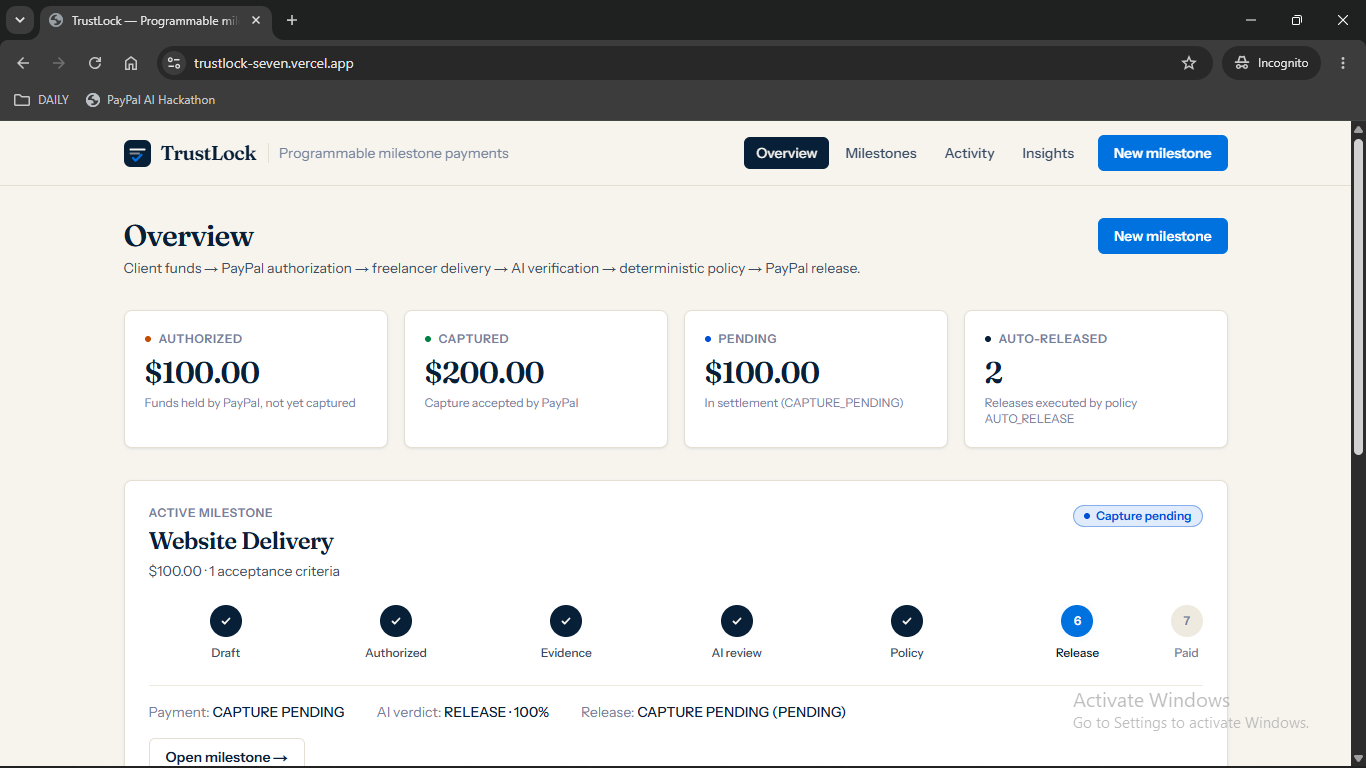
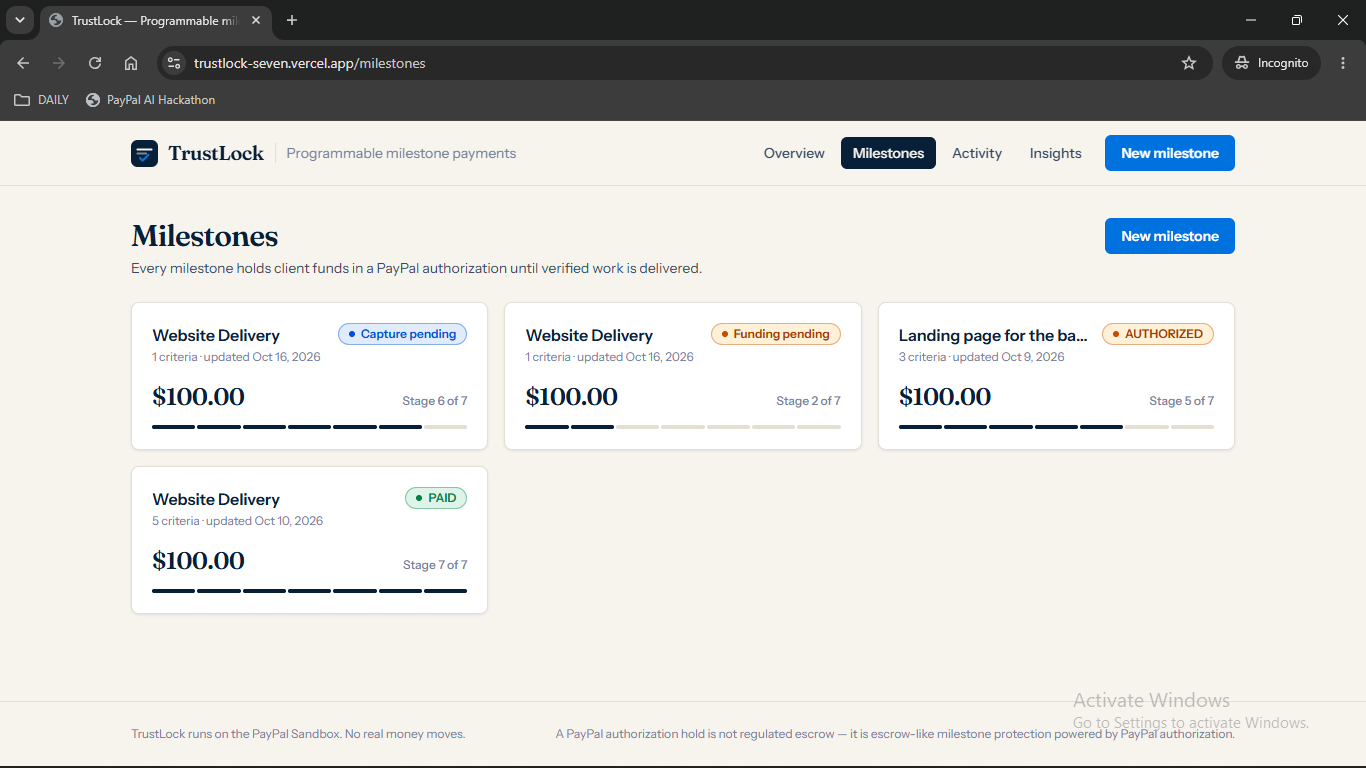
TrustLock is escrow-like milestone protection powered by a PayPal authorization:
- The client creates a milestone with structured acceptance criteria and funds it through PayPal. The money is authorized — held, not captured (Orders v2
intent=AUTHORIZE→ buyer approves → server authorizes → funds held for 29 days). - The freelancer delivers and submits evidence (deliverable URL + notes).
- An AI verification agent fetches the deliverable server-side and evaluates every acceptance criterion — PASS / FAIL / INCONCLUSIVE, each with cited evidence and a confidence score. It never invents criteria and never marks INCONCLUSIVE as PASS.
- A deterministic policy engine — not the AI — decides whether the verdict may cause a payment: AUTO_RELEASE (confidence + amount caps), HUMAN_REVIEW, REQUEST_CHANGES, or REJECTED.
- On approval, TrustLock captures the authorization (full or partial) with a stable
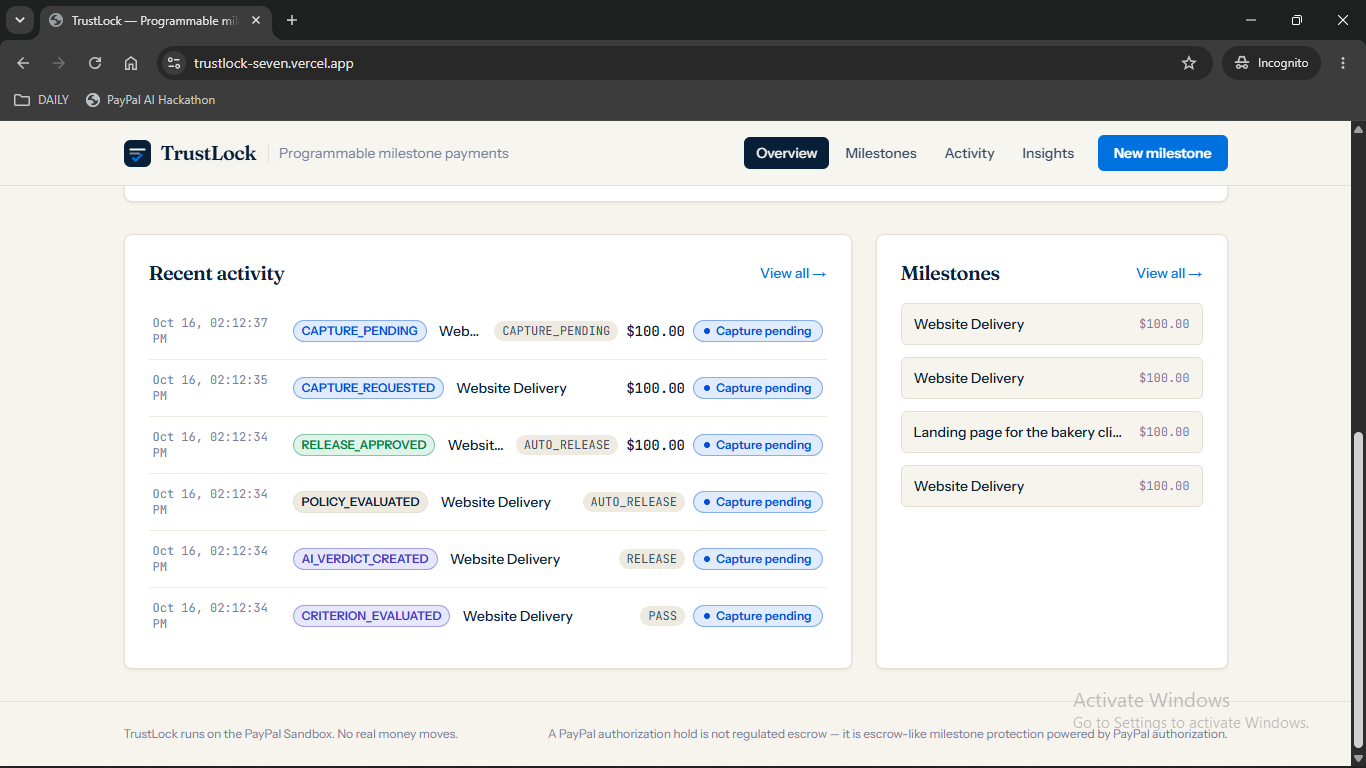
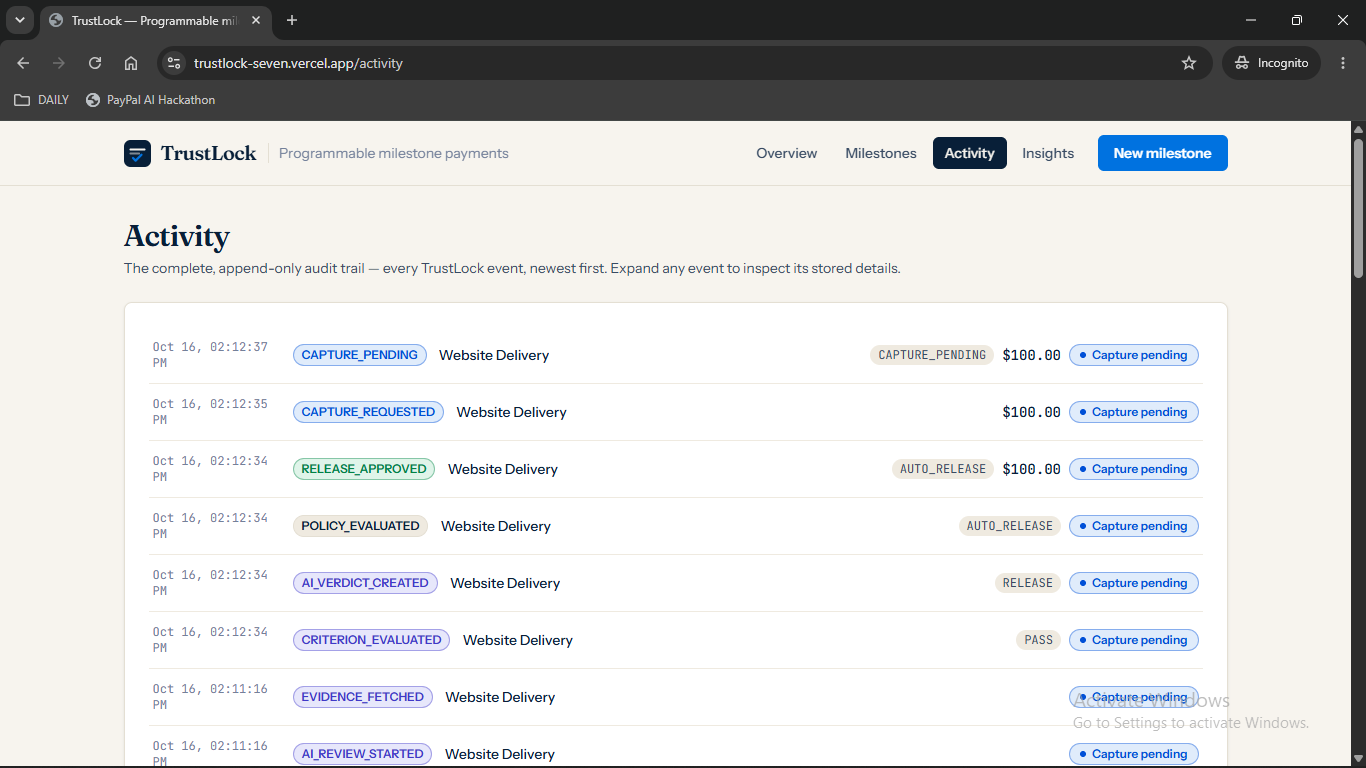
PayPal-Request-Id, reads the capture back, and reconciles async settlement (CAPTURE_PENDINGuntil PayPal reportsCOMPLETED— never shows PAID while PENDING). - Every decision is recorded in an append-only audit trail; an AG Studio dashboard gives real-time, self-serve analytics (with an AI assistant panel).
How we built it
- Stack: Next.js 15 (App Router) · TypeScript · React 19 · PostgreSQL (Neon) · Tailwind v4.
- PayPal: direct REST integration (Orders v2 authorize/capture/void, Payments v2, transaction reporting, webhooks with signature verification) + the JavaScript SDK (
intent=authorize) for buyer approval. Sandbox only — no real money moves. - AI: Vercel AI SDK + Google Gemini (
generateObjectwith a strict Zod schema for the structured verdict), with a model fallback chain for reliability. - Policy: a pure, deterministic engine (
lib/policy/engine.ts) — thresholds and caps, no LLM judgment on money movement. - Frontend: a "Ledger & Trust" design system, an operational control-room milestone page, a live agent trace, and an AG Studio insights dashboard (custom layout, KPIs, charts, AI assistant).
- Safety: server-derived payment state, amount/ownership checks on every mutation, idempotent releases (unique constraints + stable idempotency keys), append-only audit tables (trigger-enforced).
Challenges we ran into
- Sandbox async settlement. Captures can be accepted as
PENDINGand stay pending for minutes — we built a reconciler + webhook path so the UI never claims PAID before PayPal confirms. - Model availability.
gemini-2.5-flashwas retired mid-build andgemini-3.8-flashwas rate-limited — we probed availability live and shipped a fallback chain. - Vercel build failures. AG Studio is heavy (build OOM on small machines), and
next/font/googlefailed at build time on Vercel — we self-hosted the fonts (next/font/local). - Honesty vs. demo pressure. The agent marked criteria INCONCLUSIVE when text evidence couldn't establish them (e.g. mobile viewport) — we kept that behavior; it's the product's core differentiator.
Accomplishments that we're proud of
- A fully working, live-verified loop: fund → hold → evidence → AI verification (RELEASE, 100% confidence, 5/5 criteria) → policy AUTO_RELEASE → PayPal capture → CAPTURE_PENDING, with a complete audit trail.
- The honesty path: the same system returns REQUEST_CHANGES and releases $0 when evidence is insufficient — no rubber-stamping.
- No duplicate captures: duplicate release requests are idempotent (proven at PayPal: exactly one capture per authorization).
- A premium, truthful UI — and an AG Studio dashboard with an AI assistant panel.
What we learned
- PayPal's authorize → capture → void lifecycle is a genuinely underused escrow primitive — the 29-day hold, 3-day honor period, and single reauthorization (Day 4–29) map perfectly onto milestone work.
- Treating AI output as untrusted input (Zod + deterministic policy) is what makes autonomous payment release defensible.
- Judges don't run your code — the video and the write-up are the product.
What's next for TrustLock
- Multi-milestone contracts, milestone reauthorization scheduling, and a void/cancel path.
- Partial-release remainder handling and dispute support.
- Real authentication and a freelancer payout rail (PayPal Payouts), then a production launch.
Built With
- ag
- ai
- api
- css
- gemini
- grid
- javascript
- neon
- next.js
- node.js
- paypal
- postgresql
- react
- rest
- sdk
- studio
- tailwind
- typescript
- vercel

Log in or sign up for Devpost to join the conversation.