-
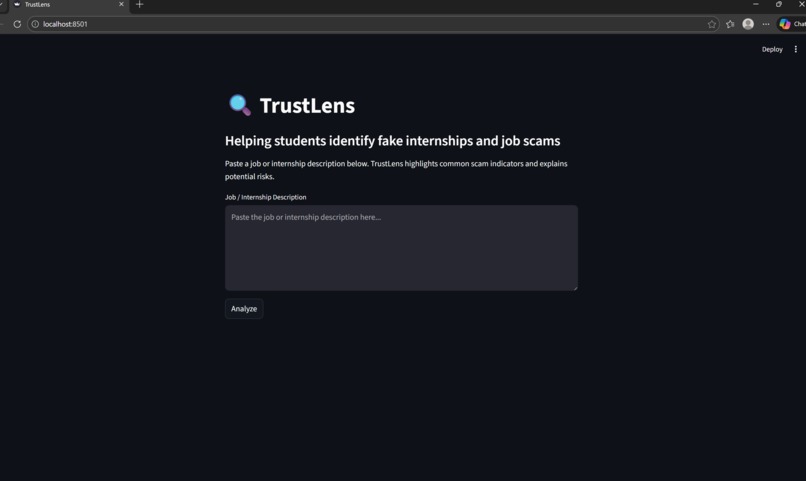
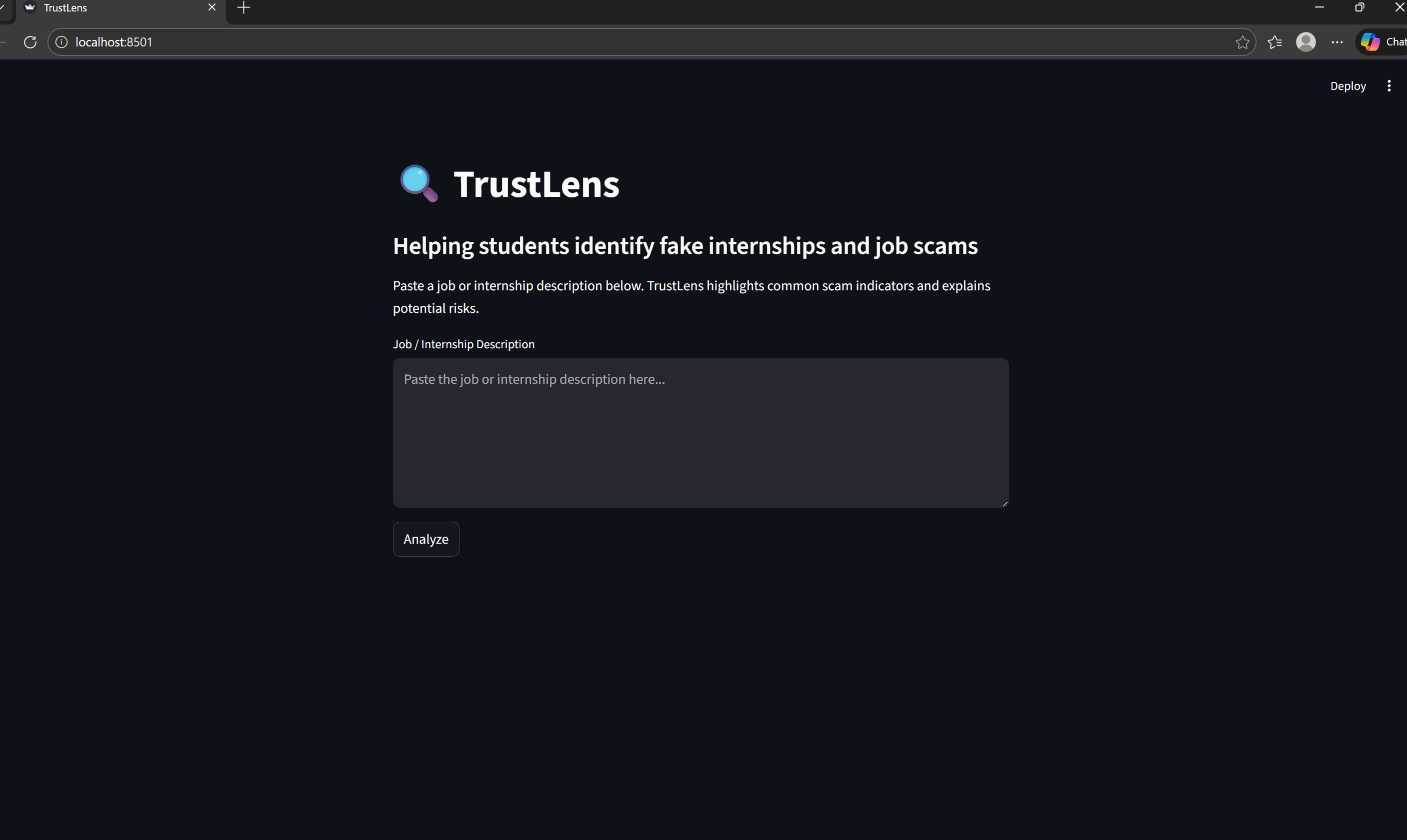
Screenshot of TrustLens web interface.
TrustLens
Inspiration
Job and internship related scams have escalated to a great extent over recent years. They mostly occur in places where people normally feel safe such as emails, messaging apps, and social media. There is a large number of people who do not see the red flags because they are not trying to deceive themselves but because scammers have made their scams in such a way that they appear to be legit. TrustLens came out of the need for a tool that helps people not only to avoid but to understand the risk.
What it does
TrustLens looks for verbiage in the case of a job or internship description. These phrases, among others, serve as a signal for the presence of a scam in which illusory salaries, payment in advance, use of the urgent tone, roles that are not clearly defined, or even contact that comes from a suspicious source may be found. The risk is only indicated by TrustLens which also points out why in simple words. To remind themselves, users can also export structured PDF risk evaluation report.
How we built it
The rule-based detection system used in the building of TrustLens was quite a challenge that eventually provided scam patterns from the real world served as the basis. The indicators of a scam are in the externally located JSON files from which they can easy be retrieved and updated. The program is designed to be a less heavy web frontend that puts the emphasis on the user's understanding, openness, and invite other people, rather than on complex automation.
Challenges we ran into
It was a difficult task to come up with a set of very demanding posting texts that will be flagged as fraudulent without which legitimate ones will be mistakenly flagged. The another difficult task was to keep the level of simplified explanations balanced with the input without being too brief and also without being too long. Moreover, it was a technical issue of managing file creation and at the same time keeping the user interface neat under limited time.
Accomplishments that we're proud of
We have a working prototype that not only points out fraud but also provides a reason for it behind the words. TrustLens is available in other forms apart from the usual job portals thanks to the downloadable PDF report and platform-agnostic design. Above all, it is very important that the tool be used for awareness rather than that the users blindly filter.
What we learned
From the building of TrustLens, we realized that trust is better earned through transparency rather than through automation. Users are in a better position to take decisions if they are provided with clear explanations, and also, they do not overly depend on the tools. Besides, we have gotten hands-on experience in conceptualizing user-centered, ethical software.
What's next for TrustLens
Some of the upgrades in the pipeline are adaptive detection, community-updated scam indicators, company domain verification, and multilingual support. Besides that, TrustLens may be converted into an API, browser extension, or campus awareness tool.


Log in or sign up for Devpost to join the conversation.