-
-
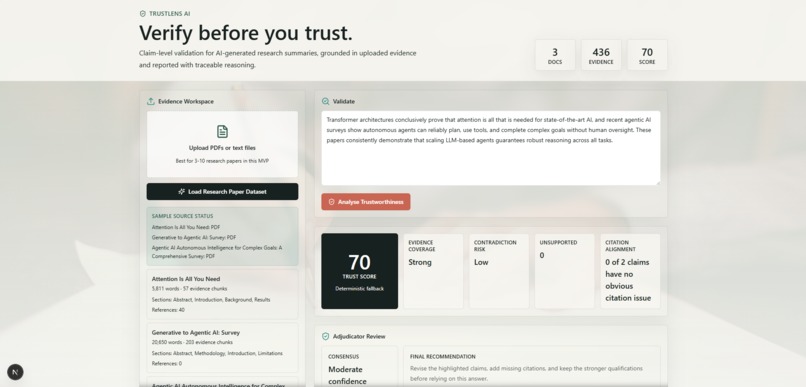
Landing-page
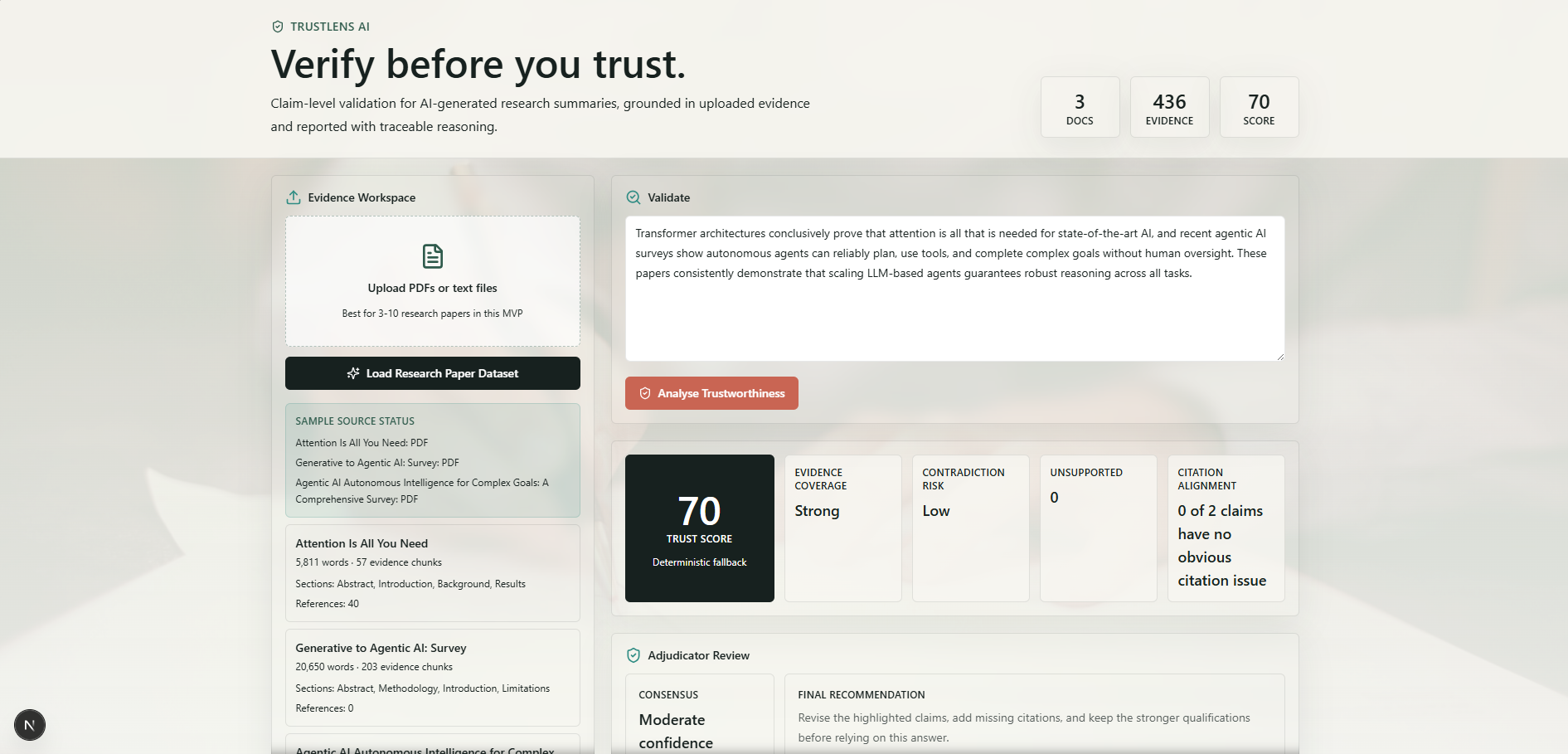
Inspiration
AI tools can generate polished research summaries, but they can also make unsupported or overconfident claims. TrustLens AI was inspired by the need for a transparent way to verify AI-generated academic and research writing against actual source documents before trusting or sharing it.
What it does
TrustLens AI validates AI-generated research claims against uploaded papers and evidence. It breaks an answer into individual claims, retrieves relevant passages from the uploaded documents, checks whether each claim is supported, partially supported, unsupported, contradicted, or has insufficient evidence, and generates a clear trust report.
It also flags overclaiming, citation alignment issues, originality risk, and missing qualifications. At the end, it produces an evidence-grounded rewritten answer that is safer and more faithful to the source material.
How we built it
I built TrustLens AI as a web app using Next.js, TypeScript, and Tailwind CSS. The app includes document upload and parsing, claim decomposition, evidence retrieval, claim validation, trust scoring, citation checking, originality analysis, and evidence-calibrated rewriting.
The system uses a multi-agent workflow with specialized agents for claim decomposition, evidence retrieval, citation alignment, originality checking, validation, scoring, research guidance, and rewriting. I also added a Demo Mode with bundled sample research data so judges can test the full workflow without needing API keys or external setup.
Challenges we ran into
My major challenge was making the verification process explainable instead of returning only a single score. I needed to show why each claim was supported or unsupported by connecting every judgment back to specific evidence passages.
Another challenge was handling nuanced academic language, long documents, partial support, citation mismatches, and overclaiming. I also focused on making the demo reliable for judges by adding deterministic fallback behavior when external AI services are unavailable.
Accomplishments that we're proud of
I am proud that TrustLens AI goes beyond a basic chatbot interface and produces an auditable trust report. The app gives claim-level evidence, trust scoring, originality checks, citation alignment, and a rewritten answer grounded in the uploaded documents.
I am also proud of the Demo Mode, which makes the project easy to evaluate, and the multi-agent architecture that separates the core research verification tasks clearly.
What we learned
I learned that trustworthy AI is not only about generating better answers, but also about making the reasoning process inspectable. A useful research assistant should show uncertainty, cite evidence, and make it easy for humans to review the final judgment.
I also learned how important it is to design for edge cases such as partial evidence, unsupported claims, and claims that sound plausible but are not actually present in the source documents.
What's next for TrustLens AI
Next, I want to expand TrustLens AI with deeper PDF understanding, stronger semantic retrieval, collaborative review workflows, and integrations with research tools such as Zotero, Google Drive, and institutional repositories.
I also plan to add support for larger document collections, richer citation analysis, exportable research audit reports, and more advanced evaluation benchmarks so TrustLens AI can become a dependable research companion for students, academics, and professionals.
Built With
- codex
- gpt-5.6
- next.js
- typescript

Log in or sign up for Devpost to join the conversation.