Inspiration
Finding a place to live should not feel risky, but for students and young renters, it often does. Across countries, people lose time, money, and trust due to fake rental listings and scams—especially when searching online under pressure. Several of our team members have personally seen friends lose deposits or narrowly avoid scams. This made us ask a simple question: why is it still so hard to tell if a rental listing is real? TrustLease was inspired by the need for a fast, accessible way to restore trust in the rental search process.
What it does
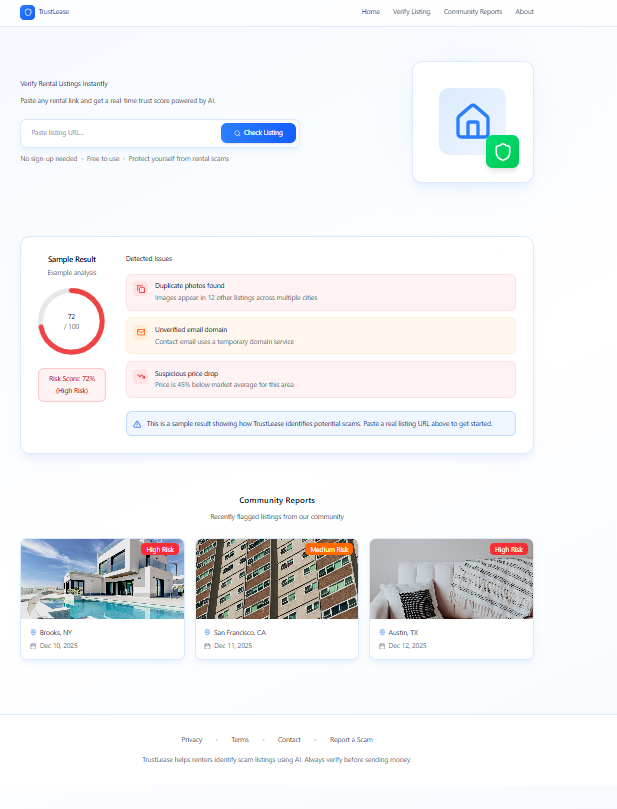
TrustLease is a concept for a rental-listing verification tool that helps renters identify potentially fraudulent housing ads before they send money. Users paste a rental listing link into the platform and receive a risk score based on automated checks such as duplicate images, suspicious contact details, and known scam patterns. The platform also highlights common red flags and allows community reporting to warn others. The goal is to help renters make safer decisions with minimal effort.
How we built it
This project was developed as an ideation and design-focused solution, not a full software build. We started by researching rental scam patterns, user pain points, and existing solutions. From there, we defined a clear MVP scope and designed user flows showing how a renter would interact with the tool. We created a UI mockup to visualize the experience and mapped out the technical feasibility using existing APIs and lightweight AI-based analysis. AI tools were used only for brainstorming, not for generating final content verbatim.
Challenges we ran into
One major challenge was balancing accuracy with simplicity. Rental fraud detection is complex, and we had to carefully scope what could realistically be included in an MVP without overpromising. Another challenge was ensuring the solution works across different countries, where rental platforms and data availability vary. We also had to think carefully about false positives and ethical concerns—flagging a legitimate listing incorrectly could cause harm if not handled responsibly.
Accomplishments that we're proud of
- Clearly defining a real, global problem backed by data
- Designing a solution that is feasible, ethical, and user-centered
- Creating a clean, intuitive UI mockup that communicates the idea effectively
- Demonstrating how the concept could realistically move from idea to MVP
- Keeping the solution accessible and student-friendly without relying on heavy infrastructure ## What we learned We learned that strong ideas don’t need to start with code—they start with understanding users deeply. This ideathon helped us practice breaking down complex systems into testable MVPs and thinking critically about trust, ethics, and inclusion in technology. We also learned how important clarity is: a simple, well-explained idea can be more powerful than a technically complex one. ## What's next for TrustLease If taken forward, the next steps would include building a small working prototype, testing it with real renters, and refining the risk-scoring logic based on feedback. We would also explore partnerships with housing platforms, student communities, and tenant-rights organizations. Long-term, TrustLease could expand to include verified landlord profiles, localized scam alerts, and deeper integrations with trusted data sources—helping renters everywhere search with confidence.
Built With
- chatgpt
- online

Log in or sign up for Devpost to join the conversation.