-
-
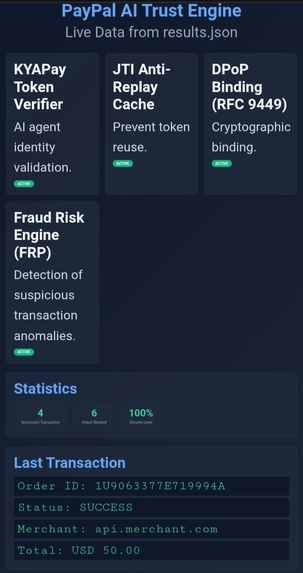
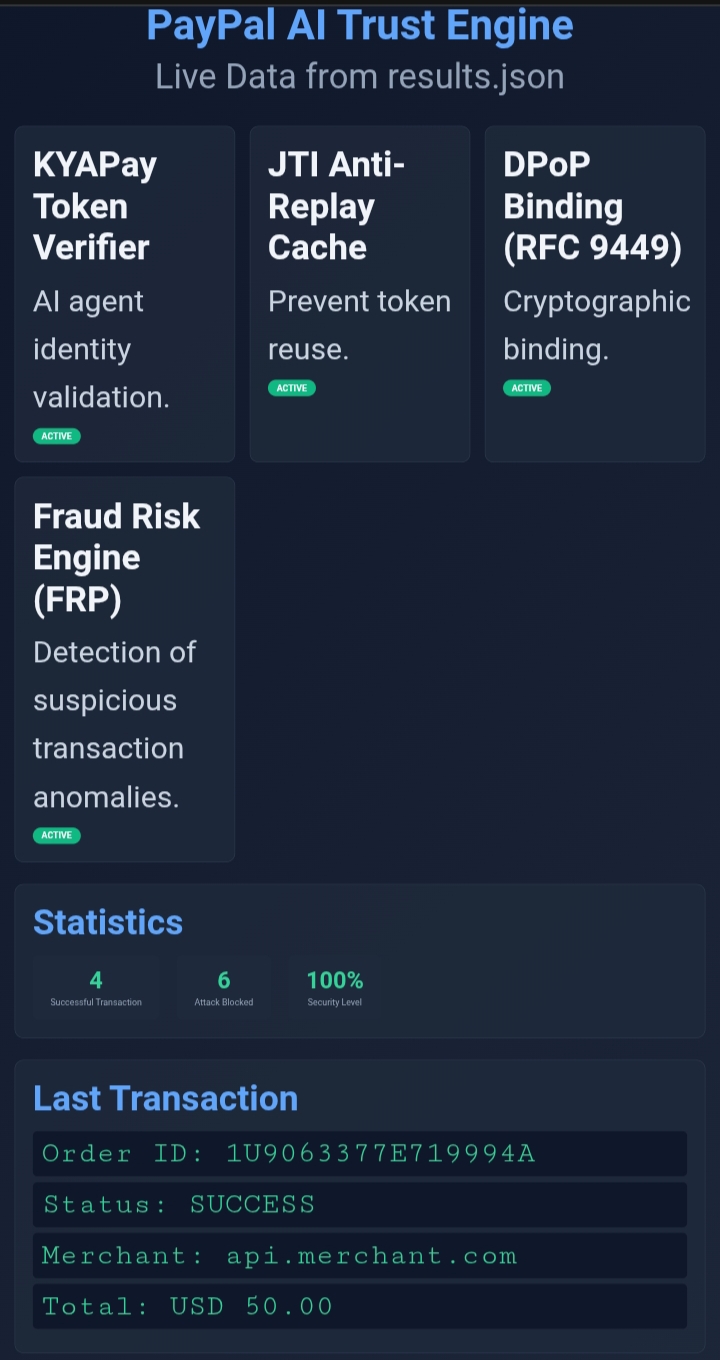
AI-agent payment security prototype interface and monitoring visualization
Inspiration
As AI agents become increasingly capable of interacting with payment services, security must go beyond simply granting an agent access to a payment API.
We were inspired to explore a critical question: how can we establish stronger trust boundaries before an AI agent initiates a payment?
TrustGuard Agent was developed as a prototype to investigate layered authorization, replay protection, proof-of-possession concepts, and anomaly-detection research in AI-agent payment workflows.
What It Does
PayPal AI Trust Engine — TrustGuard Agent is a multi-layered security prototype with the following components:
- KYAPay Token Verifier: Validates selected authorization claims and delegation constraints.
- JTI Anti-Replay: Demonstrates detection and rejection of previously used token identifiers.
- DPoP Binding: Implements selected proof-binding checks as part of the security research.
- Fraud Risk Research: Evaluates synthetic anomaly-detection scenarios.
- PayPal Sandbox Integration: Explores controlled payment integration without claiming real-money transactions.
- Monitoring Dashboard: Presents project information and explicitly simulated sample data.
How We Built It
The backend is developed in Python, with FastAPI and supporting security libraries.
The frontend uses HTML, CSS, and JavaScript. A JSON data bridge connects the dashboard to the project's data output.
GitHub Actions provides automated testing and validation. GitHub Pages hosts the public dashboard.
The research architecture maintains the V3 baseline while introducing V4 as a Synthetic Anomaly Detection Evaluation track.
AI and Machine Learning Approach
The V4 research direction focuses on evaluating anomaly-detection behavior using synthetic data.
It is intentionally not presented as supervised fraud classification or as a model validated against real-world fraud transactions.
This separation helps preserve the existing V3 baseline while allowing controlled experimentation with synthetic anomaly scenarios.
Challenges and What We Learned
One of the main challenges was separating authorization verification from payment execution.
We also investigated token replay protection, proof binding, deterministic security testing, and the consistency of transaction data across system components.
The project reinforced the importance of distinguishing successful automated tests from verified production security guarantees.
Current Limitations
TrustGuard Agent is a research and hackathon prototype, not a production-ready payment-security gateway.
- Anti-replay state currently uses an in-memory mechanism.
- Full DPoP proof-signature verification is not yet implemented.
- Synthetic evaluation does not establish real-world fraud detection accuracy.
- Payment dispatch is disabled in the CI workflow.
- The published dashboard uses simulated data and does not claim live transaction statistics.
Future Direction
Future development will focus on stronger cryptographic proof verification, persistent atomic replay protection, transaction-payload integrity, and more complete PayPal Sandbox integration.
Our goal is to explore how layered security controls can make AI-agent payment workflows more trustworthy.
TrustGuard Agent — Verify First. Authorize Carefully. Pay Securely.
What it does
How we built it
Challenges we ran into
Accomplishments that we're proud of
What we learned
What's next for TrustGuard Agent
Built With
- css
- fastapi
- githubactions
- githubpages
- html
- javascript
- jwt
- paypal
- paypalsandbox
- python
- restapi
- scikit-learn
