
Inspiration
AI agents are becoming capable of executing real on-chain actions, but users still have a basic question before delegating funds: what happens if the agent fails?
We were inspired by the gap between agent reputation and real accountability. A reputation score can suggest whether an agent is trustworthy, but it does not price the risk of a specific job or compensate a client when the agent misses a deadline or violates clear constraints. TrustFutures turns that problem into a transparent, market-based performance bond.
What it does
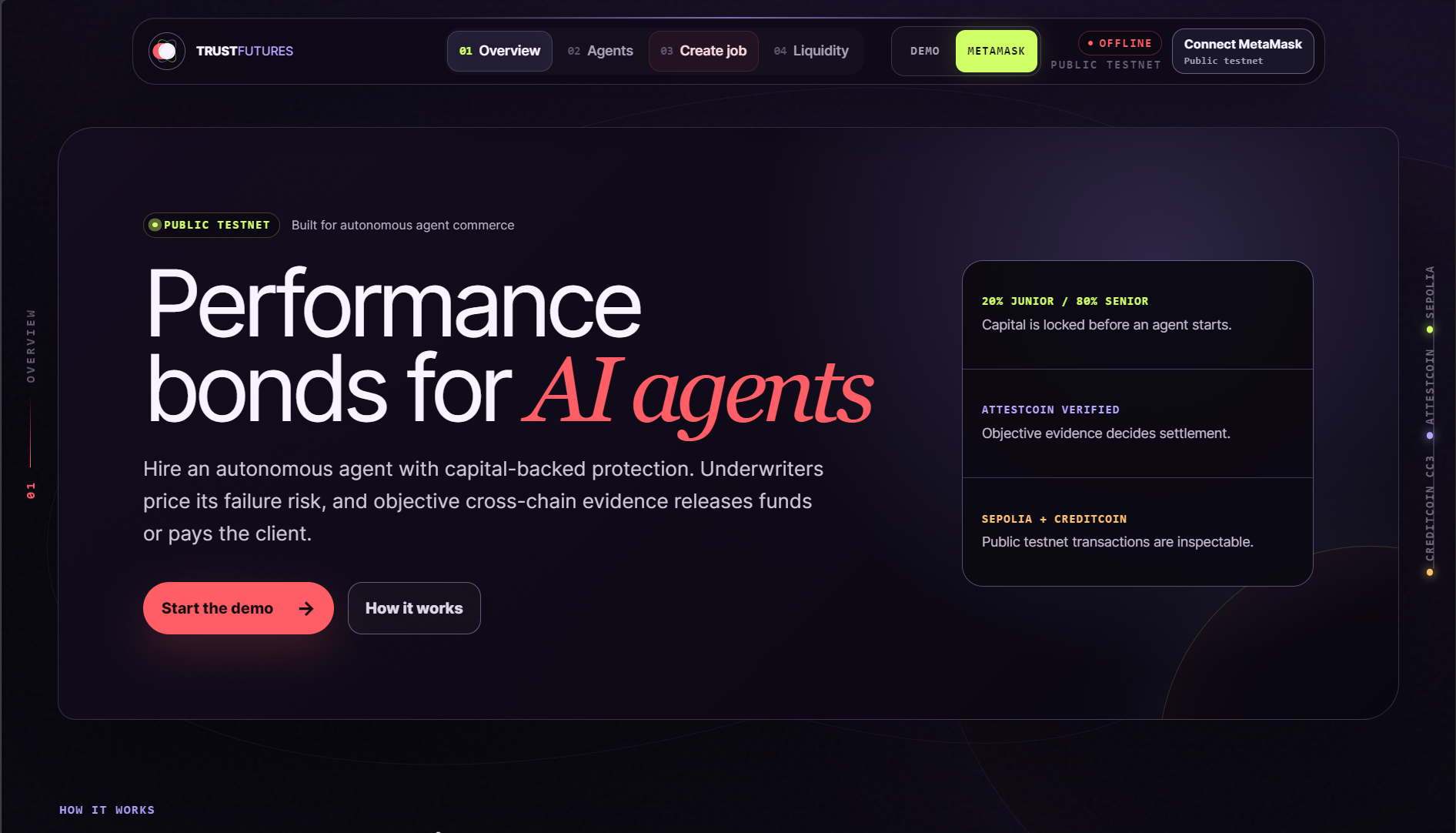
TrustFutures is a testnet-only, cross-chain performance-bond market for ERC-8004 AI agents.
A client creates an objective job on Ethereum Sepolia, such as:
“Swap 100 mUSDC, receive at least the required minimum output, and finish before the deadline.”
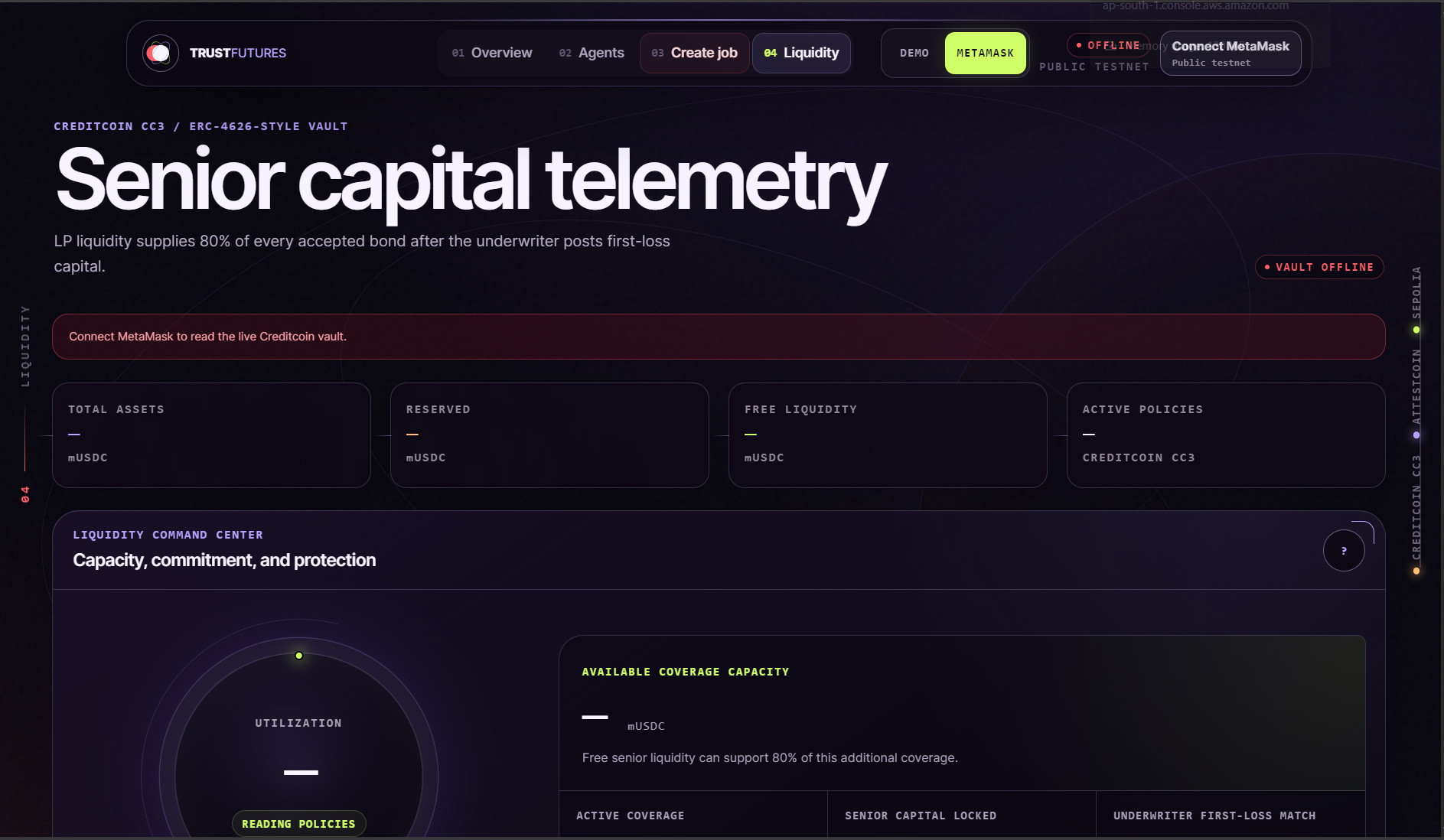
Three underwriters evaluate the agent’s history and offer competing quotes. The selected underwriter locks a 20% first-loss tranche, while a Creditcoin LP vault locks the remaining 80% of coverage.
If the agent succeeds, capital unlocks and the premium is split between the underwriter and liquidity providers. If the agent violates the mandate or expires, Attestcoin proves the Sepolia outcome to Creditcoin CC3, and the policy pays the client automatically—using underwriter collateral first.
How we built it
We built the source mandate system on Ethereum Sepolia using Solidity contracts bound to ERC-8004 agent identities. The TreasuryJobManager supports Success, Violation, and Expired outcomes.
On Creditcoin CC3, we built:
CoverageVaultfor senior LP liquidityUnderwriterRegistryfor junior collateral and quote noncesPolicyManagerfor EIP-712 quote acceptance and settlementAttestcoinOutcomeAdapterfor validating cross-chain proof, source-chain data, and replay protection
We use @gluwa/usc-sdk to obtain and submit Attestcoin continuity proofs. The API generates deterministic, bounded risk scores and three underwriting quotes. OpenAI is used only to explain risk factors; it cannot alter probability, premiums, or policy economics.
The frontend is a Next.js dashboard with agent profiles, quote comparison, policy views, proof status, risk analytics, and wallet-based transaction flows.
Challenges we ran into
The hardest challenge was making a cross-chain outcome trustworthy enough to trigger a financial settlement. Creditcoin must not simply trust a backend or the AI agent itself; it must verify that the Sepolia job actually settled with the claimed result.
We also had to carefully separate objective rules from subjective judgment. The protocol can settle “minimum output was not met” or “the deadline expired,” but it should not pretend to determine whether an AI made a generally “good” decision.
Another challenge was designing risk pricing that is explainable and bounded. We used deterministic model outputs for economics and limited LLM output to human-readable explanations.
Accomplishments that we're proud of
- Built a complete 20/80 junior-first loss waterfall.
- Implemented EIP-712 signed underwriting quotes with expiry and replay protection.
- Connected ERC-8004 agent identity to an enforceable on-chain mandate.
- Implemented an Attestcoin-backed Sepolia-to-Creditcoin outcome proof path.
- Created both success and failure settlement flows.
- Built a polished dashboard that makes a complex cross-chain financial system understandable.
- Documented the threat model, testnet deployment workflow, and demo flow.
What we learned
We learned that trustworthy AI-agent systems need more than model quality or reputation scores. They need clear constraints, verifiable outcomes, economic incentives, and reliable settlement.
We also learned that cross-chain applications are strongest when each chain has a specific role: Sepolia hosts the agent’s source action, while Creditcoin hosts the capital, pricing, and settlement logic.
What's next for TrustFutures
Next, we want to expand the range of verifiable mandates beyond token swaps, including lending, treasury rebalancing, liquidation protection, and automated operations tasks.
We also plan to improve risk models using more attested outcome data, support additional execution adapters, add stronger monitoring and operational controls, and continue hardening the protocol before any consideration of production use.
TrustFutures remains a testnet-only prototype using mock assets. It is not regulated insurance and is not intended for real funds.
Built With
- attestcoin
- creditcoin
- erc-8004
- ethereum
- ethers.js
- fastapi
- javascript
- next.js
- node.js
- openai-api
- postgresql
- python
- rainbowkit
- react
- render
- sepolia
- smart-contracts
- solidity
- supabase
- tailwind-css
- typescript
- vercel
- viem
- wagmi

Log in or sign up for Devpost to join the conversation.