Inspiration
The traditional rental market is bogged down by high intermediary fees, slow bank transfers, and complex credit checks. We wanted to build a streamlined, crypto-native solution that leverages the Solana blockchain to make renting a property as fast and transparent as a DeFi swap.
What it does
LeaseLedger is a decentralized rental platform that eliminates the "middleman" for landlords and tenants.
On-Chain Listings: Landlords can list their properties directly on the platform, creating a permanent and verifiable record of available housing.
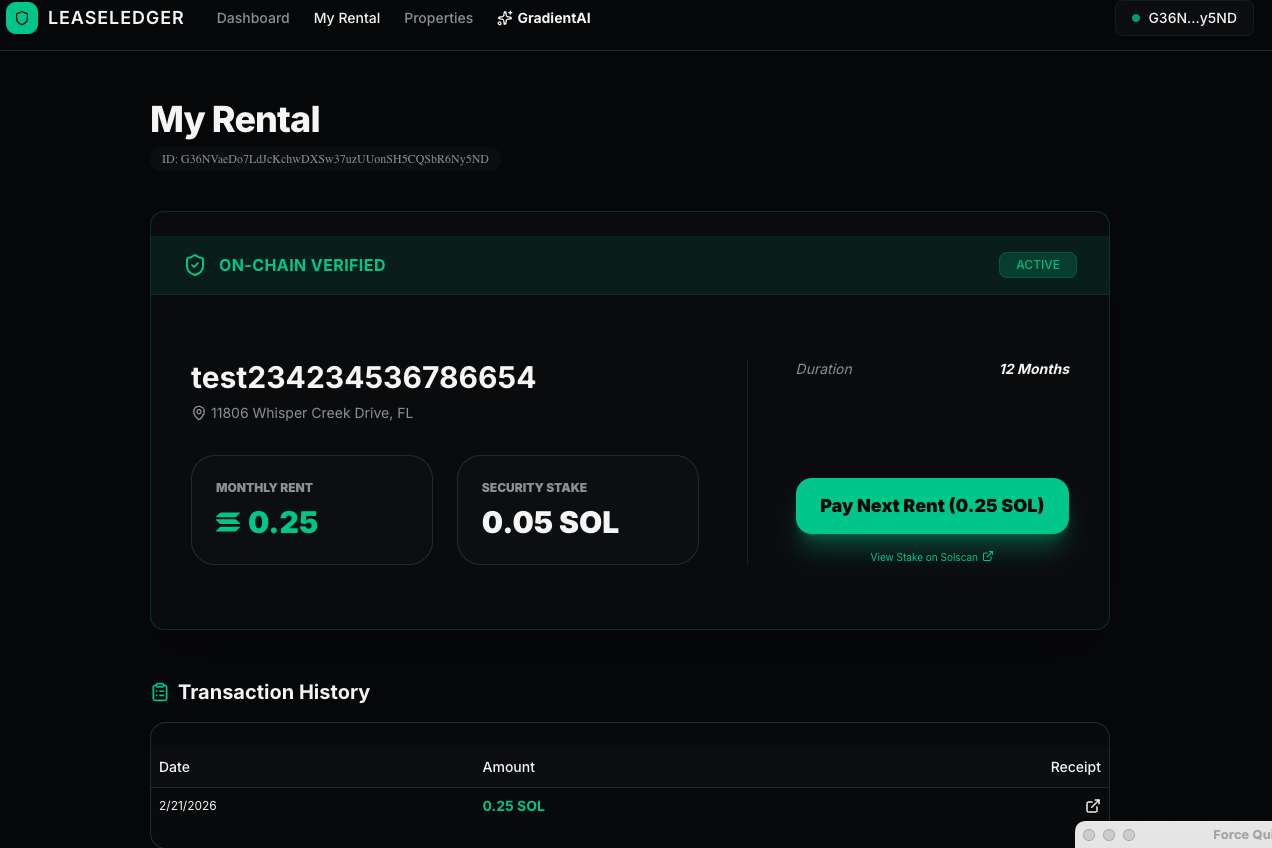
Staked Applications: To prove financial serious and "skin in the game," tenants apply for properties by staking SOL. This acts as a decentralized proof of funds and commitment, replacing traditional, invasive credit checks.
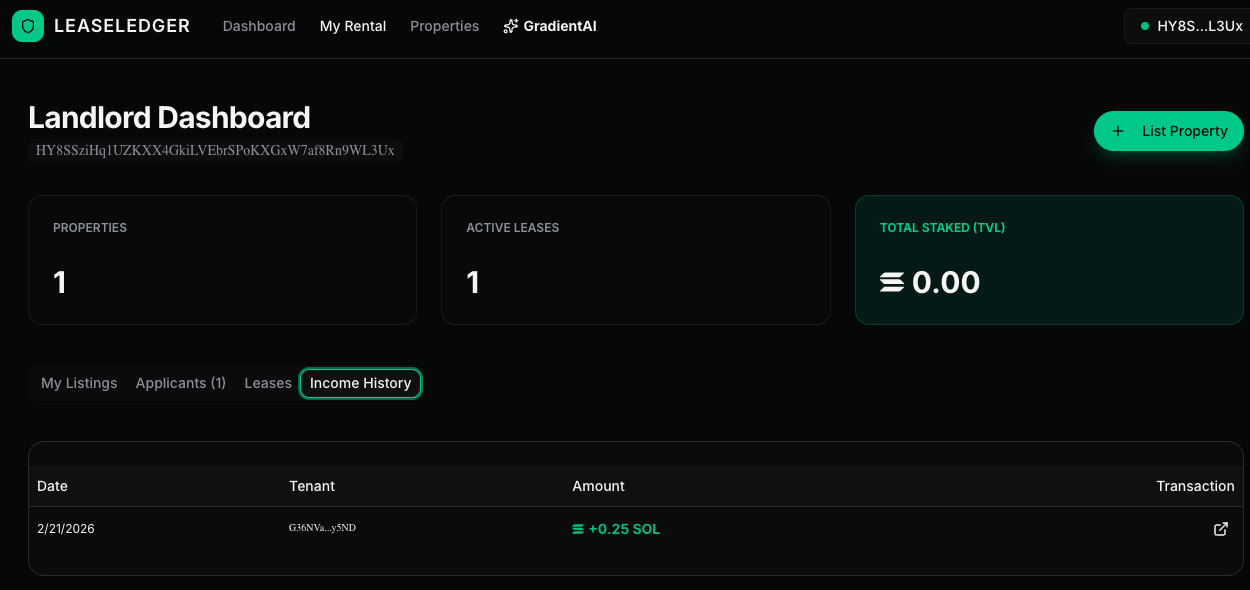
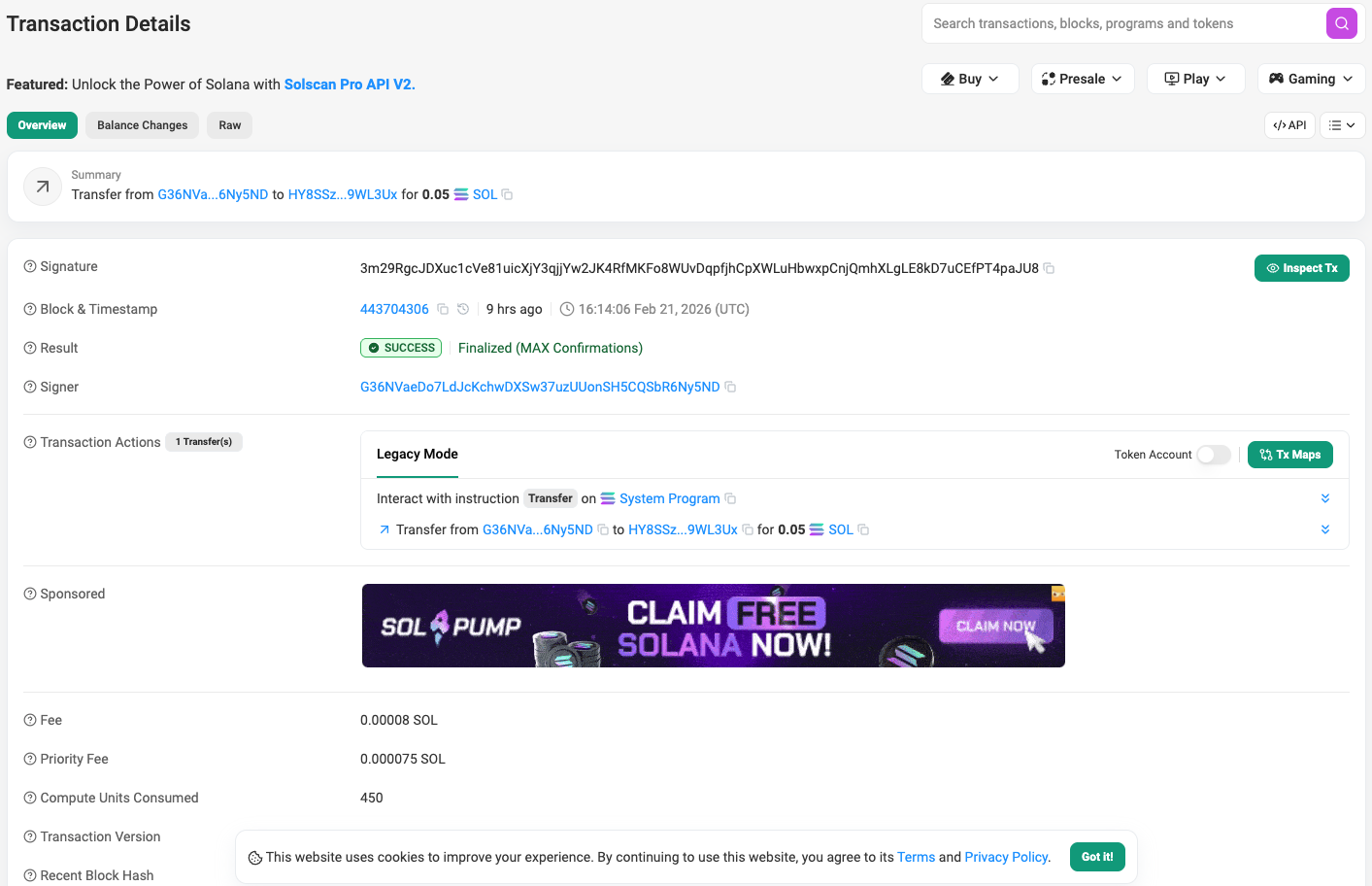
Streamlined Rent Payments: Tenants pay rent directly in SOL. Transactions are near-instant, have negligible fees, and provide an immutable payment history for both parties.
GradientAI Assistant: A smart assistant that analyzes your on-chain rental activity (leases, stakes, and payments) to give you instant updates on your rental standing and earnings.
How we built it
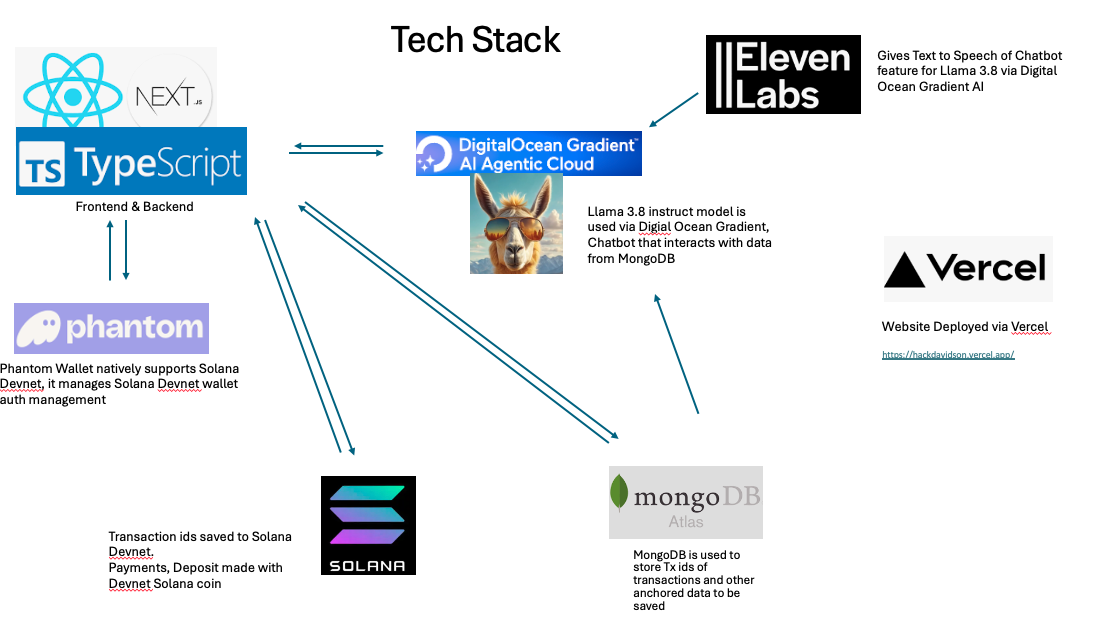
Frontend: Built with Next.js , featuring a clean dashboard for managing property listings and applications.
Wallet Integration: Powered by Phantom Wallet, allowing users to sign transactions for staking and paying rent securely.
AI Intelligence: Integrated DigitalOcean’s Gradient AI (Llama 3). We built a custom "Context Bridge" that pulls the user's Solana transaction history from MongoDB and feeds it into the AI so it can speak intelligently about their specific leases.
Voice Integration: Integrated ElevenLabs for a premium VoiceAI experience, giving our rental assistant a professional and helpful voice for the user.
Best Use of Vercel
Who knows Vercel could be powerful Vibe-Coding/Design tool? We tried V0 by Vercel to make fancy frontend of our platform. We figured that if we ask V0 by Vercel to implement backend feature, it would lead to failure. However, V0 by Vercel offers visually appealing clean front-end. After that, we coded backend features and connected them to our frontend application.
In addition to V0 by Vercel, Vercel offers a free no-cost-at-all deployment of web application. We successfully deployed it to vercel. https://hackdavidson.vercel.app/
MLH Track - Solana
LeaseLedger utilizes the Solana Blockchain as the source of truth for all financial and contractual interactions.
Stake-to-Apply: We implemented a "proof of commitment" system where tenants stake SOL via the Phantom Wallet to apply for properties, replacing traditional credit checks with decentralized proof of funds.
On-Chain Payments: All rent is paid in SOL, benefiting from Solana’s high throughput and sub-penny transaction fees.
Immutable Ledger: Every lease agreement and rent payment is recorded on-chain, providing a transparent, non-custodial history that both landlords and tenants can trust without a middleman.
MLH Track - DigitalOcean
We deployed our project’s "intelligence" using DigitalOcean’s cutting-edge AI infrastructure.
Gradient AI (Llama 3): We leveraged DigitalOcean’s serverless inference to power GradientAI, our smart rental assistant.
Context Injection: We built a custom "Context Bridge" within a Next.js API route that pulls the user's rental history and feeds it into the Llama 3 model, allowing the AI to provide personalized insights rather than generic advice.
Scalable Hosting: The backend logic and API routes are designed to run seamlessly on DigitalOcean’s App Platform, ensuring low latency between the AI inference and the user.
MLH Track - ElevenLabs
To make LeaseLedger more accessible and engaging, we integrated ElevenLabs to give our AI assistant a premium voice.
Premium Text-to-Speech: We used the ElevenLabs API (specifically the eleven_multilingual_v2 model) to convert GradientAI's text responses into high-fidelity audio.
Multimodal Interaction: Users can toggle "Voice Mode" to have their rental standing, earnings, and lease details read aloud in a natural, professional voice, significantly enhancing the UX for a "concierge-style" property management experience.
MLH Track - MongoDB
MongoDB Atlas serves as the high-performance data hub that syncs our blockchain events with the frontend.
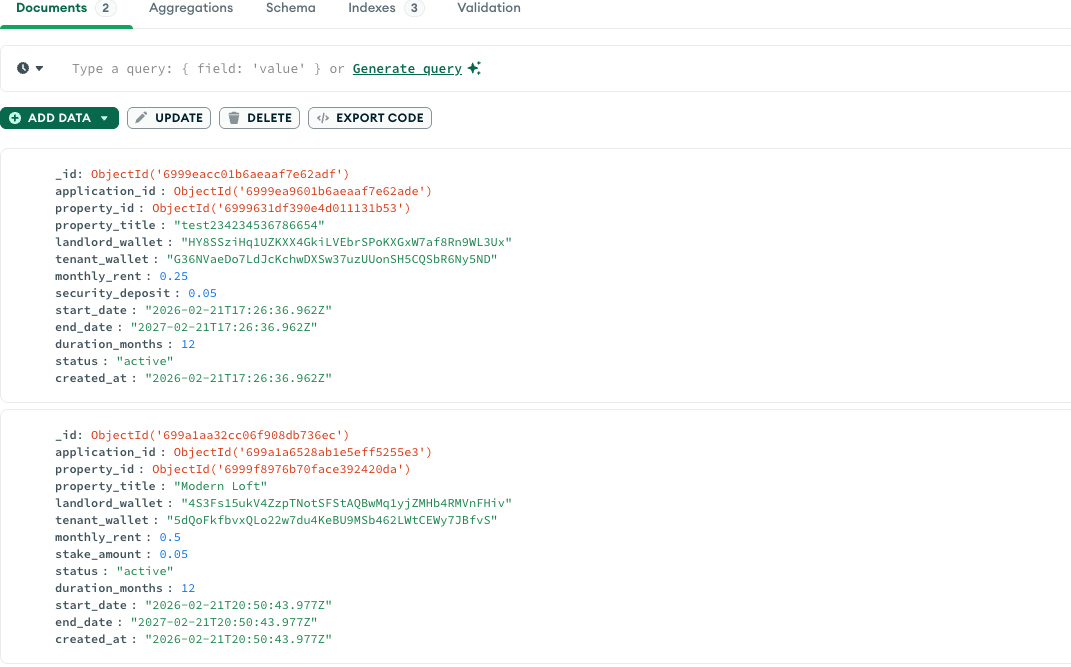
Relational Mapping: We used MongoDB to store property metadata (images, descriptions, amenities) that isn't efficient to store directly on-chain.
Fast Indexing: By indexing user wallets and lease IDs, we allowed the GradientAI to query complex rental histories in milliseconds, which would be significantly slower if querying the blockchain directly for every chat message.
Dynamic Schema: MongoDB's flexible schema allowed us to iterate quickly on our "Property" and "Evaluation" models as we refined the landlord-tenant application flow during the hackathon.
Challenges we ran into
Handling Staking Logic: Designing a flow where the user’s SOL is staked as part of the application process required careful consideration of Solana’s transaction lifecycle.
Data Synchronization: Ensuring the AI assistant stayed "in sync" with the latest on-chain payments required building a robust indexing system between the blockchain and our database.
Secure API Routing: Migrating our AI and Voice logic into Next.js API routes was a major step to prevent exposing sensitive API keys while maintaining fast performance.
Accomplishments that we're proud of
Trustless Applications: Successfully implementing the "Stake-to-Apply" feature, which introduces a new way for tenants to build trust without sharing private bank statements.
The "Magic" AI Moment: The first time GradientAI was able to tell a landlord exactly how much they earned in SOL this month by reading the blockchain data.
Seamless UX: Creating a crypto-native app that feels as intuitive as a traditional property management tool.
What we learned
We learned that the Solana ecosystem is uniquely suited for real-world assets (RWA) due to its high speed and low cost. We discovered that by using smart contracts, we can replace most of the administrative work usually handled by property managers, significantly lowering the barrier to entry for both landlords and tenants.
What's next for LeaseLedger
Automated Security Deposits: Smart contracts that automatically release security deposits back to the tenant upon successful lease completion.
Lease-Back NFTs: Turning active leases into NFTs that can be used as collateral for decentralized loans.
Reputation Scores: A decentralized "Tenant Score" based on on-chain payment history to help landlords find reliable renters faster.
Built With
- blockchain
- digitalocean
- elevenlabs
- llama
- mongodb
- next.js
- react
- solana
- typescript
- vercel

Log in or sign up for Devpost to join the conversation.