-
-
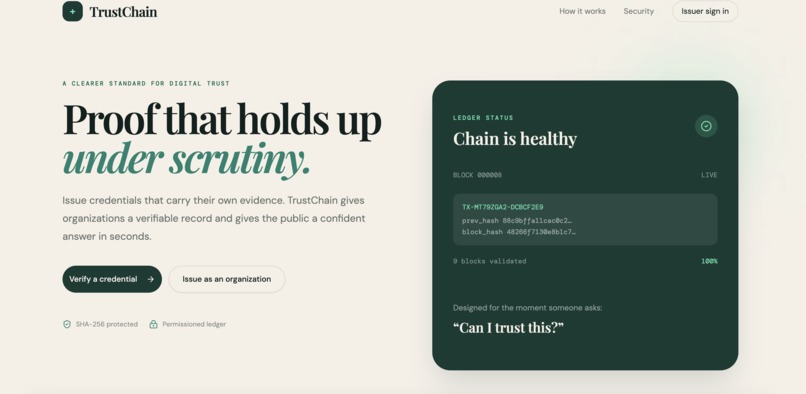
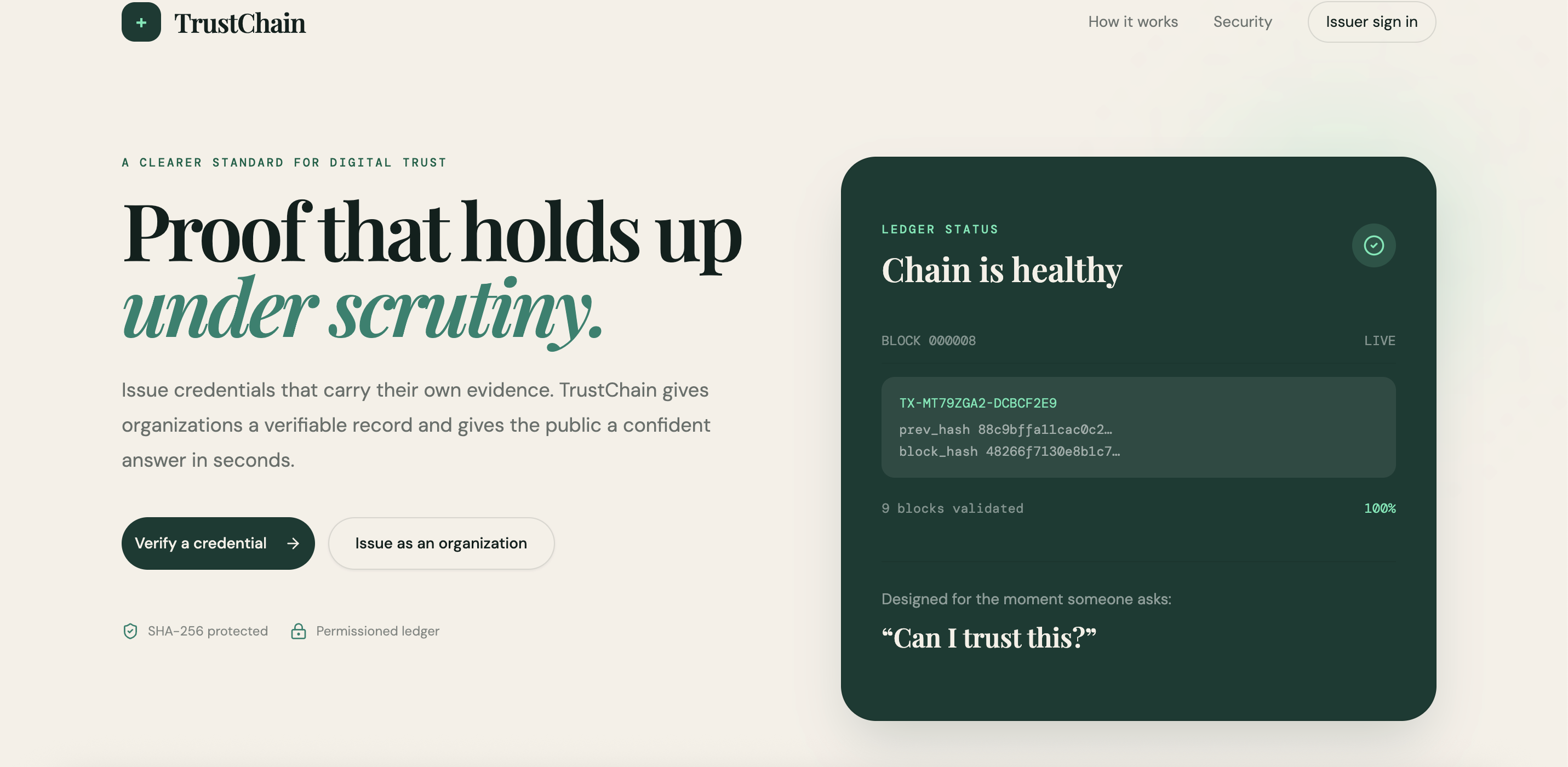
Home Page
-
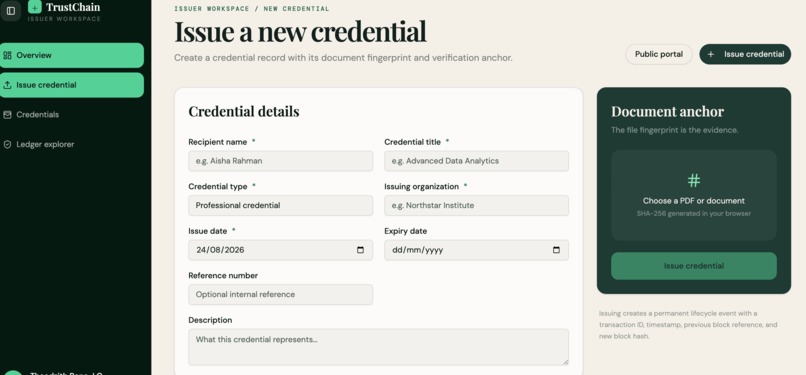
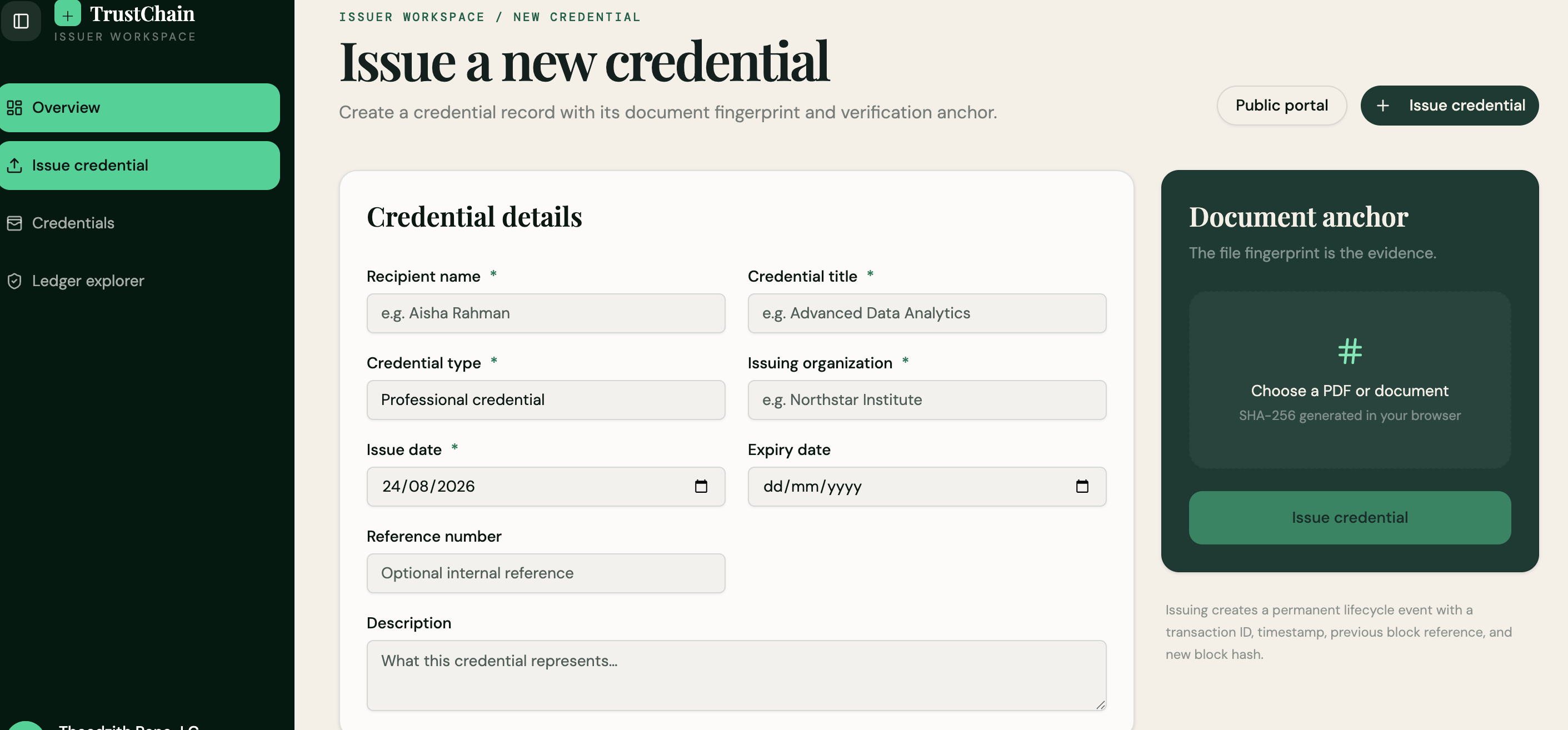
Credentials Page
-
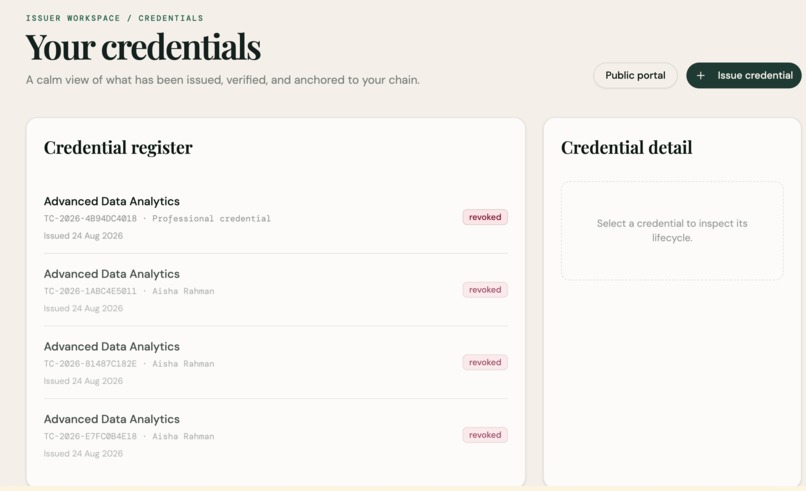
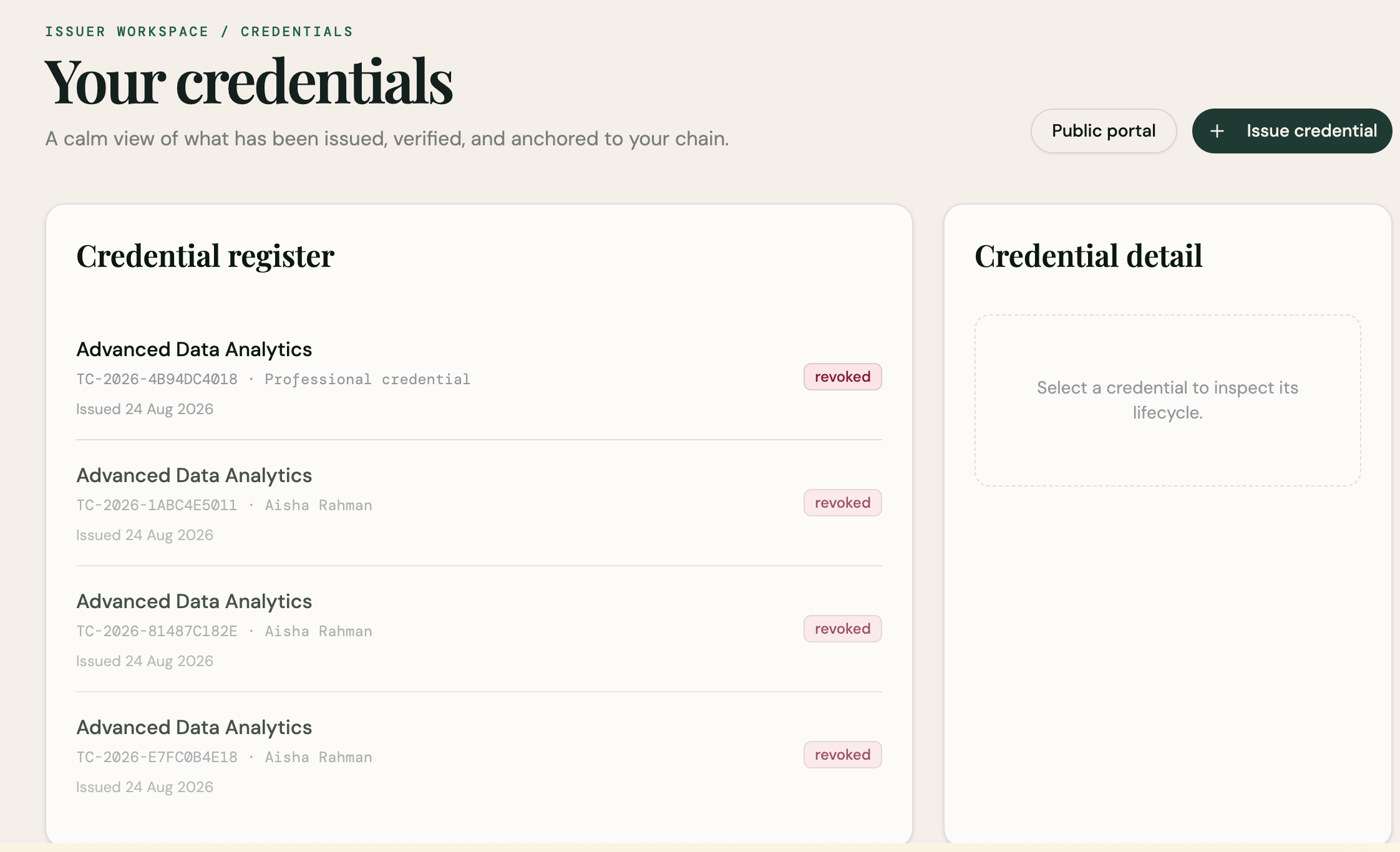
My credentials page
-
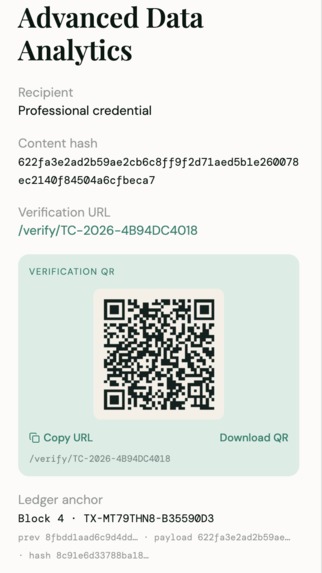
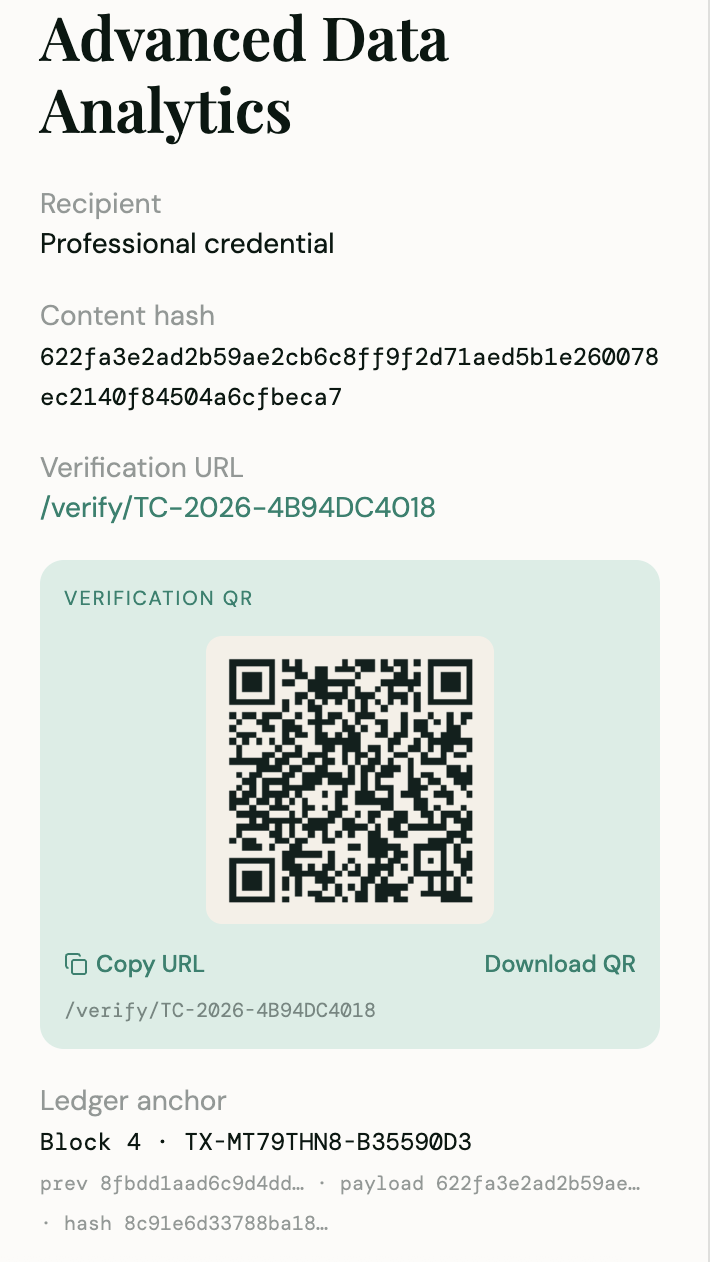
QR and Link page
Inspiration
Digital certificates are easy to copy, edit, and share, but verifying whether a document is truly authentic is often still a manual process. A certificate may look completely legitimate even after important details such as the recipient's name, issue date, or qualification have been altered.
That problem inspired TrustChain. We wanted to create a system where trust does not depend only on how a document looks. Instead, every issued document receives a unique cryptographic fingerprint that can later be used to prove whether the exact original file is still intact.
Our goal was to make document verification simple for everyone while keeping the underlying security model powerful. An issuer can secure a certificate once, and an employer, institution, or anyone else can verify it instantly.
What it does
TrustChain is a tamper-evident document and certificate verification platform built around cryptographic hashing and a permissioned blockchain-style ledger.
When an authorized organization issues a certificate, TrustChain generates a SHA-256 hash of the document and creates a unique certificate ID. The certificate is then recorded in a linked ledger where each block references the hash of the previous block, creating an integrity chain starting from a Genesis Block.
Anyone can verify a certificate by entering its certificate ID, opening its QR-based verification link, or uploading the document along with its certificate ID for cryptographic comparison.
TrustChain can identify multiple verification states:
- Verified — the uploaded document exactly matches the cryptographic record.
- Tampered — the document has been modified and its hash no longer matches.
- Revoked — the document is authentic, but the issuing organization has withdrawn its validity.
- Unknown — no matching TrustChain record exists.
- Integrity Warning — the ledger validation detects an inconsistency.
The platform also includes an issuer dashboard, certificate management, revocation controls, verification history, QR verification, a blockchain explorer, and live ledger health monitoring.
How I built it
TrustChain was built as a full-stack web application using a modern TypeScript-based architecture.
The application includes a responsive frontend, backend APIs, authentication, persistent database storage, and file handling. SHA-256 hashing is used to generate a cryptographic fingerprint for every document.
The ledger system was implemented as a permissioned, application-managed blockchain-style structure. Each block contains a block number, certificate or event reference, payload hash, previous block hash, timestamp, version information, and its own deterministically generated block hash.
The system begins with a Genesis Block. Every new issuance or revocation creates a new ledger event linked to the previous block.
The integrity validator performs several checks:
- Recalculates every block hash.
- Compares the recalculated hash with the stored hash.
- Verifies sequential block numbering.
- Verifies previous-hash relationships.
- Validates the Genesis Block.
- Detects modifications to ledger payloads.
For document verification, TrustChain generates a new SHA-256 hash for the submitted file and compares it against the original cryptographic record. Even a small modification produces a different hash, allowing the system to detect tampering.
Revocation events are also cryptographically committed to the ledger, ensuring that certificate lifecycle events are recorded as verifiable integrity records rather than simply changing a status field.
The project was designed and deployed as a self-contained application using Manus-managed infrastructure for the application, backend services, persistent data, file storage, and publishing.
Challenges I ran into
The biggest challenge was making the blockchain component technically meaningful instead of simply storing hashes in a database and calling it blockchain.
The first version focused on linking blocks through previous hashes, but that alone was not enough. A modified block could potentially retain its stored hash unless the system actively recalculated and validated the block contents.
To solve this, I implemented deterministic block hashing and a full ledger validation process that recalculates each block's hash and checks the complete chain.
Another challenge was document tampering detection. Simply uploading a modified file does not automatically tell the system which original certificate it should be compared against. The verification flow was improved to associate the uploaded document with its certificate ID before comparing its newly generated SHA-256 hash against the original record.
Maintaining consistency between certificate records and ledger events was another important challenge. I added recovery logic to detect cases where a certificate exists without its corresponding issuance ledger event and recreate the missing integrity anchor.
Finally, revocation required more than changing a certificate's status. The revocation reason and event information needed to become part of a cryptographically verifiable ledger record, so a canonical revocation payload was created and hashed before the revocation block was added.
Accomplishments that I'm proud of
The accomplishment I am most proud of is turning a simple certificate verification idea into a complete trust workflow.
TrustChain now supports the full lifecycle:
Issue → Hash → Secure → Verify → Detect Tampering → Revoke → Validate Ledger
I am particularly proud that the project does not rely on a fake blockchain visualization. It includes a real Genesis Block, deterministic block hashing, previous-hash linking, sequential block validation, full hash recalculation, and payload tampering detection.
Another important accomplishment is the verification experience. The same platform can clearly distinguish between an authentic document, a modified document, a revoked certificate, and an unknown record.
The project also includes automated tests covering cryptographic hashing, block chaining, tampering scenarios, issuance, verification, revocation, and ledger integrity.
What I learned
Building TrustChain helped me understand that blockchain concepts are not just about cryptocurrencies or smart contracts.
I learned how cryptographic hashing creates a unique fingerprint for digital data and how even a tiny modification completely changes that fingerprint.
I also learned why block linking alone is not sufficient for integrity. A reliable ledger must recalculate hashes, validate previous-hash relationships, enforce deterministic data structures, and check the entire chain for inconsistencies.
The project also gave me hands-on experience designing a complete full-stack workflow involving authentication, persistent data, file processing, cryptographic operations, role-based functionality, public verification, error states, and recovery handling.
Most importantly, I learned that building a strong security-focused product requires thinking about edge cases and failure scenarios, not just the happy path.
What's next for TrustChain
The next step for TrustChain is to expand from a hackathon-ready verification platform into a more scalable credential infrastructure.
Future improvements could include:
- Multi-organization onboarding and issuer verification.
- Digital signatures for stronger issuer authentication.
- Batch certificate issuance.
- Certificate templates generated directly within the platform.
- Advanced analytics and suspicious verification monitoring.
- Support for additional document formats.
- Public APIs for universities and employers.
- Privacy-preserving verification for sensitive credentials.
- Optional integration with public blockchain networks for organizations that require decentralized anchoring.
- Mobile-first verification and wallet-style credential storage.
The long-term vision is to make verifying a digital credential as simple as scanning a QR code while giving organizations a stronger, cryptographically verifiable foundation for trust.
TrustChain is built around one simple idea: if a document changes, its cryptographic fingerprint changes—and TrustChain makes that change impossible to ignore.
Built With
- authentication
- blockchain
- code
- cryptography
- css
- full
- next.js
- node.js
- postgresql
- qr
- react
- sha-256
- stack
- tailwind
- typescript