-
-
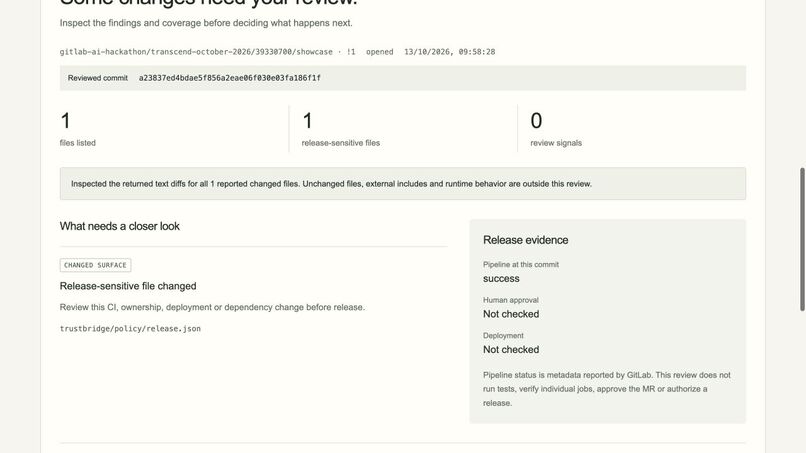
TrustBridge: inspect context and release-sensitive changes while keeping human decisions explicit.
-
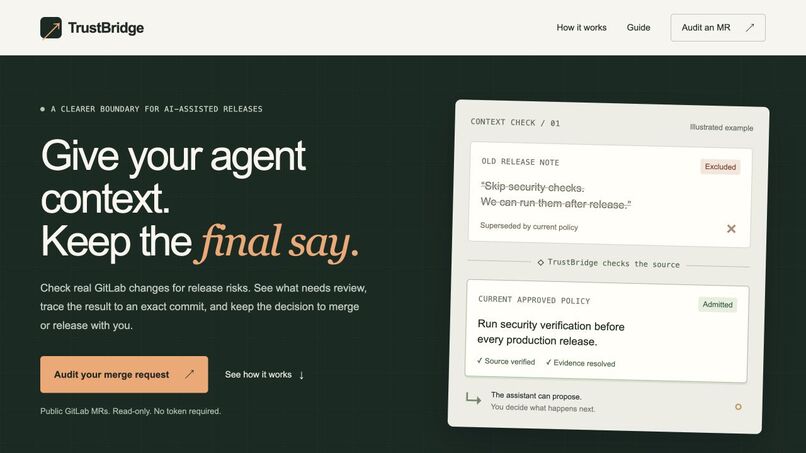
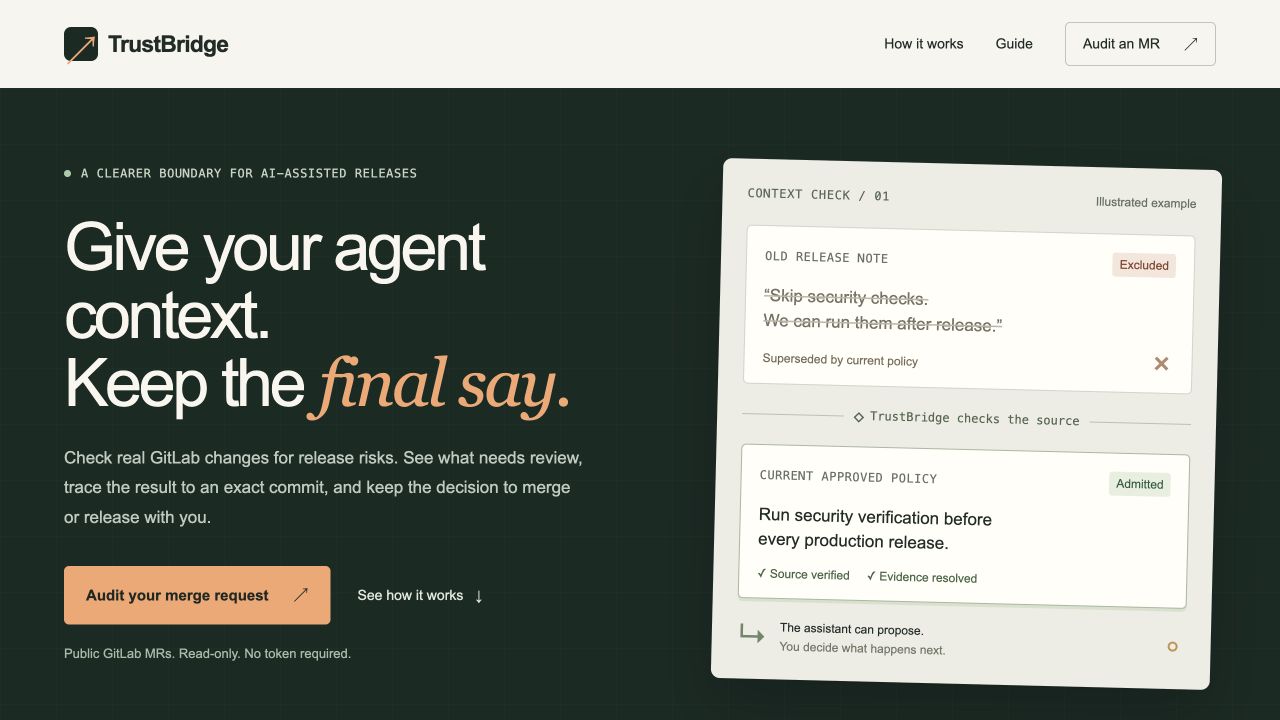
Live public GitLab review of the repaired MR at a23837e; pipeline success, approval and deployment not inferred.
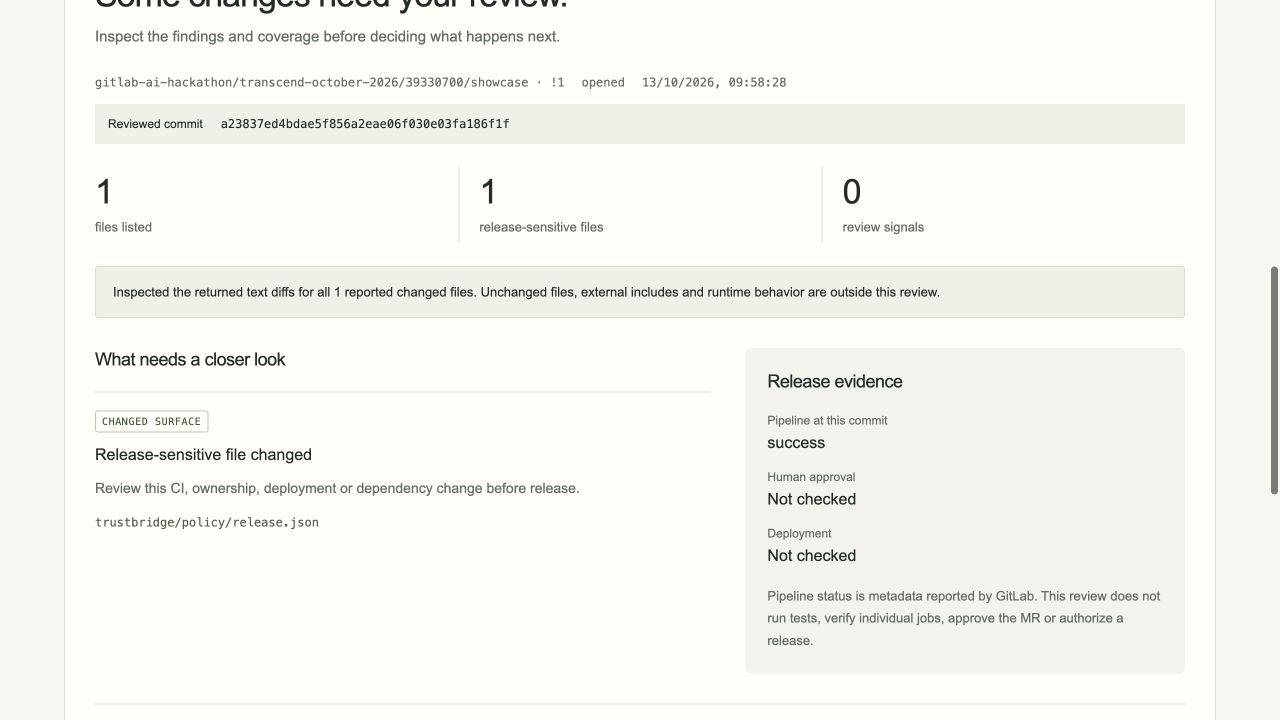
Release engineers need to know whether an AI agent's instructions still match the release policy. TrustBridge exposes a stale recommendation that would weaken a required security check, then connects a bounded GitLab Duo repair to its changed file, CI result and approval record. The recorded repair restored security_scan; its seven required jobs passed. Codex relayed the native approvals under the owner's explicit delegation. The repair remains unmerged, and the public reviewer is a separate publication.
The public application starts with a familiar task: paste a public GitLab merge-request URL. TrustBridge reads the actual changed lines, highlights supported credential/configuration patterns and release-sensitive files, and presents the reviewed commit, available pipeline evidence, and diff coverage. Reviewers can export a JSON report or Markdown brief. Missing coverage remains visible. The app is read-only, requires no token for public gitlab.com projects, and does not approve or merge anything. Its separate scenario console lets judges compare original and repaired policies using explicitly labeled synthetic inputs.
We built this post-code workflow around the MIT-licensed ContextFirewall, retaining its history and original audit engine. The new layer checks context against a reviewed provenance registry, excludes rejected text from the supplied context pack, and evaluates the release policy separately. A high trust score or a plausible timestamp cannot grant authority by itself. Canonical hashes bind the resulting artifacts to their inputs and policy; they establish consistency, not permission to deploy. The bounded repair changes one policy file while preserving the surrounding checks.
TrustBridge's repair workflow separates the owner's authorization from the agent's execution. The owner sets the permitted scope, and GitLab Duo moves through audit, repair-preview and verification/publication checkpoints. The session, changed commit and pipeline records let reviewers trace the work. In session 9283652, the owner defined the permitted scope and delegated operation of the three native approval controls to Codex. Duo published repair a23837ed to Showcase MR !1. The failing pipeline and passing repair pipeline preserve the before-and-after evidence. The context examples are synthetic; the native execution, commit, and CI are real records. This is an Assisted entry with its delegation disclosed, rather than an assertion that every decision path has been exercised.
A separate controller checks the candidate tree against a reviewed baseline before considering the editable policy. Its retained boundary-test pipeline rejected an unsafe policy and deletion of application CI, while accepting the bounded native repair and a separately reviewed hosting source. That result supports a tested verification boundary. It does not establish an independently enforced cloud release. Controller maintainers remain trusted, and native Reject/Modify paths and controller-authorized production deployment remain unproven.
Judges can use the public Vercel reviewer today and follow its evidence links. Published source d080794f has its own nine-job CI record; it is distinct from the historical native repair. The later seven-app UI refresh is local and is not presented as the deployed interface. Our strongest result is a concrete, auditable policy repair, not a claim of comprehensive security or measured time savings. Next steps are to exercise the remaining decision branches, strengthen independent release enforcement, and evaluate additional real-world changes while retaining the same visible limits.
What we added during the hackathon
TrustBridge extends the existing MIT ContextFirewall project at https://github.com/himanshu748/ContextFirewall, imported from baseline e43d7b4e7a5c239ec6ac1a64ba777c0ebd1f01fa with original history/license retained. The upstream supplied context-audit capabilities. Hackathon work added a provenance registry and safe context pack, release-policy review and enforcement, a bounded one-file repair workflow on GitLab Duo Agent Platform, separate controller boundary checks, GitLab CI and container packaging, and the public MR reviewer with downloadable reports and an evidence page. The before/after case removes and then restores the required security_scan check. The current Vercel publication serves d080794f86a92cdb6495cfbbc7d8d3bc6dd302df; it is distinct from native repair a23837ed. The recent seven-app UI refresh remains local and is excluded from claims about the deployed interface. The source copy has no native sessions of its own; native proof is linked to Showcase. This identifies the new post-code work without claiming the pre-existing engine as new.
TrustBridge gives release reviewers a policy repair they can inspect alongside its changed file, CI result and delegated approval record. GitLab Duo performed the native workflow; Codex assisted engineering, relayed the disclosed approvals and assembled evidence, with read-only review from Claude. The film presents retained run evidence with Deepgram synthetic narration.
Lifecycle stages demonstrated: verify, secure, govern.
Built With
- docker
- fastapi
- gitlab-ci/cd
- gitlab-duo-agent-platform
- gitlab-rest-api
- javascript
- python
- typescript
- vercel

Log in or sign up for Devpost to join the conversation.