-
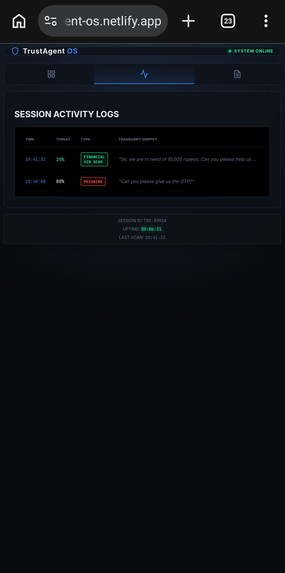
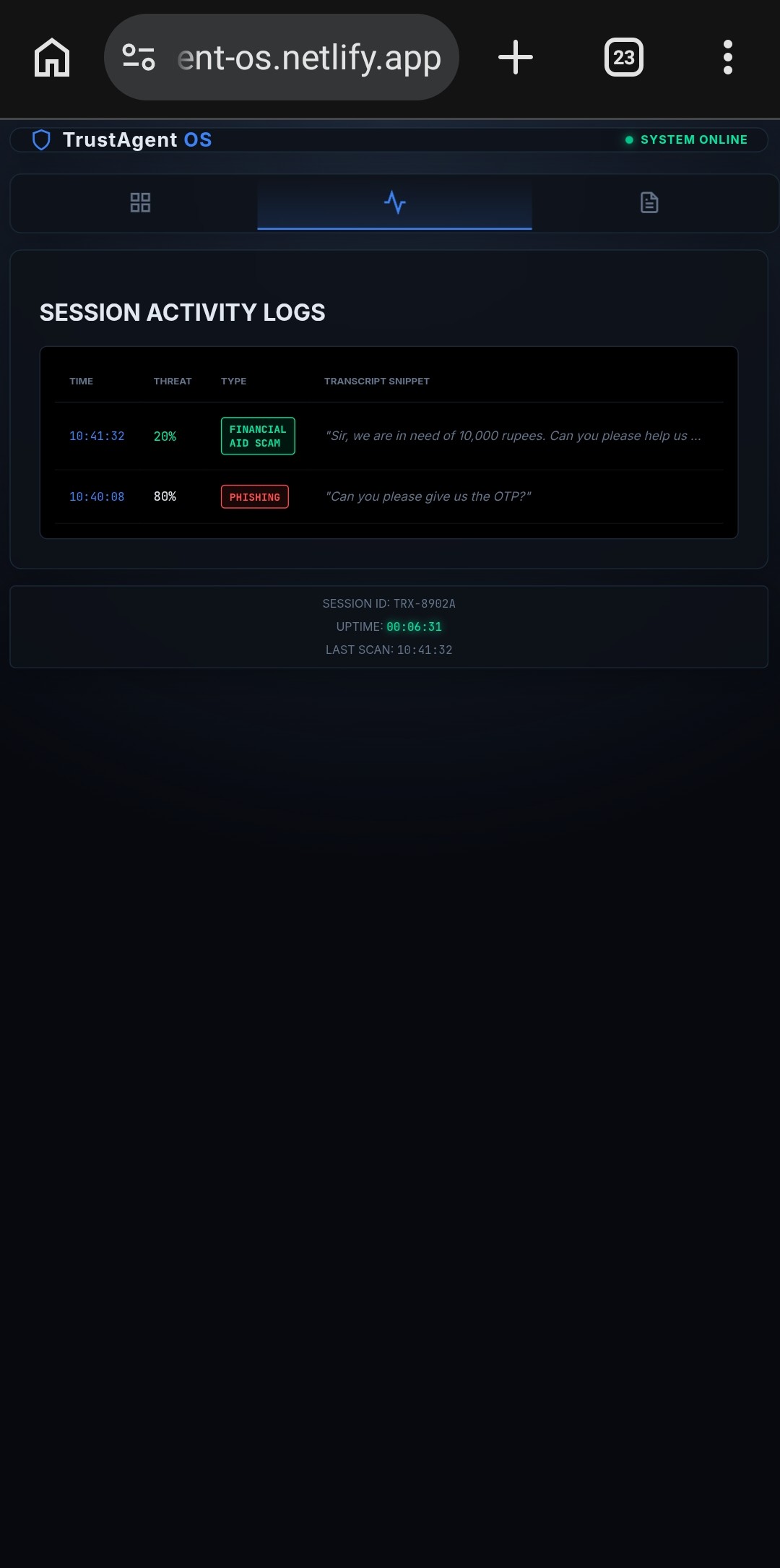
this depicts the session activity logs in which it stores info of all the transcripted snippet with the threat type
-
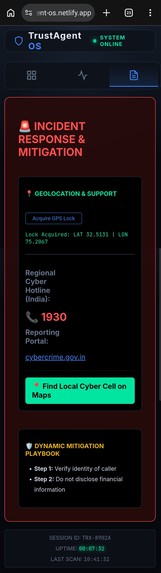
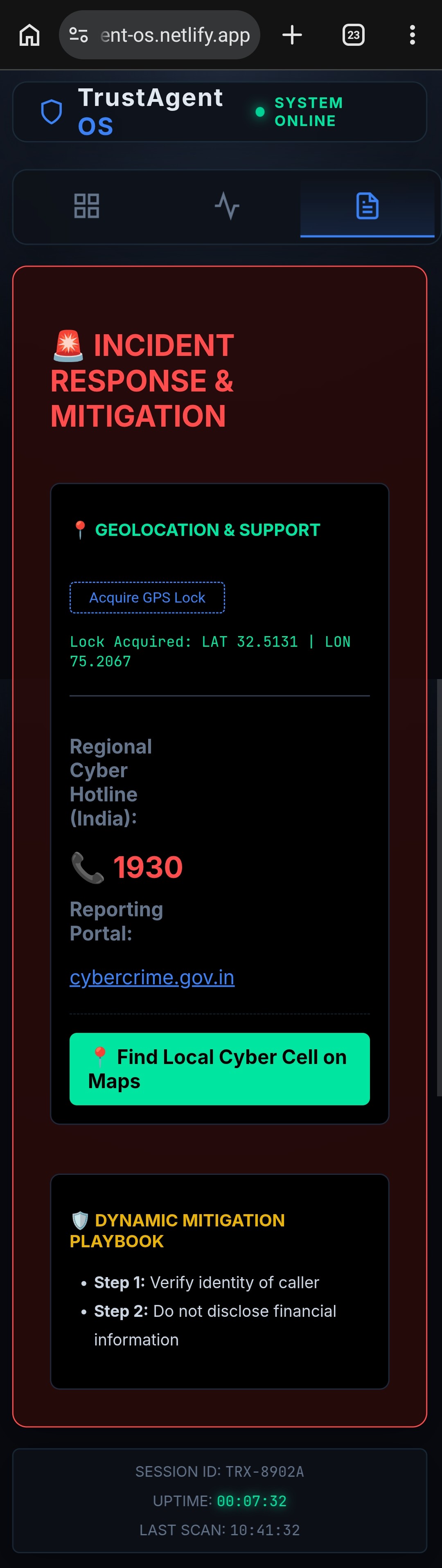
this depicts the feature of incident response and mitigation help, which gives you the contact to the regional cyber cell and mitigation
-
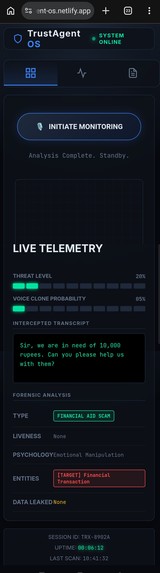
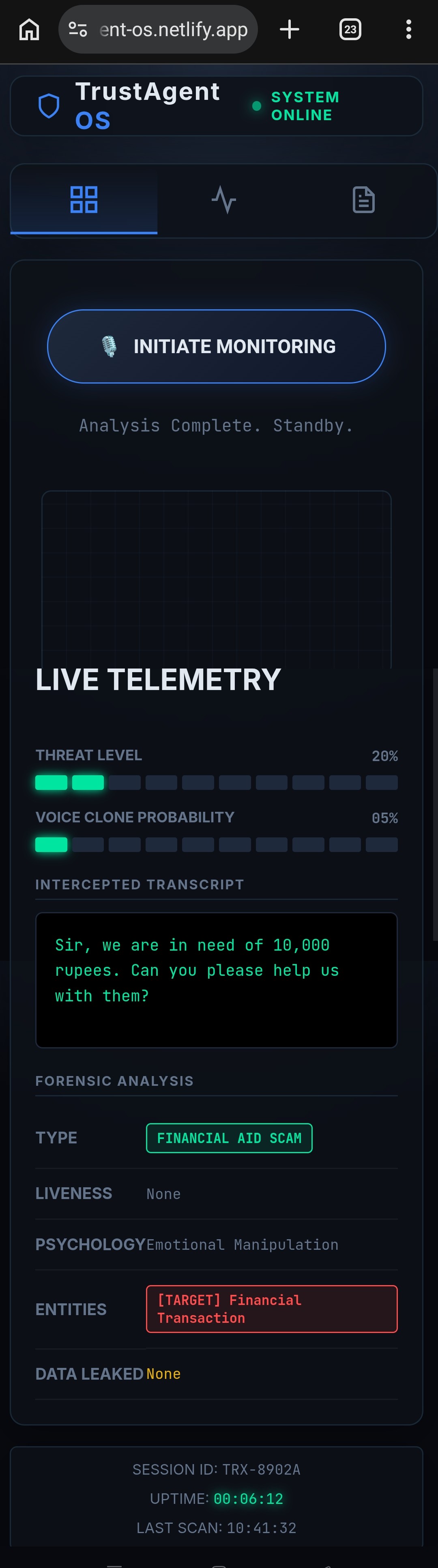
this depicts the live telemetry of what the message has been intercepted, the threat level, level of possibility of cloning and threat type
💡 Inspiration
Every 15 seconds, a vulnerable individual—often a senior citizen—loses their hard-earned savings to Vishing (Voice Phishing) and social engineering scams. Current solutions are reactive; they help you after the money is gone. I wanted to build a proactive, Zero-Trust shield. An OS-level agent that intercepts, analyzes, and neutralizes threats in real-time before the OTP is ever shared.
⚙️ What it does
TrustAgent OS is a context-aware, real-time cyber telemetry dashboard.
- Live Interception: It securely records incoming audio and transcribes it instantly.
- Contextual AI Analysis: It doesn't just look for keywords; it analyzes the psychological intent of the caller to detect Identity Theft, Extortion, or Tech Support scams.
- Dynamic Mitigation Playbook: If a threat is detected, it generates exact steps based on what the user leaked (e.g., "You mentioned SBI. Immediately block your card").
- Regional Cyber-Cell Routing: It uses reverse geocoding to lock the user's coordinates and dynamically generates a Google Maps route to their nearest local cyber police station, along with national helpline numbers.
🛠️ How we built it
We architected the system for maximum speed and zero bloat:
- Frontend: Built with vanilla HTML/CSS/JS for an ultra-lightweight, sleek, CISO-style dashboard. No heavy frameworks, ensuring millisecond UI updates.
- Backend: Powered by a FastAPI Python server hosted on Render.
- AI Core: Integrated the Groq API for blistering fast inference. We used
Whisper-large-v3for Speech-to-Text and engineered strict JSON-schema prompts forLlama-3.3-70b-versatileto handle the heavy contextual and psychological analysis. - Geolocation: Integrated BigDataCloud API for reverse geocoding.
🚧 Challenges we ran into
Building a real-time audio pipeline is notoriously difficult. We faced several major roadblocks:
- Cross-Browser Audio Codecs: Different devices (Android vs. Desktop) record in different raw formats (MP4 vs. WebM) while stripping headers. This caused the AI to reject the files as "corrupted." We built a dynamic codec resolver in JS that formats the
Blobperfectly before transmission. - AI Hallucinations (The Silence Trap): When the mic was open but the room was silent, the Whisper model hallucinated phrases like "Ignore static or silence." The LLM flagged this as a threat! We engineered a strict "Noise-Gate" filter in Python to catch ambient noise and force a 0% Threat baseline.
- Mid-Hackathon Model Deprecation: Literally hours before submission, Groq decommissioned the
llama-3.1model we were using, causing a sudden API 400 Error. We had to rapidly migrate tollama-3.3-70b-versatileand update our fail-safe UI shields to ensure the dashboard wouldn't crash during the transition.
🏆 Accomplishments that we're proud of
- Achieving sub-3-second end-to-end latency from voice recording to generating a dynamic mitigation playbook.
- Building the Zero-Trust Memory Shield on the frontend, ensuring that network jitters or API errors never wipe the user's screen but gracefully handle the exception.
- Creating a truly global tool that adapts its emergency contact info based on the user's live GPS coordinates.
📚 What we learned
- The intricacies of the browser
MediaRecorderAPI and raw audio chunking. - Advanced Prompt Engineering to force LLMs to output strict, robust JSON structures without markdown wrapping.
- Building fault-tolerant UI components that don't break when asynchronous data fails.
🚀 What's next for TrustAgent OS
- Telecom Integration: Directly integrating the agent with telecom provider APIs to automatically sever the call if the Threat Level exceeds 90%.
- Mobile Native App: Porting the web OS into a background Android/iOS service that runs seamlessly during active phone calls.
- Multi-lingual Support: Allowing the AI to detect localized scams in regional languages like Hindi, Tamil, and Bengali.
Built With
- css3
- fastapi
- geolocation-api
- groq
- html5
- javascript
- llama-3
- python
- render
- whisper

Log in or sign up for Devpost to join the conversation.