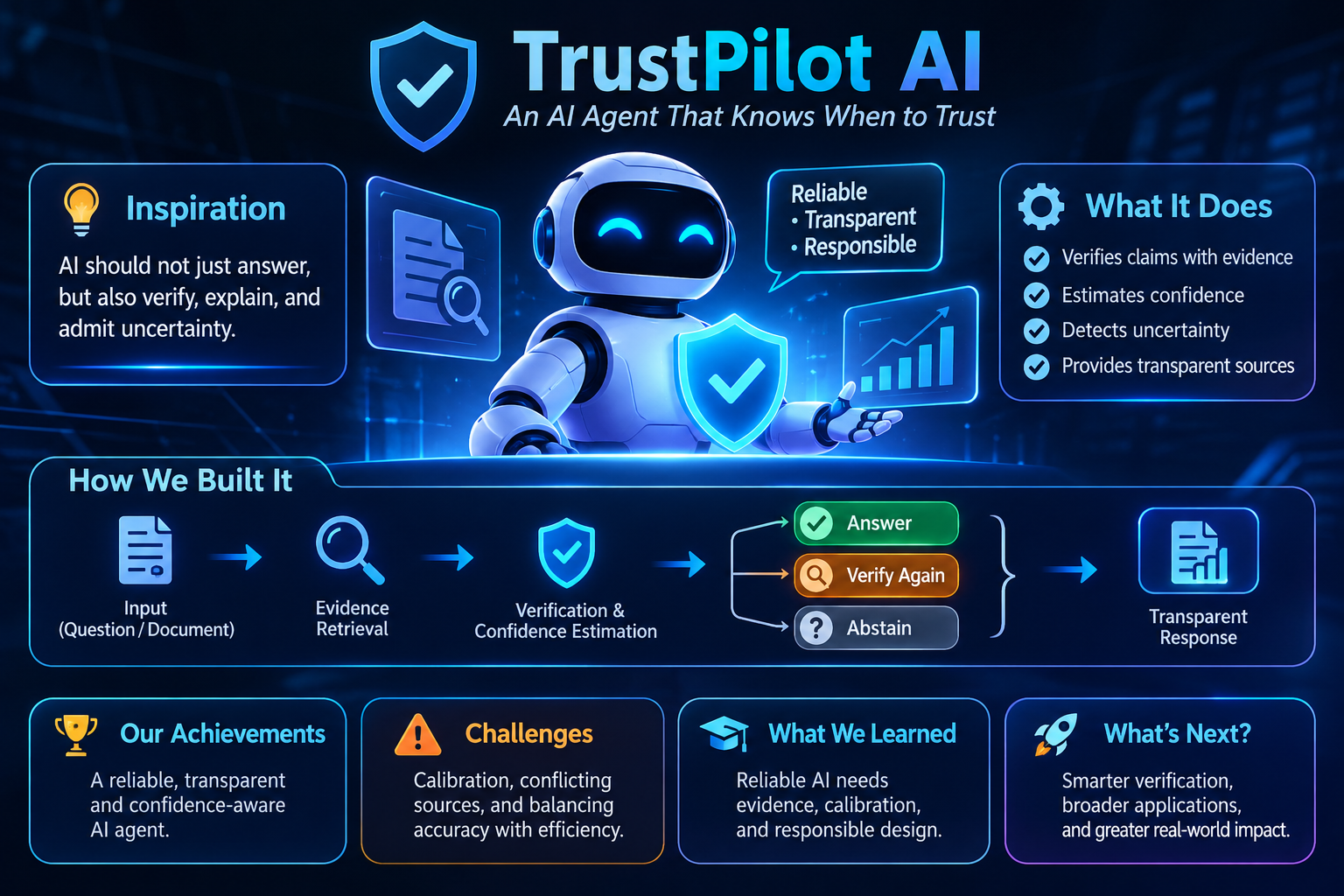
- Inspiration
Trustpilot AI was inspired by a major problem in artificial intelligence: AI systems can sometimes generate incorrect information while presenting it as if it were true. This can lead users to trust answers without checking their reliability. We wanted to develop an AI agent that does more than generate responses. We envisioned a system that evaluates the reliability of its answers, verifies information using supporting evidence, recognizes uncertainty, and decides when it needs further investigation. Our inspiration was to make AI not just intelligent, but also reliable, transparent, and responsible.
- What it does
Trustpilot AI is a confidence-aware intelligent agent designed to improve the reliability of AI-generated answers. Its main features include:
- Answer verification: Checks important claims against relevant documents and evidence.
- Confidence estimation: Estimates answer reliability using evidence quality and validated model outputs.
- Uncertainty detection: Identifies questions that cannot be answered confidently from the available information.
- Intelligent decision-making: Chooses whether to answer, gather additional evidence, or abstain.
- Source transparency: Provides supporting references so users can inspect the evidence behind an answer.
- Reliability dashboard: Displays verification results, confidence calibration, and evaluation metrics. The key idea is that Trustpilot AI should not simply provide an answer; it should also explain why that answer deserves trust—or why it does not.
- How we built it
We designed Trustpilot AI using a modular architecture that combines language models, document retrieval, verification, and reliability evaluation. Step 1: User input Question or uploaded document Step 2: Evidence retrieval Extracts relevant information from document. Step 3: Verification and confidence estimation Checks claim support, missing evidence and contradictions Answer Verify again Abstain Step 4: Transparent final response Answer, evidence, uncertainty explanation and verification history Technology stack
- Python for backend logic and AI workflows.
- A large language model (LLM) for answer generation and claim analysis.
- Sentence Transformers and FAISS for semantic document retrieval.
- PyMuPDF for extracting text from PDF documents.
- Streamlet for the interactive user interface.
- pandas and scikit-learn for evaluation and performance analysis. The system is intended to be tested against a conventional language-model baseline and a retrieval-augmented generation (RAG) baseline. This helps us measure whether verification improves reliability instead of merely adding complexity.
- Challenges we can run into
Developing Trustpilot AI involves several technical challenges.
- Misleading confidence scores: A model may report high confidence even when its answer is incorrect. We need to calibrate confidence against observed performance.
- Incorrect or incomplete evidence: Retrieved documents may not contain enough information to answer a question. The system must recognize these cases.
- Conflicting sources: Different documents may provide contradictory information, requiring careful comparison rather than arbitrary selection.
- Verification latency and cost: Repeated model calls and searches can increase response time and API expenses. We need to balance reliability with efficiency.
- Evaluation difficulty: We need trustworthy reference answers and test data that were not used to tune the system.
- Unreliable citations: A citation may mention the right topic without actually supporting the claim. Claim-level evidence checks are essential. Our approach is to test these failure cases systematically, document limitations, and improve the system based on experimental results.
- Accomplishments we're proud of
Our most important accomplishment is the design of an AI system around a different principle: an intelligent agent should evaluate the reliability of its own outputs before asking users to trust them. We are particularly proud of the following goals embodied in the project:
- Developing a modular architecture that combines retrieval, verification, confidence estimation, and decision-making.
- Designing an answer–verify–abstain workflow rather than relying on answer generation alone.
- Making evidence and uncertainty visible to users.
- Establishing a framework for comparing the system against conventional AI approaches.
- Focusing on responsible AI, measurable performance, and practical usability. The next step is to validate these contributions through a working prototype and reproducible experiments. Claims about accuracy improvements or successful testing should be added only after we obtain actual results.
- What we learned
This project helps us understand that building reliable AI involves much more than choosing a powerful model. We learned the importance of evidence retrieval, confidence calibration, evaluation datasets, and testing AI systems under uncertain conditions. We also learned that a high accuracy score alone does not guarantee trustworthy behavior. A useful AI agent must know its limitations, communicate uncertainty clearly, and avoid making unsupported claims. We also gained experience in modular system design, experiment planning, error analysis, and responsible AI development. As AIML students, this project encourages us to move beyond simply using AI tools and toward understanding, evaluating, and improving the intelligence behind them.
- What's next for Trustpilot AI?
Our future roadmap focuses on turning the prototype into a more capable and widely useful reliability platform. Phase 1 — Strengthen verification Improve claim-level checking, source relevance, contradiction detection, and confidence calibration. Phase 2 — Establish measurable reliability Build a diverse benchmark and compare answer accuracy, unsupported claims, calibration, coverage, latency, and cost. Phase 3 — Develop adaptive AI agents Enable the system to choose when additional searches or independent checks are worth the cost, based on uncertainty and the consequences of errors. Phase 4 — Expand real-world applications Explore research assistance, technical-document analysis, education, and enterprise knowledge systems, with appropriate human review for high-impact decisions. Our long-term vision is to make Trustpilot AI a reliability layer that can work alongside different AI models and help people make better-informed decisions. Closing statement Trustpilot AI represents our vision of the next generation of artificial intelligence: systems that do not simply generate answers, but evaluate evidence, recognize uncertainty, and make responsible decisions about what to communicate. Our goal is not to build an AI that claims to know everything. It is to build an AI that knows when its answers are supported, when they need verification, and when it should admit that the evidence is insufficient

Log in or sign up for Devpost to join the conversation.