-
-
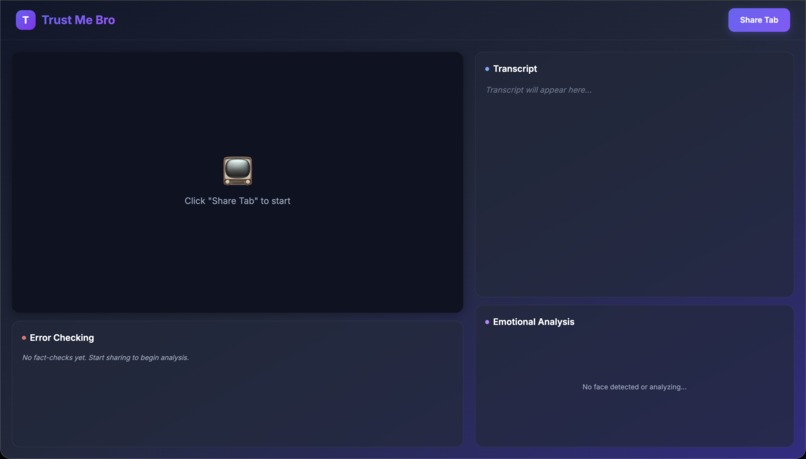
landing page
-
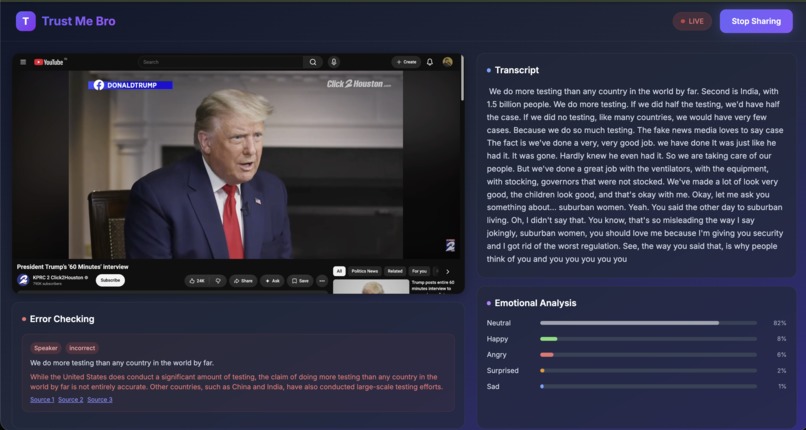
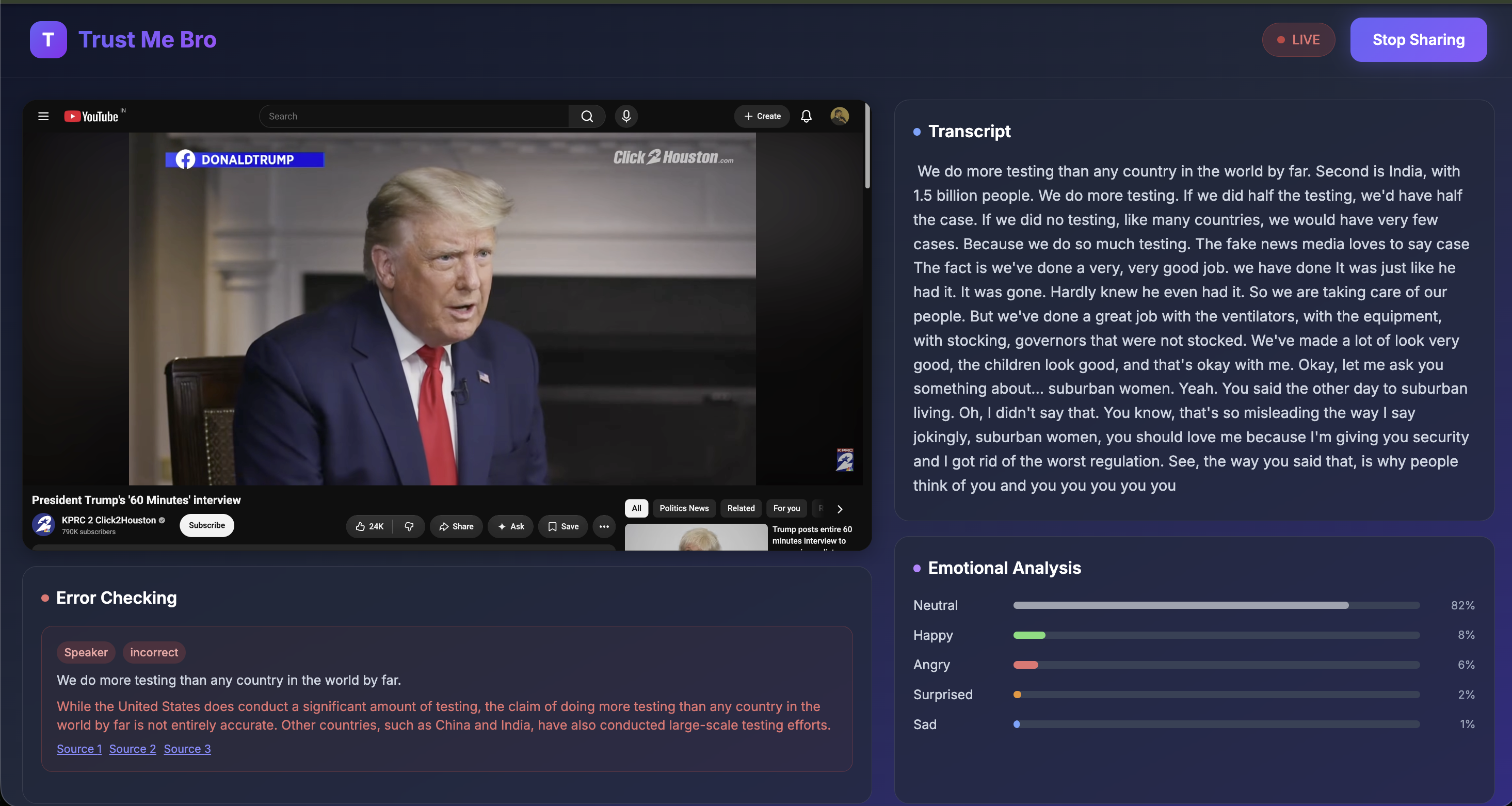
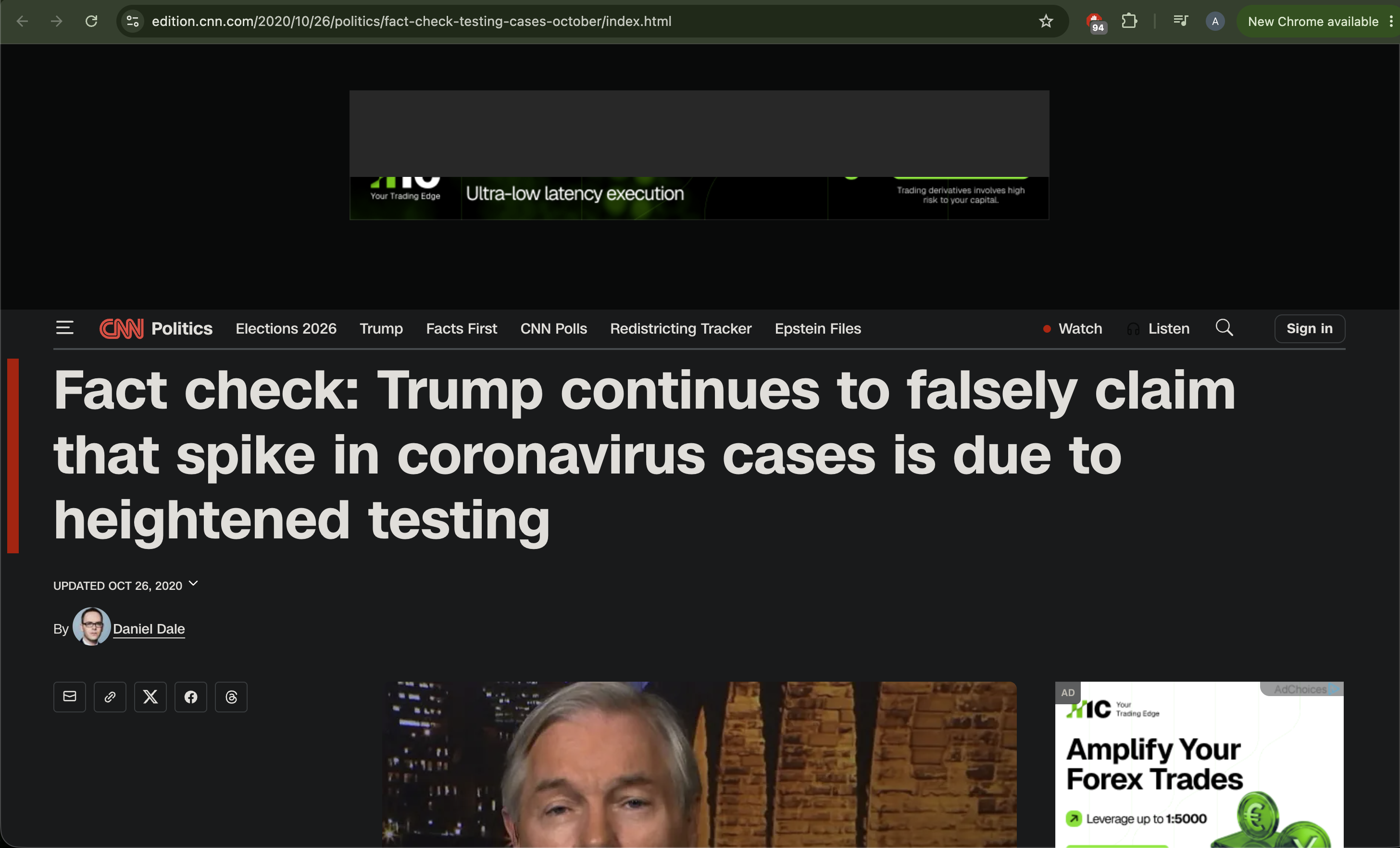
Working demo
-
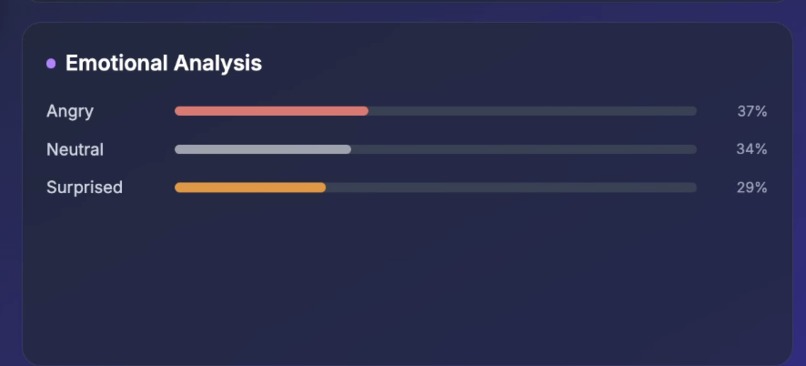
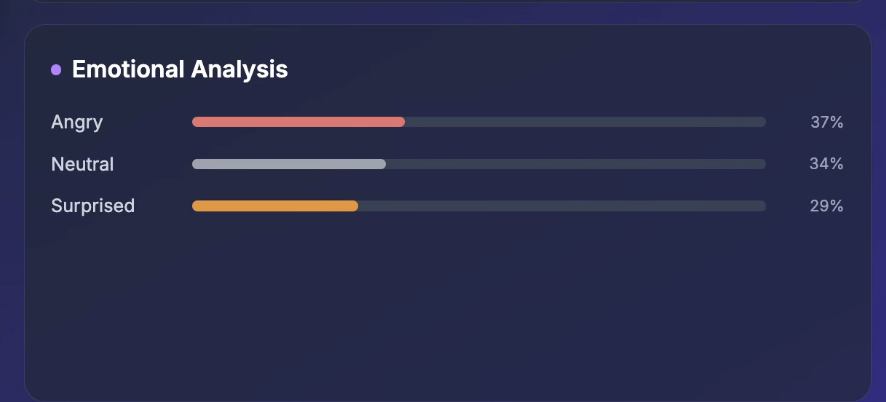
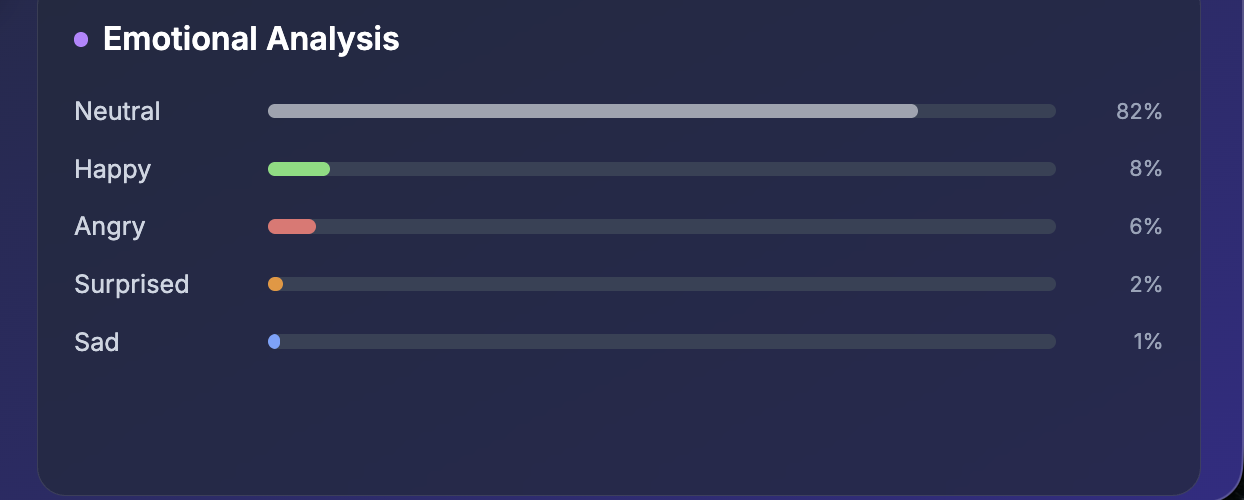
Realtime Emotional Analysis
-
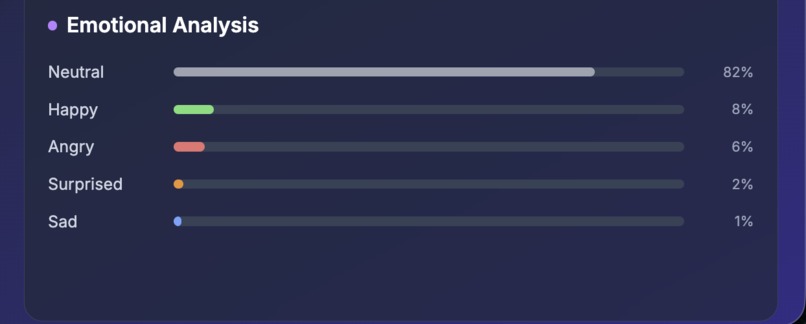
Changed Emotional Analysis
-
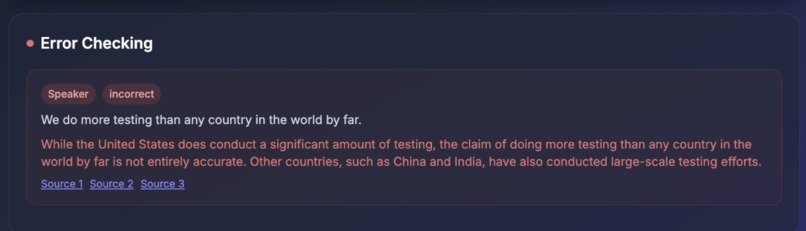
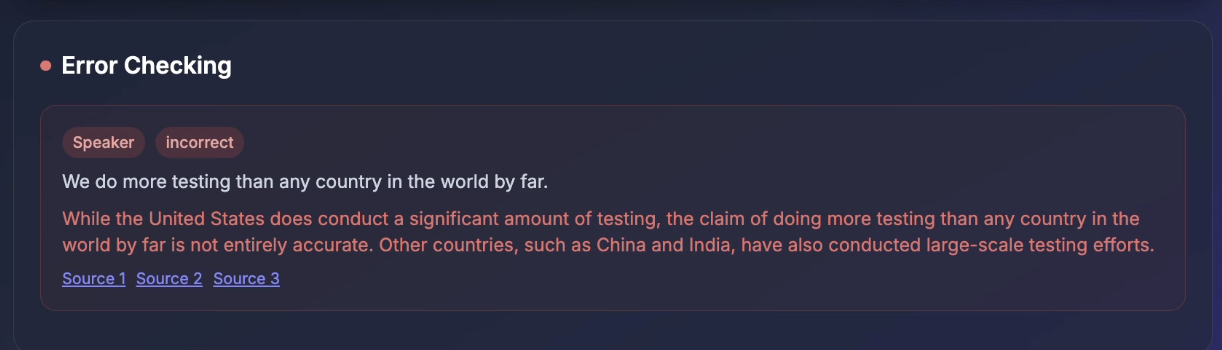
Fact/Error Analysis
-
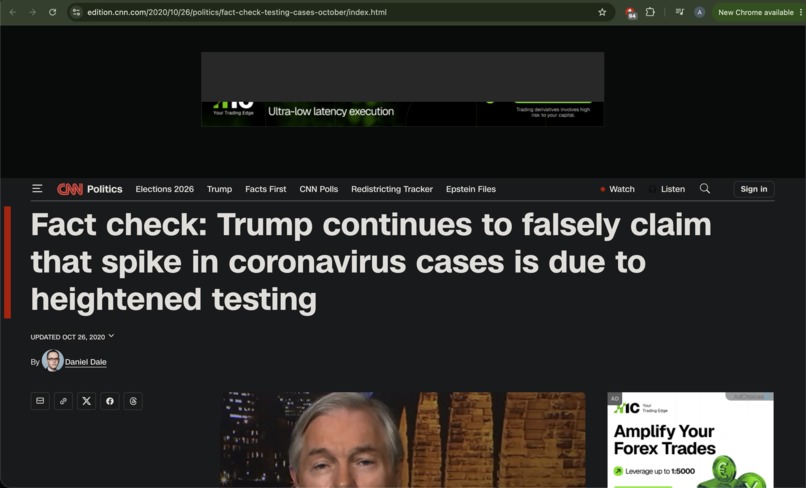
Sources for proof
-
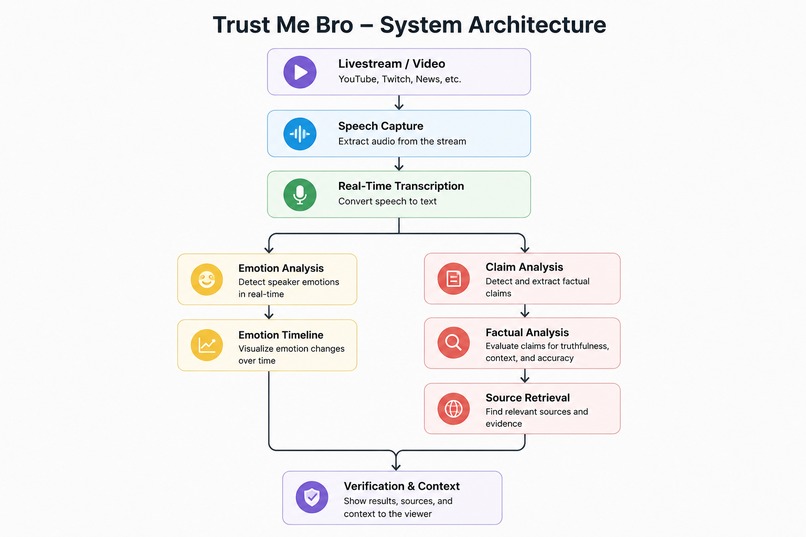
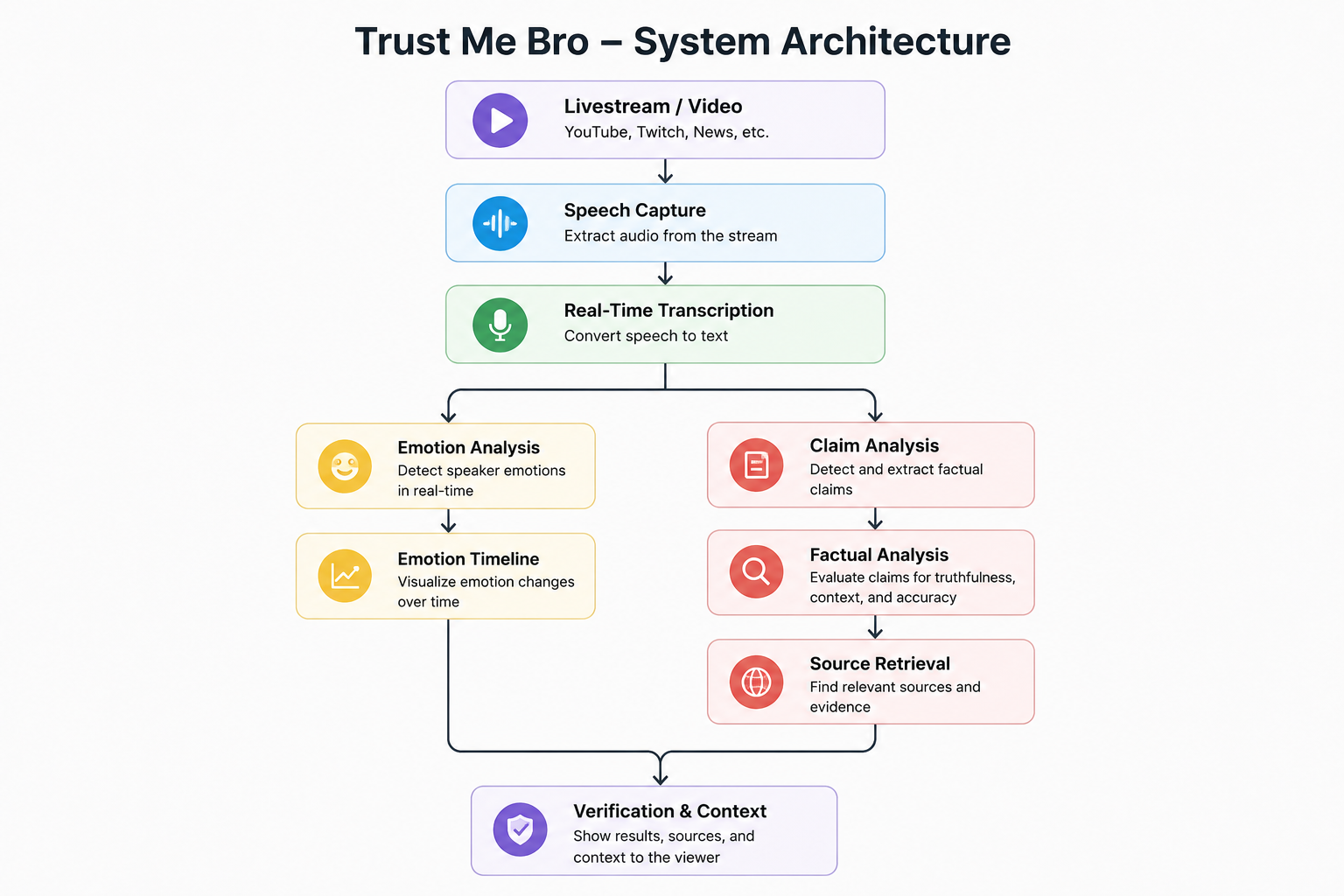
Arch
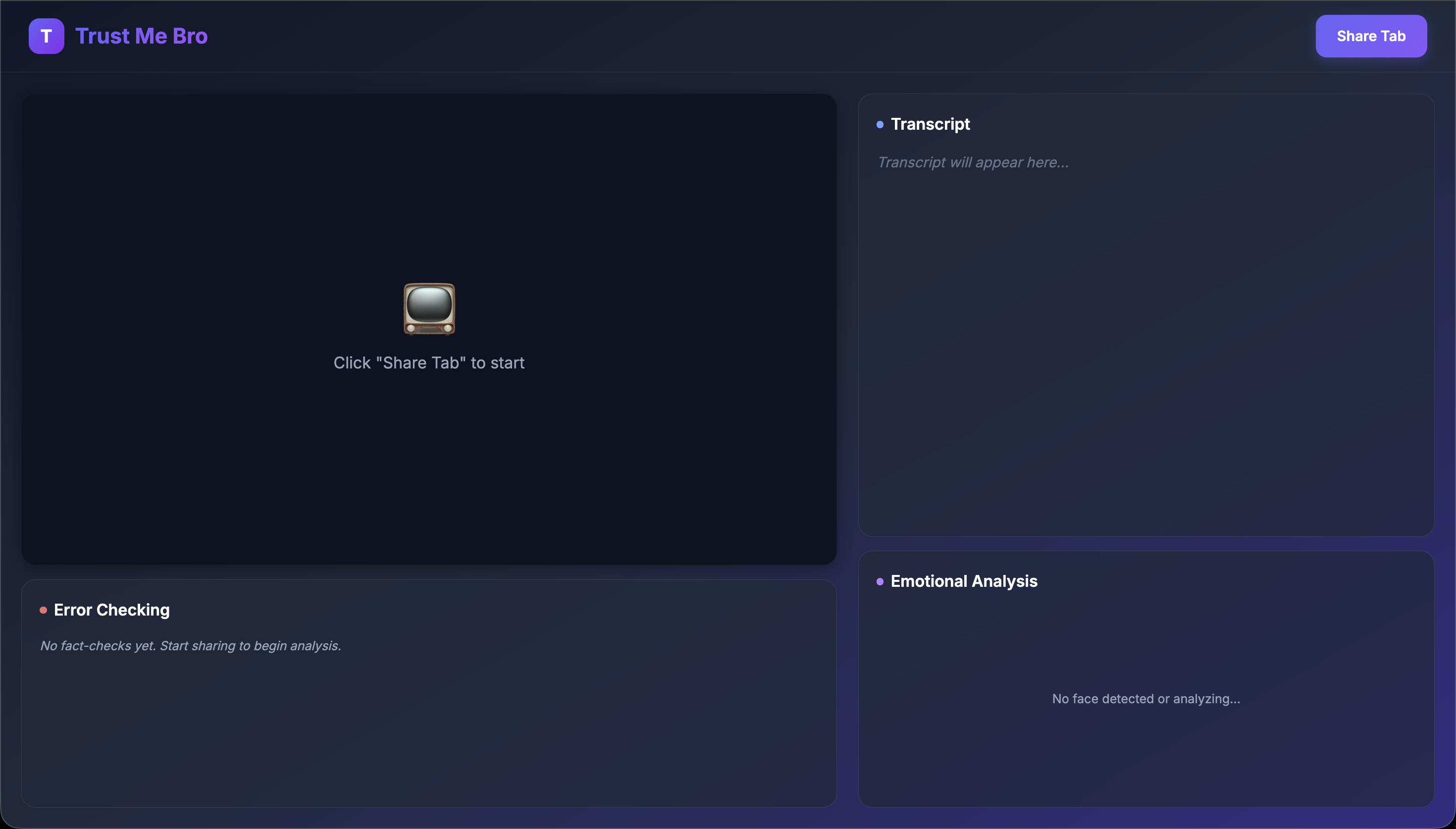
TRUST ME BRO
Don’t just watch. Verify. Understand.
My aim was to build technology with positive social impact, software that helps people make better-informed decisions and creates a more transparent and trustworthy information ecosystem.
Trust Me Bro is an AI-powered real-time intelligence layer for livestreams and online videos. It transcribes what a speaker is saying, analyzes their emotional state, identifies potentially factual claims, evaluates those claims, and provides relevant sources so viewers can verify information as it unfolds.
Inspiration
Livestreams have become one of the fastest ways people consume information. News, political discussions, podcasts, interviews, gaming streams, and creator content can reach thousands or even millions of people instantly. However, this speed also creates a serious problem: misinformation and disinformation can spread just as quickly as the livestream itself. Traditional fact-checking is often reactive. A claim may be corrected hours or days after it was made, when it has already been shared and repeated across the internet.
We wanted to explore a different approach: What if fact-checking could happen at the same speed as the information itself? We imagined a future where watching a livestream comes with an intelligent layer of real-time context. As important statements are made, viewers could immediately see relevant information, sources, and context that help them understand what they are watching.
This became the foundation of Trust Me Bro.
What It Does
Trust Me Bro analyzes livestreams and videos in real time through screen sharing, allowing it to work with content from platforms such as YouTube, Twitch, and other video services.
The system performs several tasks simultaneously:
Real-Time Transcription The application captures the speech from the video and continuously converts it into text. This creates a live transcript that becomes the foundation for the rest of the analysis.
Real-Time Emotion Analysis While the speaker is talking, the system analyzes their emotional state and displays changes over time. It can identify emotions such as:
- Happiness
- Sadness
- Anger
- Frustration
- Neutrality
- Other detectable emotional states The purpose is not to determine whether someone is lying based on their emotions. Instead, emotional analysis provides additional context about how the conversation is unfolding.
Claim Detection Not every sentence needs to be fact-checked. A person may express an opinion, tell a joke, share a personal experience, or make a factual claim. Trust Me Bro attempts to identify statements that contain meaningful claims that can be investigated.
Fact Analysis The MVP analyzes detected claims and determines whether available evidence supports, contradicts, or fails to sufficiently verify the statement. Rather than treating truth as a simple binary, the system is designed around the idea that claims can be:
- Supported
- Contradicted
- Potentially misleading
- Unverified
- Opinion-based
- Dependent on additional context
Source Retrieval When a claim requires verification, Trust Me Bro provides relevant links and sources. This is a key part of our philosophy: The goal is not to make users blindly trust AI. The goal is to help users find the evidence faster.
How We Built It
Trust Me Bro is a proof-of-concept that combines multiple AI capabilities into a single real-time pipeline. The user shares their screen while watching a livestream. The system captures the speech, converts it into text, and continuously passes the transcript through the analysis pipeline. At the same time, the emotional state of the speaker is analyzed and visualized. When a potentially factual statement is detected , it is passed through the verification process. Relevant evidence and sources are then surfaced to the viewer. Our goal was to create an intelligence layer that works alongside content people are already watching, rather than forcing them to leave the livestream and manually search for every claim.
Challenges We Ran Into
Real-Time Processing Our biggest technical challenge was combining multiple AI processes while keeping the experience close to real time. Transcription, emotion analysis, claim detection, verification, and source retrieval all introduce latency. Even small delays can accumulate when these systems operate together. Finding the right balance between speed, accuracy, and usability was a major challenge.
Understanding What Should Be Fact-Checked Natural conversations contain facts, opinions, jokes, predictions, personal experiences, and subjective statements. Automatically determining which statements contain meaningful factual claims is surprisingly difficult. A system that attempts to fact-check everything would quickly become noisy and distracting, so identifying the right claims became an important part of the project.
Truth Is Not Always Binary Another major challenge was realizing that real-world claims are rarely just “true” or “false.” A statement may be technically accurate but misleading because important context is missing. Another statement may have been true at one point but become outdated. Some claims may simply lack enough evidence to reach a reliable conclusion. This taught us that a trustworthy system needs to communicate evidence and uncertainty, not just generate a confident answer.
Avoiding AI-Generated Misinformation There is an important challenge at the heart of this project: an AI system designed to fight misinformation could itself produce incorrect information. Because of this, providing sources and context is extremely important to us.
We don’t want Trust Me Bro to become another authority that users blindly trust. We want it to become a tool that helps users investigate information for themselves.
Accomplishments We’re Proud Of
We are proud that we turned an ambitious concept into a working proof-of-concept demonstrating the complete pipeline:
Watch -> Transcribe -> Analyze Emotion -> Detect Claims -> Verify -> Find Sources -> Understand
The most important accomplishment is demonstrating that these capabilities can work together as a single viewing experience. Instead of treating fact-checking as something users do after watching a video, Trust Me Bro explores the possibility of making verification part of the viewing experience itself. We believe this is a meaningful first step toward a future where information can be analyzed while it is being consumed.
What We Learned
We learned that building a real-time AI system is not simply about connecting different models. Latency, context, reliability, source quality, transparency, and user trust are equally important. We also learned that emotional analysis and factual analysis should remain separate. A person’s emotional state should never be treated as proof that they are telling the truth or lying. Instead, it should provide additional context about the conversation. Most importantly, we learned that AI could potentially change fact-checking from a reactive process into a real-time process. Instead of asking people to investigate misinformation after it spreads, we can help them evaluate information while they are encountering it.
What’s Next for Trust Me Bro
Our current implementation is a proof-of-concept, but we believe there is significant potential for the idea.
Native Platform Integration We want to move beyond screen sharing and build seamless integrations with platforms such as YouTube, Twitch, live news, podcasts, and other livestreaming services.
Better Verification Future versions could compare multiple independent sources, prioritize authoritative sources, provide confidence scores, and explain exactly why a claim received a particular assessment.
Claim History We want to create a timeline of claims made throughout a livestream, allowing users to go back and see what was said, when it was said, how it was evaluated, and what evidence was available.
Context and Narrative Analysis Beyond individual claims, Trust Me Bro could eventually detect missing context, contradictory statements, repeated misinformation, misleading framing, and changes in a speaker’s claims over time.
The Bigger Vision Imagine watching a live news broadcast and having a real-time layer beside it:
CLAIM DETECTED Assessment: Potentially Misleading Relevant Evidence: Source A Source B Source C Additional Context: ... Speaker Emotion: Frustrated / High Intensity
The same concept could exist across livestreams, interviews, podcasts, debates, and breaking-news broadcasts. Our goal is not to build an AI that tells people what to believe. Our goal is to build an AI that helps people ask better questions, find better evidence, and make more informed decisions.
Trust Me Bro doesn’t ask you to trust the machine. It gives you the tools to verify what you’re being told.
Built With
- css3
- fast-api
- javascri
- nextjs
- tailwind
- typescrip

Log in or sign up for Devpost to join the conversation.