The Story Behind TrustLens
Every day, people receive messages claiming to be from banks, companies, recruiters, delivery services, scholarship programs, and government organizations. Some of these messages look convincing enough that it can be difficult to decide whether they are legitimate or a scam. We wanted to build something that could help people investigate a suspicious message before acting on it.
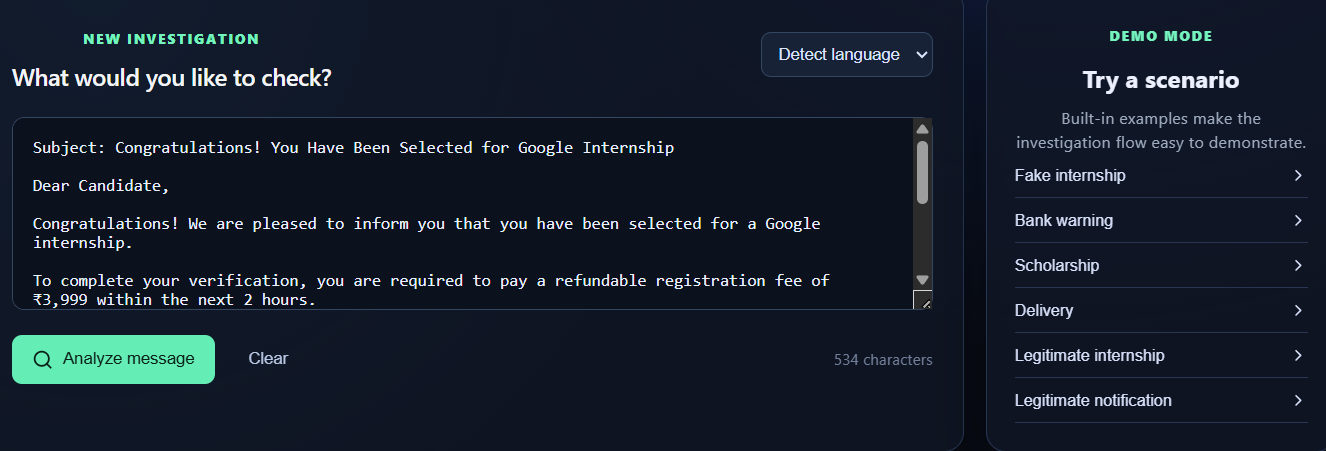
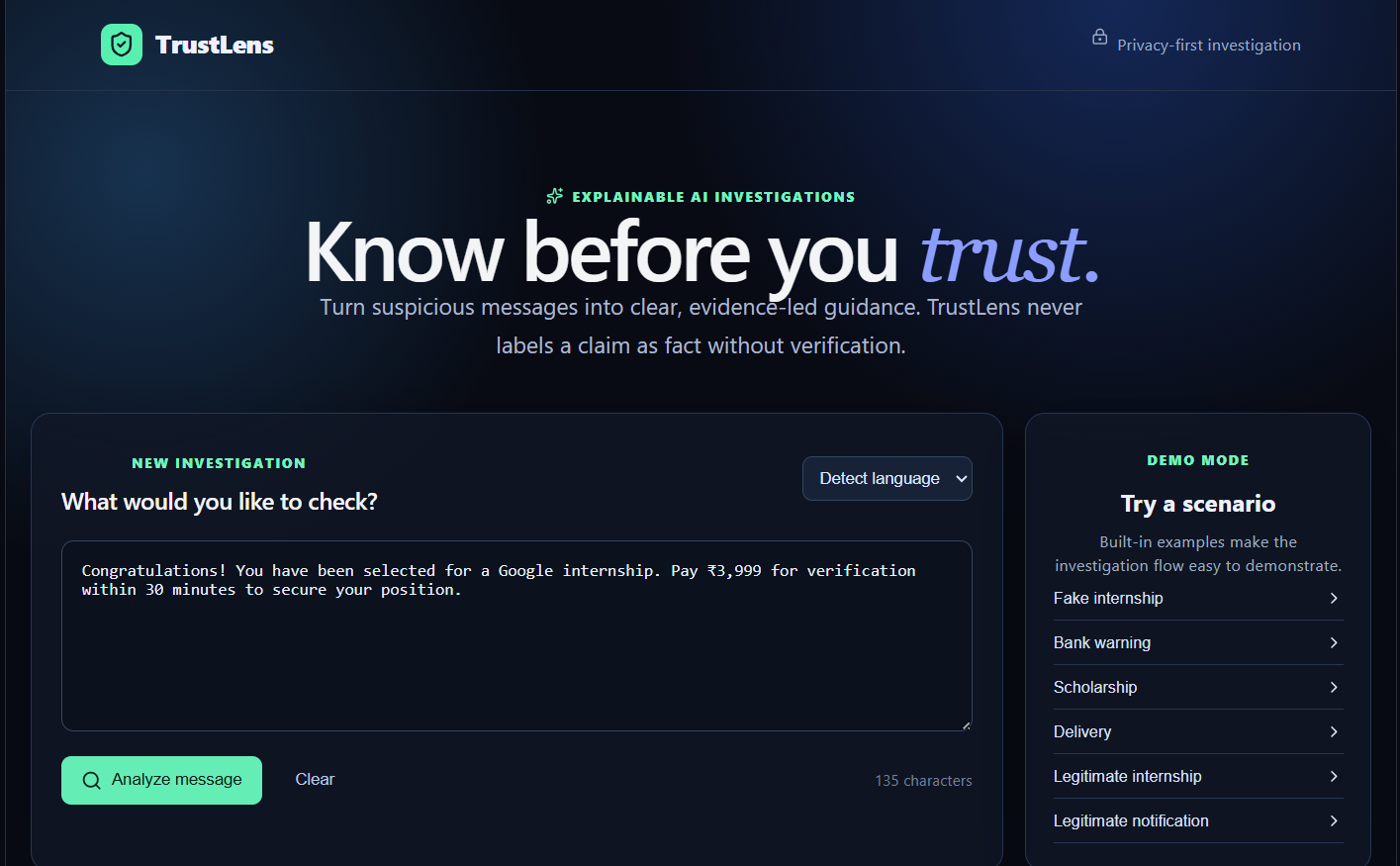
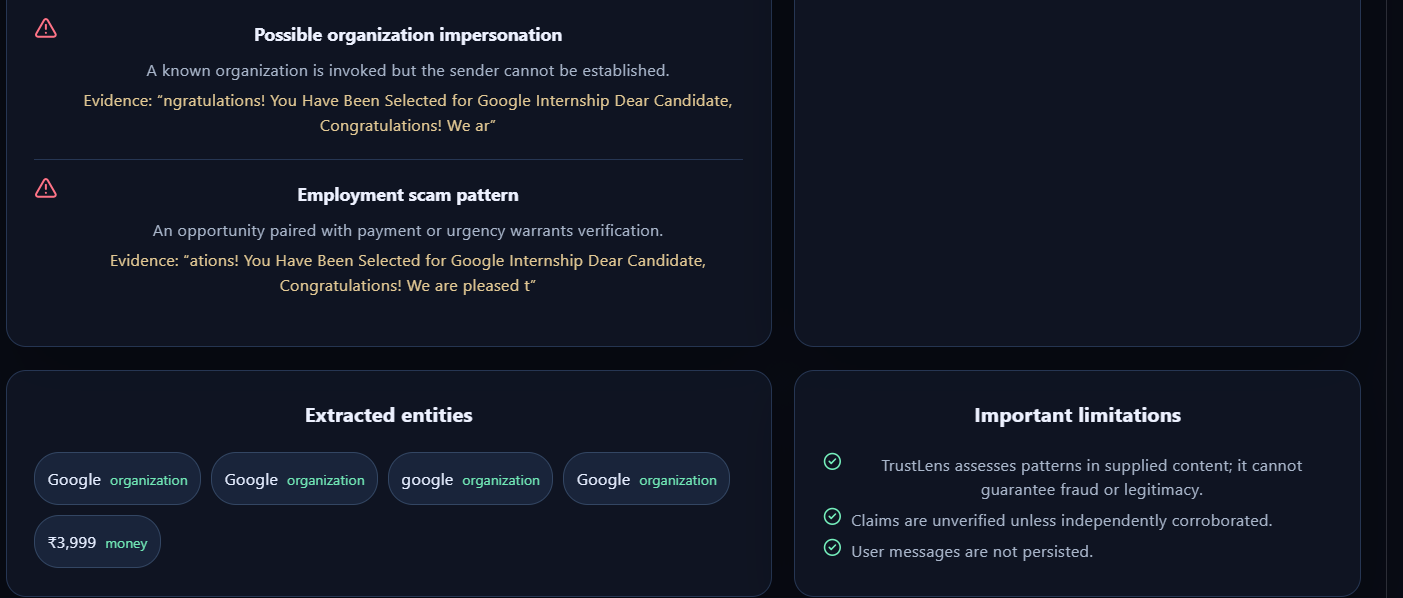
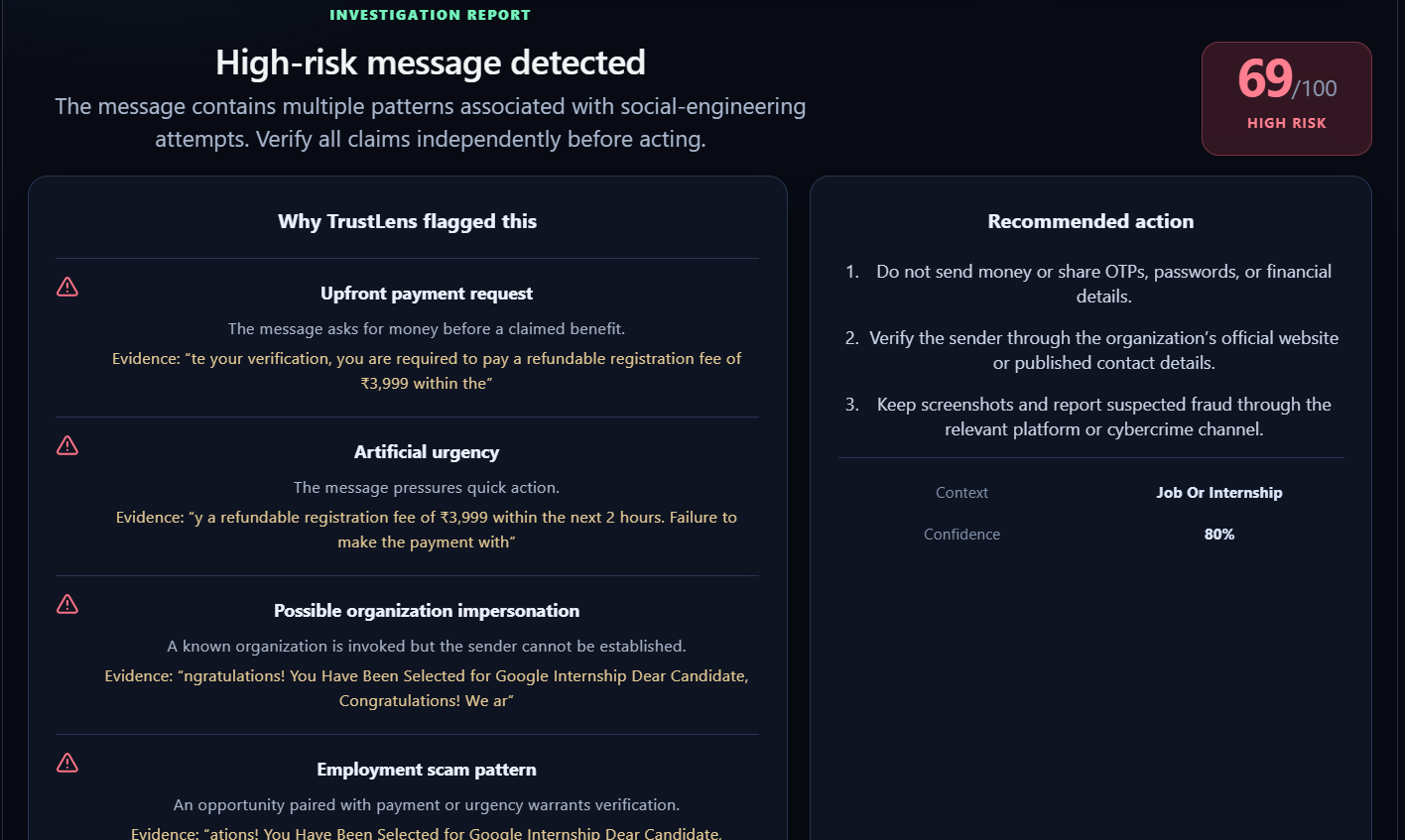
That idea led us to TrustLens, an AI-powered scam investigation platform that analyzes suspicious messages, job offers, emails, SMS, and URLs and explains why something may be risky instead of simply saying "SCAM."
What We Built
TrustLens combines multiple layers of analysis:
- TF-IDF + Logistic Regression for traditional NLP-based scam classification.
- LLM-based NLP for understanding intent, urgency, social-engineering patterns, entities, and suspicious claims.
- URL analysis for identifying potentially suspicious domains, URLs, IP-based hosts, unusual characters, HTTPS status, and other security indicators.
- Rule-based risk signals for detecting patterns such as payment requests, OTP/password requests, threats, and fake verification fees.
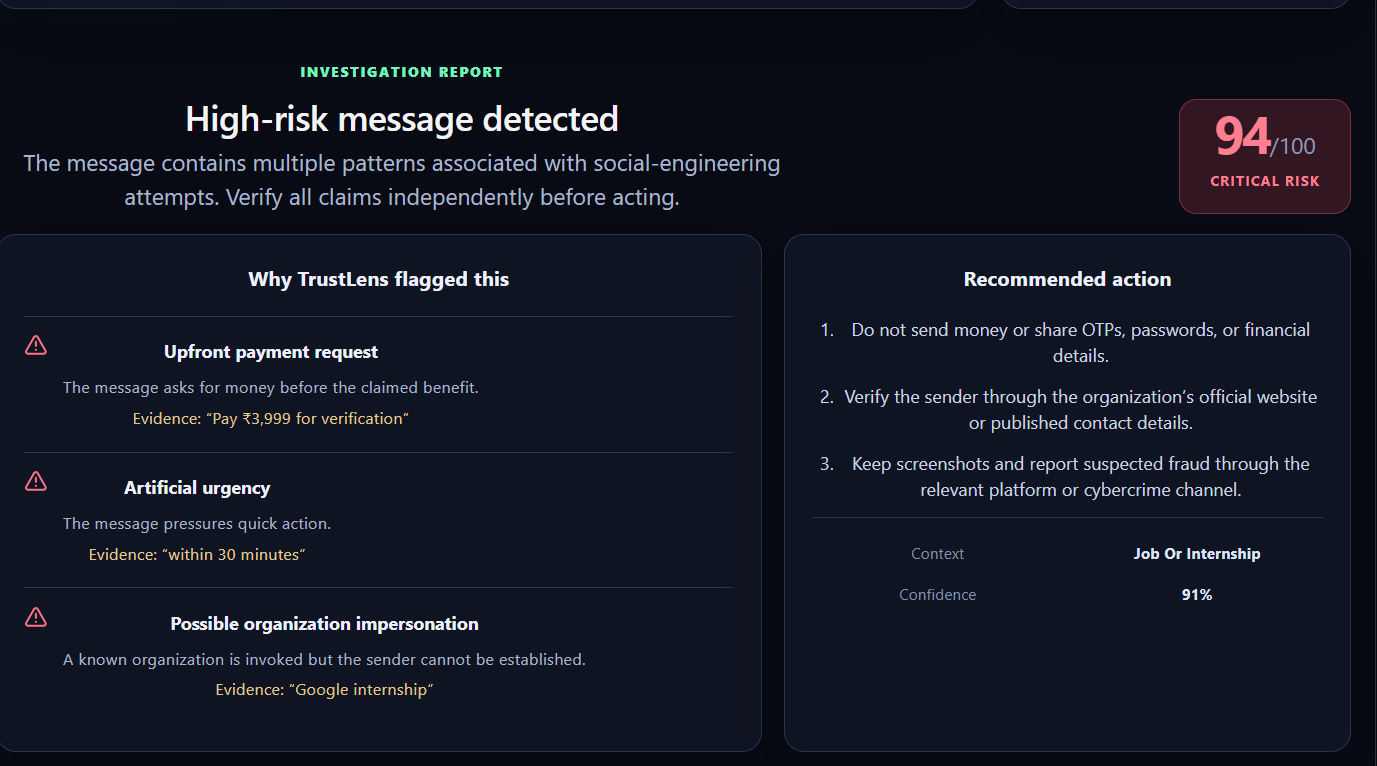
- A Risk Engine combines these signals into an explainable risk score from 0–100.
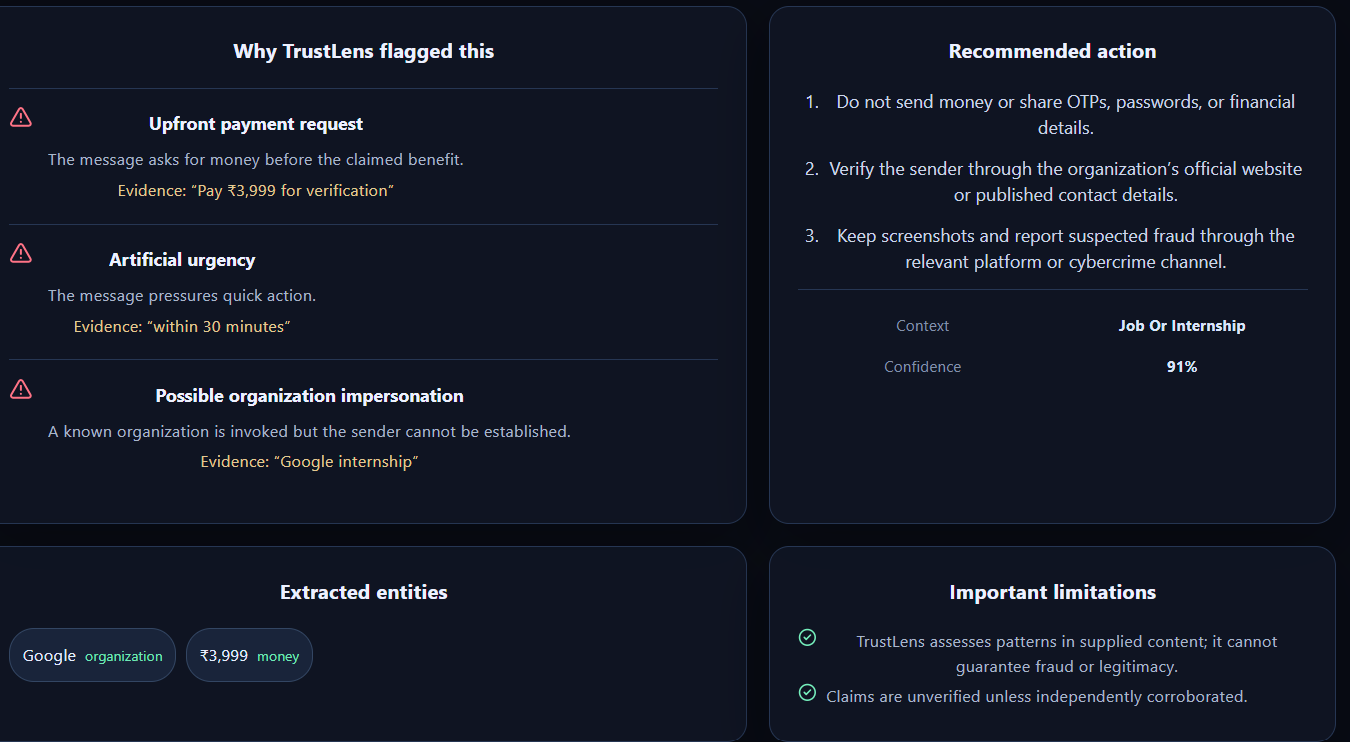
Instead of only returning a prediction, TrustLens provides suspicious signals, evidence, risk level, extracted information, recommendations, and limitations so that users can understand the reasoning behind the result.
What We Learned
Building TrustLens helped us understand that effective AI applications are not just about using an LLM. We learned how to combine traditional machine learning, NLP, LLM reasoning, deterministic rules, and backend APIs into a single decision pipeline.
We also learned about model evaluation using metrics such as precision, recall, and F1-score, API design with FastAPI, frontend-backend integration, URL security analysis, structured AI outputs, and the importance of handling uncertainty rather than presenting AI predictions as absolute truth.
Challenges We Faced
One of our biggest challenges was balancing AI flexibility with reliable security signals. An LLM can understand language very well, but it should not be trusted blindly for security decisions. We therefore designed TrustLens as a multi-layer system where the final risk assessment considers both ML/AI predictions and deterministic evidence.
Another challenge was making the results understandable. A simple "92% scam" score is not enough. We focused on turning the analysis into an investigation that tells the user what looks suspicious, why it matters, and what they should do next.
Our Goal
TrustLens is designed around one simple idea:
Before you trust the message, investigate it.
By combining NLP, machine learning, LLMs, and security-focused analysis, TrustLens aims to give people a practical second opinion when they encounter suspicious digital communication.
Built With
- agents
- ai
- analysis
- cybersecurity
- detection
- explainable
- fastapi
- generative
- learning
- llm
- logistic
- machine
- natural-language-processing
- pydantic
- python
- react
- regression
- scam
- tf-idf
- url
- vite

Log in or sign up for Devpost to join the conversation.