-
-
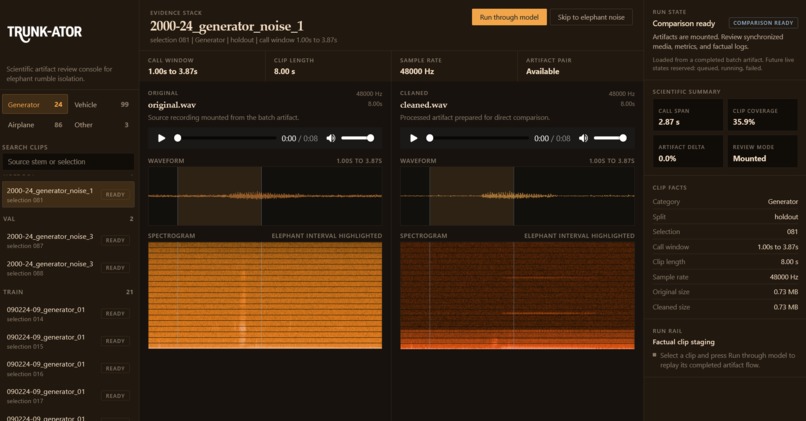
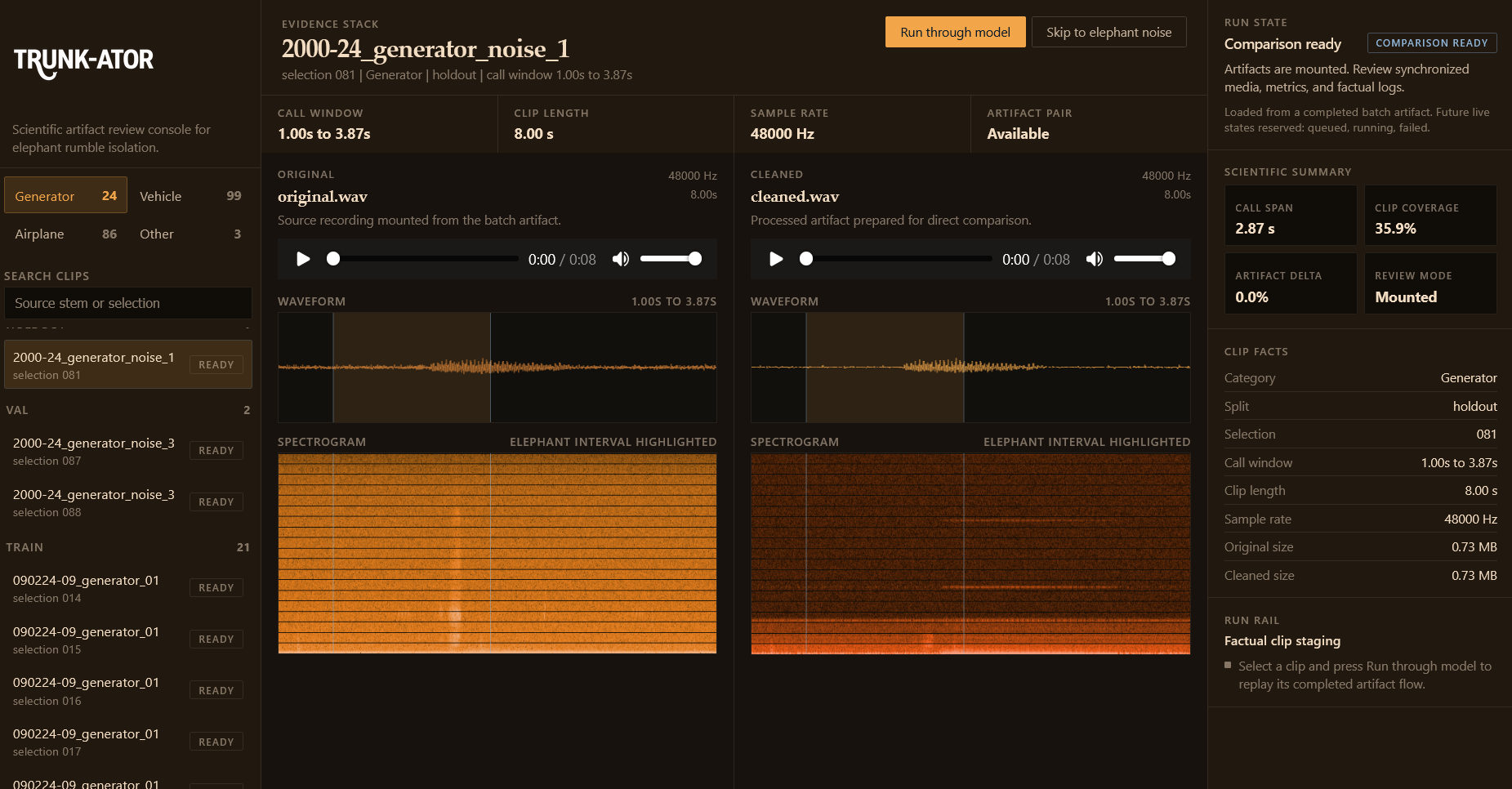
Our visual analysis dashboard.
-
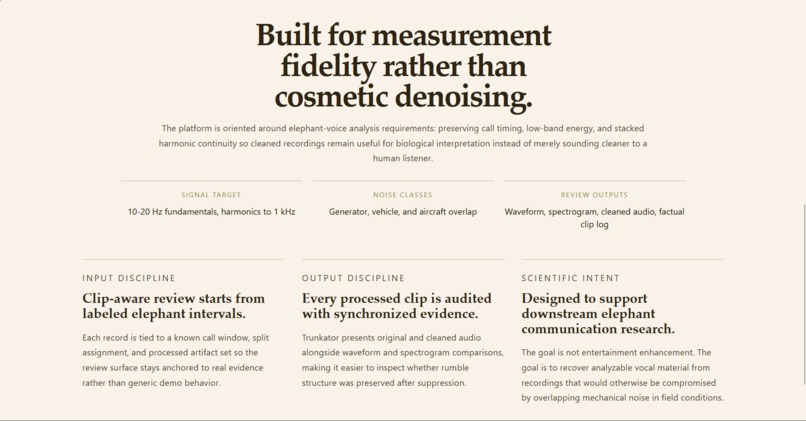
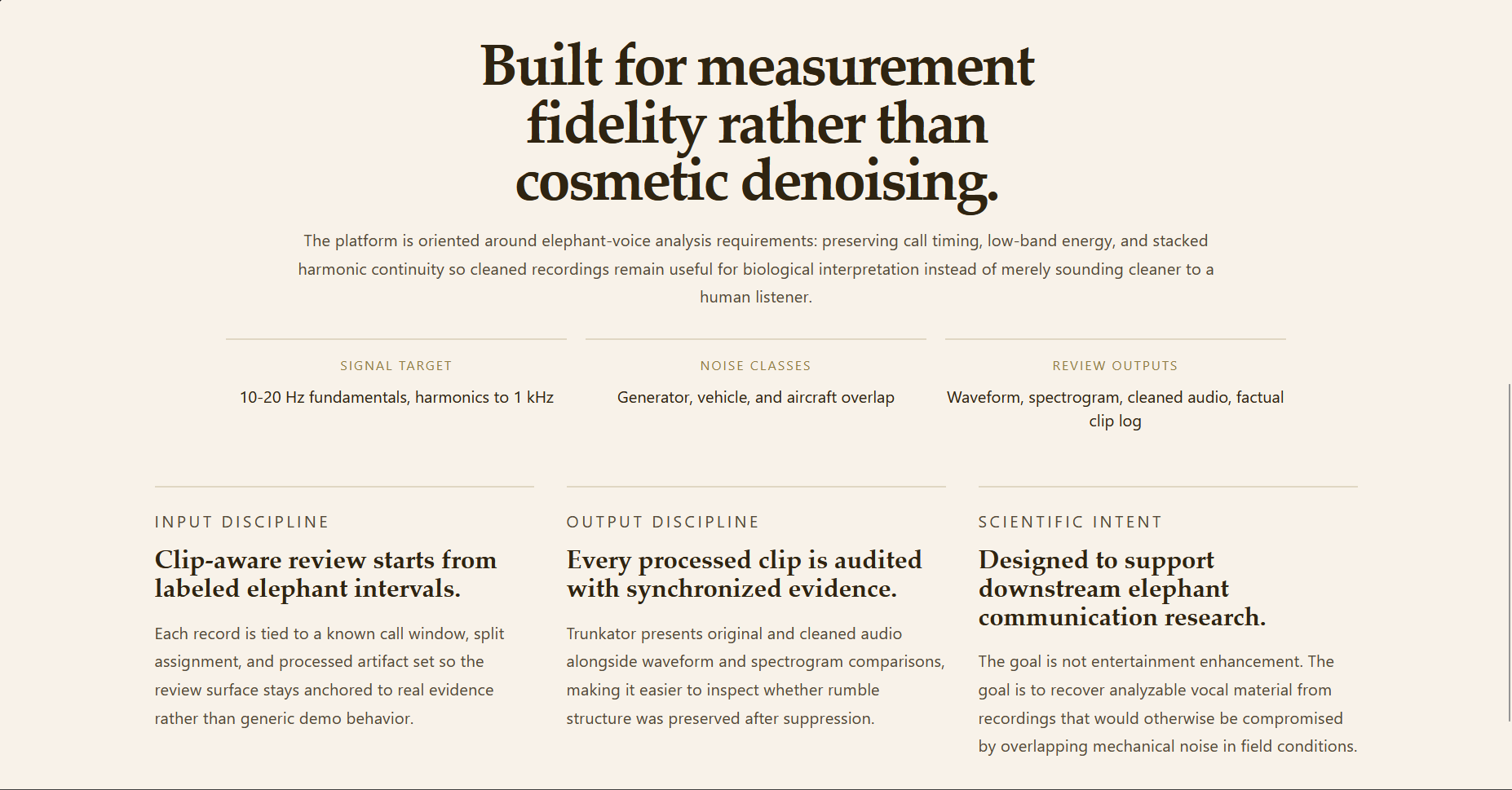
Description of Trunkator
-
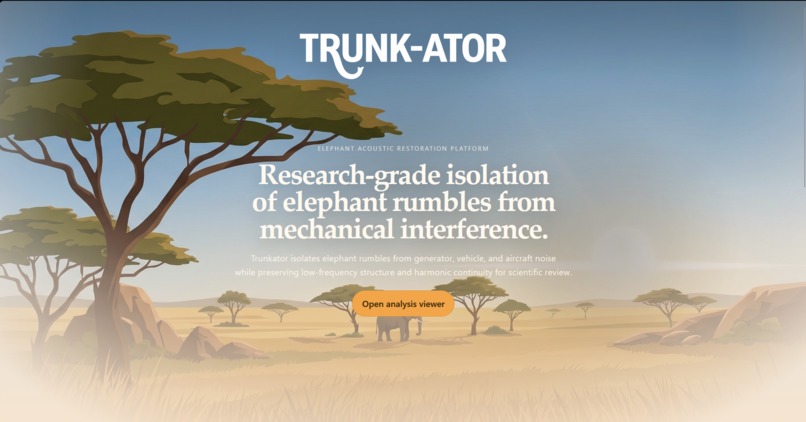
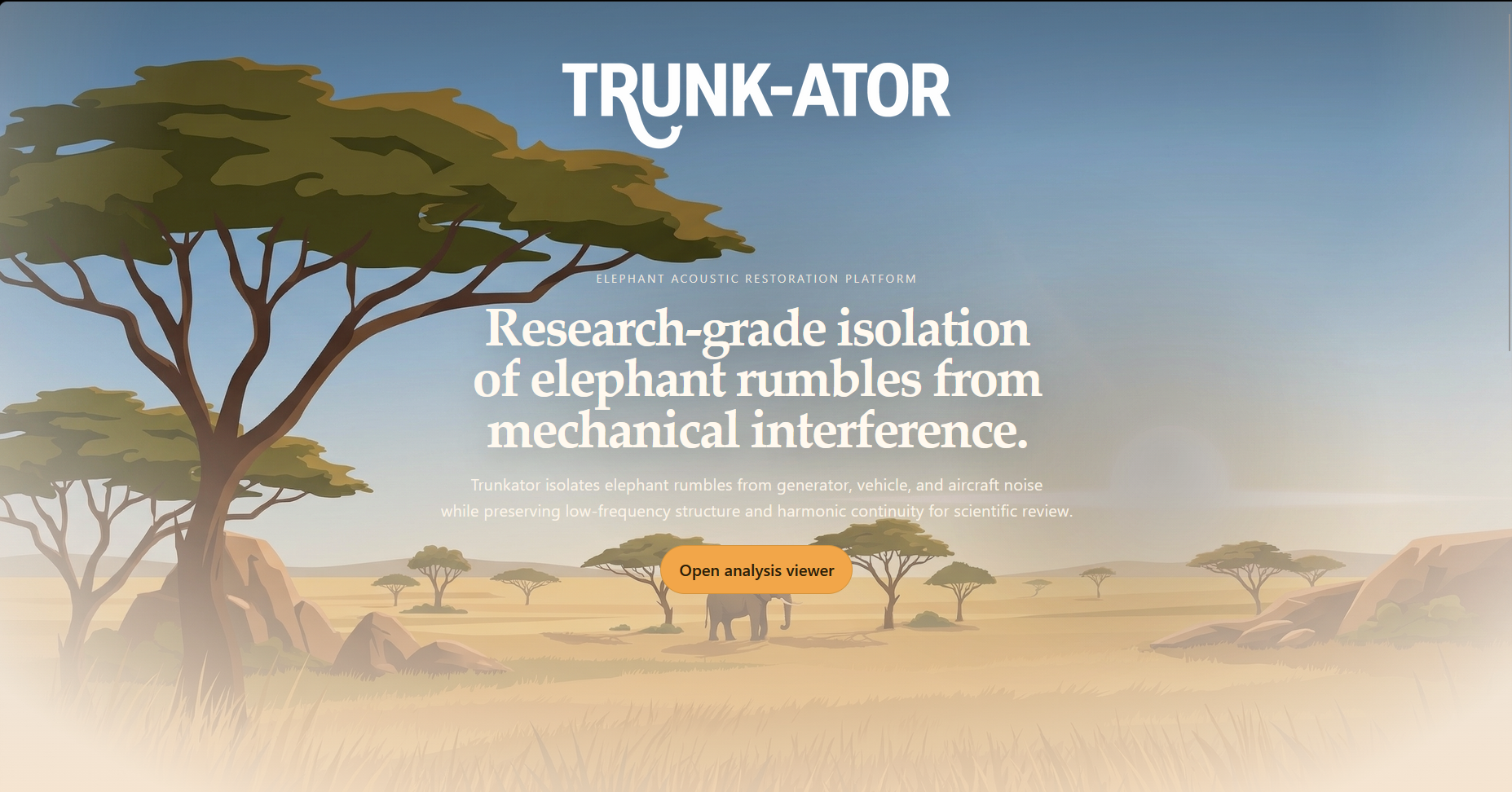
Trunkator Splashpage
-
Trunkator Banner
Elevator Pitch
We built an elephant-rumble extraction pipeline for noisy field recordings, combining signal-processing preprocessing with a custom machine-learning model trained on paired rumble-focused targets. The project is designed to make elephant rumbles easier to hear in real-world recordings where vehicles, generators, and aircraft often overlap the same low-frequency bands.
Inspiration
What made this project especially exciting for us was that it gave us a real opportunity to explore machine learning in a hands-on way through a problem that actually needed it. We have been interested in ML for a while, but this hackathon prompt was the first time we had a chance to seriously build an end-to-end system around it rather than just studying models in theory. The challenge naturally pushed us toward questions about data, supervision, feature extraction, model design, and evaluation, which made it a perfect space for us to learn by building.
It was also inspiring because the prompt sat right at the intersection of technical difficulty and real-world impact. Elephant vocalizations are biologically meaningful, but the recordings are messy, noisy, and difficult to work with. That made the problem feel authentic: it was not just about getting a model to classify something cleanly, but about trying to recover meaningful signal from imperfect field data.
Challenges We Faced
One of the hardest parts of this project was that the research papers, repositories, and methods we looked at often pointed in conflicting directions. Some focused on classification, some on event detection, some on denoising, and others on full source separation. In theory, many of those approaches sounded promising, but in practice they made different assumptions about what kind of labels, clean targets, or recording conditions were available. That meant we could not simply copy one method and expect it to work for this hackathon dataset.
We also found that elephant rumbles are especially difficult because the background interference often overlaps the same low-frequency region as the signal we care about. Engines, generators, and aircraft do not just sit outside the elephant band; they often occupy the same space. Because of that, naive filtering was not enough, but purely learned approaches were also risky when the supervision was imperfect. To deal with that, we built multiple real implementations, including deterministic filtering pipelines, event-focused cleaners, several ML-based masking and denoising experiments, and finally a paired supervised rumble-extraction model.
A major challenge was also that this was our first time building a machine-learning model like this from the ground up as a group. We were not just plugging into a finished framework. We had to work through preprocessing, target generation, model architecture, training, validation, inference, and frontend integration ourselves. That made the process more difficult, but it also forced us to understand every stage of the system in a much deeper way.
Accomplishments
Our biggest accomplishment was building a full working pipeline rather than just stopping at an idea. We created a preprocessing stage that converts the original noisy recordings and CSV rumble annotations into paired training data, produced rumble-focused target audio, trained a spectrogram U-Net model on those pairs, and connected the final model to a Gradio frontend so the full workflow could be tested interactively.
Another accomplishment was our willingness to iterate honestly. We did not settle for the first method we tried. We built multiple pipelines, tested them on the real data, learned from what did and did not work, and used those results to refine the direction of the project. That process gave us a much more realistic understanding of what is hard about elephant-audio isolation and what kinds of methods are actually feasible in a hackathon setting.
Most importantly, this project was a real first step for us in building machine-learning systems ourselves. We learned how much the quality of the data pipeline matters, how target construction shapes model behavior, how architecture and loss design affect results, and how difficult it is to move from a research idea to a functioning implementation. For us, that was one of the most meaningful outcomes of the whole project.


Log in or sign up for Devpost to join the conversation.