-
-
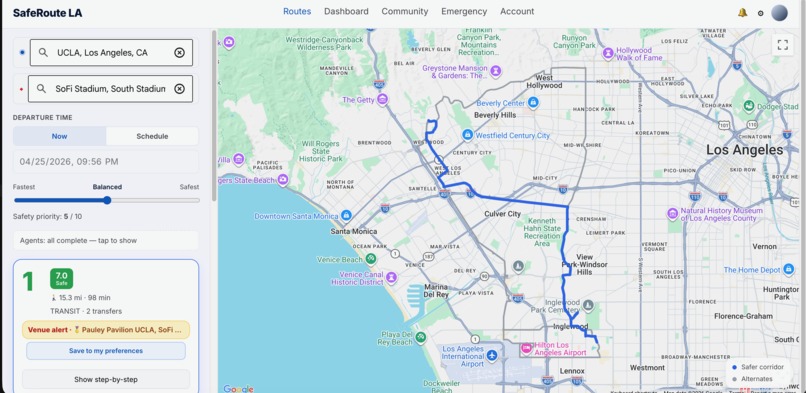
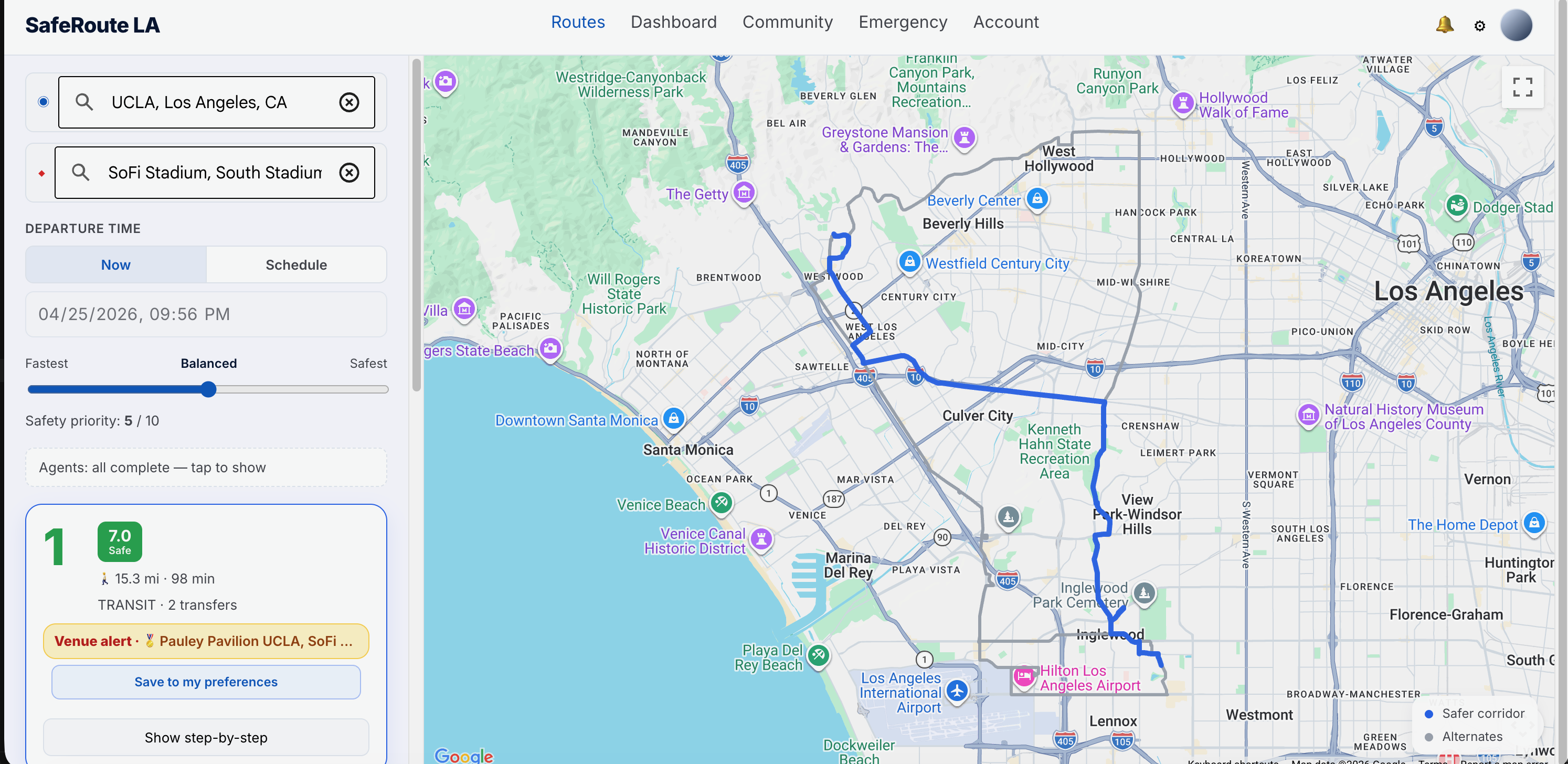
Routing Page
Inspiration
Late one night, a teammate took the wrong bus home. She didn't know the route, didn't know the neighborhood, and spent the whole ride hoping she'd made the right call. One of us was followed off a bus. Another watched a fight break out three stops from home and had to decide — get off or stay on — in seconds, alone. We've all felt it. That friction. The quiet anxiety that turns a simple commute into a mental load you carry the whole ride. Public transit should feel like flow — not a gamble. With LA28 bringing millions of visitors who will rely entirely on public transport to navigate our city, we knew that friction couldn't be the norm anymore.
What it does
Trugo ranks public transit routes by safety — not just speed. Enter your origin and destination, and a multi-agent AI system analyzes crime data, lighting conditions, foot traffic, news signals, and real-time scoring to surface the routes where you're most likely to feel safe. You choose how much safety matters to you, from fastest to safest, and Trugo does the rest. The commute stays the same. The anxiety doesn't.
How we built it
We built Trugo with a multi-agent architecture where specialized agents run in parallel — each focused on one signal: crime data, ambient lighting, pedestrian density, live news, and AI-powered scoring. These agents feed into a central scoring engine that ranks available transit routes. The frontend is built on Google Maps, with a clean interface designed to be usable under stress, at night, in an unfamiliar city.
Challenges we ran into
Safety is subjective and deeply personal — what feels unsafe to one person is routine for another. Translating that into a scoring system without stigmatizing neighborhoods was our hardest design challenge. We also had to ensure agents ran fast enough to be useful in real time, and balance data freshness with reliability.
Accomplishments that we're proud of
We built something we would actually use. Every person on our team has a story — a late night ride they regretted, a route they avoided, a moment they wished they'd had better information. Seeing those experiences turn into a working product, in a weekend, felt meaningful. We're also proud of the framing: Trugo doesn't lead with fear. It leads with confidence. It turns the mental load of navigating an unfamiliar city into something you just... don't have to think about anymore.
What we learned
Empowerment and fear are a razor's edge apart in product design. The same feature — a safety score — can make someone feel informed or make someone feel terrified. Every design decision we made had to answer one question: does this make the user feel more capable, or more afraid? Friction into function only works if the function feels human.
What's next for Trugo
LA28 is two years away, and the city is already transforming. We reached out to a nonprofit working directly with LA28 organizers — and they were unequivocal: this is exactly the kind of technology they need. Not something like it. This. That conversation changed how we see Trugo — it stopped being a hackathon project and became something the city is actively waiting for. Next steps: expanding agent coverage, adding community-reported signals, supporting multiple cities, and integrating directly into existing transit apps. Public transport will define how the world experiences Los Angeles in 2028 — millions of visitors, one city, zero margin for feeling lost or unsafe. We want every single one of them — local or visitor, day or night — to trust the route.

Log in or sign up for Devpost to join the conversation.