-
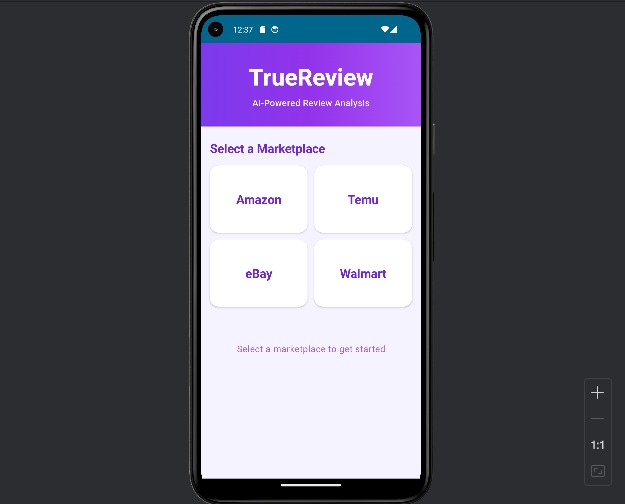
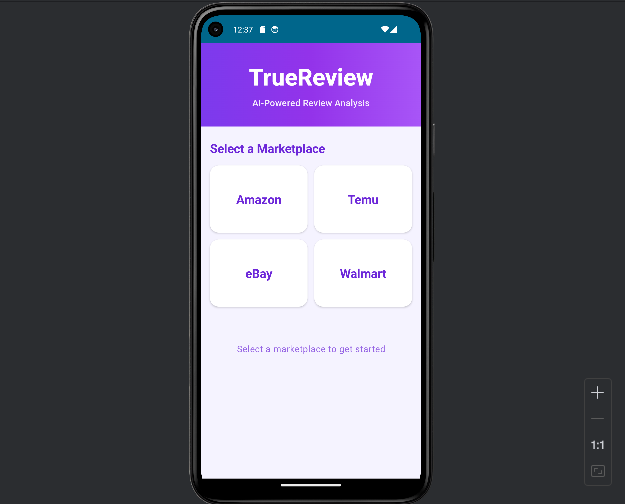
Initial Screen
-
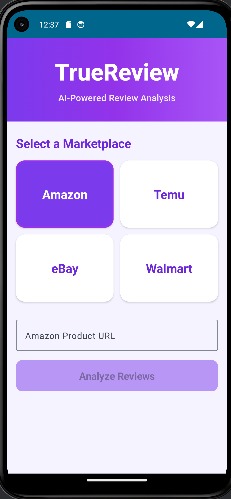
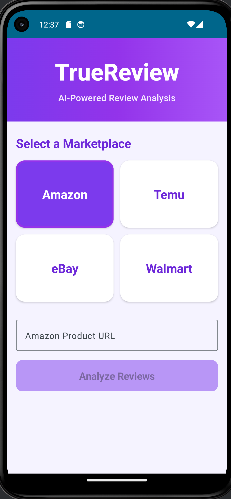
Tab Click
-
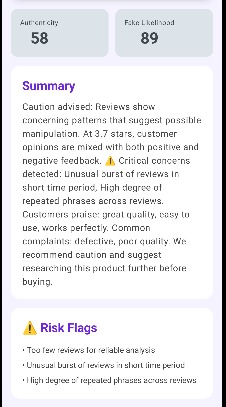
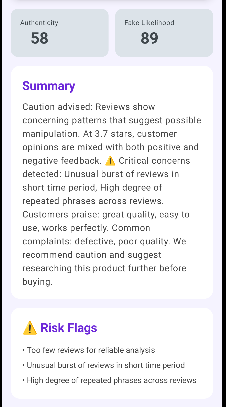
Summary & Risk Flags
-
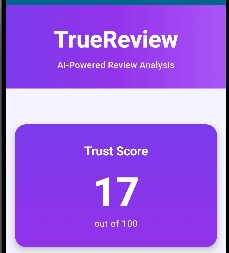
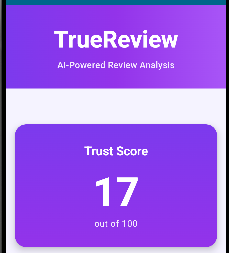
Trust Score
-

Pros
-

Cons


Inspiration
Online shopping is a trust game — and consumers are losing. Studies estimate 30-40% of online reviews are fake, yet we're expected to make purchasing decisions based on them. Existing solutions like Fakespot send your browsing data to external servers, creating privacy concerns. I wanted to build something different: a review analysis tool that runs entirely on your device, keeping your shopping habits private while giving you the truth about what you're buying.
What it does
TrueReview analyzes product reviews from Amazon, Walmart, eBay, and Temu to detect manipulation and assess trustworthiness. Paste a product URL and get:
- Trust Score (0-100): An overall reliability rating
- Authenticity & Fake Likelihood: AI-driven confidence metrics
- Risk Flags: Specific warnings like "unusual burst of reviews," "high degree of repeated phrases," or "suspiciously few negative reviews"
- Pros/Cons Extraction: Key themes pulled from the review corpus
Everything runs locally on-device. No data leaves your phone.
How I built it
TrueReview is a native Android app built with Kotlin and Jetpack Compose. The analysis pipeline includes:
- K-means clustering on review embeddings to detect coordinated review campaigns
- Temporal burst detection to catch suspicious posting patterns (>40% of reviews within a 7-day window)
- N-gram repetition analysis to identify copy-paste review farms
- Heuristic scoring combining rating distributions, review length, verified purchase ratios, and cluster tightness
- TensorFlow Lite for on-device ML inference
The architecture is modular — marketplace fetchers, preprocessing, ML models, and scoring are all independent components designed for extensibility.
Challenges I ran into
Web scraping is a war. Every major marketplace actively blocks automated requests, which forced me to implement fallback demo modes while exploring alternative data sources like official APIs. Balancing detection accuracy with on-device performance constraints required careful optimization of the clustering and embedding pipelines. Building a sophisticated analysis engine that remains responsive on mid-range hardware pushed me to think carefully about computational trade-offs.
Accomplishments that I'm proud of
I built a complete review analysis pipeline that runs entirely on-device with zero external dependencies. The risk flag system catches real manipulation patterns: review timing anomalies, language repetition, rating distribution skews, and cluster homogeneity. The UI delivers complex analysis results in a format anyone can understand — a single trust score backed by transparent, explainable flags. Most importantly, it respects user privacy by keeping all processing local.
What I learned
I learned that the hardest part of building a consumer tool isn't the algorithm — it's getting the data. Anti-bot measures are sophisticated and constantly evolving. I also gained deep experience with on-device ML constraints: model size, inference latency, and memory management all matter when you can't offload to a server. Finally, I learned how to structure a modular codebase that can evolve — the fetcher abstraction I built means adding new marketplaces or swapping data sources requires minimal changes to the core analysis engine.
What's next for TrueReview
- Alternative data pipelines: Exploring official retail APIs and browser extension approaches to bypass scraping limitations
- Model improvements: Training a custom fake review classifier on labeled datasets rather than relying on heuristics alone
- Arm optimization: Quantizing models to int8 and benchmarking inference performance across device tiers
- Expanded detection: Adding reviewer behavior analysis, cross-marketplace identity matching, and AI-generated text detection

Log in or sign up for Devpost to join the conversation.