-
trueproof
Inspiration
The idea for TrueProof was born out of the daily reality of modern software development. While building projects and grinding algorithmic problems in C++ and Java—tackling complex data structures like array manipulations and string logic—the coding workflow has fundamentally changed. We use AI tools like Cursor to move faster, but a major friction point arises during hiring and portfolio evaluation. The AI often handles the syntax, but we build the core logic. Yet, when applying for engineering roles or delivering freelance work, reviewers look at a clean codebase and wonder, "Did this person actually write this, or did an LLM generate the entire repository?" The current solutions are terrible: either submit to invasive, anxiety-inducing live whiteboarding, or allow spyware-like keystroke trackers to monitor your screen. We wanted to use the Egoist AI Passport to create a third option: a way to prove human craftsmanship without surrendering privacy.
What it does
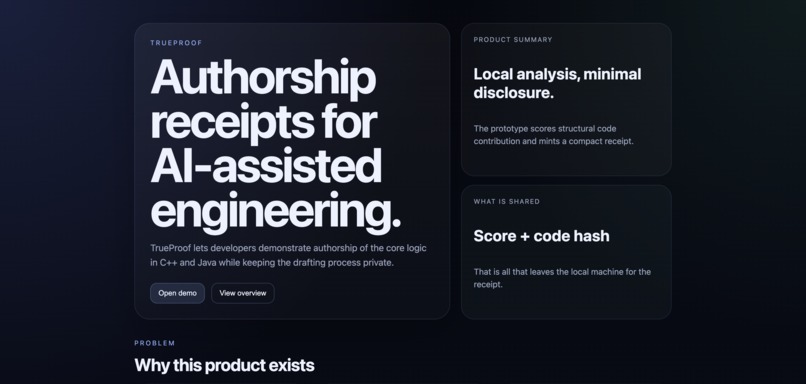
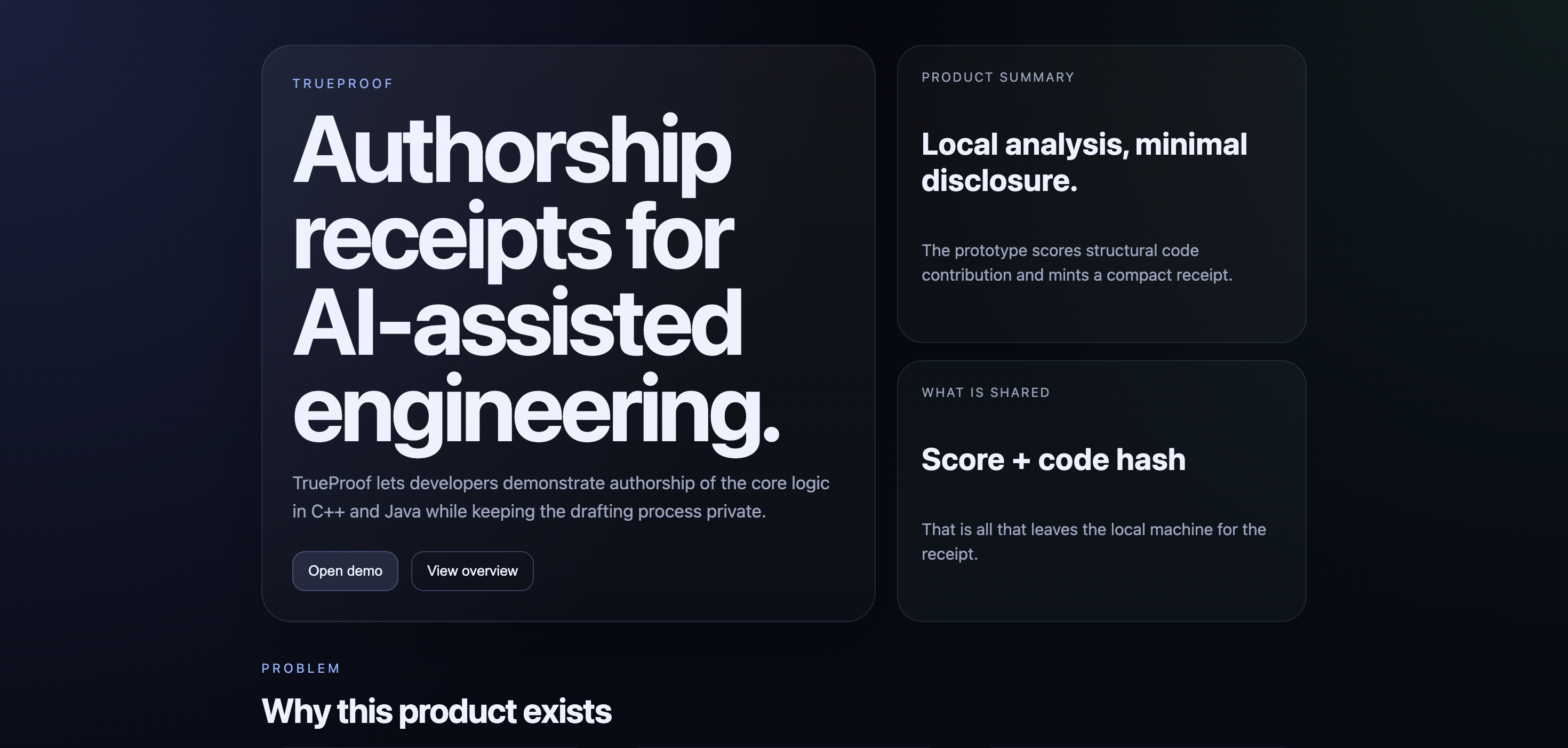
TrueProof is an Authorship Provenance Pass that lives within the Egoist AI Passport ecosystem. It separates human-architected logic from AI-generated syntax. Instead of tracking every typo, prompt, or deleted line, it mints a lightweight, cryptographic receipt that travels with your code. When a recruiter, client, or open-source maintainer wants to verify your skills, they request access. You grant them a one-time, read-only pass that proves you architected the core logic of the project. They get the cryptographic trust they need; you keep your private drafting process completely hidden, avoiding the "surveillance state" of modern hiring.
How we built it
Because we submitted to the Concept Lane with an executable prototype design, our primary focus was creating a privacy-first data schema and an Abstract Syntax Tree (AST) parser using Tree-sitter that prevents the tool from becoming spyware. Rather than measuring raw character counts or logging keystrokes, we conceptualized the TrueProof Authorship Score ($S$).
The system evaluates the semantic weight of human-generated logic nodes ($H_L$) versus AI-generated boilerplate or syntax completion nodes ($A_S$). Using configurable weights ($W_1$ for structural logic like loops and conditional trees, $W_2$ for standard syntax/imports), the core ratio is calculated as:
$$S=\left(\frac{W_1 \sum H_L}{W_1 \sum H_L + W_2 \sum A_S}\right) \times 100$$
Once this score $S$ is calculated locally (e.g., $S=88\%$), the local environment discards all granular tracking data and mints a single, static Verifiable Credential receipt to the user's AI Passport Inbox.
Challenges we ran into
The biggest challenge was defining the boundary between "Logic" and "Syntax." If the metric is too simple (like counting character edits), developers will just manually re-type AI suggestions to game the system. If it is too deep, the system becomes the exact surveillance tool we are trying to destroy. We overcame this by shifting our mindset to the Creative Track—treating code not as an employee test, but as digital IP. By focusing the algorithm strictly on structural architecture (AST function definitions, loops, algorithmic steps) rather than raw typing speed, we aligned perfectly with Egoist's principle of minimal disclosure.
Accomplishments that we're proud of
We are incredibly proud of designing a system that shifts power back to the creator. Most "anti-cheat" or AI-detection tools operate from a baseline of distrust and surveillance, punishing the user. TrueProof operates on empowerment. We successfully mapped a workflow where the user initiates the proof, owns the context, and can instantly revoke access when a hiring cycle ends.
What we learned
Building this deepened our understanding of generative intelligence, AST parsing, and privacy design. Drawing on concepts from recent AI engineering workshops, we learned that distinguishing human intent from AI generation requires tracking the origin of the structural constraints, not the speed of the output. We also learned how to aggressively edit a product idea down to its first, most necessary move: proving one single claim to one specific verifier.
What's next for TrueProof
The immediate next step is to build out our full VS Code / Cursor extension to parse Tree-sitter AST nodes in real-time locally. We want to implement this tracking logic offline so it can generate signed JSON-LD receipts upon commit. From there, we plan to finalize the API integration with the Egoist AI Passport ecosystem, allowing developers to seamlessly attach a TrueProof receipt to a GitHub repository or portfolio link, making "portable trust" the default standard for the next generation of engineers.
Built With
- ast-parsing
- fastapi
- next.js
- node.js
- python
- react
- tree-sitter
- typescript


Log in or sign up for Devpost to join the conversation.