-
-
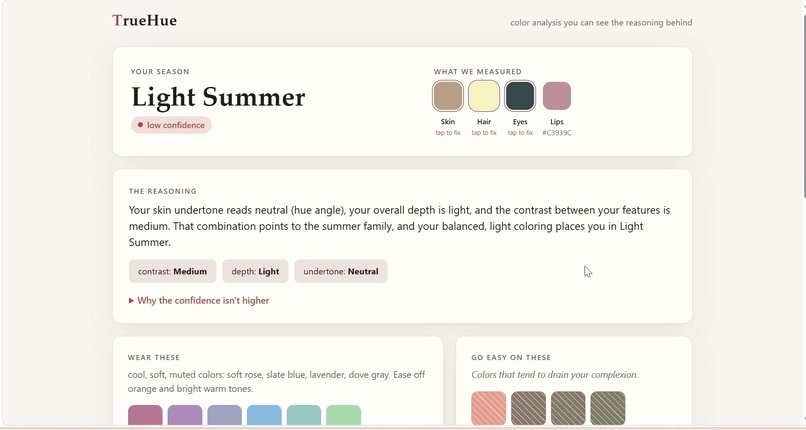
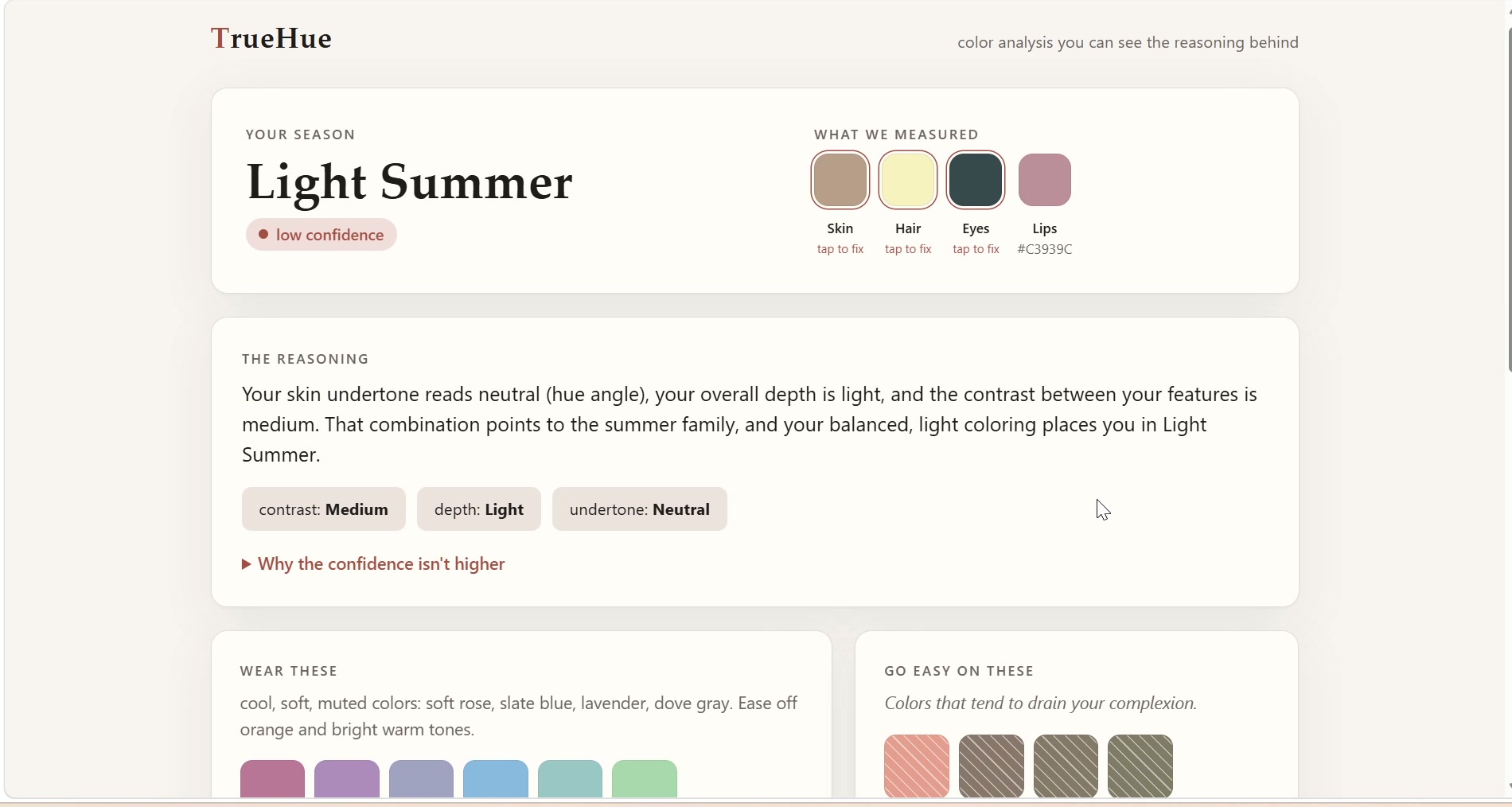
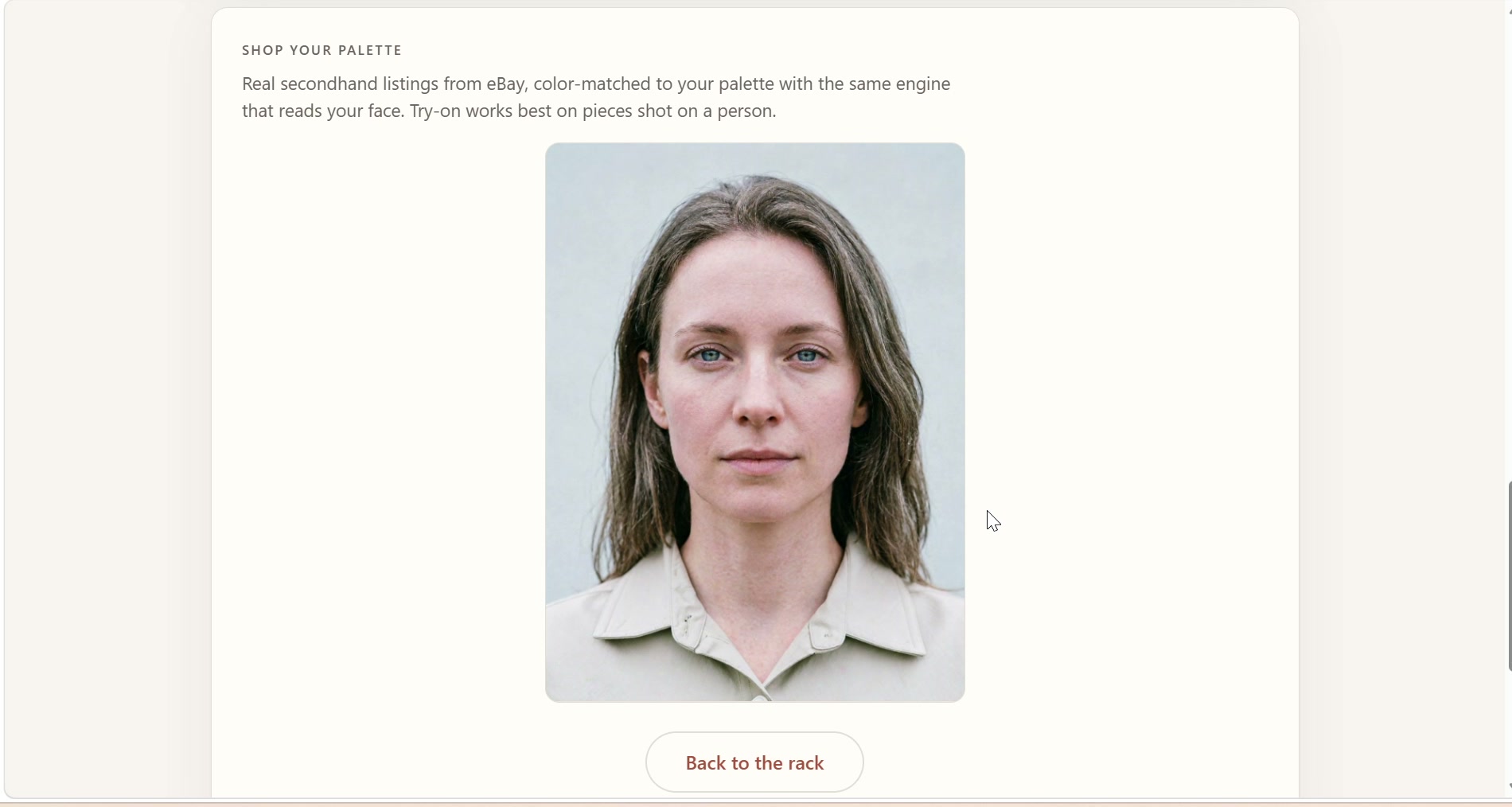
One selfie in: your season, your confidence level, and the exact colors we measured from your skin, hair, and eyes.
-
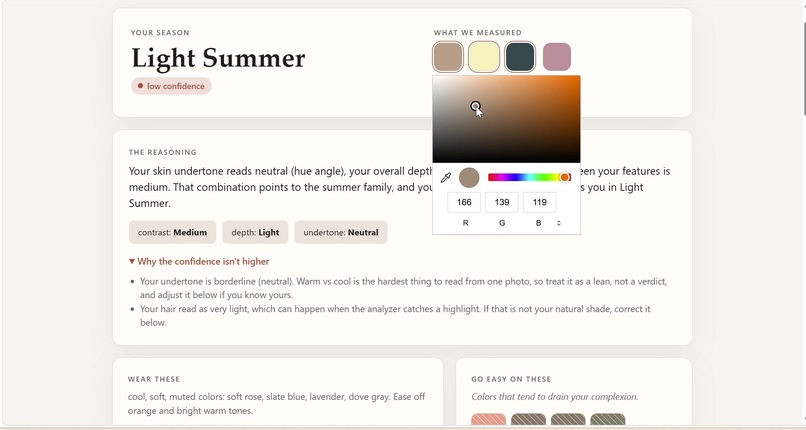
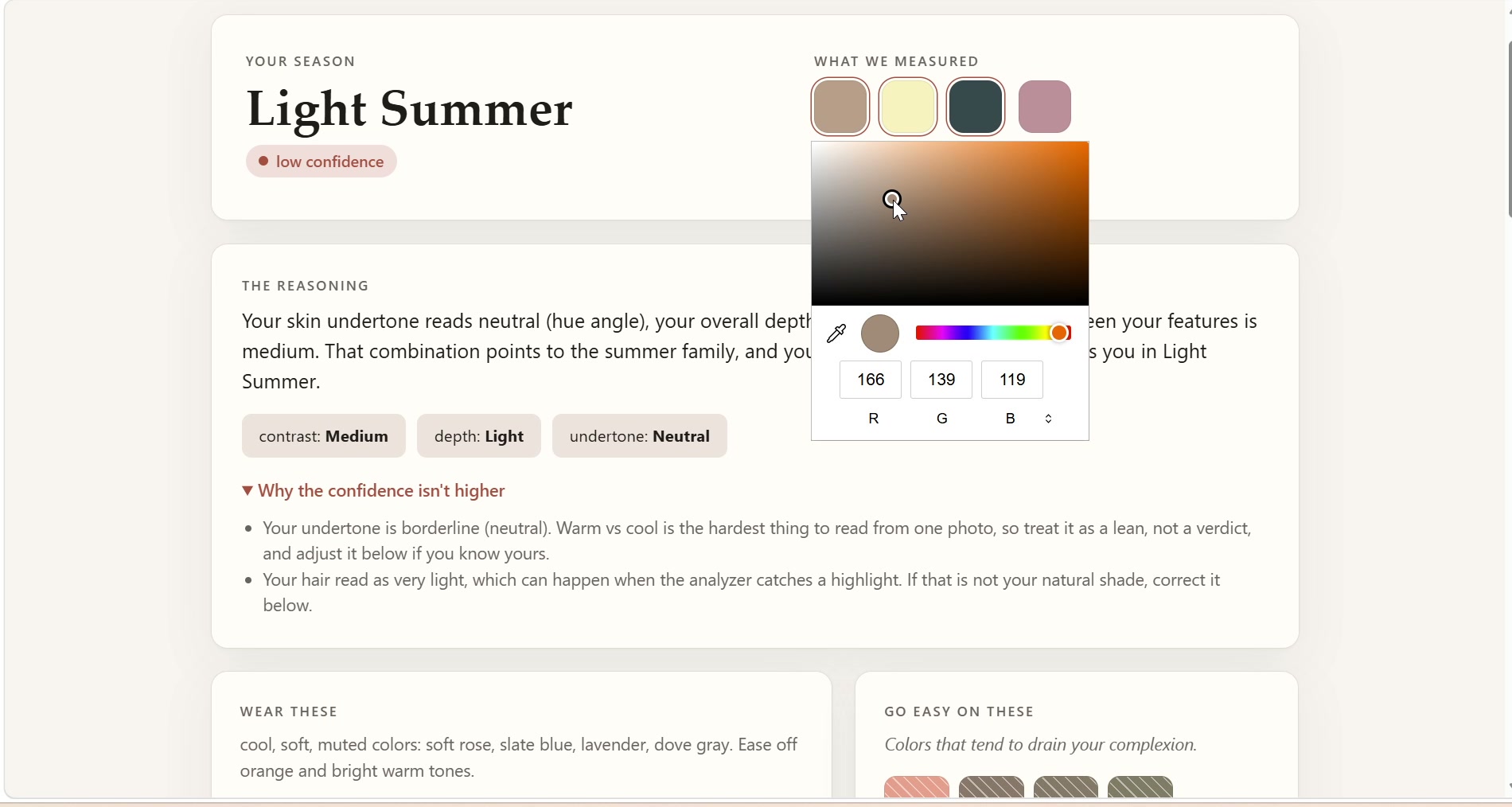
Every reading is correctable. Tap a swatch, fix what the analyzer got wrong, and the whole result updates instantly at no cost.
-
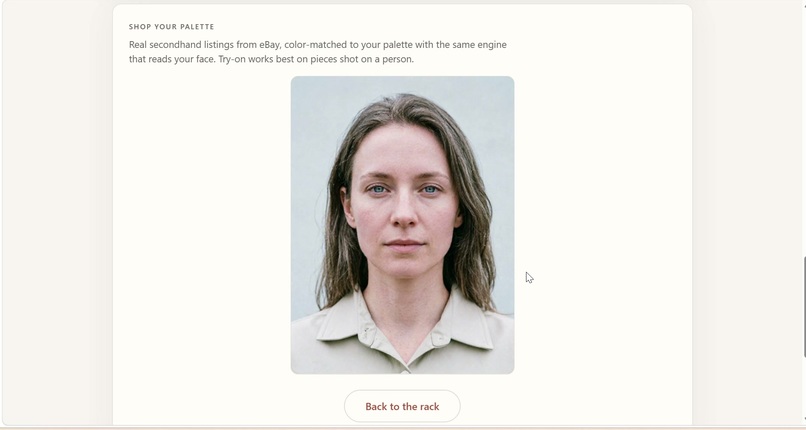
Try the real listing on your own body before you buy, powered by YouCam Clothes Virtual Try-On.
-
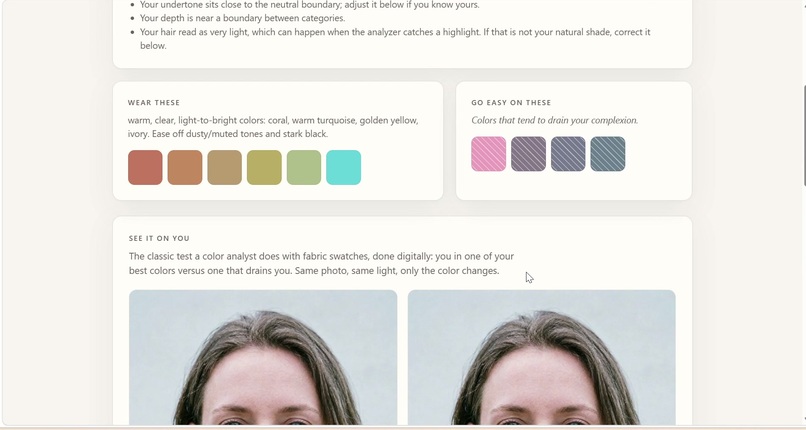
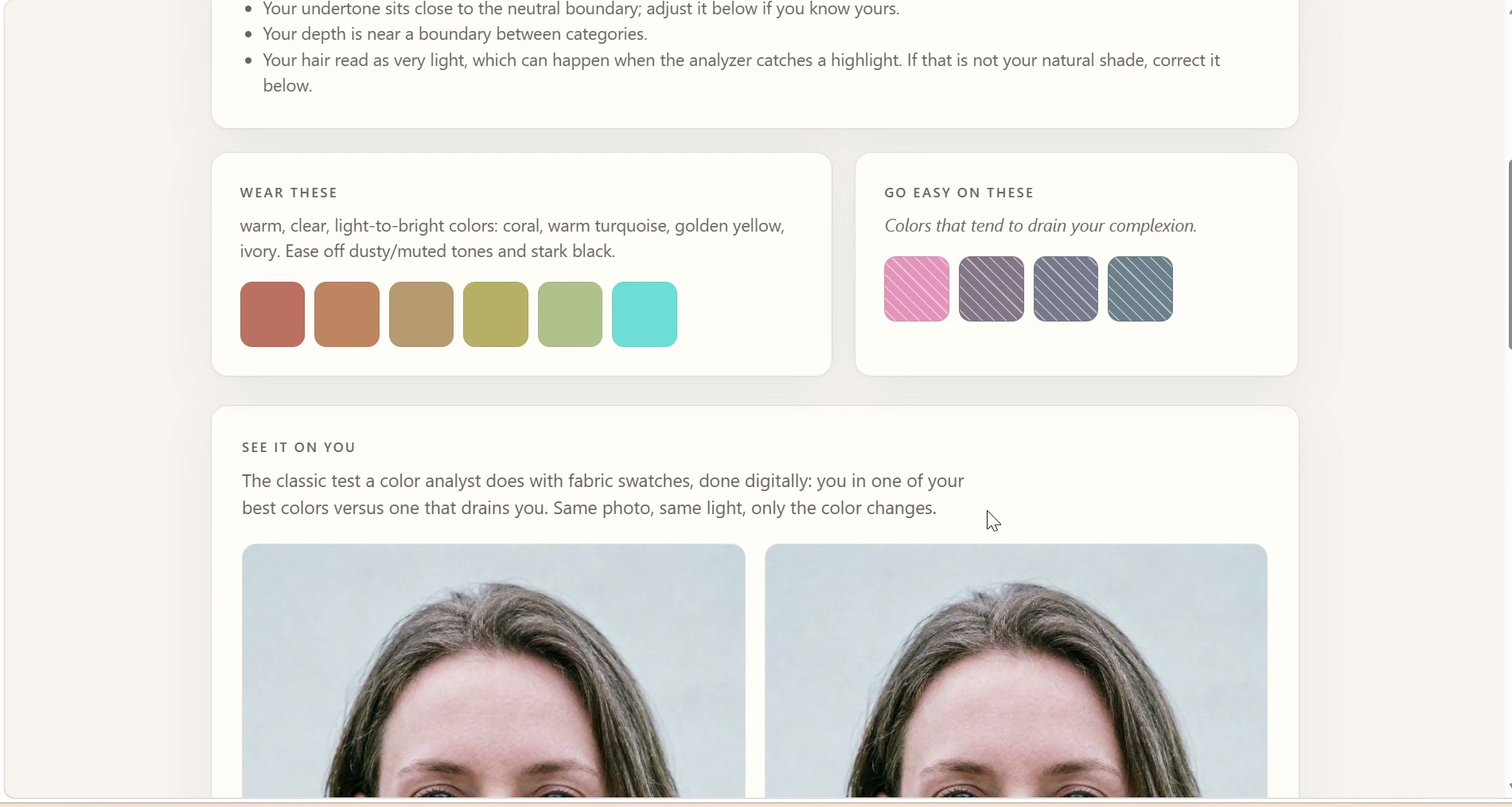
A palette personalized to your measured coloring: the colors to wear, and the ones that tend to drain you.
-
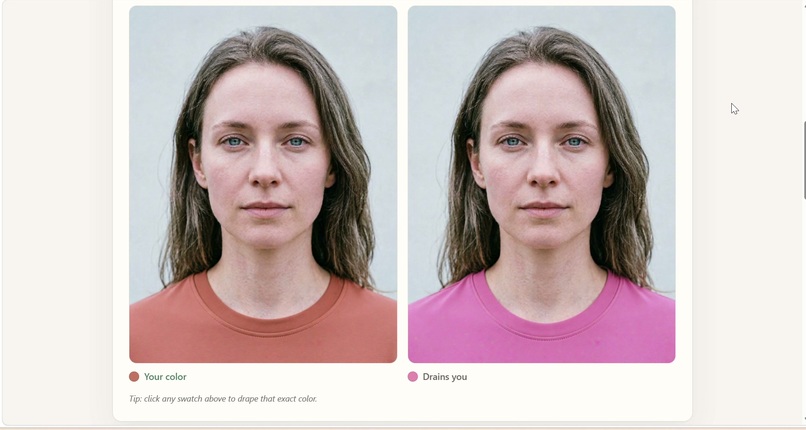
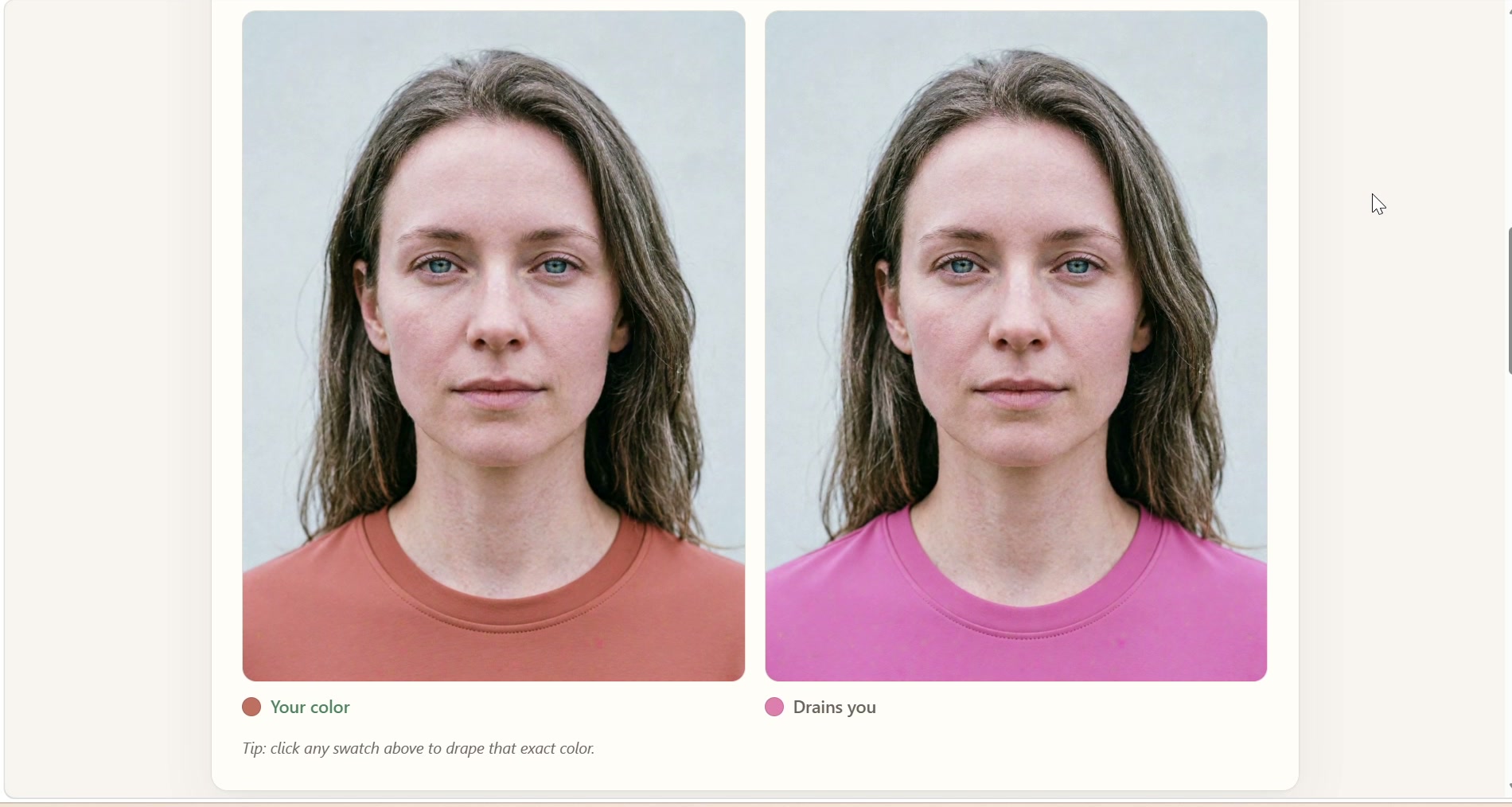
Digital draping with YouCam Virtual Try-On: your best color versus one that drains you. Same photo, same light.
-
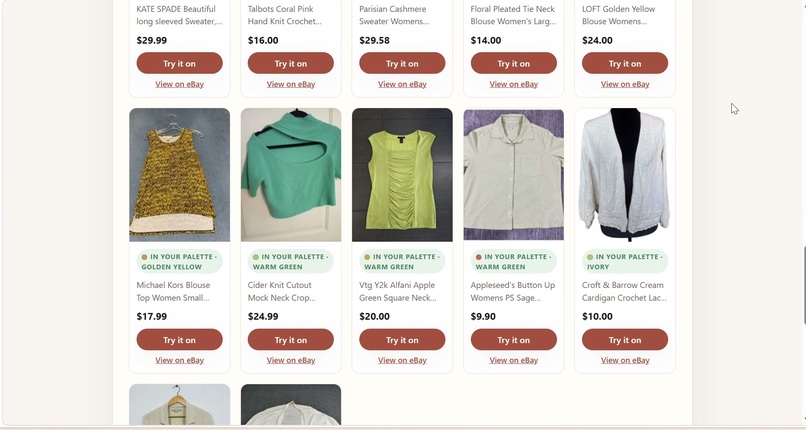
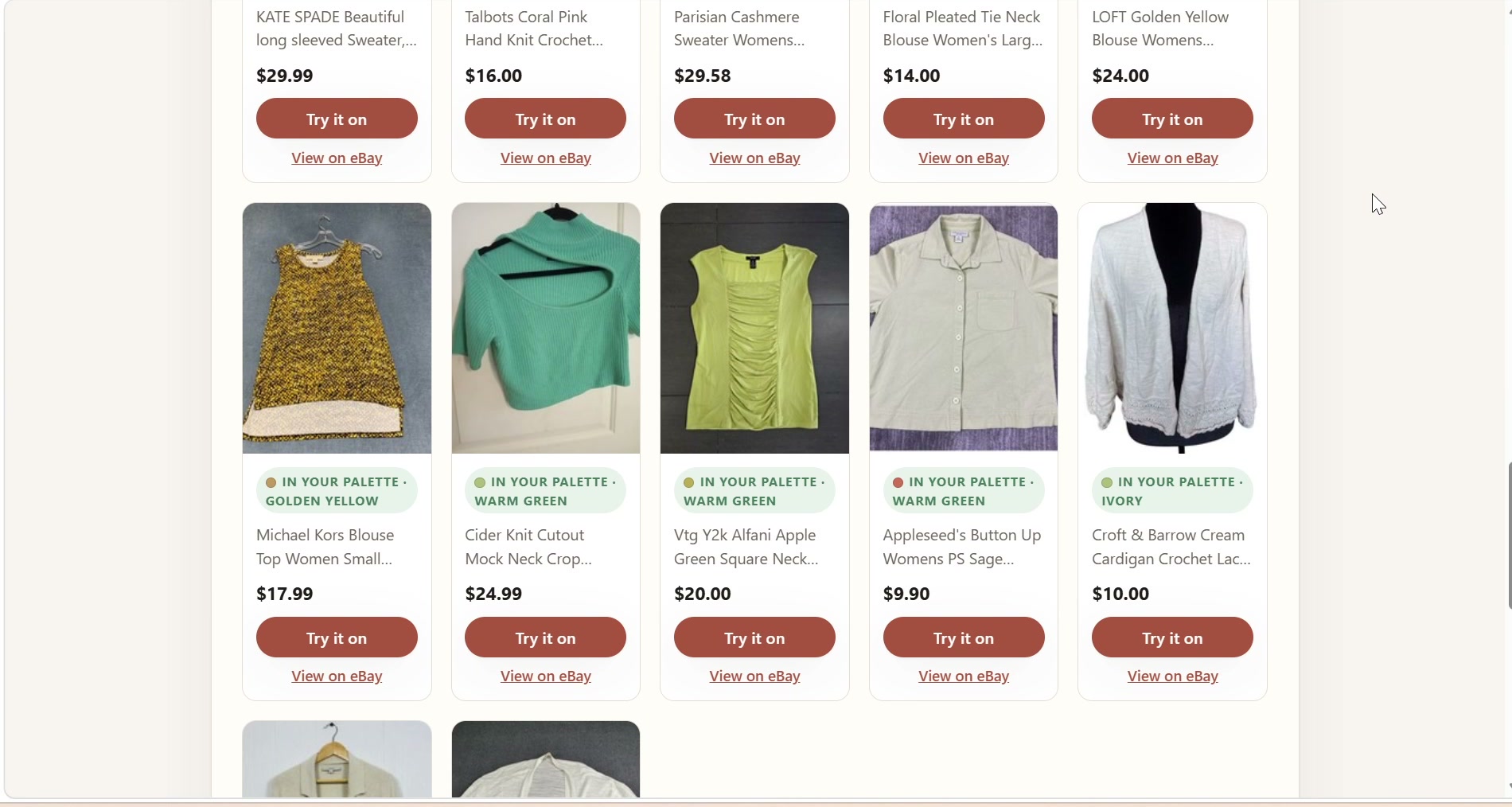
Shop your palette: real secondhand eBay listings, color-verified against your palette with the same CIEDE2000 engine.
Inspiration
Personal color analysis is having a moment: studios charge $150 to $300, and it is all over TikTok and K-beauty. But it is mystique sold as certainty, a consultant's verdict you cannot inspect, and different analysts often disagree. We wanted the opposite: show the measurement, show the confidence, let people correct it, and prove it visually on their own body.
What it does
TrueHue turns one selfie into a color-season reading you can actually see the reasoning behind, then wear:
- Reads your skin, hair, and eye color with YouCam's Facial Color Tones Analyzer.
- Computes your undertone (skin hue angle), depth, and contrast in CIELab, and maps them to a color-season family with a plain-language explanation and a confidence score.
- Generates a palette anchored to your measured coloring, so two people in the same season get different palettes.
- Digital draping: renders you in your best color versus a draining one, side by side, with YouCam Clothes Virtual Try-On. It is the fabric-swatch test a color analyst does by hand, done digitally.
- Shop your palette: pulls real secondhand listings from eBay, color-verifies each one against your palette by running CIEDE2000 on the listing's own thumbnail (the same engine that read your face), and tries the real garment on your body.
How we built it
A Python and Flask backend keeps the API key server-side and proxies two YouCam APIs (Facial Color Tones Analyzer and Clothes Virtual Try-On). The color science is an original, open module: sRGB to CIELab, a lightness-invariant undertone from hue angle, a full season decision tree, palette generation in LCh personalized to the user, and CIEDE2000 for catalog fit. Draping recolors a background-removed tee template (via YouCam Background Removal) to any exact palette hex, then runs it through virtual try-on. The frontend is a vanilla-JS single-page app. It is deployed live at truehue.rowset.co.
How we use the YouCam API
Facial Color Tones Analyzer is the sensor that reads your color. Clothes Virtual Try-On is the proof that puts your palette on your body. One theme, color, ties them together, and the decision layer is ours, so this is a reference implementation, not a wrapper.
Potential impact
Apparel has retail's worst returns problem: the average online clothing return rate is around 24 percent, and its top drivers are exactly what TrueHue removes before purchase. Fit and sizing cause roughly half of apparel returns, and "it looked different" (color and appearance) is the next largest reason at about a fifth. TrueHue attacks both: the palette filter shows only colors that suit the shopper, and virtual try-on shows the piece on their own body, before they buy. The opportunity is largest in resale, where TrueHue already runs live on real eBay inventory: US secondhand apparel is projected at about $74B and global at about $367B by 2029. Resale inventory is one-of-a-kind and rarely shot on a model, so color-and-fit uncertainty runs higher there, which makes the fit tighter. This is precisely Perfect Corp's own model: TrueHue is a drop-in color-analysis-plus-try-on layer that resale marketplaces and apparel brands can embed to lift conversion and cut returns.
Challenges we ran into
Reading warm-versus-cool undertone from one photo is genuinely hard: human skin hue clusters narrowly, and the analyzer's hair read can be unreliable. Instead of hiding that, we measured it across a range of skin tones, made the read lean on the most reliable signal (skin) so depth holds up at any tone, added a confidence system that explains itself, and made every extracted color user-correctable, so a fix re-runs the engine instantly with zero API cost. The honest, correctable read is the product's differentiator against studios that sell certainty.
What we learned
Colorimetry (CIELab, CIEDE2000, ITA) is real, computable science; seasonal color is a design tradition best offered as explainable guidance, not a verdict. Drawing that line honestly, and letting users correct the machine, makes the product more trustworthy, not less.
What's next for TrueHue
Calibrate the axis thresholds against a labeled dataset; corroborate the color read with a second YouCam signal (Fitzpatrick skin type); add in-app camera capture; and package the color-analysis-plus-try-on layer as an embeddable SDK for resale marketplaces and brands.

Log in or sign up for Devpost to join the conversation.