-
-
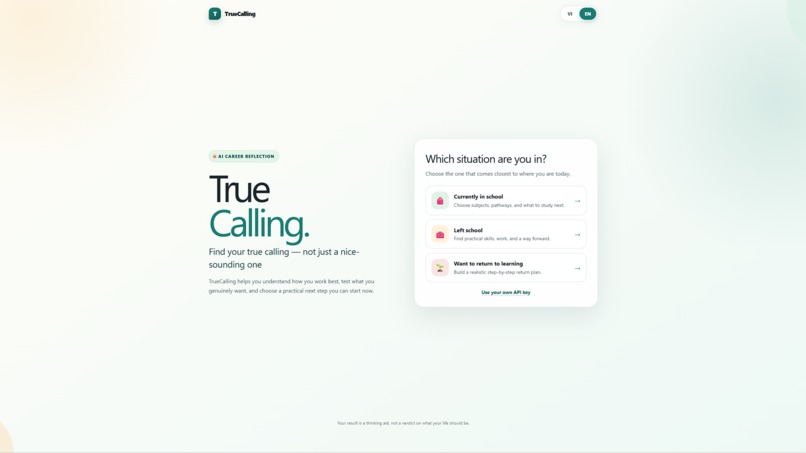
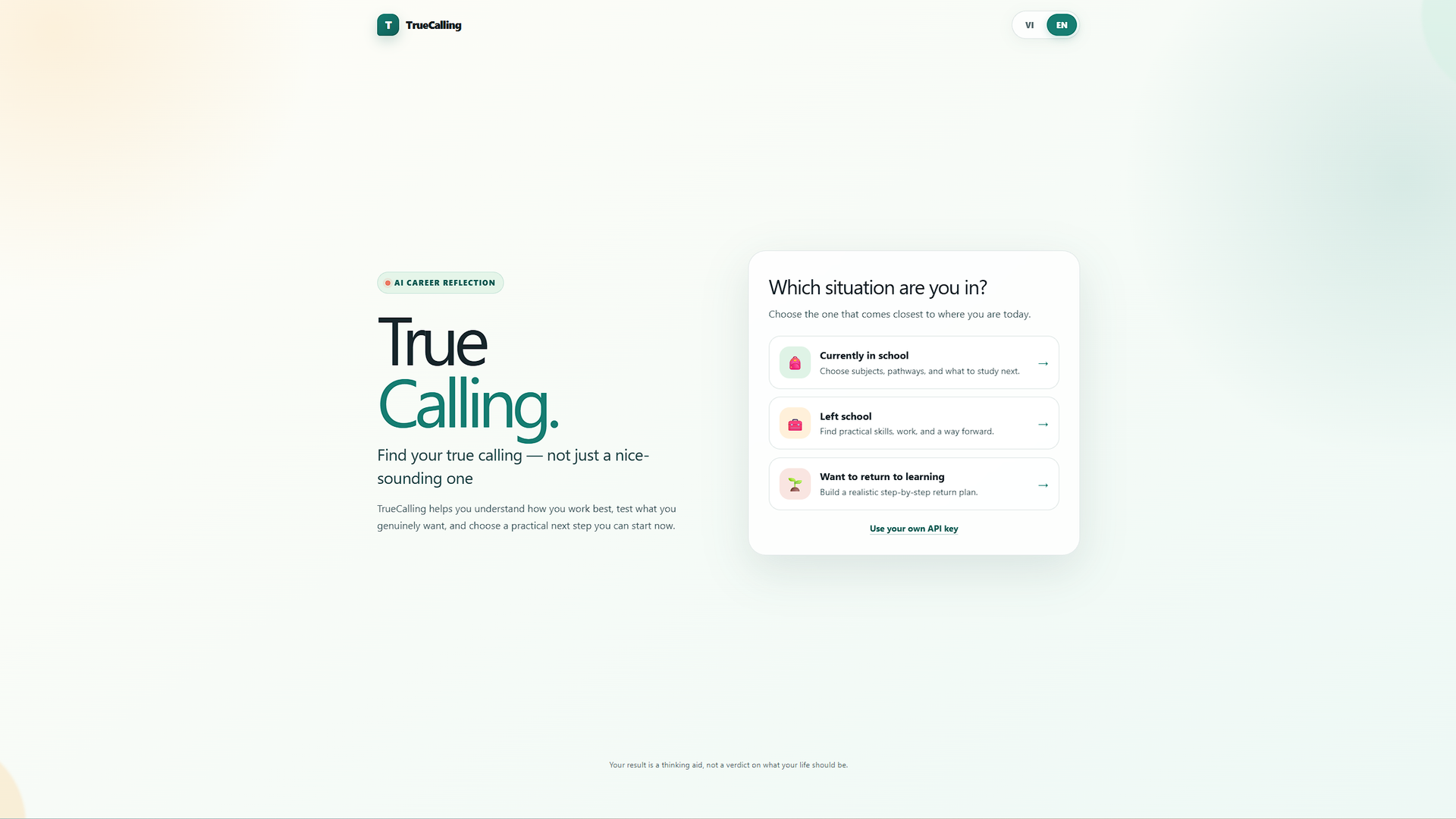
Bilingual welcome — pick one of three life situations: in school, left school, or returning to learning.
-
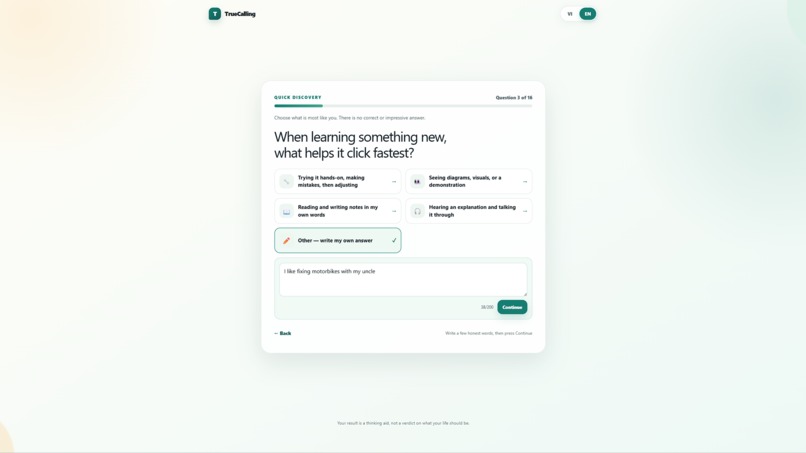
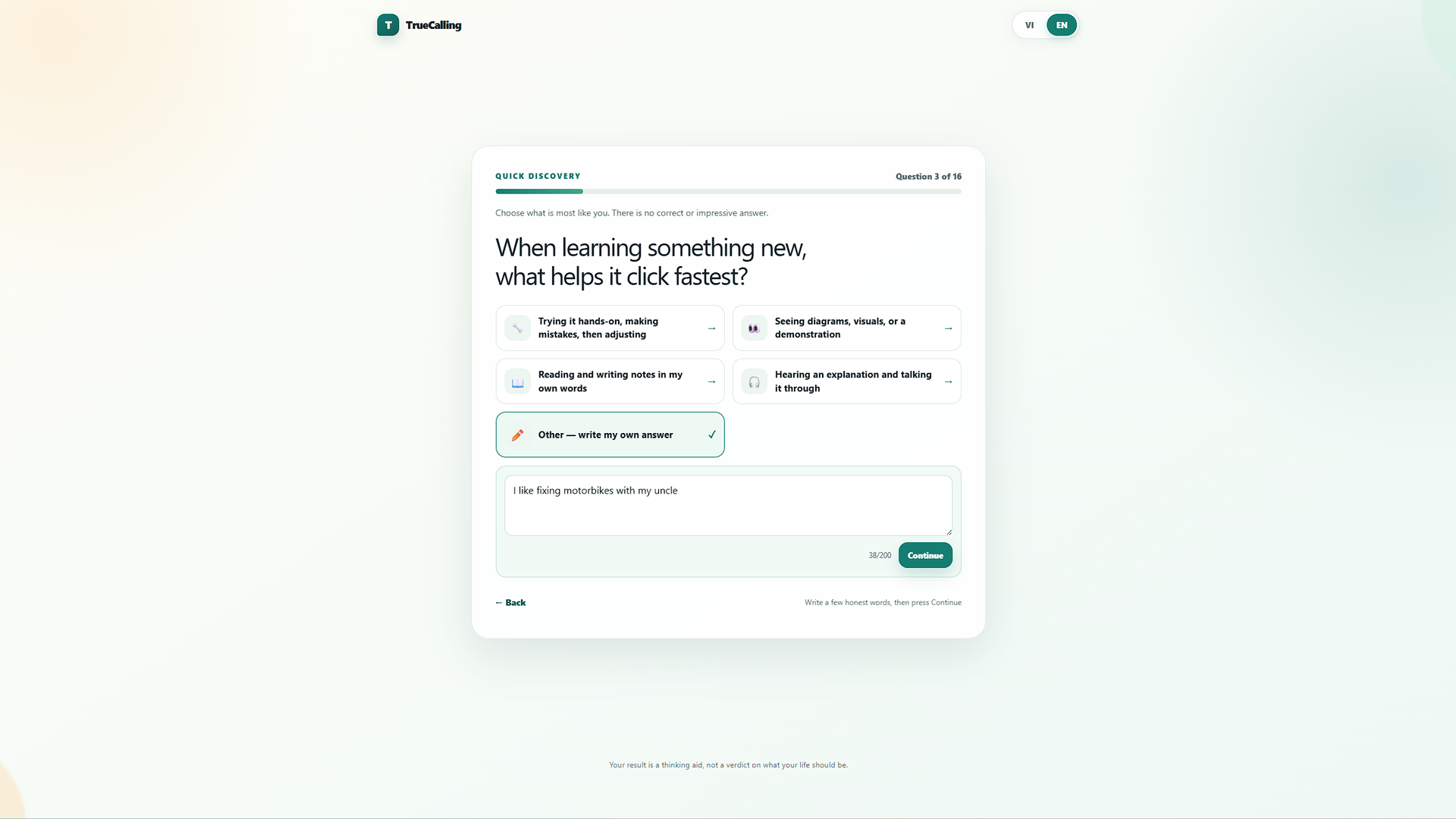
Every quiz question has a write-your-own option, so no one is forced into a preset answer.
-
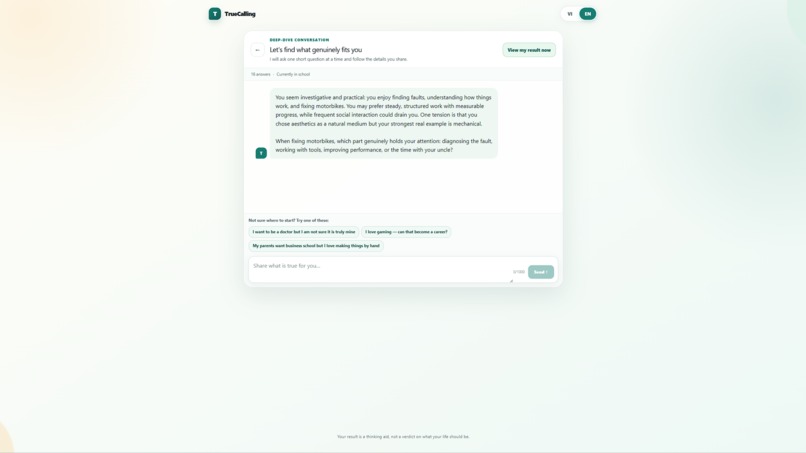
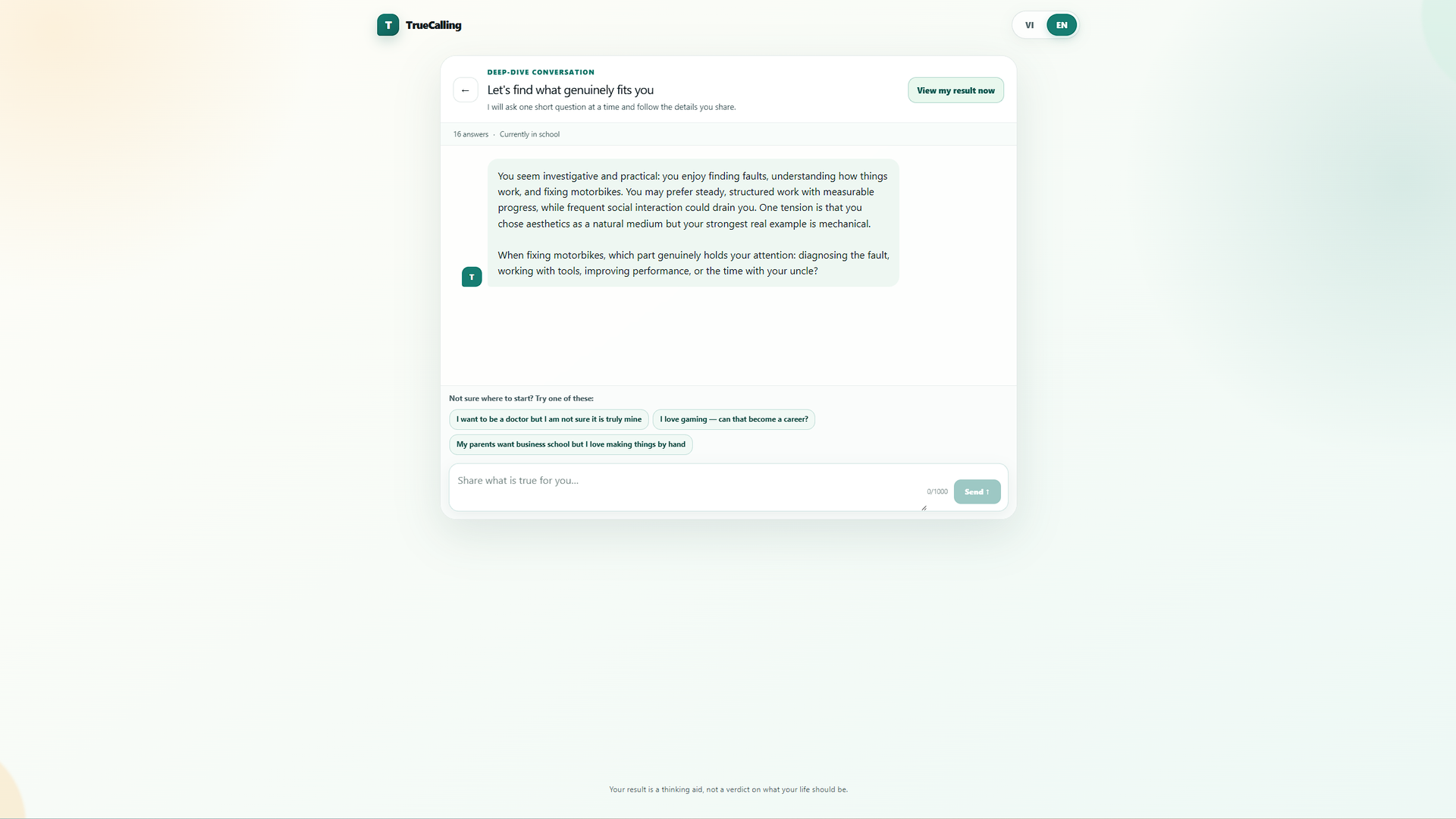
Reverse questioning: instead of agreeing, it asks whether you want the work itself or just the image of the job.
-
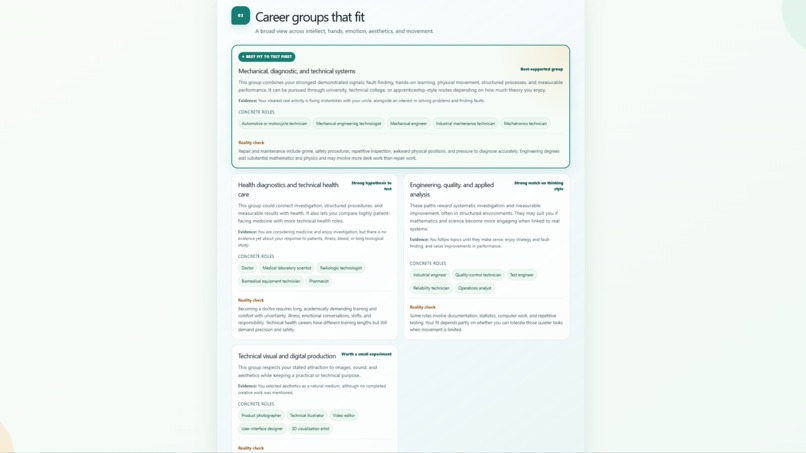
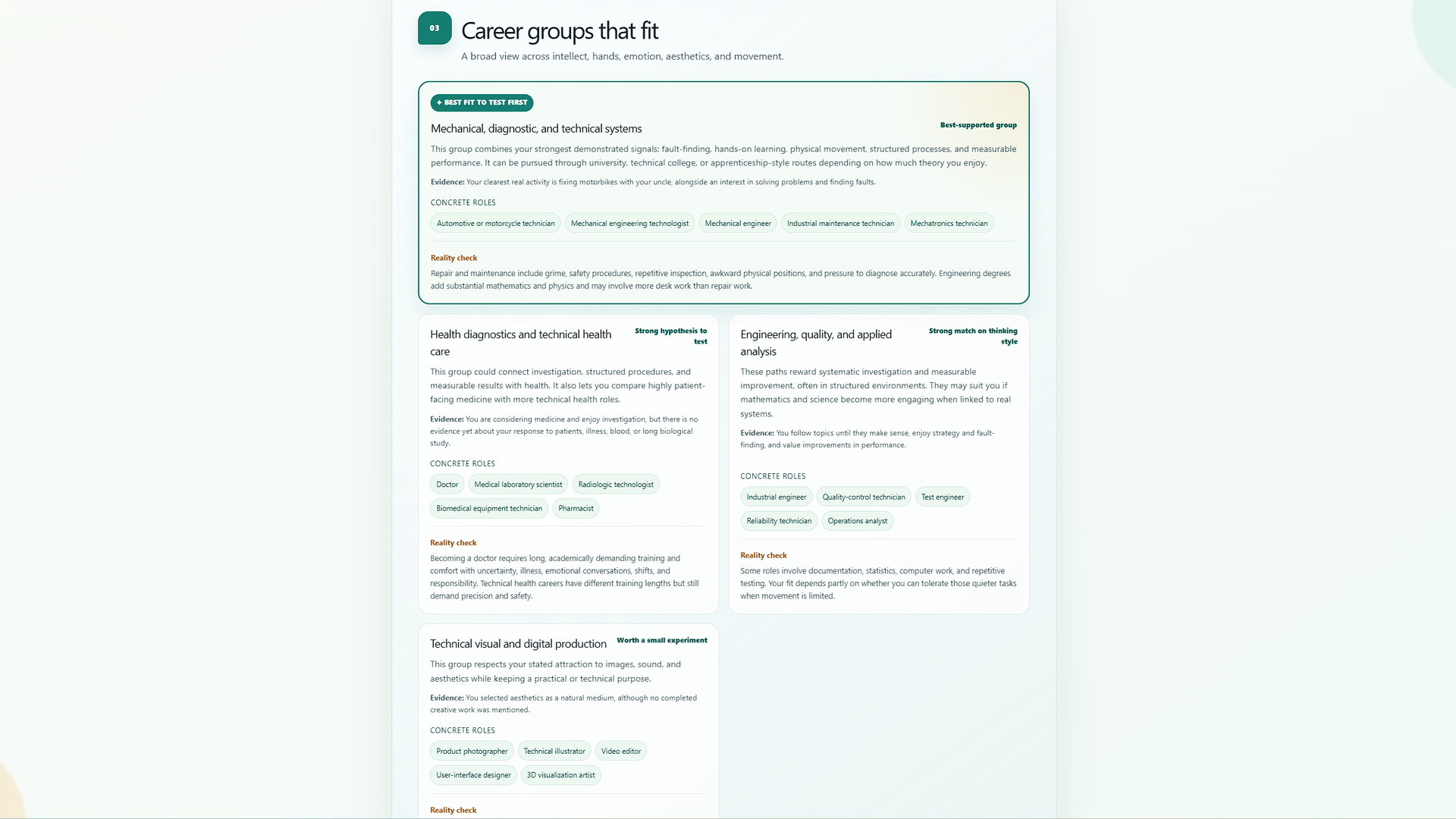
The evidence-based direction map: one best-fit career group to test first, with reasons drawn from your own answers.
Inspiration
Many young people — especially in Vietnam — are pushed to choose a career before they have real evidence about how they actually like to learn, work, and persist. Most career quizzes reward a nice-sounding answer. We wanted the opposite: a guide that gently reality-tests a stated dream instead of flattering it.
What it does
TrueCalling is a bilingual (Vietnamese/English) AI career-reflection app with three life paths — currently in school, left school, and returning to learning. It runs a 16-question discovery quiz (with a "write your own" option on every question), then a short streamed conversation that uses reverse questioning: when you name a direction, it asks whether you want the daily work itself or just the status and image around it, how long the interest has lasted, and what you have actually tried. It ends with an evidence-based direction map: a portrait with cited evidence, honest verdicts on each direction (proven / promising / passing), 3–4 broad career groups with one best fit to test first, and a branch-aware 30-day / 6-month / 1–2-year path. Results can be saved as a PDF or copied as text. No account, no database — everything stays in browser memory.
How we built it with Codex and GPT-5.6
The entire product was built end-to-end with OpenAI Codex: Codex scaffolded the separated React/TypeScript frontend and server, authored and localized the full bilingual quiz bank and both server-only counselor prompts, implemented the model integration, and handled deployment to OpenAI Sites. GPT-5.6 powers all three AI stages through the Responses API — the opening portrait, every streamed chat turn, and the final synthesis — using prompt caching, bounded token budgets, and Structured Outputs with a strict JSON Schema for the four-section result.
Challenges we ran into
Keeping streamed model output progressive through a safe server channel; designing reverse questioning that challenges without discouraging; treating every quiz answer as untrusted input to resist prompt injection; and building a recommendation space that respects trades, arts, sport, and care work equally with academic paths.
Accomplishments we're proud of
A working, polished, bilingual product — not a proof of concept — with real safety design (crisis handoff, scope limits, no personal data), privacy by default, accessibility (reduced motion, ARIA, 390px mobile), and an automated test suite. The final result genuinely cites the user's own answers as evidence.
What we learned
How much of the value lives in prompt design and the reverse-questioning method rather than the UI, and how to work with Codex as the primary builder while keeping product vision, safety, and bilingual direction owner-driven.
What's next
Grounding roadmaps in more concrete local pathways, adding more languages (the architecture already supports it), and an optional way to revisit a saved direction map.
Built With
- cloudflare
- codex
- gpt-5.6
- openai
- react
- responses
- sites
- structured
- typescript
- vite

Log in or sign up for Devpost to join the conversation.