-
-
Logo
-
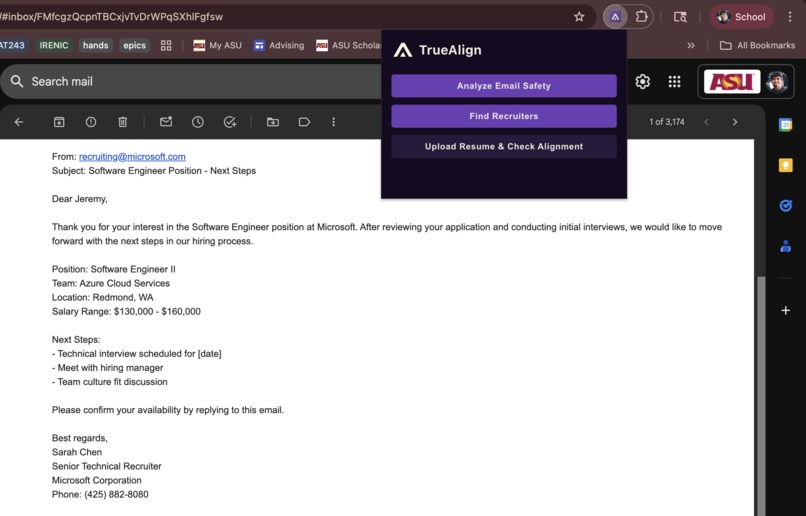
Home Page
-
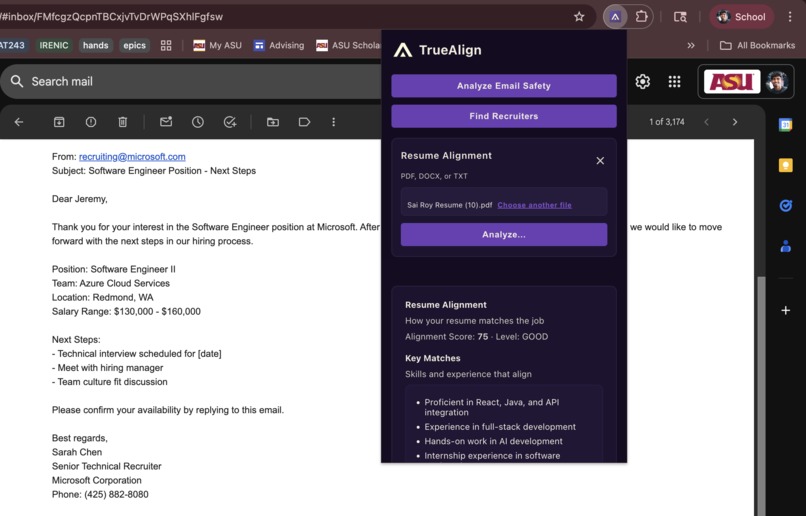
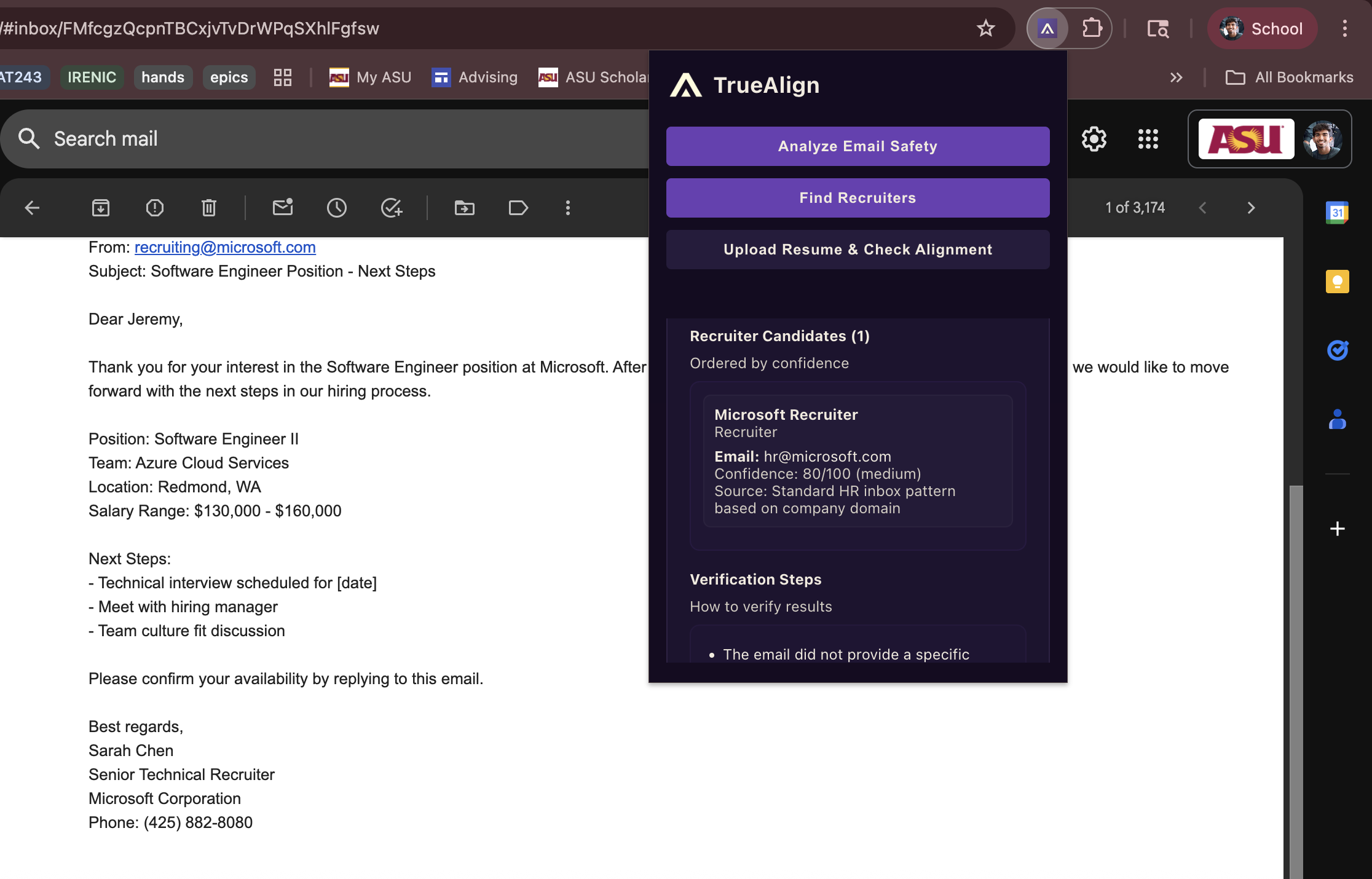
Email Analysis
-
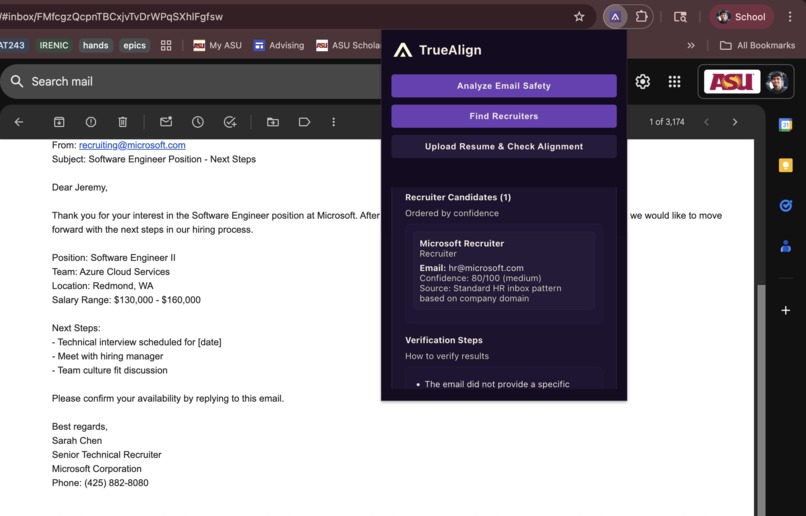
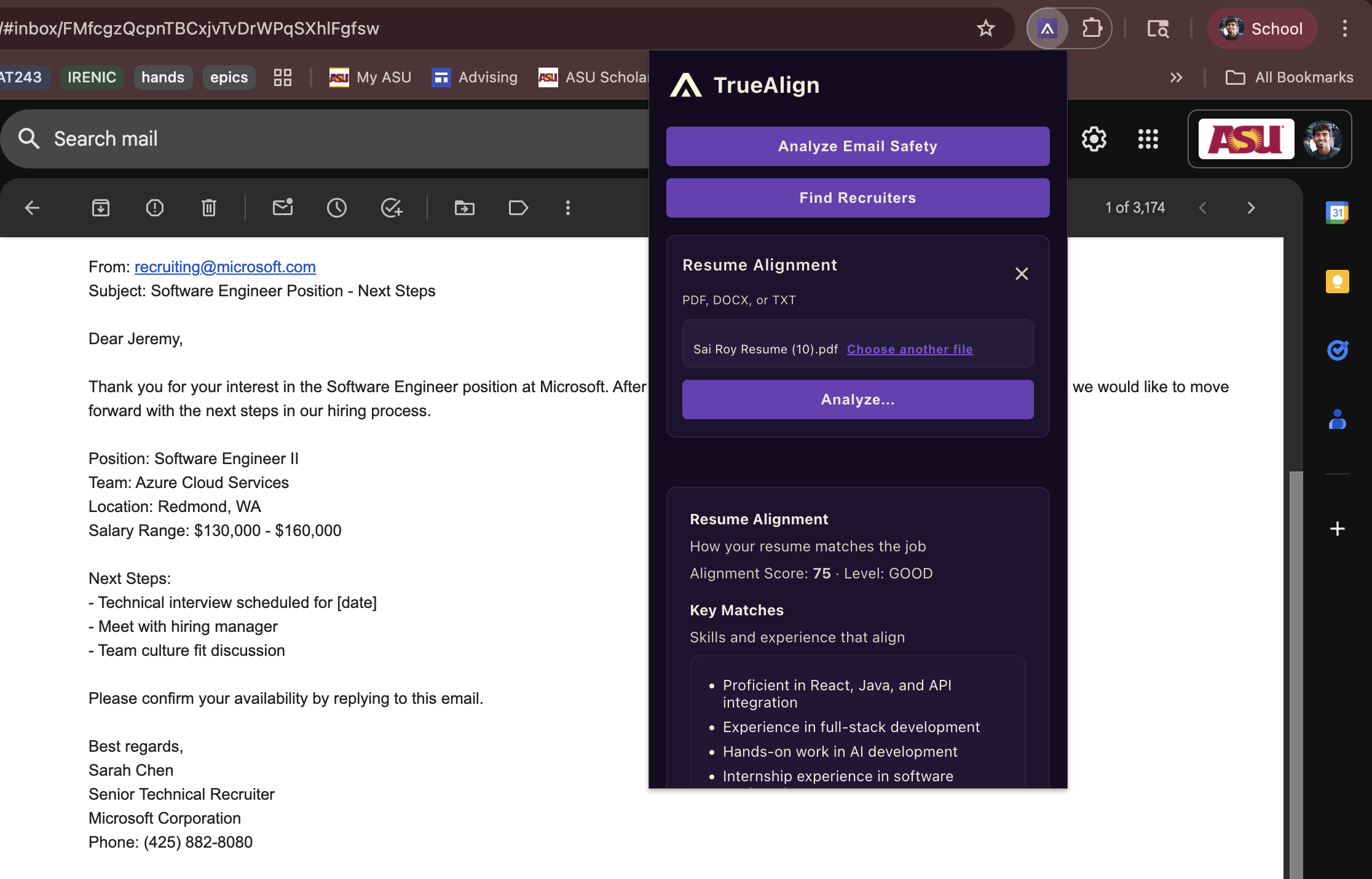
Alignment Checker
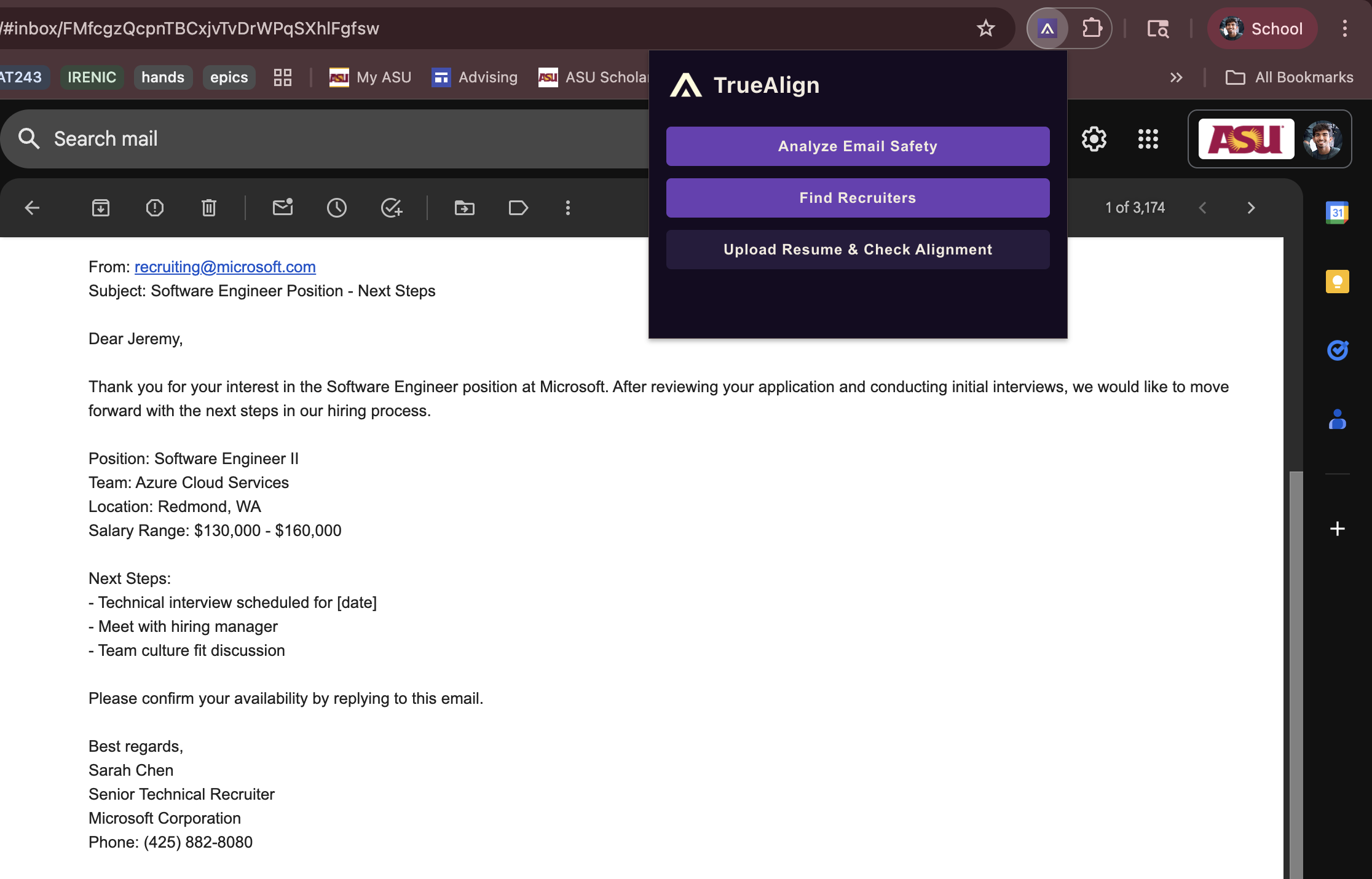
What Inspired Us: As computer science students, we were constantly receiving fake internship and job offers that looked completely legitimate. These weren't obvious scams but sophisticated, AI-generated emails that appeared professional and credible. We would spend hours researching companies and tailoring applications, only to discover they were elaborate fraud schemes. The breaking point came when my teammate received a Google internship offer from a Gmail account promising $8,000 per month with no interview process required. We realized that traditional advice like checking company websites was ineffective when scammers could easily clone legitimate sites. We needed a solution that could instantly analyze job emails and help us focus on opportunities that were both legitimate and aligned with our career goals.
How We Built It: Our system follows a straightforward architecture where Gmail emails flow through our Chrome extension to a Python backend for AI analysis before returning results to the user dashboard. For the frontend, we built a Chrome extension using manifest.json for configuration with Gmail permissions, content.js to scan Gmail for job-related emails in real-time, background.js to handle API communication with our backend, and popup.html with JavaScript for a clean user interface displaying analysis results.
The backend consists of a Python Flask application with REST API endpoints for email analysis, OpenAI GPT-4o Mini integration for fraud detection, email pattern recognition using regex and natural language processing, and company verification through domain analysis and business lookup APIs. Our key features include real-time email scanning within the Gmail interface, a dual scoring system providing both fraud risk and career alignment scores from 0 to 100, intelligent red flag detection for patterns like Gmail recruiting for major companies or unrealistic salaries, and career goal matching based on user preferences and job requirements.
What We Learned: Through this project, we gained valuable technical insights into Chrome Extension APIs, mastering content scripts, background workers, and cross-origin requests. We learned the importance of prompt engineering to structure GPT responses for consistent, professional JSON output. Most importantly, we discovered that email content analysis is far more reliable than website verification for fraud detection. From a domain knowledge perspective, we learned that scammers use predictable language patterns and contact methods, while career alignment depends on factors like job titles, required skills, company size, and role descriptions. We also learned that user experience design for real-time analysis must prioritize speed, keeping response times under two seconds to maintain user engagement.
Challenges We Faced: Chrome Extension complexity proved challenging as Manifest V3 has strict security policies that initially blocked our API calls. We solved this by implementing proper CORS handling and moving API calls to background service workers. AI response consistency was another hurdle since GPT responses included emojis and conversational language that made parsing difficult. We addressed this by engineering precise prompts with temperature settings of 0.1 and strict JSON format requirements that eliminated casual language.
Real-time performance presented issues when email analysis took 5-10 seconds, creating poor user experience. We implemented asynchronous processing and result caching for previously analyzed companies to solve this. Fraud detection accuracy was initially problematic when we tried using website screenshots and OCR, which had poor accuracy due to sophisticated scammers copying legitimate sites. We pivoted to email content analysis, which proved far more effective for detecting fraud patterns. Finally, integration complexity arose when coordinating between the Chrome extension frontend and Python backend during development. We used a local development setup with the extension calling localhost APIs, which enabled rapid iteration and testing.
The project successfully demonstrates how AI can be applied to solve real-world problems that students face daily. By combining fraud detection with career alignment scoring, TrueAlign helps users make better decisions about where to invest their time and energy in job applications, ultimately leading to more successful career outcomes while avoiding the frustration and wasted effort of pursuing fraudulent opportunities.

Log in or sign up for Devpost to join the conversation.