-
-
-
logo
Inspiration
"Based on a true story" can make a production compelling, but it also turns every statement about a real person into a potential legal risk. High-profile disputes involving productions such as Baby Reindeer and The Queen's Gambit showed how a single inaccurate sentence can create enormous consequences.
Traditional script clearance is essential, but it is also slow, expensive, and quickly becomes outdated as scripts, licences, and public records change. We built TRUE STORY to transform that manual snapshot into a fast, evidence-backed, continuously updated workflow.
What It Does
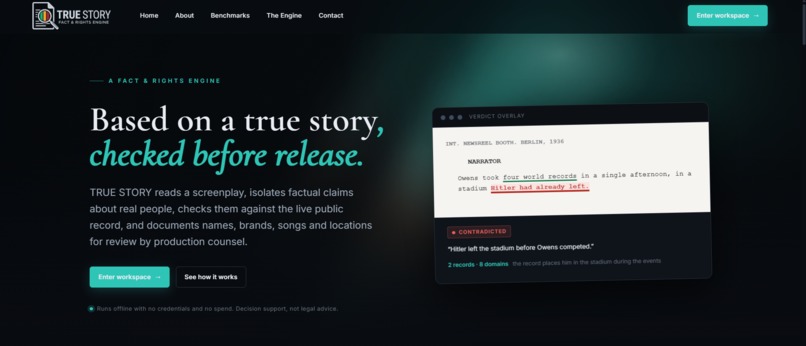
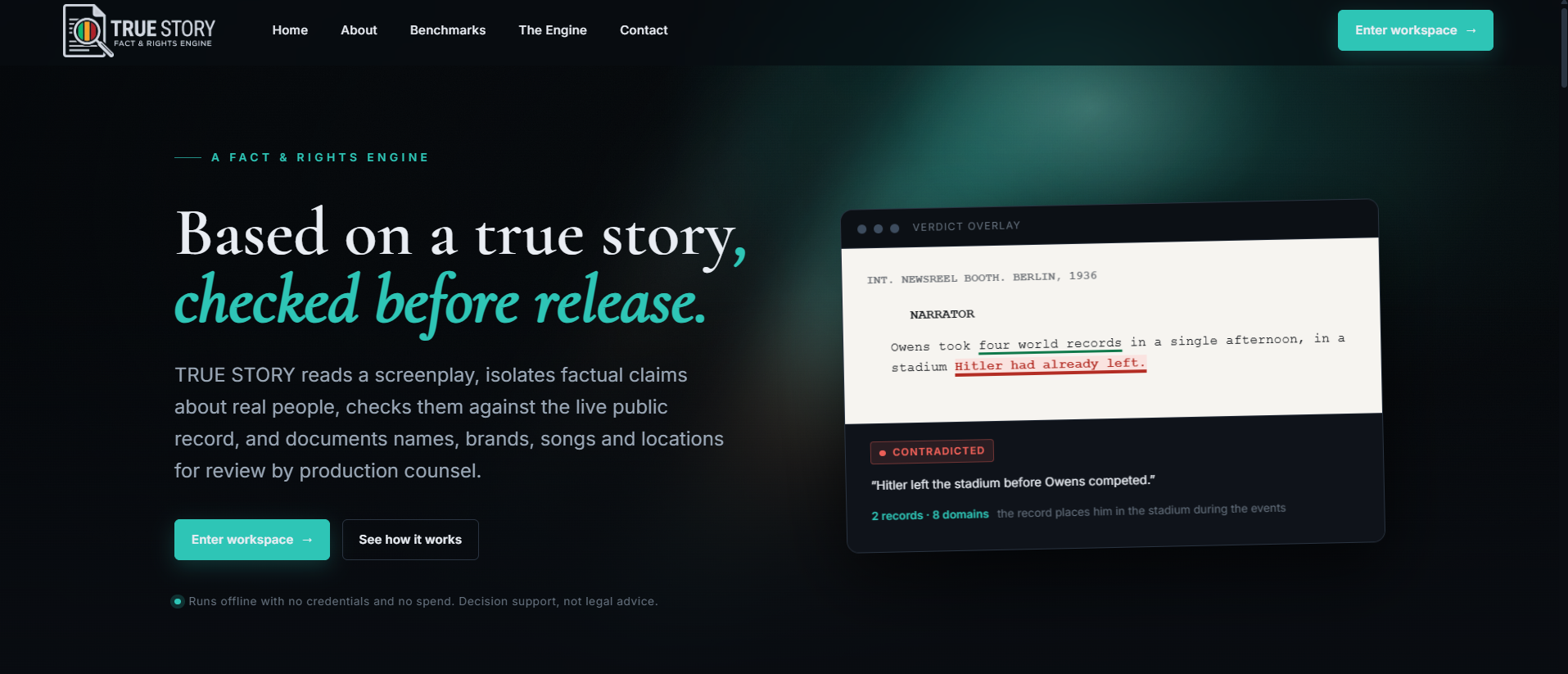
TRUE STORY reads a screenplay, identifies factual claims about real people, and checks each one against the public record. Claims are classified as:
- Green: Verified
- Amber: Unsupported
- Red: Contradicted
Every verdict includes citations and supporting evidence. The system also identifies rights-bearing elements, including names, brands, music, artwork, and locations, then produces an E&O-style clearance package for professional review.
When a claim is contradicted, TRUE STORY can propose a safer rewrite and verify the replacement before presenting it. It can also monitor licences, litigation, and public records after the initial report is completed.
How We Built It
We created an eight-stage agentic pipeline using Gemini, Google Cloud ADK, Vertex AI Agent Engine, and Parallel Web APIs. The pipeline:
- Parses the screenplay into typed spans.
- Decomposes sentences into atomic factual claims.
- Resolves identities and removes duplicates.
- Assigns risk using deterministic policy rules.
- Researches claims through Parallel's web infrastructure.
- Adjudicates the collected evidence.
- Generates and verifies possible remedies.
- Produces an annotated script and clearance report.
The backend uses Python, FastAPI, Pydantic, and structured JSON schemas. The interface is built with Next.js and React, presenting verdicts directly over the screenplay alongside citations, costs, and counsel escalations. Google Cloud services provide storage, telemetry, task execution, monitoring, and secure secret management.
Challenges We Faced
The hardest challenge was preventing confident conclusions from weak or irrelevant evidence. A source about someone with the same name is not necessarily evidence about the person in the screenplay. We added identity resolution before research and block findings when the subject cannot be reliably matched.
We also had to preserve the crucial difference between unsupported and false. An incomplete public record cannot justify calling a claim inaccurate, so the system explicitly represents uncertainty and escalates ambiguous cases to human counsel.
Live research introduced additional challenges, including long-running queries, timeouts, rate limits, conflicting sources, and budget constraints. We built polling, caching, provider fallbacks, confidence caps, and a budget governor that protects resources for the highest-risk claims.
Privacy was also essential because the output may contain sensitive assertions about real people. Living private individuals are masked by default, and every reveal is role-restricted and audited.
What We Learned
We learned that trustworthy legal AI depends less on unrestricted model autonomy and more on carefully designed boundaries. Language models are valuable for interpretation, but evidence requirements, escalation rules, budgets, and privacy controls should remain deterministic.
We also learned that the claim, not the scene or character, is the correct unit of verification. One sentence can contain several independently testable assertions with different verdicts.
Most importantly, we learned that the useful output is not another chatbot response. Professionals need a reviewable document showing exactly what was checked, what the evidence says, what remains uncertain, and where human judgment is required.
TRUE STORY provides decision support for clearance professionals. It is not legal advice.
Built With
- firestore
- gcp
- gemini
- parallel

Log in or sign up for Devpost to join the conversation.