-
-
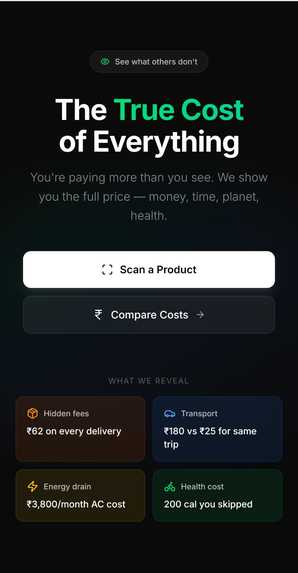
homepage
-
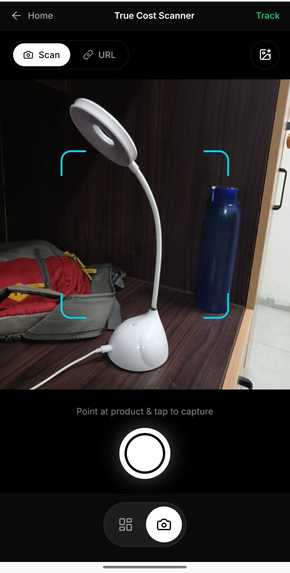
true scanner

EcoVision
Inspiration
Everyday choices look cheap or convenient, but their real cost is hidden. I was inspired by how often we overpay—not just in money, but in time, health, and environmental impact—without realizing it. Existing eco apps focus on guilt; I wanted a tool that helps people first, with sustainability as a natural outcome.
What I Learned
I learned how to turn abstract ideas (like CO₂ and sustainability) into clear, actionable decisions. Technically, I improved my skills in AI integration, mobile-first UX, state management, and performance optimization, and learned how much good design matters for real behavior change.
How I Built It
EcoVision is built using Next.js, Tailwind CSS, and Zustand. I used Google Gemini 1.5 Flash to analyze products from camera input and return structured data. All calculations and comparisons run on-device, and data is stored locally for privacy. Shareable impact cards are generated client-side using HTML-to-canvas rendering.
Challenges Faced
The biggest challenges were getting reliable AI outputs, designing a smooth mobile experience, and balancing accuracy with simplicity. Handling camera input, JSON-only AI responses, and performance on low-end devices required multiple iterations and careful optimization.
Math Behind “True Cost”
The core idea is simple: [ \text{Cost per Use} = \frac{\text{Total Price}}{\text{Expected Lifetime Uses}} ]
This makes long-lasting, higher-quality products clearly cheaper over time.
Built With
- framer-motion
- google-gemini-1.5-flash-api
- html2canvas
- javascript
- localstorage)
- next.js-16-(app-router)
- react
- react-webcam
- share
- tailwind-css-v4
- typescript
- vercel
- vercel-ai-sdk
- web-apis-(camera
- zustand


Log in or sign up for Devpost to join the conversation.