-
-
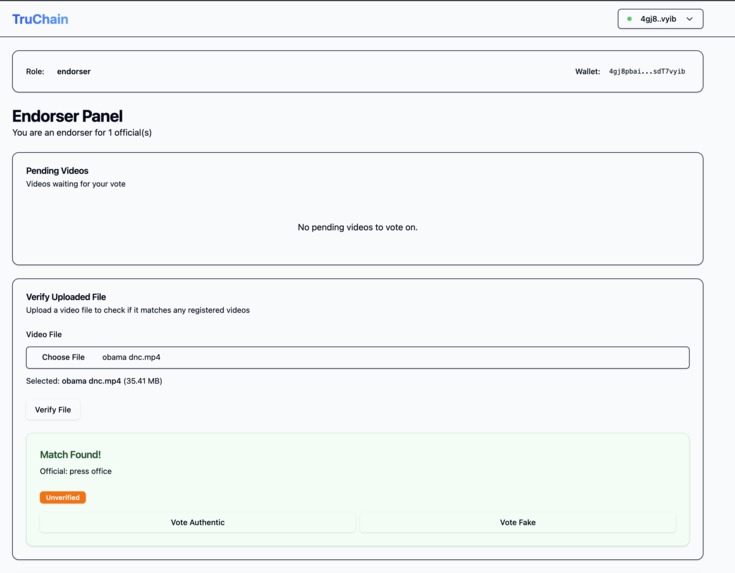
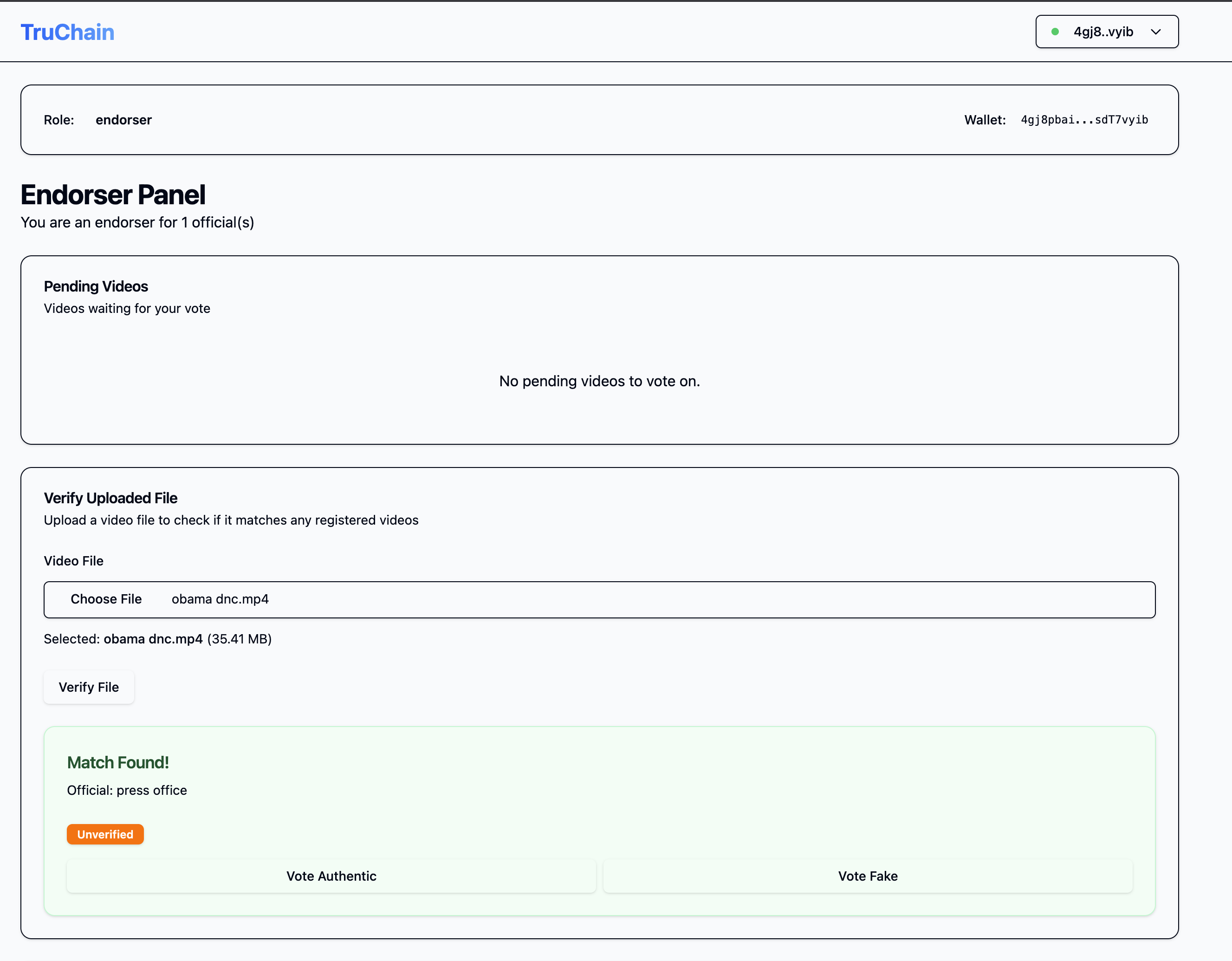
endorser view
-
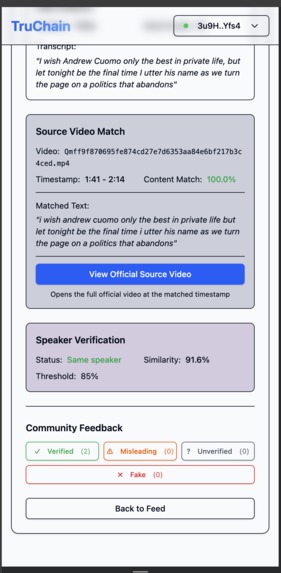
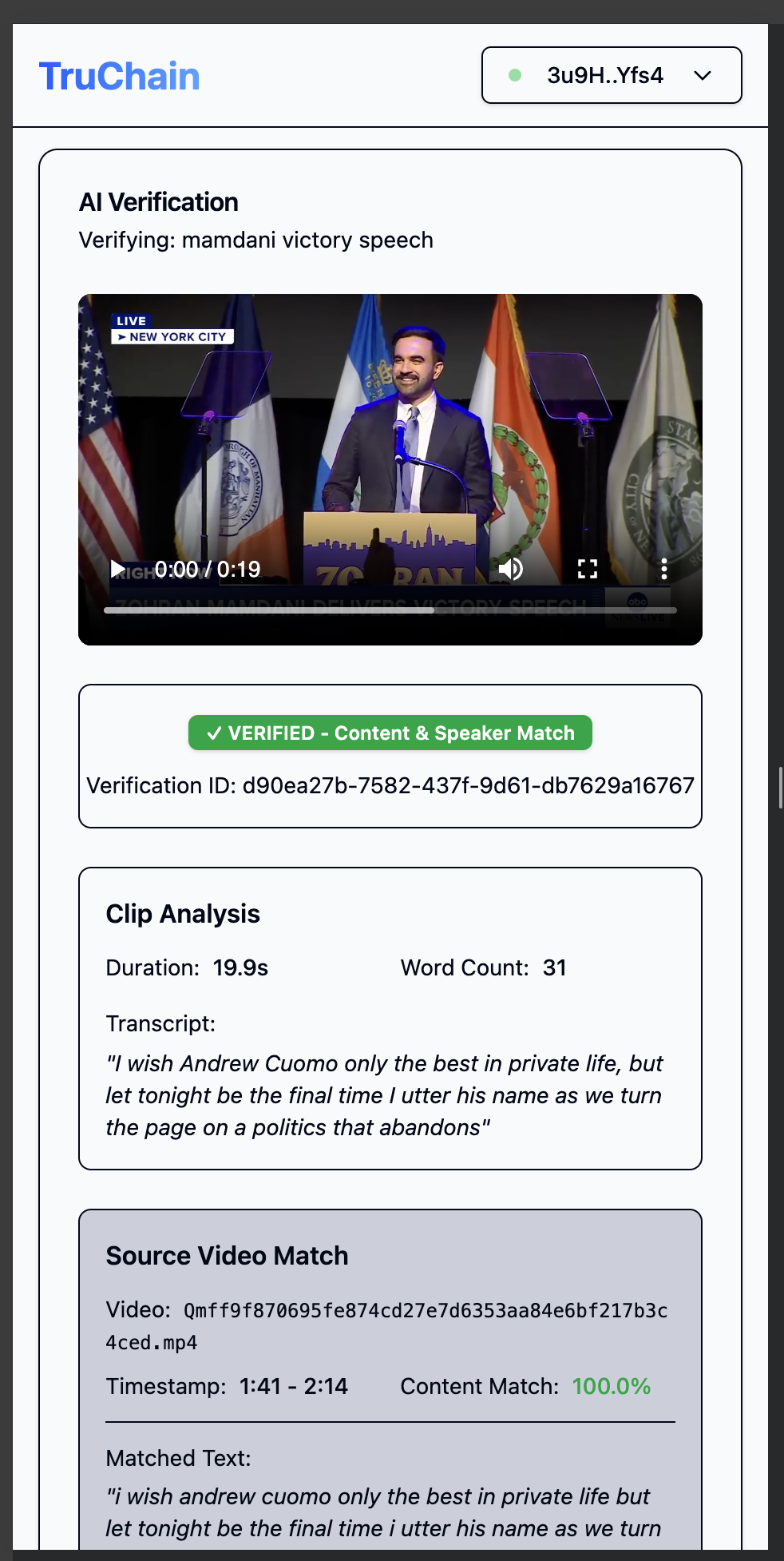
ai verification
-
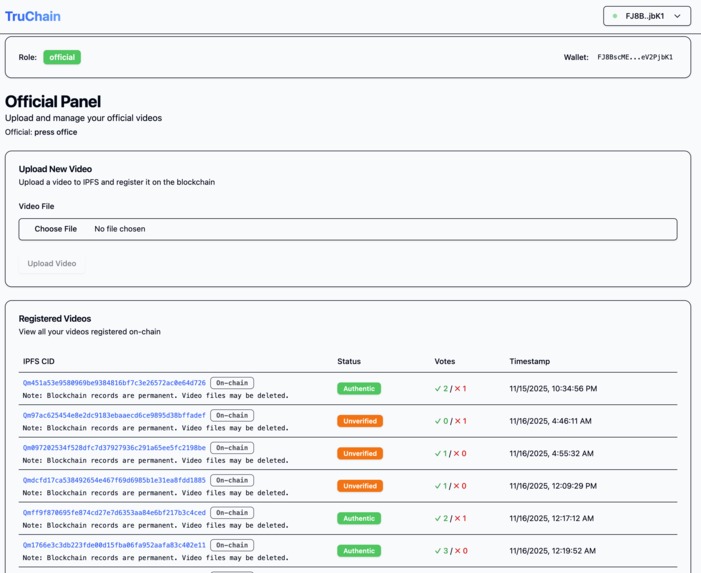
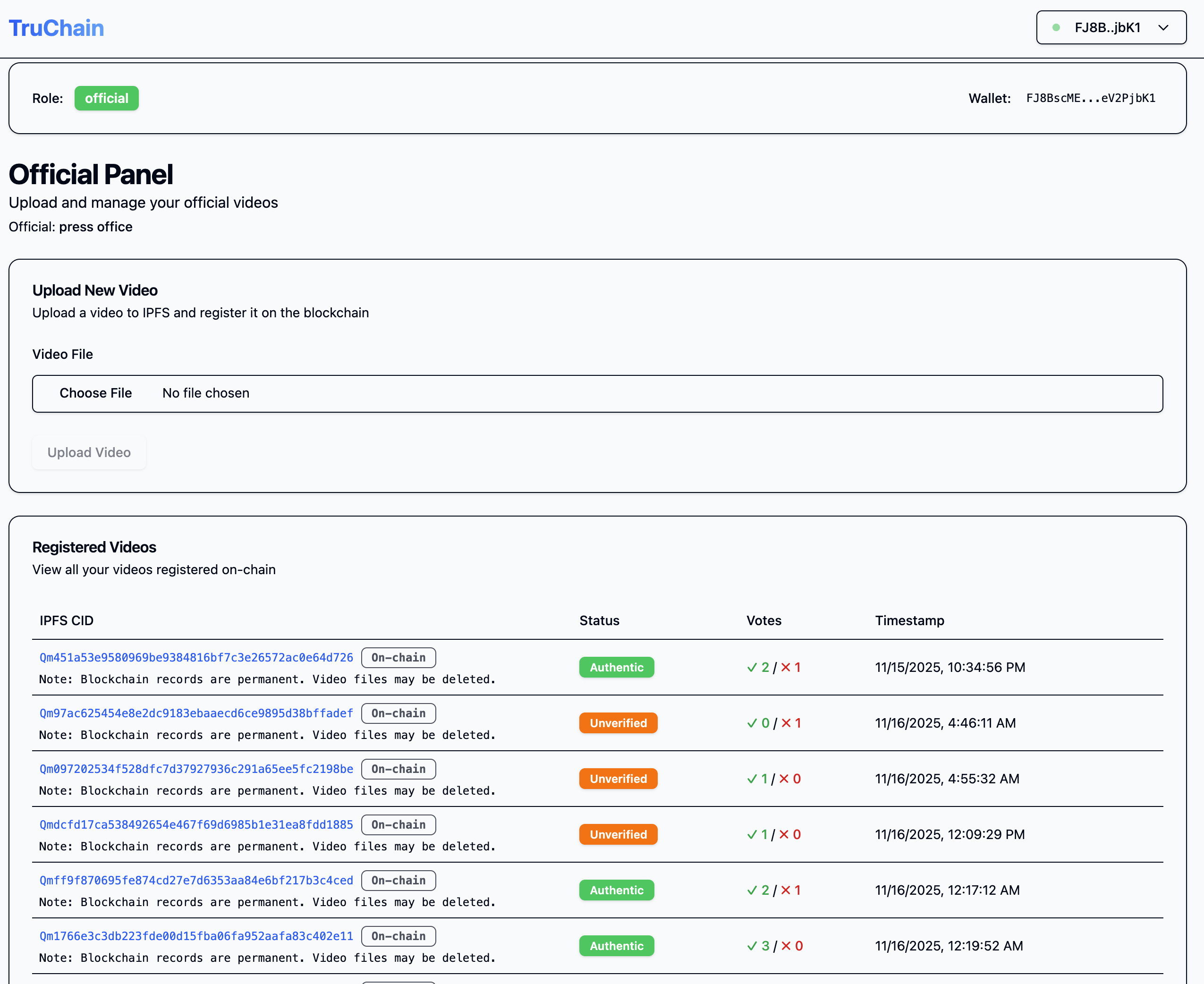
official view
-
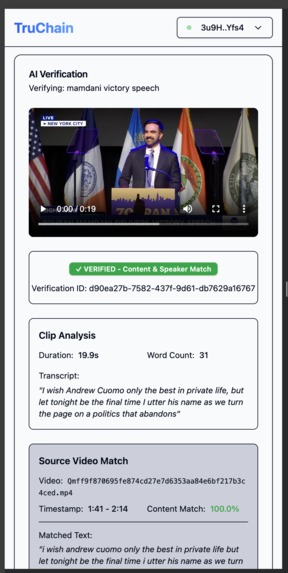
ai verification
-
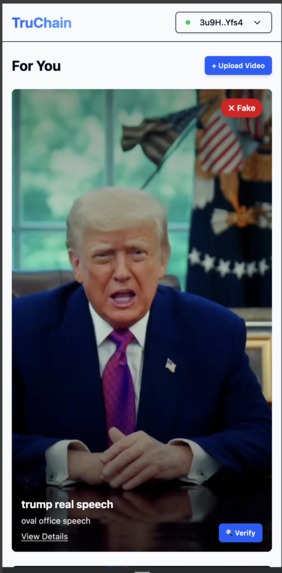
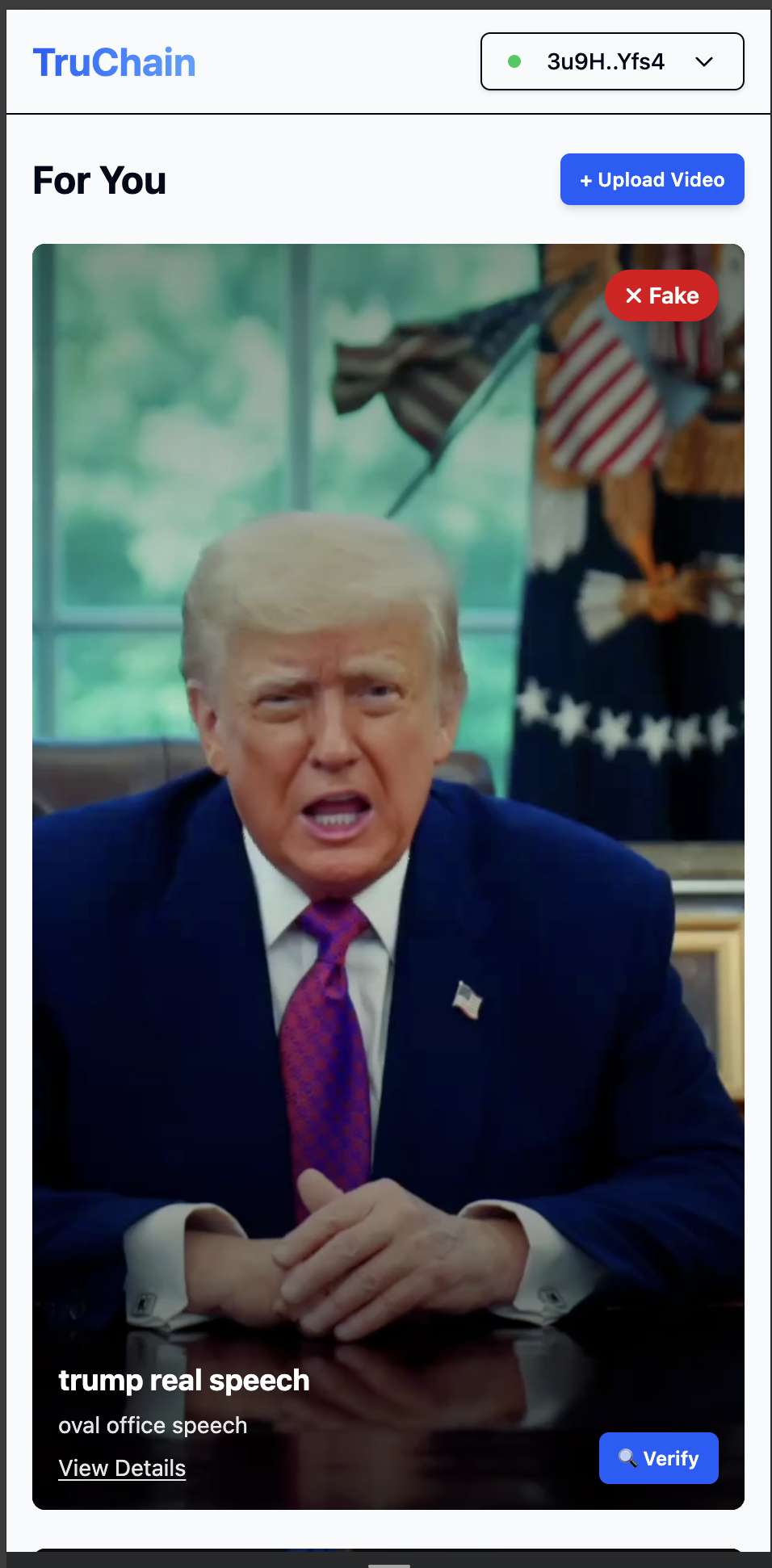
verification tagging on feed

TruChain: Fighting Deepfakes with Blockchain and AI
Inspiration 💡
We live in an era where seeing is no longer believing. Deepfake videos of elected officials often go viral, claiming they said something they never did. By the time fact-checkers catch it, millions have already seen it. That moment hit us hard:
What happens when we can't trust videos of our own elected officials?
Traditional deepfake detection is like playing whack-a-mole — forensic tools analyze videos looking for glitches, but deepfakes keep getting better. We realized we needed a completely different approach:
Instead of asking “is this fake?”, we should be asking “can we prove this is real?”
That's how TruChain was born — a system where authenticity comes from the source, not from after-the-fact analysis.
What We Built 🏗️
TruChain is a three-layer video verification system:
Layer 1: Blockchain Provenance
When an official’s media team uploads a speech video, we hash it, store it on IPFS, and register it on the Solana blockchain.
This creates an immutable timestamp:
“This video existed at this exact moment, uploaded by this exact authority.”
Layer 2: AI Verification
When someone encounters a suspicious clip online, our AI does something clever:
- Transcribes the clip using Whisper
- Searches for matching text across all official videos
- Uses Wav2Vec2 speaker verification to confirm the voice
This catches both content manipulation and voice deepfakes.
Layer 3: Social Consensus
A network of whitelisted endorsers (trusted journalists, party officials, etc.) vote on whether videos they receive match what's on-chain.
Two out of three votes marks a video as Authentic.
Regular users can flag clips as misleading or out-of-context — because sometimes real clips can be used deceptively.
How We Built It 🛠️
Our tech stack came together like a puzzle:
- Solana blockchain (Rust + Anchor)
- React frontend with four role-based views: admin, official, endorser, public feed
- Node.js backend for IPFS uploads + routing
- Python FastAPI AI service running Whisper + Wav2Vec2
The most interesting challenge was the hybrid verification algorithm.
We needed to solve:
“Given a 30-second clip, find where it appears in hours of official speeches.”
Our solution:
- Perform word-level timestamp matching with a sliding window
- Extract that segment from the original video
- Compare voice embeddings
This results in three verification states:
- ✅ Full Verification — content matches and speaker matches → Authentic
- ⚠️ Content-Only — text matches but voice doesn’t → Possible deepfake
- ❌ Not Verified — no match in database → Unknown source
Challenges We Faced 🧗
1. The PDA Puzzle
Solana’s PDAs were a brain-bender.
We needed deterministic account addresses for videos, using seeds like: [b"video", official_pubkey, video_hash]
After multiple “invalid seeds” errors at 2 AM, it finally clicked.
2. The Endorser Dilemma
Originally endorsers could vote by checking hashes.
But how do we know they actually have the authentic video?
We refactored the entire workflow: endorsers must upload the actual file before voting.
3. AI Performance
Running Whisper on full speeches was painfully slow.
We added aggressive caching — transcribe once, search many times.
Verification now runs in 4–7 seconds instead of minutes.
4. The Three-Layer Balance
We debated what belongs on-chain vs. off-chain.
Final decision:
- On-chain: protocol-level authenticity
- Off-chain: community flags + context
Blockchain is the source of truth; SQLite handles the social layer.
What We Learned
Blockchain Architecture
- Program Derived Addresses (PDAs) are powerful primitives for deterministic account generation using
seeds = [b"video", official_pubkey, video_hash] - Account space optimization is critical on Solana—every byte costs rent, requiring precise calculations: $$\text{Space} = 8_{\text{discriminator}} + 32_{\text{pubkey}} + 32_{\text{hash}} + 64_{\text{CID}} + 4_{\text{vec}} + 99_{\text{votes}} + 2_{\text{metadata}}$$
- On-chain governance through threshold voting ($\geq \frac{2}{3}$ endorsers for consensus) provides decentralized trust without oracles
System Design Tradeoffs
- What belongs on-chain: Provenance data (hashes, timestamps, votes) → immutable
- What stays off-chain: Social signals (user flags, comments) → mutable and cheap
- Hybrid architecture balances decentralization with practicality
Cross-Stack Integration
- Connecting Rust smart contracts → TypeScript frontend → Python AI services required careful serialization and error handling across language boundaries
- IPFS content addressing ($\text{CID} = \text{Hash}(\text{content})$) provides decentralized storage that pairs naturally with blockchain's trustless model
Closing Thoughts
We built TruChain in a few intense hours, fueled by the belief that democracy needs trustworthy information. It’s not perfect — but it’s a start.
In the age of AI-generated everything, proving authenticity at the source might be our best defense.
Built With
- express.js
- ipfs
- ipfs-storage
- node.js
- node.js-+-express-+-sqlite
- phantom-wallet
- python
- react
- rust
- solana
- solana-blockchain-+-anchor-(rust)
- sqlite
- typescript

Log in or sign up for Devpost to join the conversation.