Inspiration
Working by yourself can get lonely. Your coffee gets cold, your unfinished work is silently judging you, and you wish your friends were there to keep you company.
We thought: what if the group chat escaped and moved onto your desktop?
TroubleMakers brings your friends into a tiny, chaotic world on your screen. They are there to keep you company. Whether they help you concentrate is a separate research question.
What it does
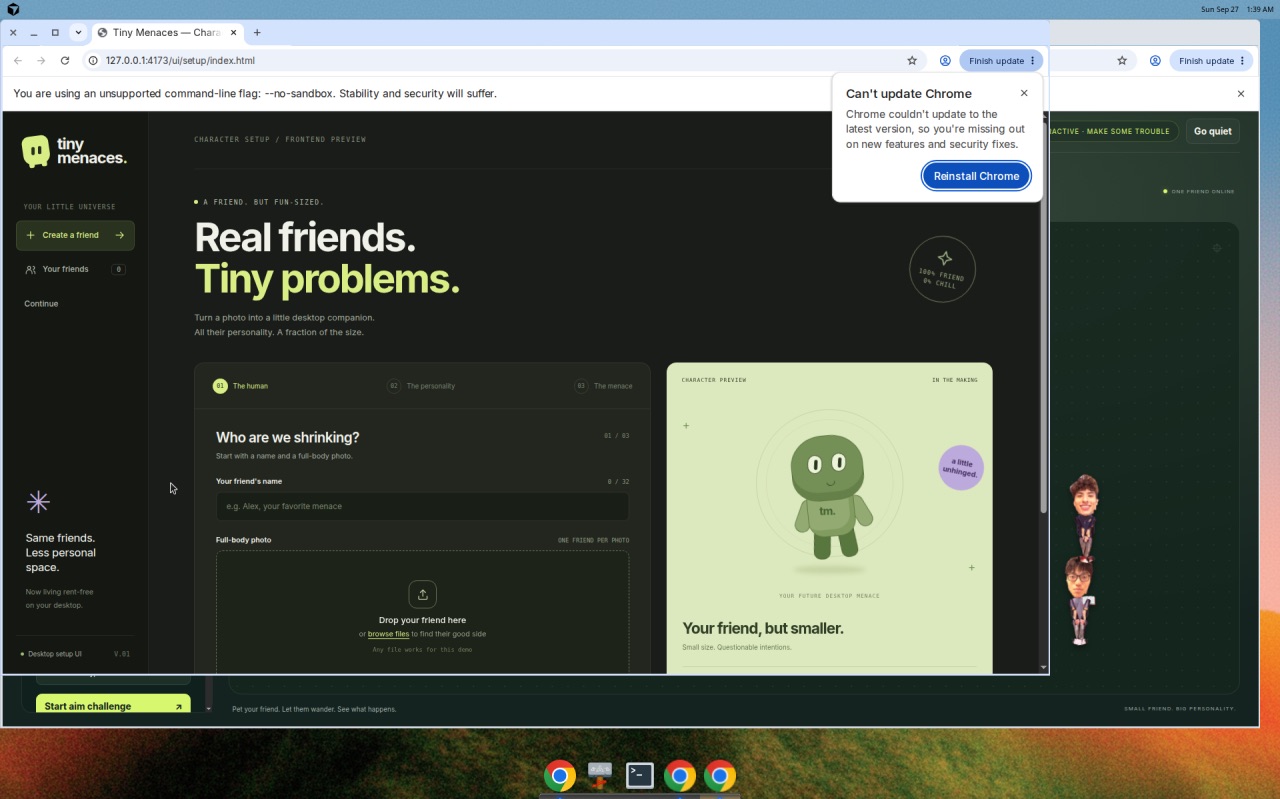
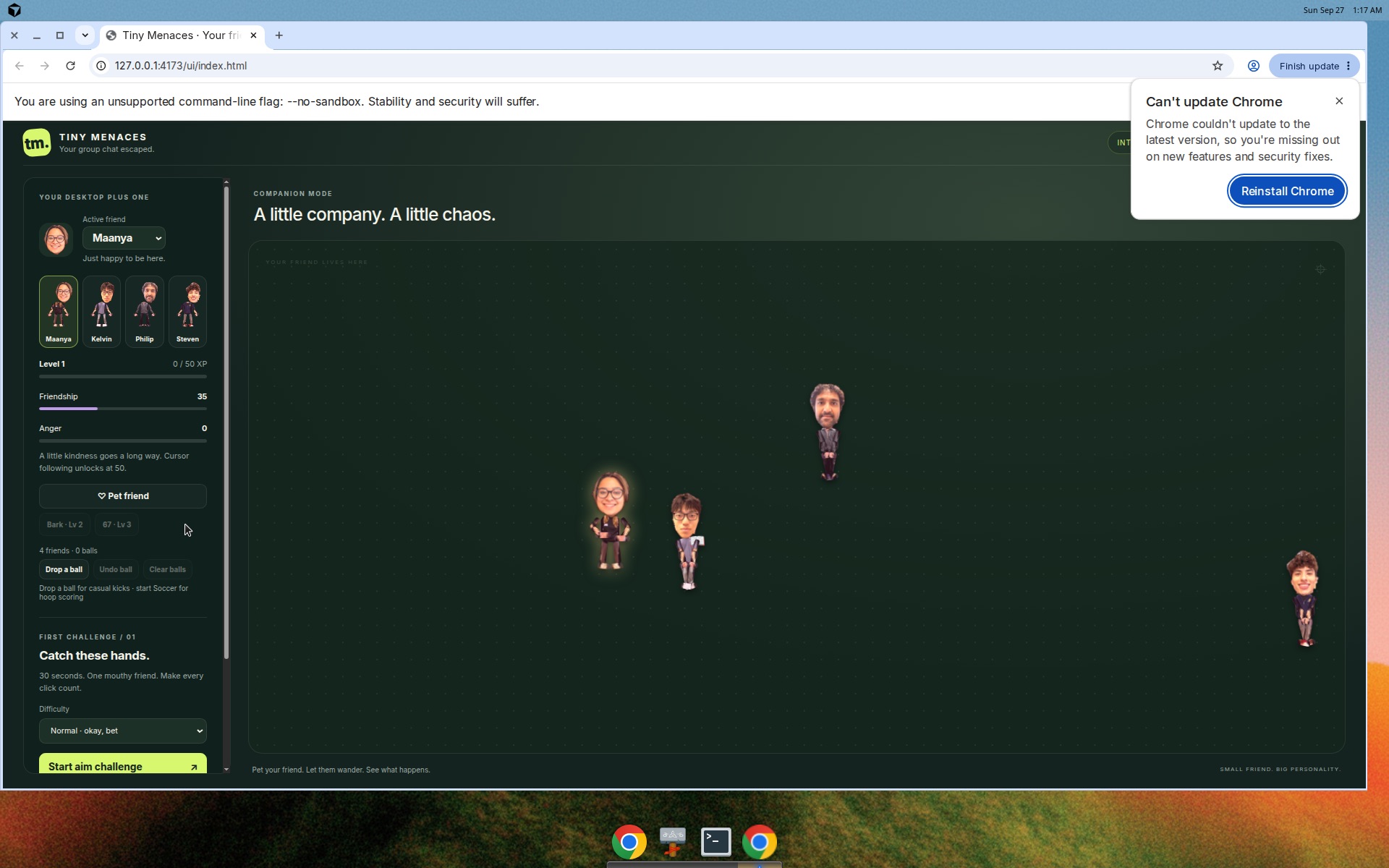
TroubleMakers is a simulation of your friends hanging out on your desktop. They do not wait politely for you to click a button. They wander off, read, rest, run into each other, start conversations, and kick a ball around. Give them a moment and your workspace starts to feel like a very small, poorly supervised house party.
You can shape who each friend becomes. Every character has customizable Chaos, Brainrot, Competitiveness, and Friendliness scores. These labels influence how the character moves, plays, and interacts with the others. Friendship, anger, and progression can change as you spend time with them. A friend who loves soccer will chase the ball while a friend with too much Brainrot may decide that infinite “67” is a complete sentence.
You can pick up and drag a friend, pet them, or repeatedly make them bark and say “67.” When watching the chaos is not enough, Aim Challenge gives you 30 seconds to hit a dodging friend and chase a better score, streak, and accuracy. Soccer lets you play with a friend and a ball, with competitive characters taking the game a little too seriously.
Our vision is for the group to feel increasingly alive: forming friendships, teasing each other, getting annoyed, and eventually having the sort of ridiculous arguments that remind you these really are your friends.
How we built it
We built TroubleMakers as an Electron app with a transparent desktop overlay. Our character pipeline turns photos of friends into portraits, body parts, and animated sprites. A separate simulation gives each character activities, mood, relationships, and behavior influenced by their customizable personality. The game system handles Aim Challenge, Soccer, scores, timers, and progression, while the reaction system supplies character-specific lines and effects.
We split those systems across GitHub workstreams so our team could build the characters, desktop app, simulation, games, and reactions together.
Challenges we ran into
The first challenge we ran into was operating system permissions. We wanted more ways to interact with the desktop, but decided to revisit them after more user testing.
Coming up with a good body segmentation was also not trivial, because we wanted the sprites to look good and articulate through different motions.
Combining personality with actual behaviors also took some work but we like the results.
Accomplishments that we're proud of
We have a working desktop world where friends can go about their day, meet, talk, and play with a ball without the player directing every move. Players can customize a character’s personality, interact with them directly, and jump into two playable 30-second games.
It doesn't take long for this app to stop feeling like pictures moving around and start feeling like your friends have moved into your computer without asking for permission.
What we learned
Working cooperatively under time pressure with teammates you like is always a joy. Robert from Chatforce gave us ideas on game design principles that we could try to incorporate. Honestly there were too many good recommendations.
What's next for TroubleMakers
We want to make the avatar generation even smoother and more expressive. We also want to add more mini games and open it up for community development. Triadic and higher order conversations are really difficult to tackle, but would be more naturalistic. We also want more time to test and implement how friends change over time.## Inspiration
Working by yourself can get lonely. Your coffee gets cold, your unfinished work is silently judging you, and your friends reply “67” when you ask them for emotional support.
We thought: what if the group chat escaped and moved onto your desktop?
TroubleMakers brings your friends into a tiny, chaotic world on your screen. They are there to keep you company. Whether they help you concentrate is a separate research question.
What it does
TroubleMakers is a simulation of your friends hanging out on your desktop. They do not wait politely for you to click a button. They wander off, read, rest, run into each other, start conversations, and kick a ball around. Give them a moment and your workspace starts to feel like a very small, poorly supervised house party.
You can shape who each friend becomes. Every character has customizable Chaos, Brainrot, Competitiveness, and Friendliness scores. These labels influence how the character moves, plays, and interacts with the others. Friendship, anger, and progression can change as you spend time with them. A friend who loves soccer will chase the ball while a friend with too much Brainrot may decide that infinite “67” is a complete sentence.
You can pick up and drag a friend, pet them, or repeatedly make them bark and say “67.” When watching the chaos is not enough, Aim Challenge gives you 30 seconds to hit a dodging friend and chase a better score, streak, and accuracy. Soccer lets you play with a friend and a ball, with competitive characters taking the game a little too seriously.
Our vision is for the group to feel increasingly alive: forming friendships, teasing each other, getting annoyed, and eventually having the sort of ridiculous arguments that remind you these really are your friends.
How we built it
We built TroubleMakers as an Electron app with a transparent desktop overlay. Our character pipeline turns photos of friends into portraits, body parts, and animated sprites. A separate simulation gives each character activities, mood, relationships, and behavior influenced by their customizable personality. The game system handles Aim Challenge, Soccer, scores, timers, and progression, while the reaction system supplies character-specific lines and effects.
We split those systems across GitHub workstreams so our team could build the characters, desktop app, simulation, games, and reactions together.
Challenges we ran into
The first challenge was ran into was operating system permissions for the heightened interactivity we wanted on our desktop so tabled that for the future after more user testing.
Coming up with a good body segmentation was also not trivial, because we wanted the sprites to look good and articulate through different motions.
Combining personality with actual behaviors also took some work but we like the results.
Accomplishments that we're proud of
We have a working desktop world where friends can go about their day, meet, talk, and play with a ball without the player directing every move. Players can customize a character’s personality, interact with them directly, and jump into two playable 30-second games.
It doesn't take long for this app to stop feeling like pictures moving around and start feeling like your friends have moved into your computer without asking for permission.
What we learned
Working cooperatively under time pressure with teammates you like is always a joy. Robert from Chatforce gave us ideas on game design principles that we could try to incorporate. Honestly there were too many good recommendations.
What's next for TroubleMakers
We want to make the avatar generation even smoother and more expressive. We also want to add more mini games and open it up for community development. Triadic and higher order conversations are really difficult to tackle, but would be more naturalistic. We also want more time to test and implement how friends change over time.

Log in or sign up for Devpost to join the conversation.