-
-
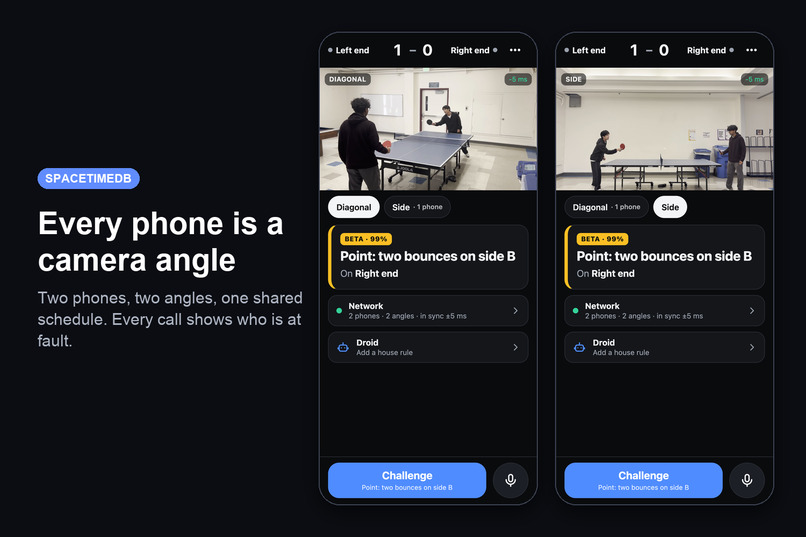
2 angles in sync
-
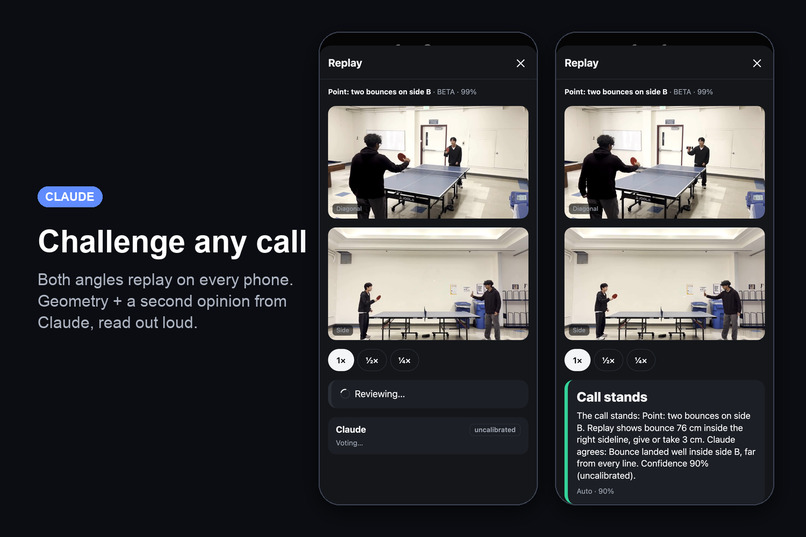
challenge
-
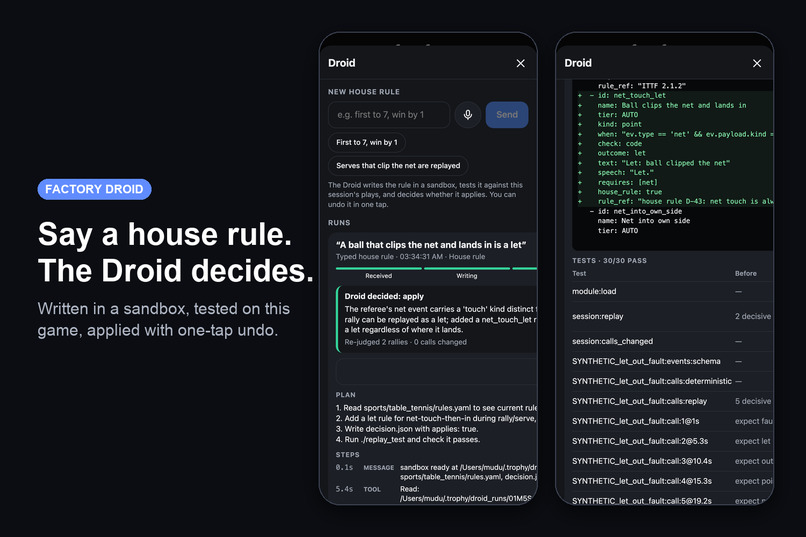
droid house rules
-
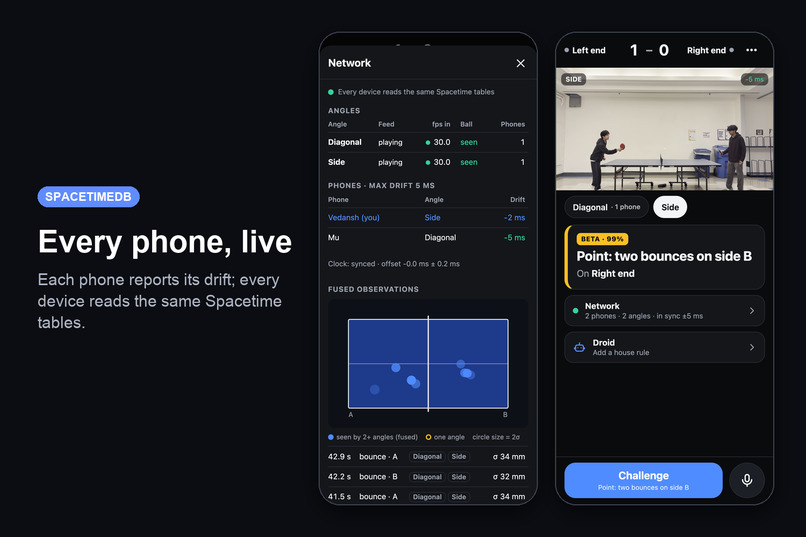
network
-
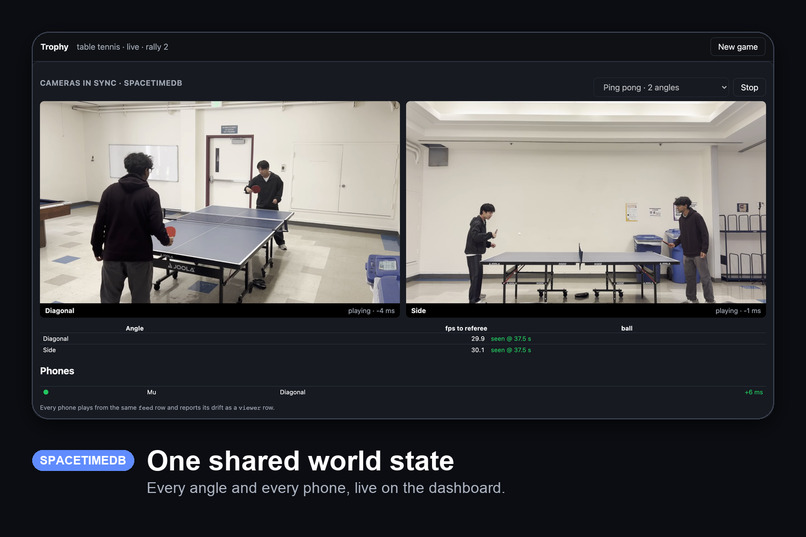
dashboard
-
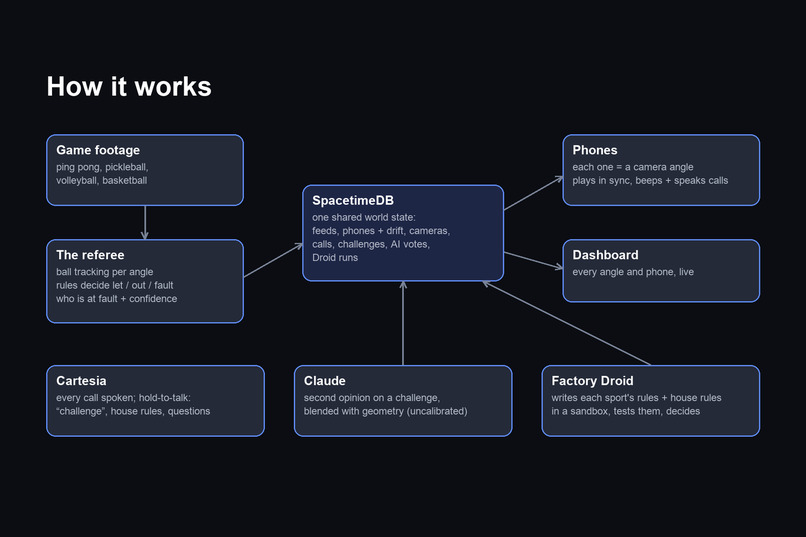
how it works
-
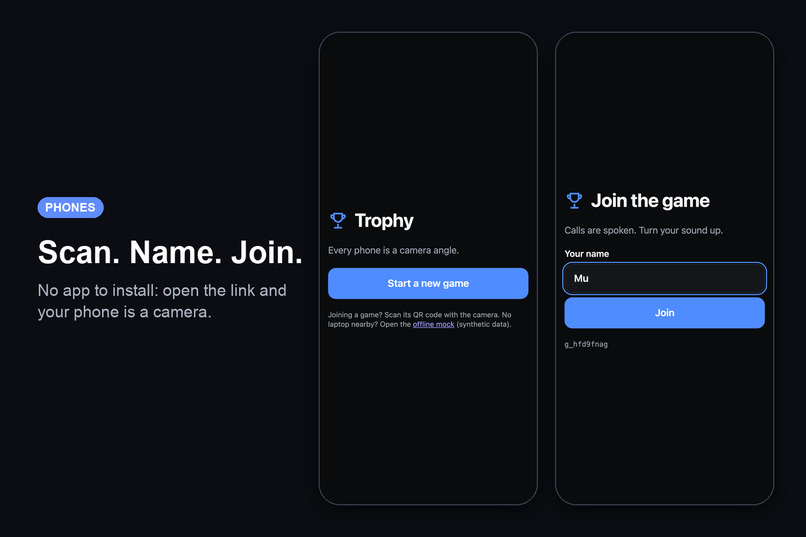
join
-
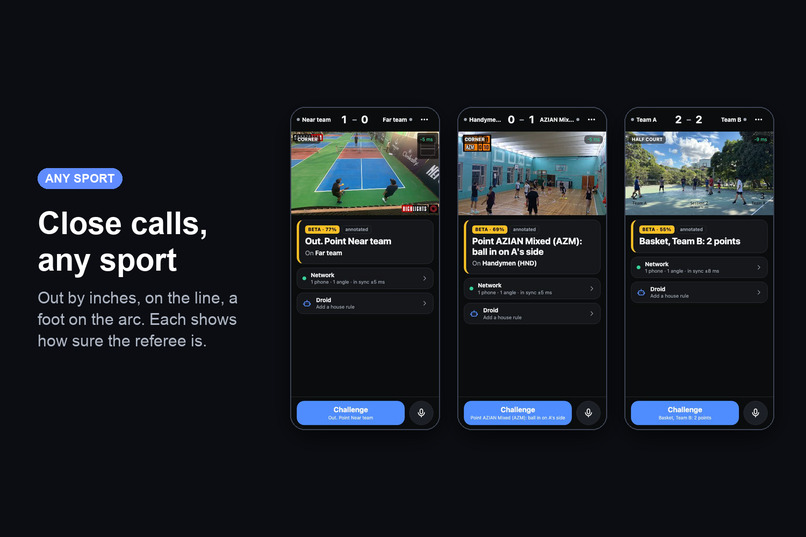
close calls
Trophy
An AI referee for pickup games: every phone is a camera angle, every call is spoken, and it tells you how sure it is.
Inspiration
Our teammate Mu Du played table-tennis for Team USA internationally, and sometimes even he can't tell whether a ball clipped the edge or a serve toss was actually legal. In a tournament there's an umpire and various VAR angles. However, in a recreational ping pong tournament, close calls become arguments and stop people from playing the game. Casual games have no referee, no replay, and no way to settle a close call except whoever argues loudest.
We wanted a referee that anyone could use just by placing their phone down. And we wanted it to work for any sport.
What it does
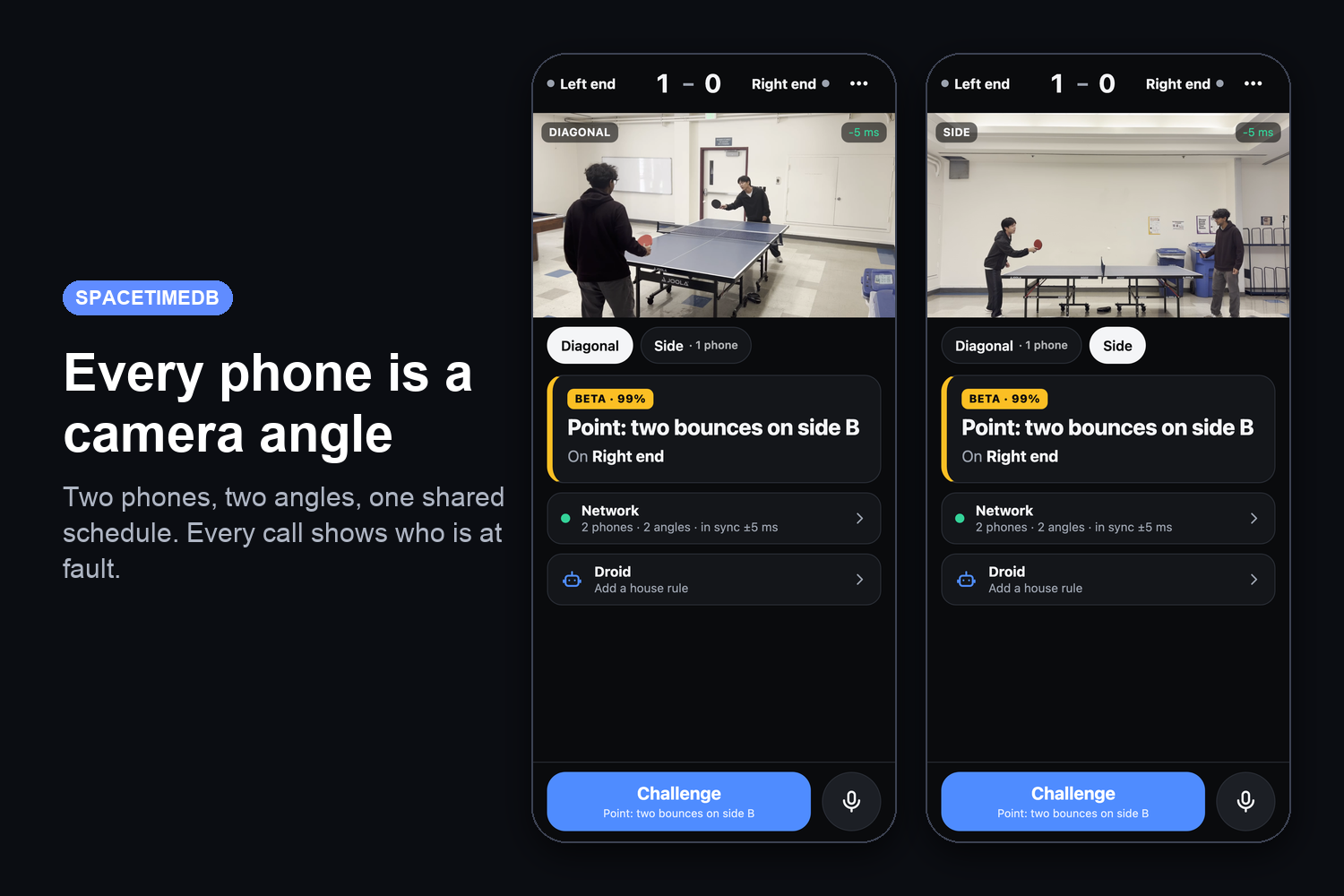
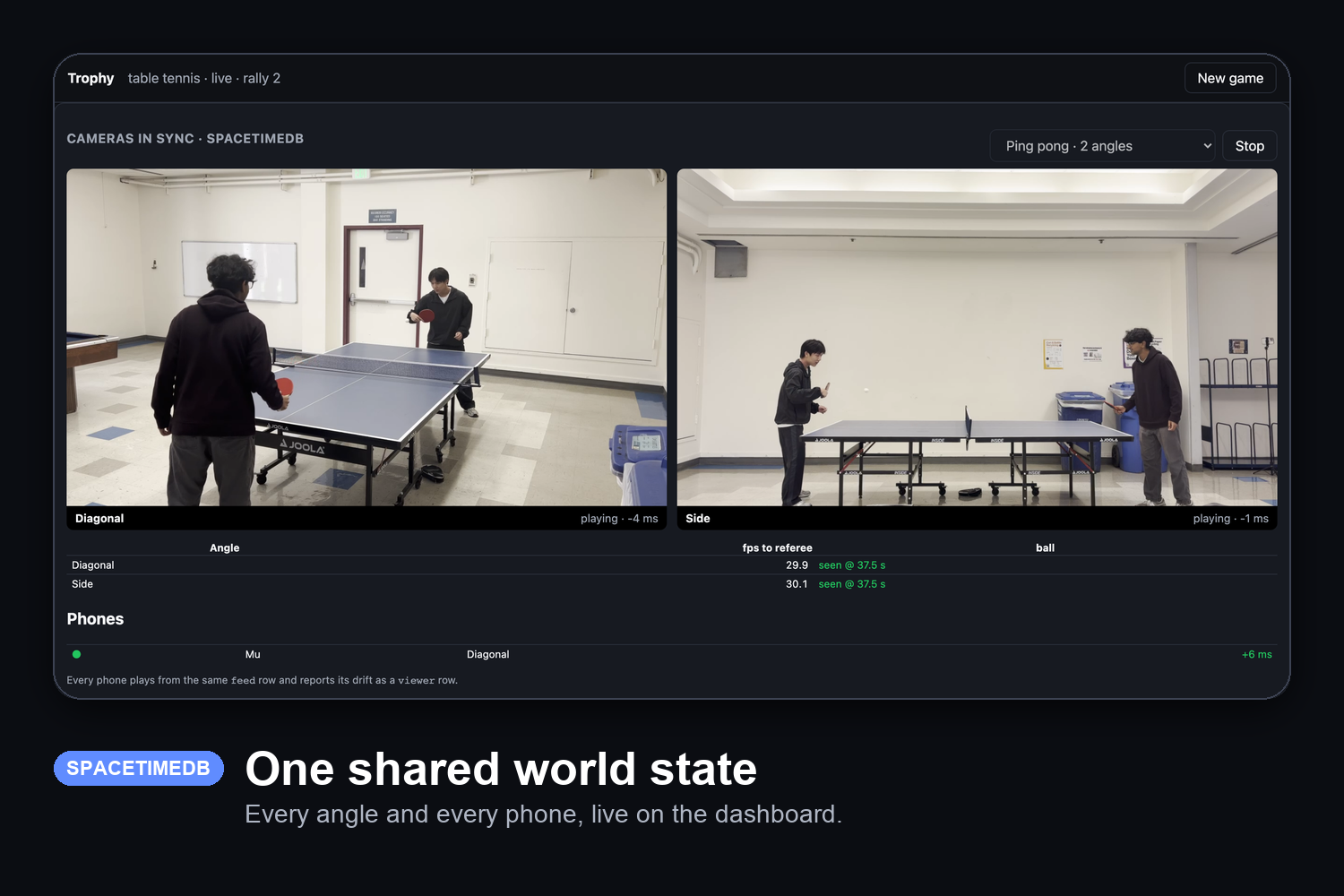
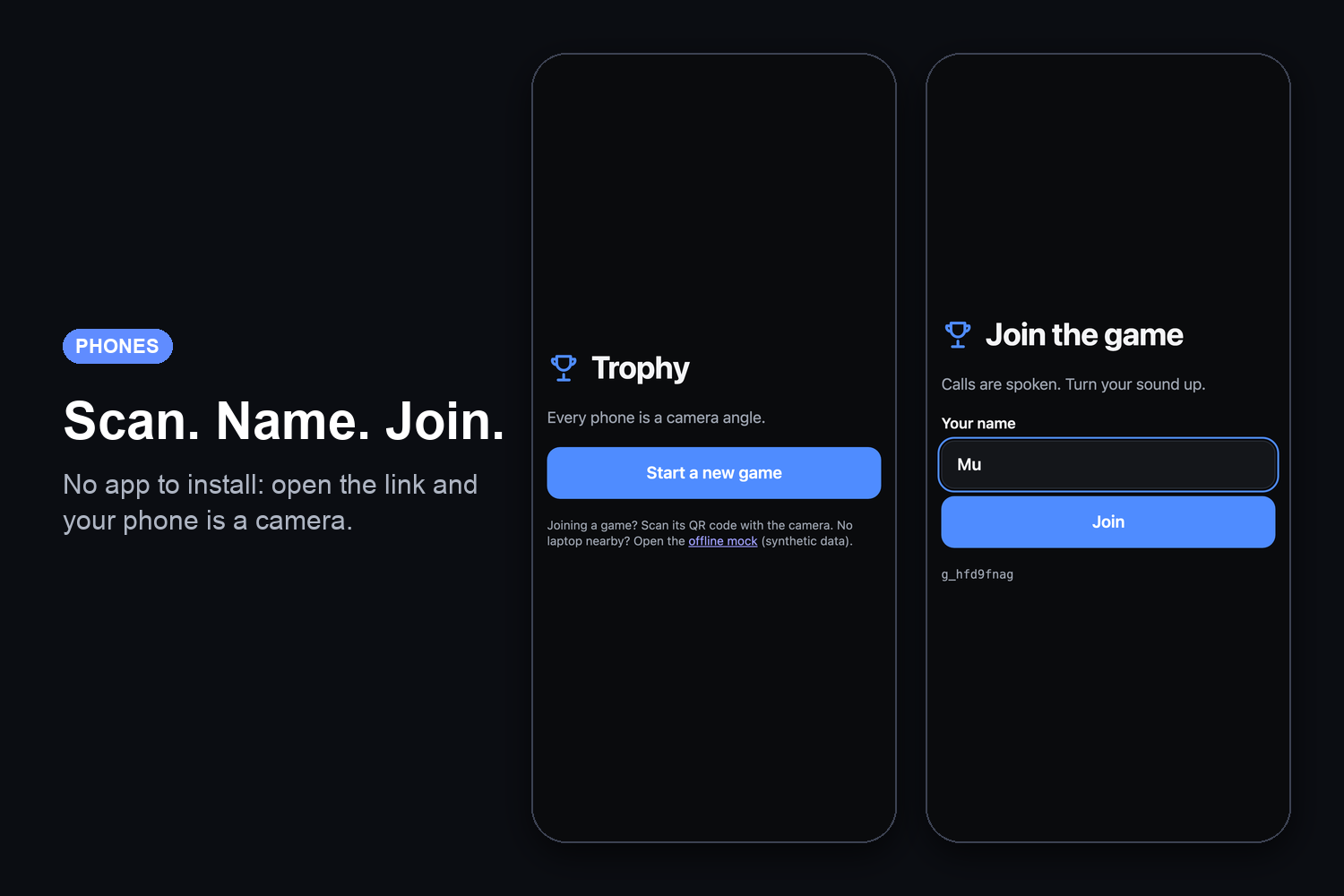
- Phones become cameras. Users simply scan a QR code, type their name, and place their phone down. Two phones give two angles of the same rally, kept in sync down to the millisecond.
- It makes the call. The referee tracks the ball in every frame. Each sport's rules then decide what happened: a point, a fault, out, a let, a double bounce, an illegal serve.
- Every call is spoken. Every phone beeps, then says what happened and whose fault it was ("Out. Point, Mu. Vedansh's fault.").
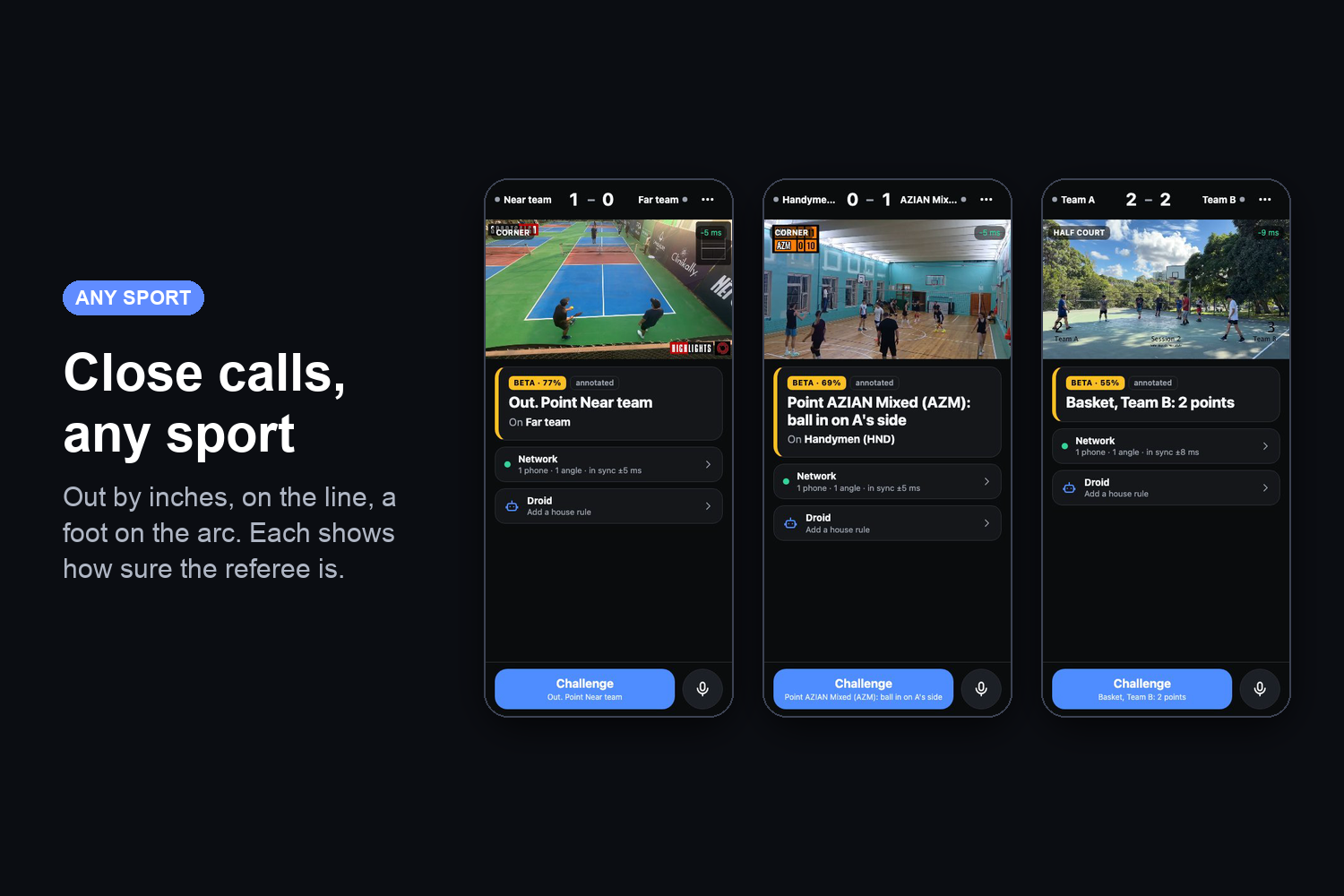
- It's honest about confidence. Calls are automatic when the referee is sure (p ≥ 0.90). Below that they're shown with their probability and can be challenged.
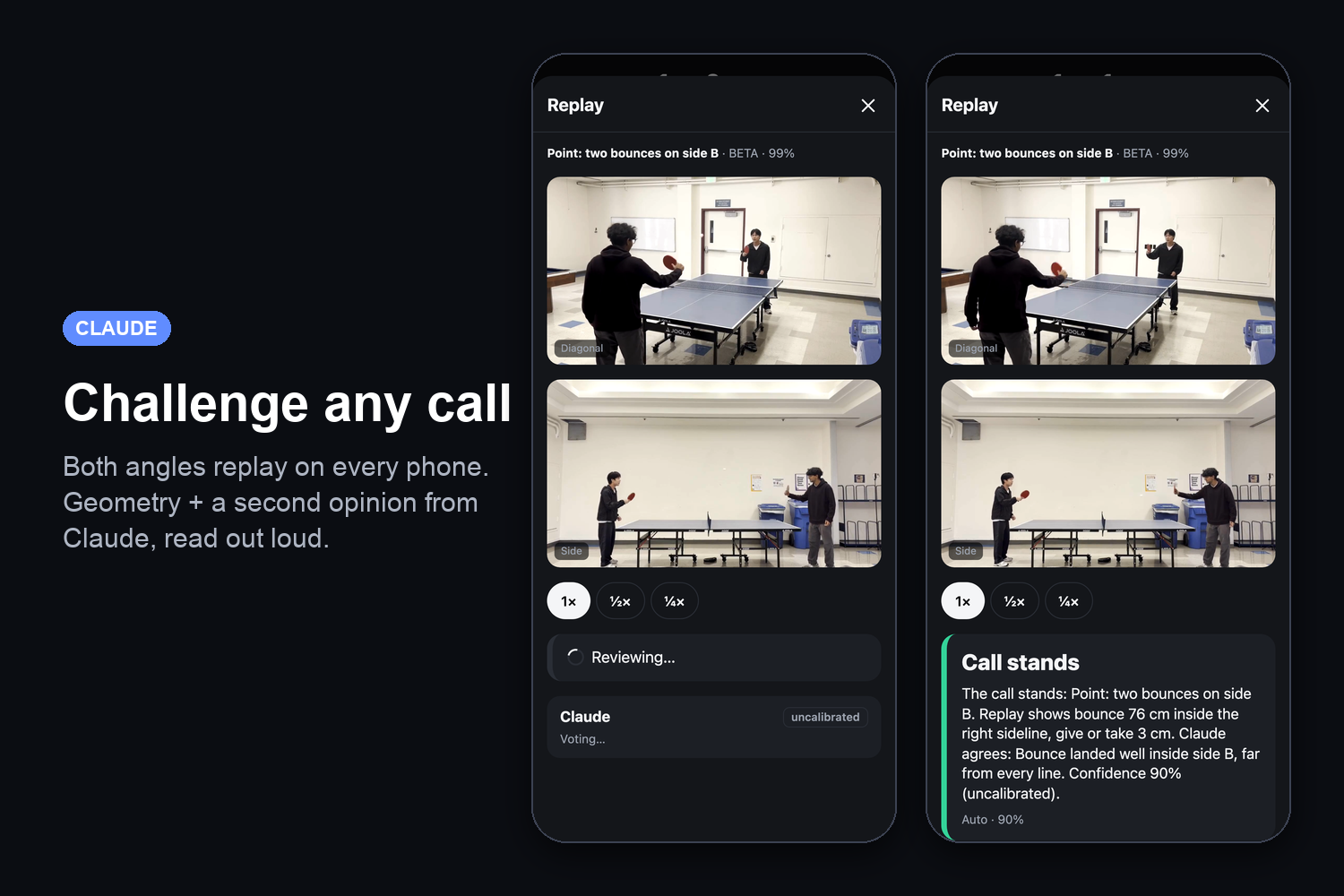
- Challenge it. Tap Challenge or just say "challenge". Every phone opens an instant replay of both angles. The geometry is re-checked, Claude gives a second opinion, and the verdict and its reason are read out loud, usually within about 4 seconds.
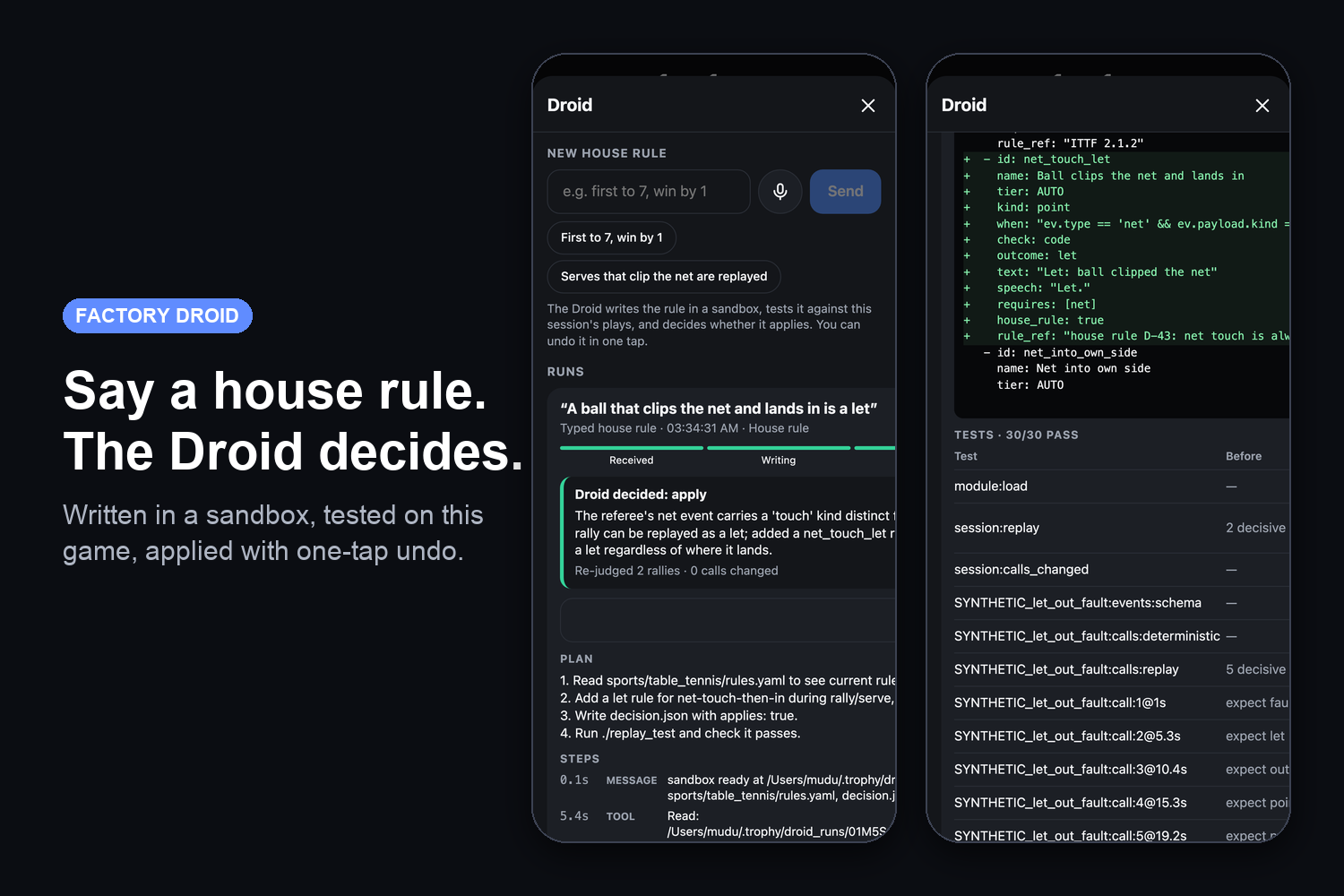
- House rules, in plain English. Say "a ball that clips the net and lands in is a let". A Factory Droid writes the rule in a locked-down sandbox and tests it against the plays already made. It then decides: it applies the rule, re-judges the game, and reports exactly which calls changed. One tap undoes it.
- Any sport. Ping pong runs on real ball tracking. For pickleball, volleyball and basketball, the Droid wrote each sport's let / out / fault rules from a rulebook summary and tested them against hand-marked plays.
- Ask the ref. Users can shout out "What's the score?" or "Why was that called?" and the referee will respond in real-time
How we built it
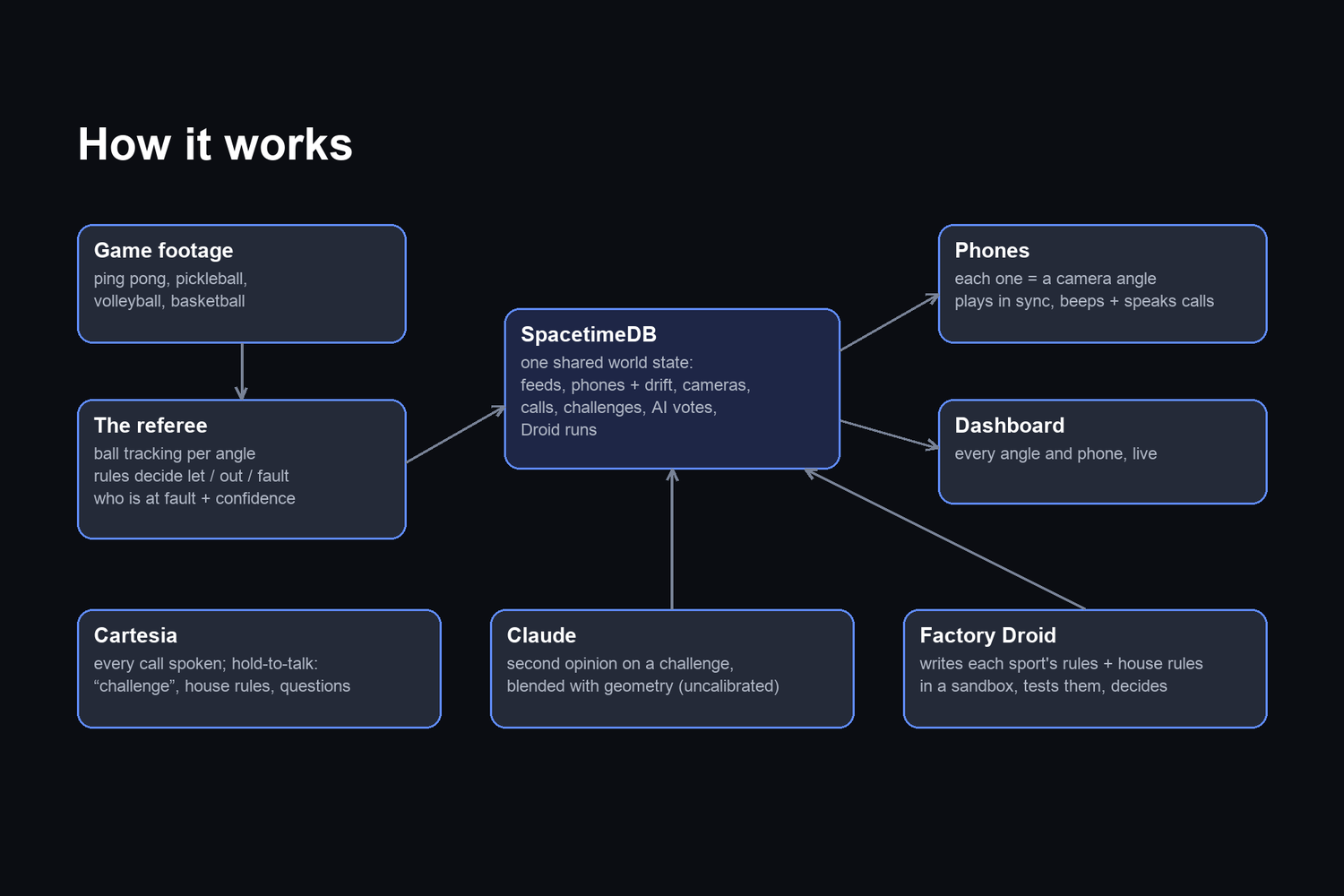
SpacetimeDB Trophy uses two synced camera feeds with an ML ball tracking algorithm running on our Mac, and every call has to reach every phone before the referee voice finishes speaking. SpacetimeDB is what allows us to create one shared record of the game that every phone, dashboard, rule engine, and the Factory Droid read and write.
- 19 tables, 28 reducers Camera schedules, ball positions, calls with confidence, challenges, Claude's votes, house rules, Droid runs. We don't put actual video frames into the database (while we considered event tables to push data frame-by-frame, each phone didn't actually need to access the other phone's frames)
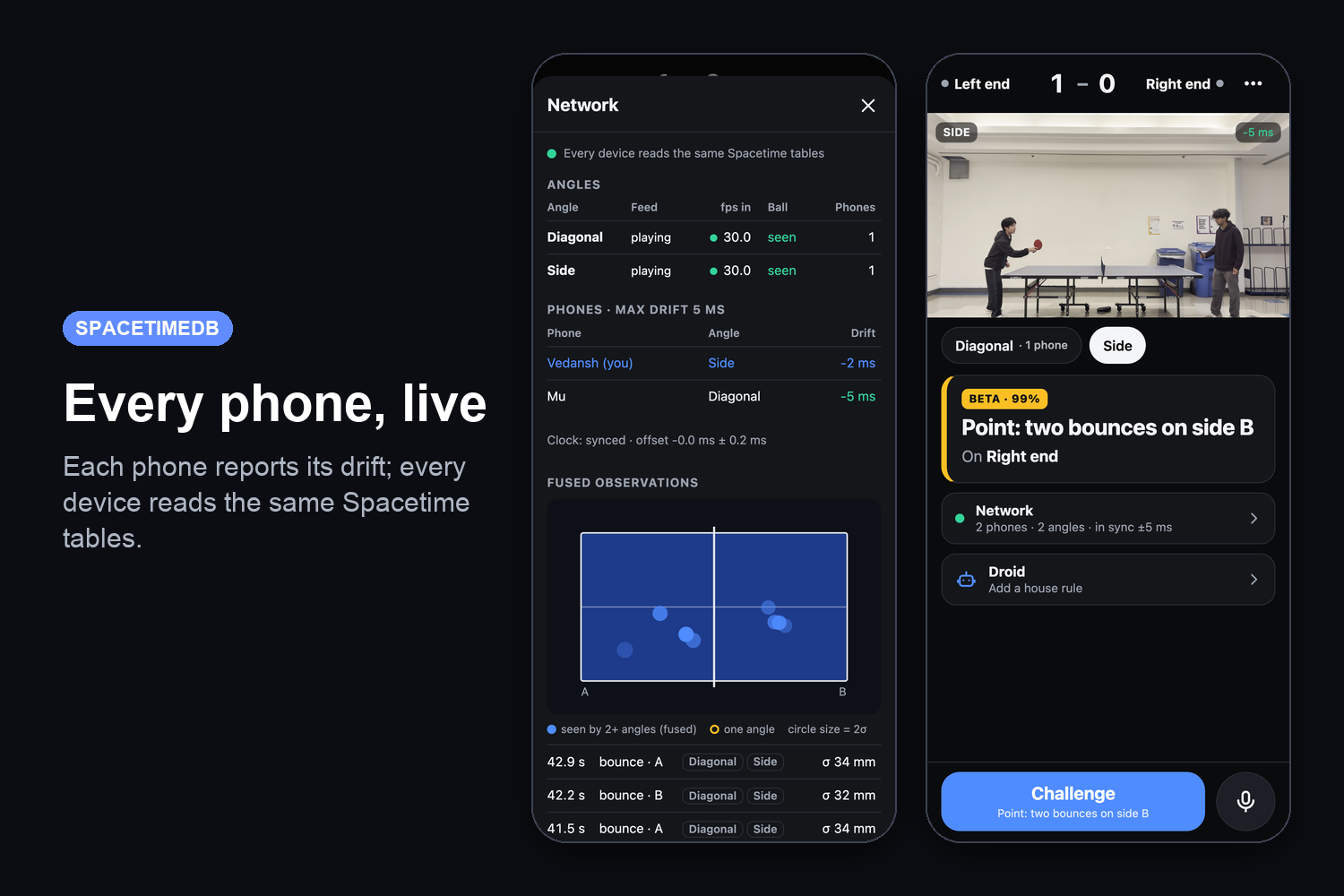
- Each phone is a real-time subscriber Phones get the full game state the moment they connect, and every change is pushed in sync. A late-joining phone will thus sync instantly.
- The table is where we communicate For example, to add custom game rules, we add an extra row. The Droid agent is subscribed to pending rows, wakes up, and writes its plan and diffs back into that row while the dashboard watches.
- One reducer, one transaction When a player challenges a call,
open_challengerecords the challenge, marks the call and attaches Claude's earlier votes together, so every screen sees the replay with the second opinion already there. - Write checks Every reducer checks who is calling. Phones can only read - writing happens through the Mac.
Measured: our calls can reach each phone within 36–59 ms after the engine makes it.
The referee:
- BlurBall ball detection on the GPU (PyTorch) runs on every frame of every angle;
- a sport module turns ball tracks into bounces, contacts and net events, merging cameras;
- a rule engine (CEL rule packs per sport) decides the call, who's at fault and the confidence tier.
It runs on a laptop on the same network. In the demo it replays our own two-phone recordings, plus Creative Commons clips for the other sports, as if they were live.
- Cartesia:
- Sonic text-to-speech reads every call and verdict on the phones;
- Ink-2 speech-to-text powers hold-to-talk: challenge, house rules, questions;
- phones get short-lived tokens minted by our server, never the API key. Claude:
- casts the second-opinion vote on a challenge (structured output, blended with geometry, labelled uncalibrated, never delaying a call);
- phrases the explanations;
- answers ask-the-ref questions from the rule pack. Factory Droid:
- Triggers: a new sport coming into play (an event), "regenerate" (a user action), or a house rule spoken or typed (a Spacetime row).
- Sandbox: each run gets a fresh git sandbox. A PreToolUse guard limits edits to that job's rule file, the only command it may run is the test gate, file reads stay inside the sandbox, and the gate runs with no network and no writes outside.
- Audit: the runner checks
git statusafter every turn and fails any run that touched anything else. - Visibility: the plan, live steps, the diff, the test table, blocked tool calls and the calls changed all stream to the phones and the dashboard. Gateway (FastAPI + Redis): game joins, clock sync, the frame bus, replay clips, and the Cloudflare tunnel fallback for venue Wi-Fi that isolates devices.
Measured this weekend
- Two angles in sync: 30 fps per angle into the referee; ball found in 76–100 % of frames on our recording; phone playback within ±2–13 ms of the shared schedule (measured in a browser on the laptop's network).
- Challenge → spoken verdict: about 4 s, including a live Claude vote of about 3 s.
- Factory Droid, live runs:
- interpreters written and gated in 44–66 s (pickleball 9/9 tests, volleyball 9/9, basketball 11/11);
- house rules applied in 31–82 s, re-judging the game; Undo is instant.
- Cartesia: first audio about 112 ms after the request on an iPhone.
The ping-pong footage is unlabelled, so we don't claim an accuracy number. Claude's confidence is uncalibrated, and the app says so.
Challenges we ran into
- Venue Wi-Fi isolates devices, so phones couldn't reach the laptop. We added a Cloudflare quick tunnel: phones join from any network, and the app hands out the reachable address automatically.
- Two phones joining together picked the same angle, because each saw the other's choice too late. Each phone now ranks itself among the game's phones.
- A random join key starting with "-" broke our clip streamer's argument parsing, failing about 1 game in 64. We found it while recording the demo video.
- Sandboxing an AI agent is hard. Our first runs produced a "ready" result with an empty diff, and a 90-second timeout. We enforce the sandbox with a hook, audit the git tree after every turn, and run the tests in a jail.
- Structured output rejected our vote schema (free-form maps aren't allowed), so the challenge vote silently failed until we switched to a list of options.
Accomplishments we're proud of
- Two phones showing two angles of the same rally, in sync through SpacetimeDB, with every device seeing every other device's drift live.
- A Factory Droid that doesn't just write code: it decides, shows its work, and can be undone in one tap.
- A referee that says how sure it is, and that a player can argue with by voice.
What we learned
- Honest confidence is a feature. Players accept "too close, you decide" far more easily than a confident wrong call.
- Shared state beats messaging. Once every device reads the same Spacetime tables, sync, replay, votes and Droid progress come for free on every screen.
- For an agent you trust with real decisions, the guardrails and the visible trail matter more than the model.
What's next
- Real-time capture from the phones at a hackathon
- Calibrated confidence from labelled games.
- 3D reconstruction from multiple phones for line calls.
Built With
- cartesia
- claude
- droid
- factory
- fastapi
- python
- react
- spacetimedb
- typescript
- vite

Log in or sign up for Devpost to join the conversation.