-
-
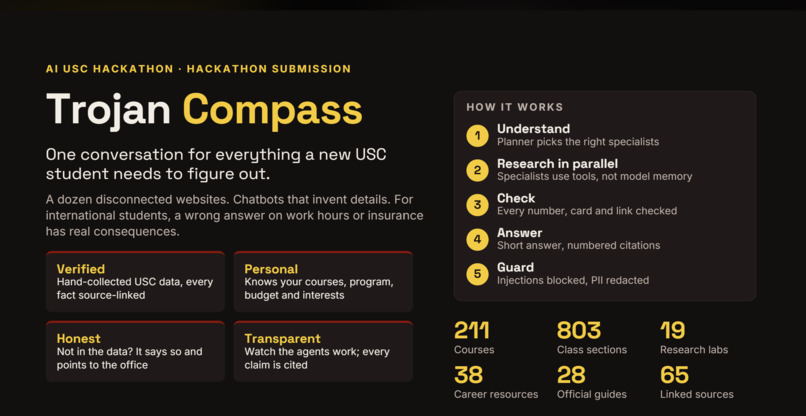
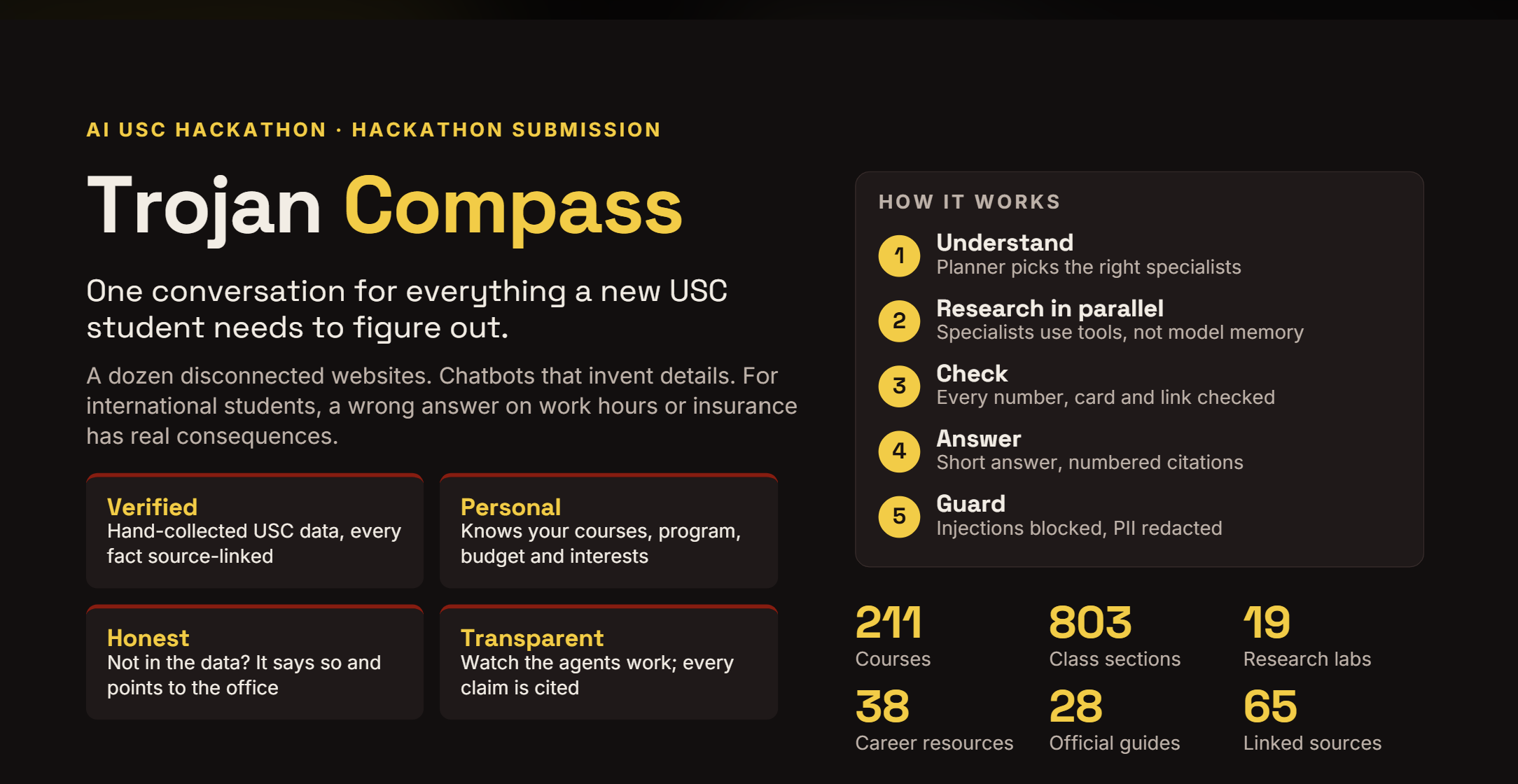
Trojan Compass: One AI-powered hub connecting USC students to academics, research, campus services, and personalized support.
-
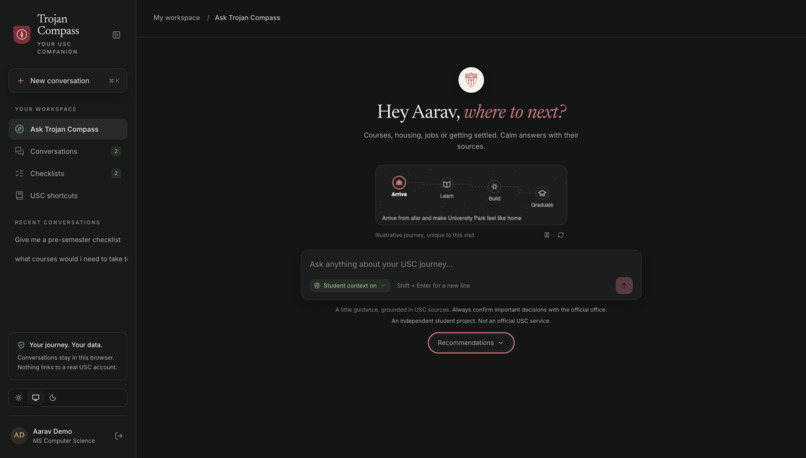
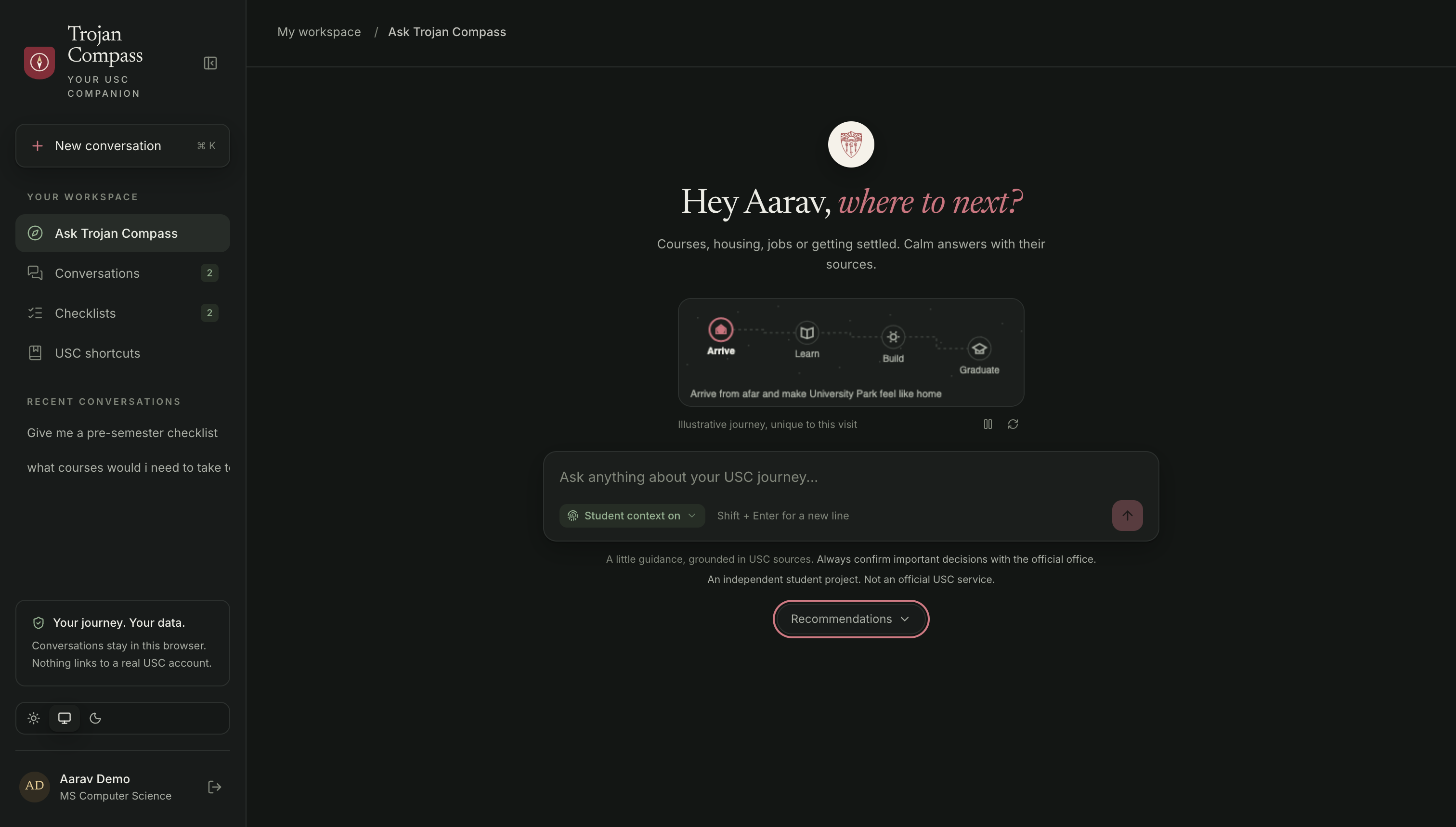
The Trojan Compass interface, where students can ask questions in natural language and receive personalized university guidance.
Inspiration
Starting at USC means navigating a dozen separate portals for courses, registration, billing, health services, jobs, and campus events. New students, especially international students, often spend their first weeks searching through fragmented websites and administrative systems for information that already exists but is difficult to find.
We wanted to change that experience by creating one intelligent place where every student can simply ask a question and get a reliable answer.
What it does
Trojan Compass is an AI-powered assistant designed to simplify the entire USC student experience. Students can ask questions in natural language and receive personalized, context-aware answers grounded in verified USC sources, complete with citations and verification dates.
Our platform brings together several essential student services:
- Academics: Course information, prerequisites, available sections, and conflict-free weekly schedules.
- Research: Discover USC research labs, explore their published recruitment status, and learn how to apply.
- Onboarding: Personalized pre-semester checklists to help new and international students navigate their transition to USC.
- Personalized Assistance: Responses tailored to individual student profiles, accessible through desktop and mobile interfaces.
How we built it
We built Trojan Compass using a modular, multi-agent architecture designed around reliability, security, and scalability.
- Frontend: React and Vite for a responsive, intuitive student interface.
- Backend: FastAPI and LangGraph for orchestration and multi-agent coordination.
- Agent Architecture: A supervisor agent intelligently routes requests to specialized domain agents covering academics, careers, and student services.
- Tools: Typed, allow-listed tools provide controlled access to verified university information.
- Verification: A dedicated verification layer checks generated responses against retrieved data before delivery.
- Safety: Input and output guardrails protect against prompt injection, unauthorized access, and sensitive information exposure.
- Data & Retrieval: Public USC information collected and verified, indexed using Pinecone with hybrid retrieval combining dense embeddings and keyword matching.
- LLM: Groq's gpt-oss-120b powers natural-language understanding and response generation.
- Cost Optimization: Response caching reduces repeated model calls and overall inference costs.
- Demo: A Remotion-based demonstration video created using actual application recordings and measured system data.
Challenges we ran into
- Free-tier API rate limits: Limited inference quotas created reliability challenges. We implemented response caching and bounded retries to handle repeated requests efficiently.
- Incomplete answers: Multi-step queries, particularly course and section combinations, sometimes resulted in missing information. We consolidated related operations into unified tool calls to improve completeness.
- Agent reliability: Coordinating multiple specialized agents required structured routing, controlled tool access, and verification to prevent unsupported responses.
- Information accuracy: Ensuring that responses remained grounded in actual USC information required a dedicated retrieval and verification pipeline.
Accomplishments that we're proud of
- Grounded responses: Every answer includes dated sources, with unknown information explicitly identified rather than fabricated.
- Security by design: Prompt injection is blocked before any model call, student sessions are isolated, and sensitive personal information is redacted.
- Cost efficiency: New questions cost less than one-tenth of a cent, while cached responses require $0 in additional live model calls.
- End-to-end integration: Successfully brought multiple student-support domains together through a unified multi-agent architecture.
- Evidence-backed demonstration: Every performance and capability claim presented in our demo is supported by actual application evidence and measured data.
What we learned
We learned that building a useful AI assistant requires much more than selecting a powerful language model. Grounded information, structured tools, verification, and carefully designed agent interactions are essential for producing trustworthy results.
We also learned to treat reliability, security, and cost optimization as foundational architectural requirements rather than features to add later.
What's next for Trojan Compass
We envision expanding Trojan Compass into a more comprehensive student-support ecosystem.
- Multilingual Support: Introduce Chinese, Hindi, and additional languages to support USC's diverse international community.
- Voice Interaction: Enable students to interact with the assistant through voice input.
- Proactive Notifications: Provide personalized reminders for registration windows, academic deadlines, and important university events.
- Housing Integration: Incorporate verified university housing information and resources.
- Campus Pilot: Collaborate with a USC student organization to conduct a pilot, followed by authorized university integrations after appropriate privacy reviews.
