Inspiration
Every trivia app I've ever played has the same problem: stale question banks. You play a few rounds and you've seen it all. I wanted to build something where the questions are always fresh, always surprising, and tailored to exactly what you want to play — whether that's "90s Bollywood" or "Quantum Physics" or "Street Food Around the World."
The bigger inspiration was a simple question: what if AI did all the heavy lifting so players just focus on having fun? Not just generating questions — but commentating the game, writing personalized roasts after each round, and keeping the energy alive the whole time. That's what Trivia Royale does.
What it does
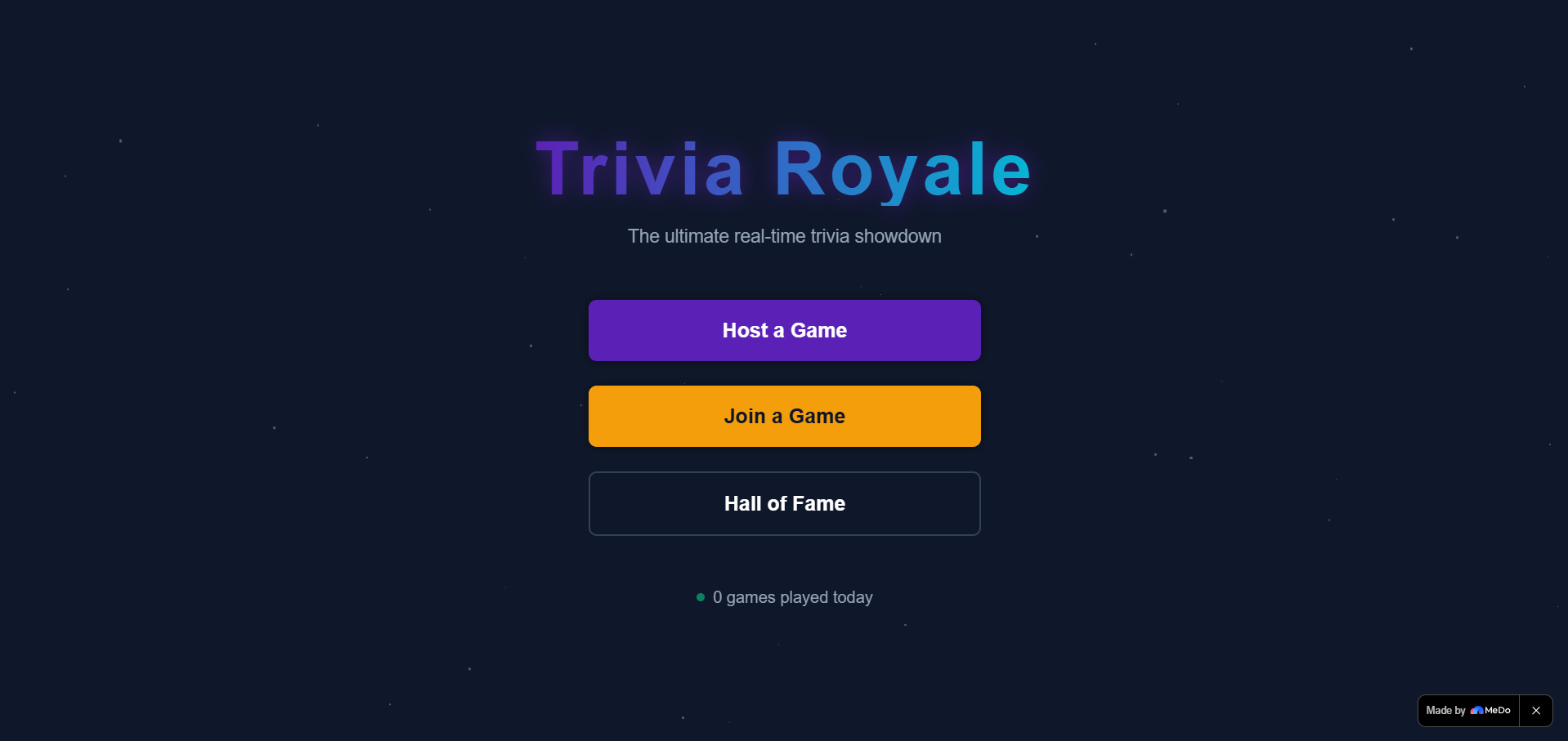
Trivia Royale is a real-time multiplayer trivia battle where every single question is generated live by Groq AI (LLaMA 3.3 70B) the moment you start a game — no question banks, no repeats, infinite replay value.
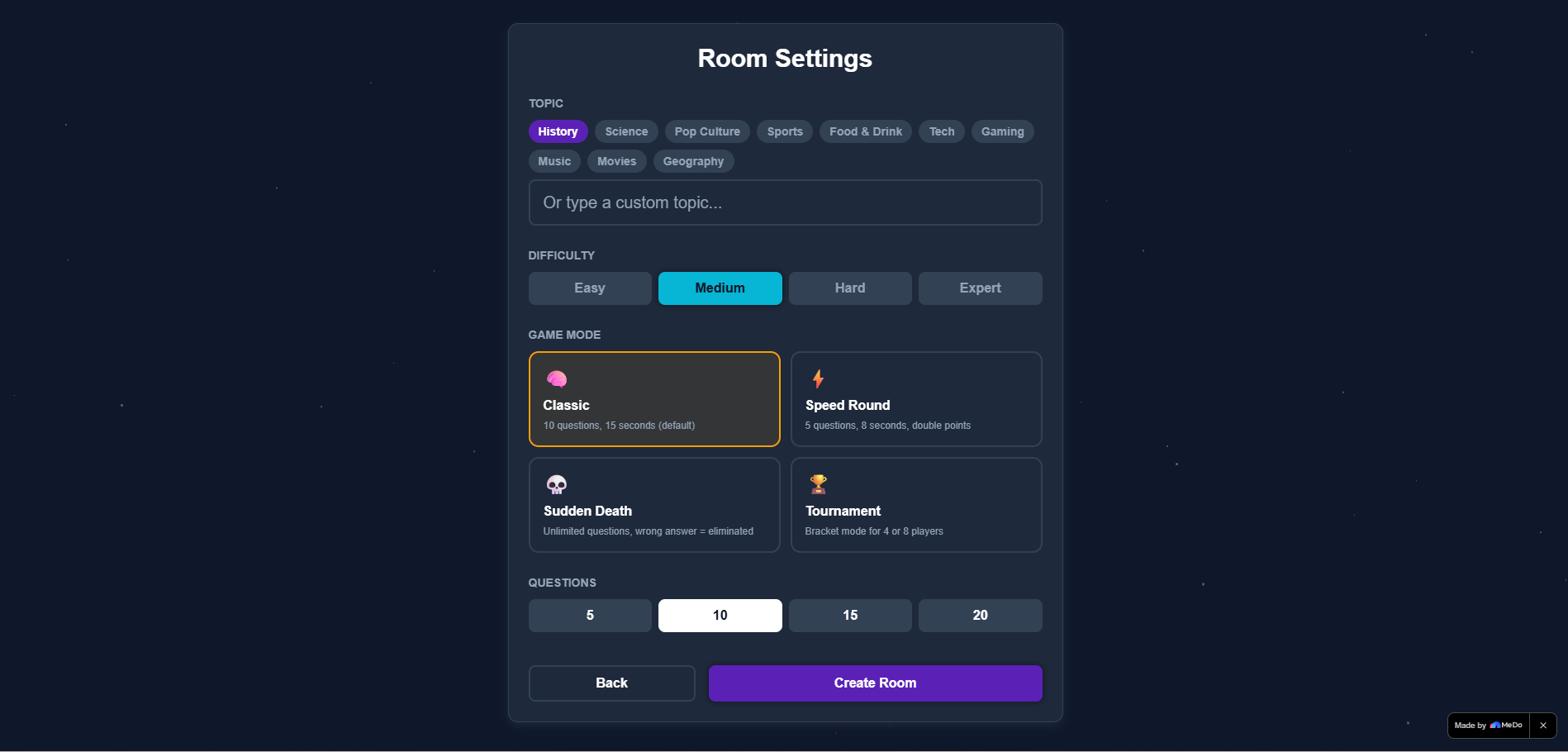
- 🎯 Infinite topics — type anything ("90s Bollywood", "Space Exploration", "Indian Street Food") and get 10 perfectly crafted questions instantly
- ⚡ 4 game modes — Classic, Speed Round, Sudden Death (wrong answer = eliminated), and Tournament bracket
- 🔥 Streak combos — consecutive correct answers multiply your score up to 2×
- 💥 Power-ups — Double Points, Time Freeze, 50/50, and Spy
- 😂 Live reactions — emoji reactions float across everyone's screen simultaneously in real time
- 🎙️ AI Commentator — Groq writes a witty one-liner commentary after every single question result
- 📊 Spectator mode — watch live with a real-time answer distribution chart updating as players answer
- 🏆 AI Report Cards — after the game, Groq personally roasts and praises every player's performance based on their stats
- 🌍 Global Hall of Fame — persistent leaderboard across every game ever played on the platform
How I built it
I built the entire app using MeDo — describing every feature in plain English and letting MeDo handle all the architecture, code generation, and API wiring.
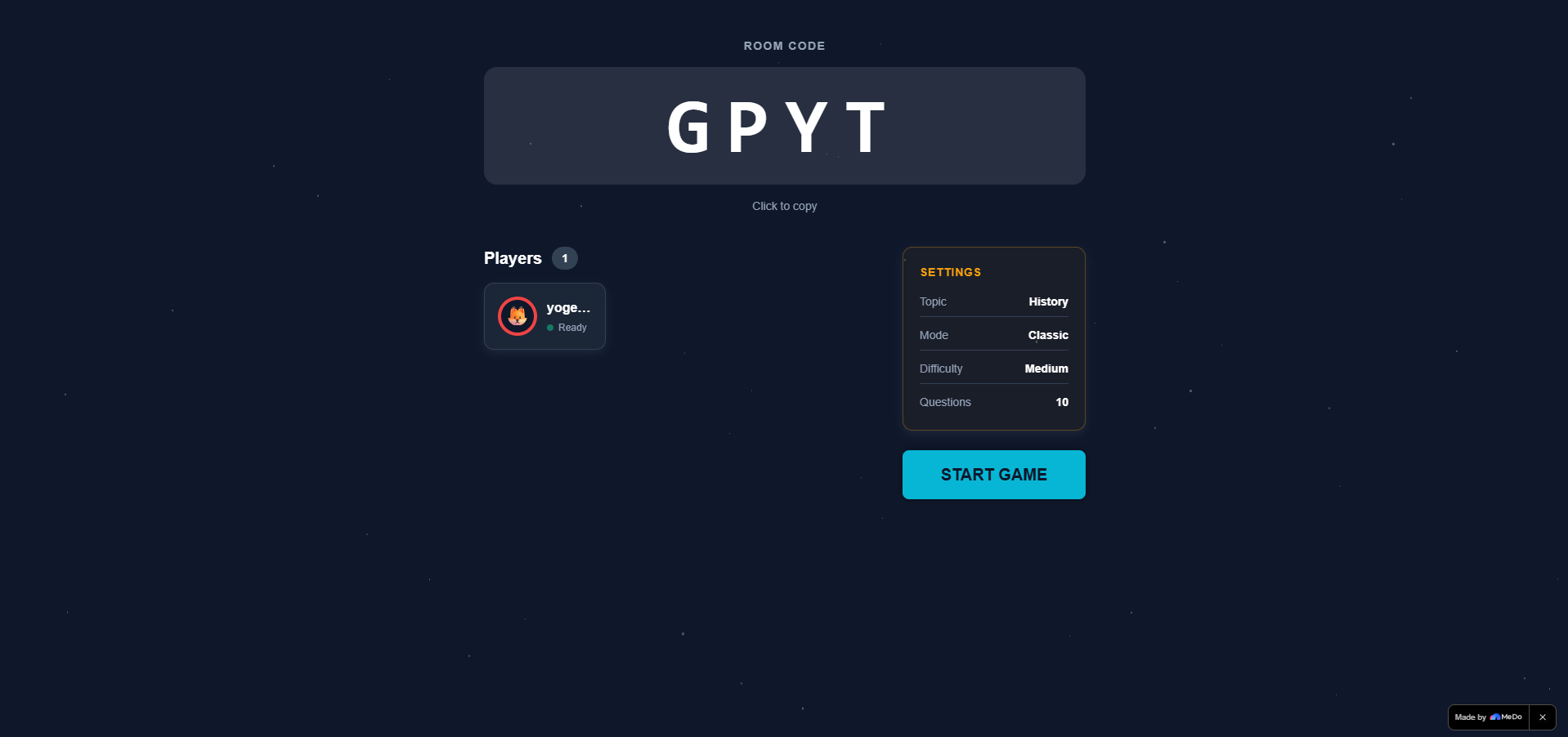
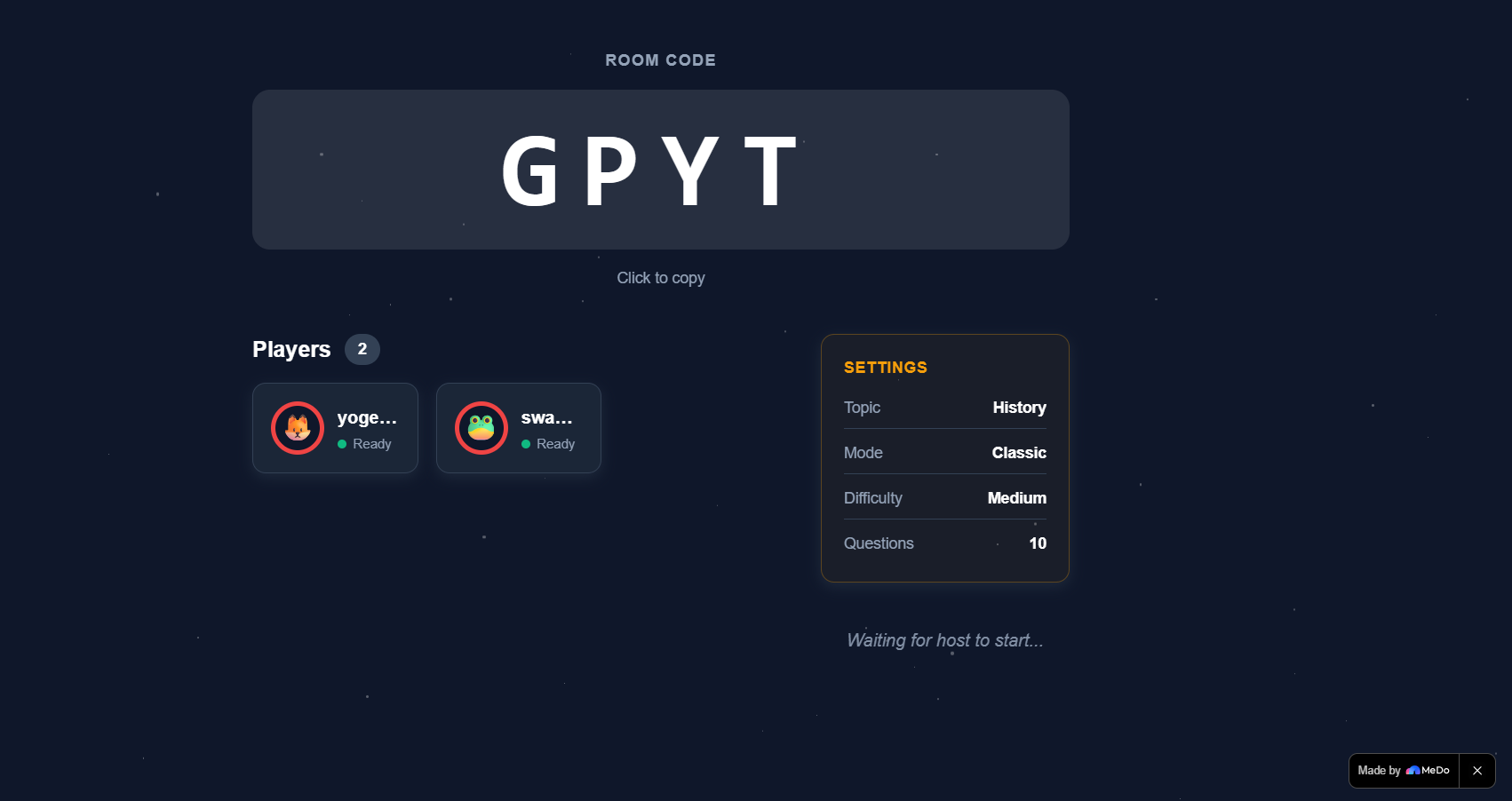
The most impressive thing MeDo generated was the full real-time multiplayer sync system using Supabase subscriptions. Every player's screen updates simultaneously — answer locks, timer state, leaderboard changes, power-up effects, and floating emoji reactions — all driven from a single Supabase real-time channel. I described what I wanted in plain English and MeDo built the entire system end to end without me writing a single line of code.
The AI integration uses the Groq API with LLaMA 3.3 70B for three things:
- Question generation — structured JSON with question, 4 options, correct index, and a fun fact per question
- Live commentator — a witty one-sentence reaction after every round result
- Player report cards — personalized 2-sentence performance reviews after the game
MeDo automatically handled the prompt engineering, JSON parsing, markdown fence stripping, and retry logic — I just described the outcome I wanted.
Full stack MeDo built:
- React + Tailwind CSS (frontend)
- Supabase (real-time database + live subscriptions)
- Groq API with LLaMA 3.3 70B (AI question generation, commentator, report cards)
- Web Audio API (procedural sound effects — zero external audio files)
- One-click deployment to public URL
Challenges I ran into
Challenge 1 — Real-time sync across all players. The hardest problem was making sure every player sees the exact same screen at the exact same moment — when the timer runs out, when the answer reveals, when the leaderboard updates. MeDo solved this by making Supabase the single source of truth for all game state. No local React state drives the game flow — everything is subscription-driven. When I described the sync problem in plain English, MeDo refactored the entire state management approach in one prompt.
Challenge 2 — Reliable JSON from the AI. Occasionally the Groq API would wrap its JSON response in markdown code fences, breaking the parser. MeDo automatically added a stripping layer and a one-retry fallback when I described the edge case. It also added a hardcoded fallback set of 5 questions per topic in case the API is unavailable during a live game.
Challenge 3 — Tournament bracket logic. Seeding players, running semifinals, advancing winners, and updating the visual bracket in real time was the most complex piece. I described the outcome — "players should see a bracket tree that updates live after each round" — and MeDo figured out the data structure and rendering logic entirely on its own.
Accomplishments that we're proud of
- A trivia game with literally infinite replayability — no two games are ever identical because every question is freshly generated
- The AI Commentator mode — watching Groq drop razor-sharp one-liners after every result made playtesting genuinely hilarious and addictive
- Sudden Death mode — the tension of one wrong answer eliminating you creates a completely different emotional experience from regular trivia
- Tournament bracket with live visual updates — feels like a real esports event
- AI-written player report cards — personalized, funny, and surprisingly accurate based on actual game stats
- The entire app — from first MeDo prompt to deployed public URL — was built and tested in under 48 hours
What I learned
MeDo fundamentally changes the speed at which you can go from idea to deployed product. The key insight I kept coming back to: describe the outcome you want, not the implementation.
When I told MeDo "players should feel anxious when someone hits a 3-streak," it added a full-screen banner announcement visible to all players simultaneously — I never specified how to implement it. When I said "make the timer feel urgent," it turned the progress bar red under 5 seconds and added a ticking sound. The gap between what you imagine and what gets built is almost zero.
I also learned that AI-powered features compound. Question generation alone would make a decent app. Add the commentator, and every round feels like a live show. Add the report cards, and players want to screenshot and share. Each AI touch point makes the whole experience more alive.
What's next for Trivia Royale
- Custom question packs — hosts upload a PDF, textbook, or article and Groq generates questions directly from that content
- Voice mode — questions read aloud via text-to-speech, answers spoken back
- Weekly Leagues — persistent standings and ELO-style rankings across weeks
- Classroom mode — teachers generate curriculum-specific quiz rounds from their own study material
- Mobile app — native iOS and Android with push notifications for game invites
Built With
- 3.3
- api
- css
- groq
- javascript
- llama
- node.js
- react
- supabase
- tailwind

Log in or sign up for Devpost to join the conversation.