-
-
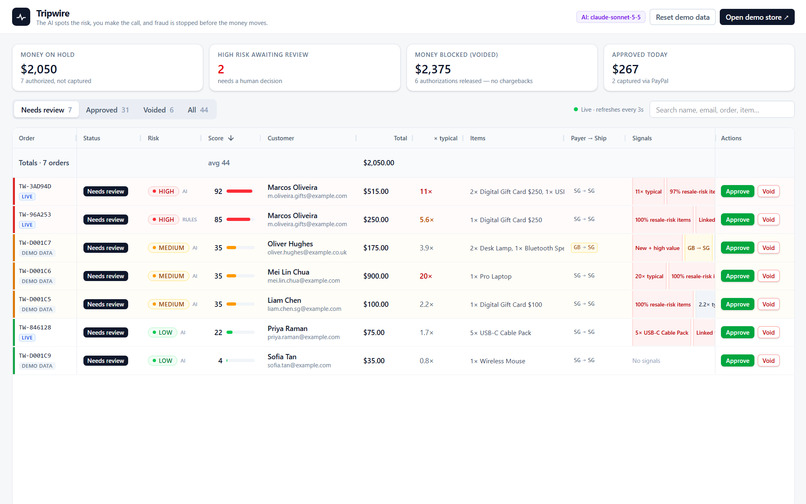
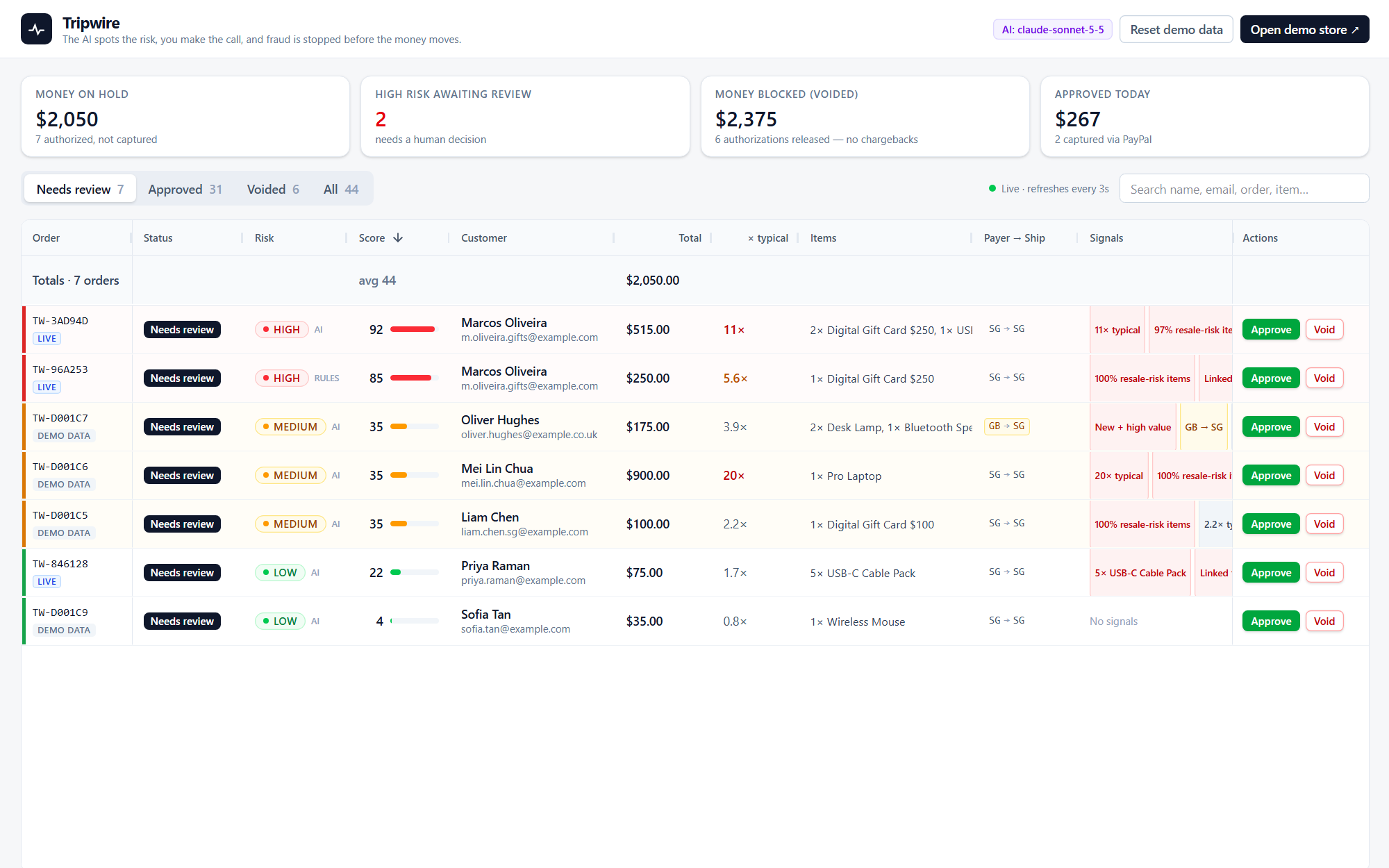
Tripwire Review Queue
-
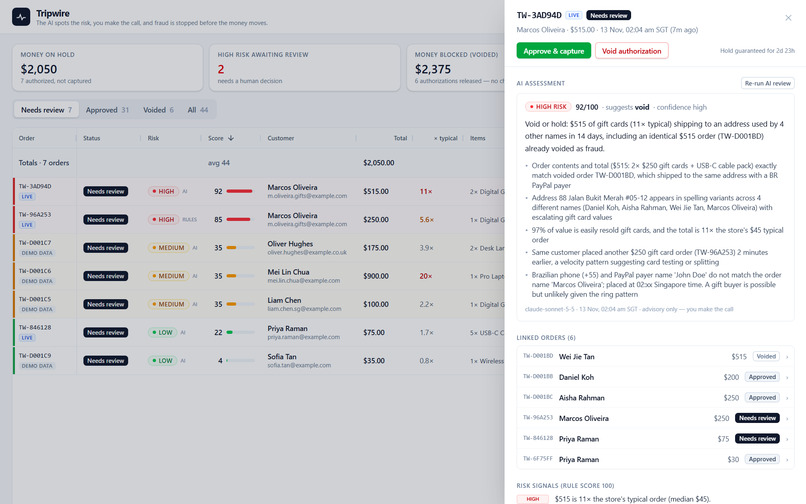
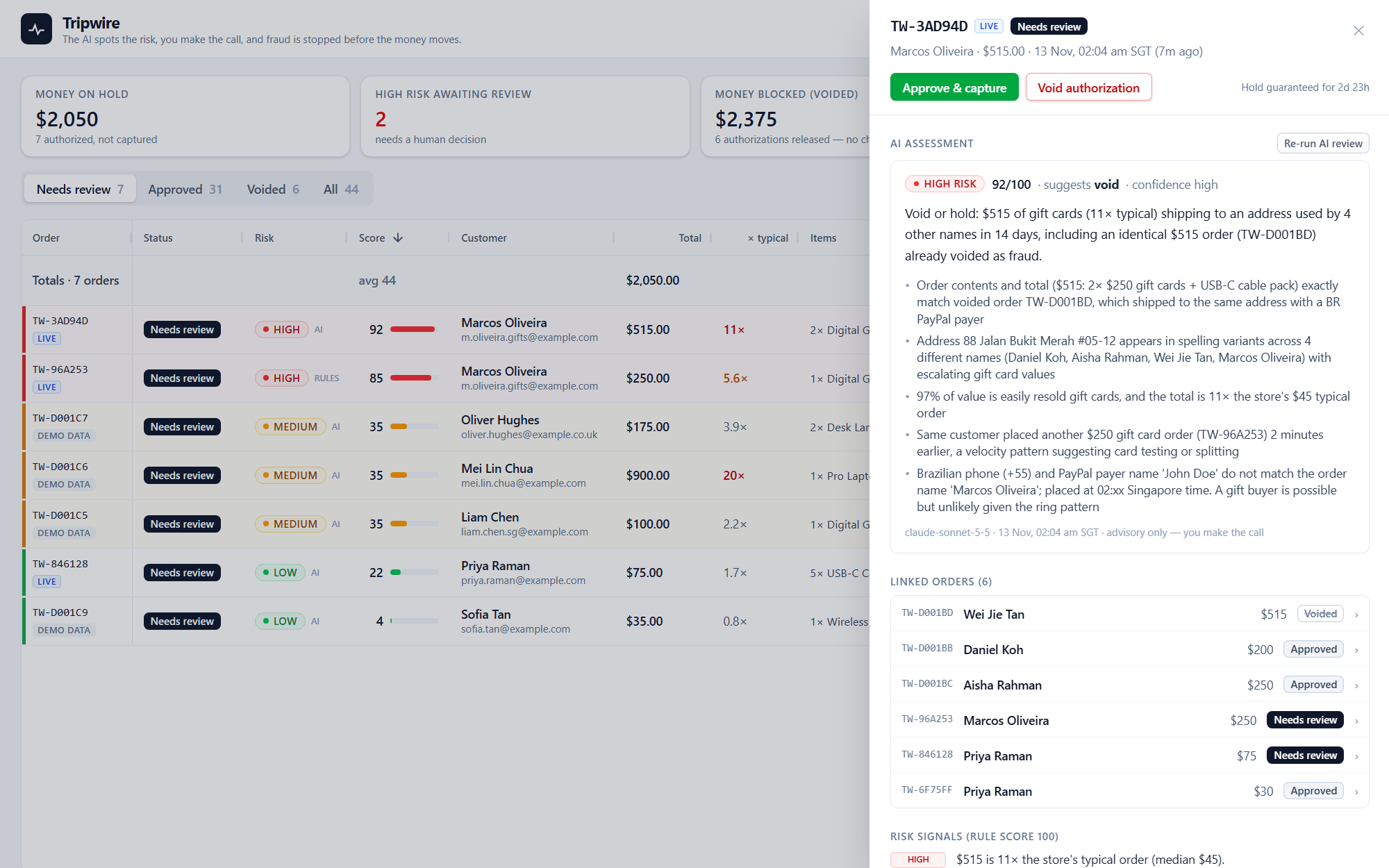
Tripwire Review Drawer
Tripwire stops fraud before the money moves: suspicious PayPal orders are authorized, reviewed, then voided — no refund, no chargeback.
Tagline: The AI spots the risk, you make the call, and fraud is stopped before the money moves.
Demo data vs. live: the queue ships with 40 seeded orders, clearly badged Demo data; approving or voiding them only changes local state. Both demo scenarios (a normal order and a fraud order) are real PayPal sandbox transactions, badged Live, that call PayPal's authorize, capture and void APIs.
Inspiration
Small online shops get hit by fraud they can't see coming: resellers placing orders under a handful of fake names, stolen PayPal accounts, card-testing bursts at 3 a.m. PayPal does a great job of judging whether a payment is legitimate, but it can't know what's normal for one particular store. A $750 order might be routine for an electronics retailer and wildly unusual for a shop whose typical order is $45.
The usual fix comes too late. The merchant captures the money, ships the goods, and finds out weeks later through a chargeback. We wanted to move the decision to before the money moves.
What it does
Tripwire is an AI-assisted fraud review queue for PayPal orders.
- Every checkout uses PayPal's authorize-then-capture flow. The buyer's funds are held, not taken.
- Each new order lands in a live review queue built on AG Grid.
- Deterministic code computes risk signals from the store's own history: how far the order is above the store's typical order, ordering velocity, PayPal account country vs. shipping country, new customer + high value, gift cards and other easy-to-resell goods, quantity anomalies, odd hours, and shared identity (the same address, phone or PayPal account used under different names, even with small typing differences).
- Claude reads the order, the signals and related orders, and writes a specific, evidence-based explanation. A real example from a live sandbox order: "Void or hold: $515 of gift cards (11× typical) shipping to an address used by 4 other names in 14 days, including an identical $515 order (TW-D001BD) already voided as fraud." It also suggests an action and links orders that look like the same person.
- A human decides. Approve captures the authorization through PayPal. Void voids it, so the money never moves: no refund, no chargeback, no dispute fee.
The AI never moves money on its own.
How we built it
- Next.js (App Router) + TypeScript + Tailwind for the storefront, the review queue and the API routes.
- PayPal REST APIs (sandbox): Orders v2 to create (
intent: AUTHORIZE, with the buyer-entered address viaSET_PROVIDED_ADDRESS) and authorize orders; Payments v2 to capture or void authorizations; and the PayPal JS SDK for the checkout buttons. All calls are server-side with a cached OAuth token, idempotency keys and plain-English error handling. - Anthropic Claude (
claude-sonnet-5-5) for the risk review, with structured JSON output validated by zod, a retry, and a deterministic rule-score fallback when the AI is unavailable. The prompt requires evidence-based reasons, honesty about weak evidence, consideration of innocent explanations, and treating customer-written text as untrusted data. - Google Gemini (optional, free tier) as a second provider behind the same interface, so anyone can run the full AI review without paying. With no key at all, Tripwire still runs on rule scores and labels them "AI unavailable".
- AG Grid Community as the centerpiece: a customized Quartz theme, custom cell renderers (risk badges, score bars, signal chips, country-mismatch highlight, honor-period countdown, action buttons), risk-based row styling, a pinned totals row, cell flashing for new and changed orders, a quick filter, tooltips and live updates via
getRowId. There are no Enterprise features, so no license key is needed. - Claude Code as a coding assistant during the build. The product design, fraud signals and demo were directed by us.
Why AG Grid
In Tripwire the grid is the product, not a display. The review queue is a live operations console where money decisions happen: every Approve or Void button in a row captures or voids a real PayPal authorization.
getRowId+ cell flashing: rows update in place every 3 seconds. New orders and status/risk changes flash instead of the table reloading.- Custom cell renderers: risk badges, score bars, a payer → ship country-mismatch highlight, signal chips, an honor-period countdown and Approve/Void action buttons.
- Theming API: a customized Quartz theme with risk-colored row styling, so it reads like a real ops tool.
- Pinned totals row and pinned columns: order IDs and action buttons never scroll out of view.
- Tooltips and quick filter: the full AI summary on hover, and instant search across names, emails, items and order IDs.
It's built entirely on AG Grid Community, with no Enterprise modules and no license key, so any small merchant could run it for free.
Challenges we ran into
- Linking identities through typos. "88 Jalan Bukit Merah, #05-12" and "88 Jln Bukit Merah 05-12" are the same flat. We normalize addresses (case, punctuation, whitespace, common abbreviations) and phone numbers so a reseller can't dodge the link by retyping.
- Keeping the AI honest. Early on it is tempting to let the model "decide". We kept it strictly advisory, made it cite evidence from the input only, and validate its linked order IDs against real orders so it can't invent links.
- Authorization lifecycles. Authorizations have a 3-day honor period and can already be captured, voided or expired by the time someone clicks a button. We surface the countdown and reconcile local state with PayPal's answer when an action fails.
- Making a demo that always looks recent. Seed data is re-dated on load (keeping time of day), so "orders in the last 14 days" stays true whenever a judge runs it.
Accomplishments that we're proud of
- A complete authorize → AI review → human capture/void loop on real PayPal sandbox APIs.
- Explanations a busy merchant can act on in seconds, specific to their own store.
- A review queue that feels like a real operations tool.
- Graceful failure everywhere: if the AI is down, the rule score still works; if PayPal says no, the merchant is told why.
What we learned
- Authorize/capture/void is an under-used superpower for small merchants. It turns fraud from a refund problem into a decision.
- LLMs are most useful here as explainers and connectors on top of deterministic signals, not as black-box judges.
- Store-specific context ("17× your typical order") is what makes a risk explanation trustworthy.
What's next for Tripwire
- PayPal webhooks for authorization events, and server-sent events instead of polling
- A real database and multi-store support
- Merchant-defined auto-approve policies for clearly low-risk orders
- Learning from each merchant's past approve/void decisions to calibrate the AI
- Re-authorization prompts before the honor period ends
Built With
- ag-grid
- anthropic
- claude
- gemini
- nextjs
- paypal
- paypal-js-sdk
- paypal-orders-v2
- paypal-payments-v2
- react
- tailwindcss
- typescript
- zod
