-
-
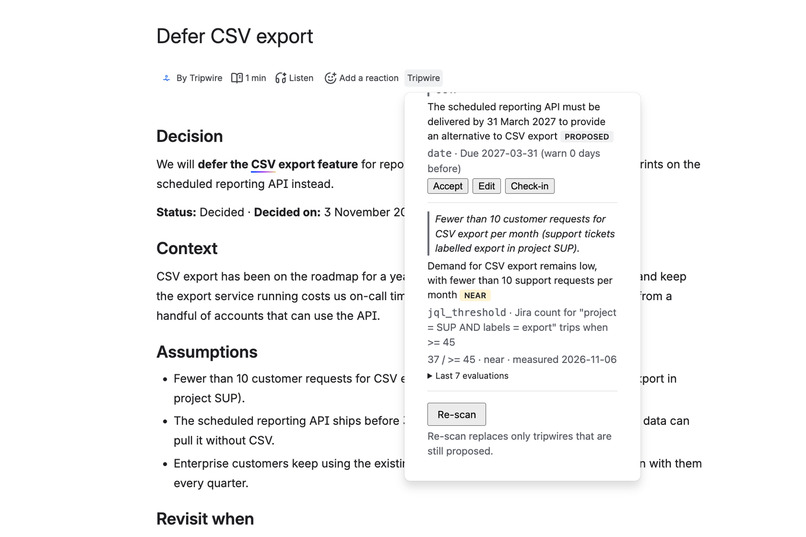
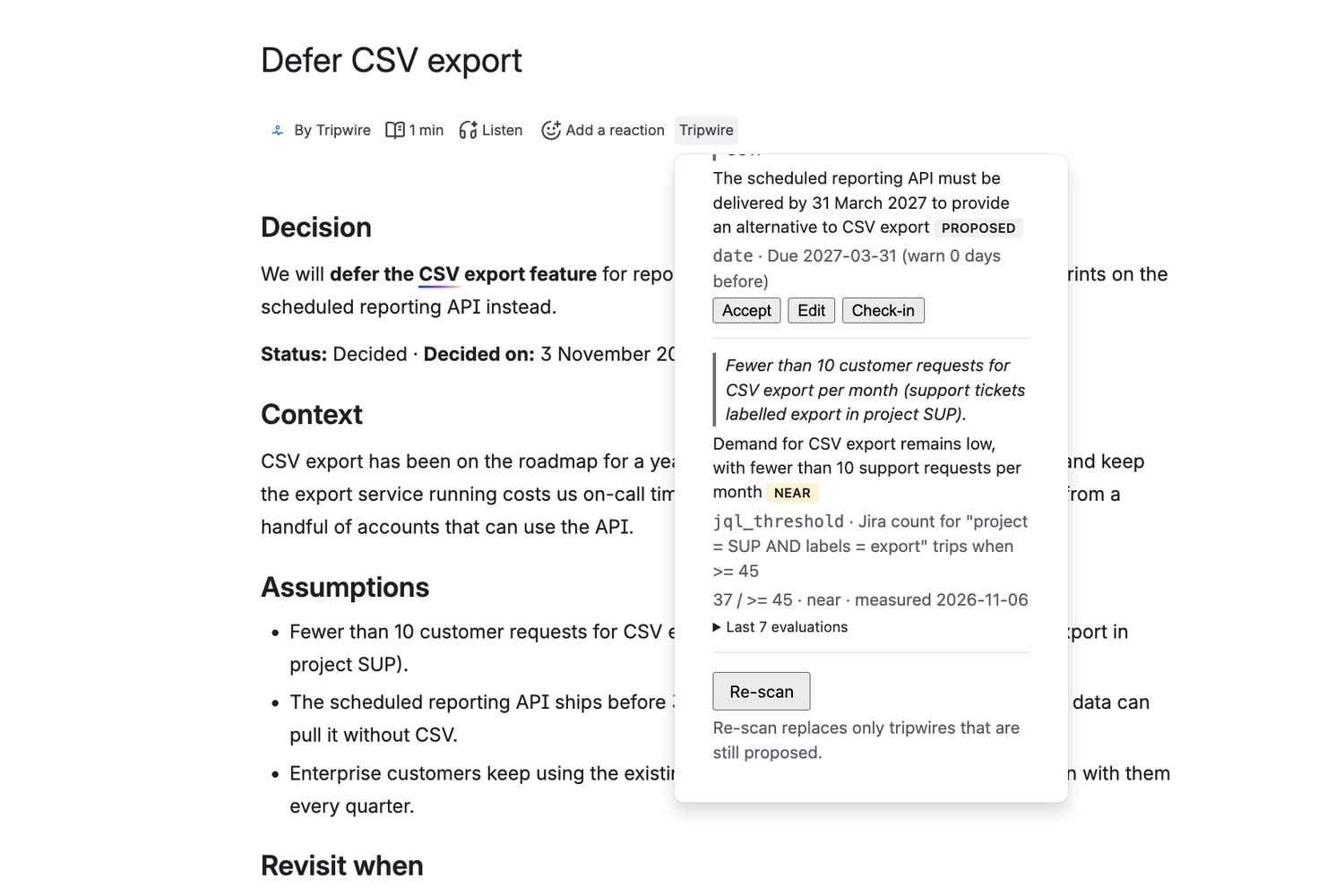
Confluence: the Tripwire panel on the "Defer CSV export" decision shows each assumption's live Jira count vs threshold (37 / ≥ 45, NEAR).
-
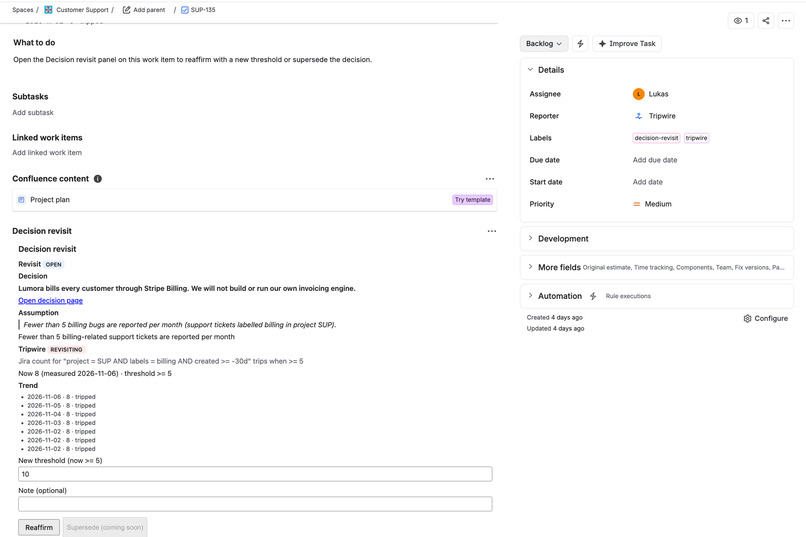
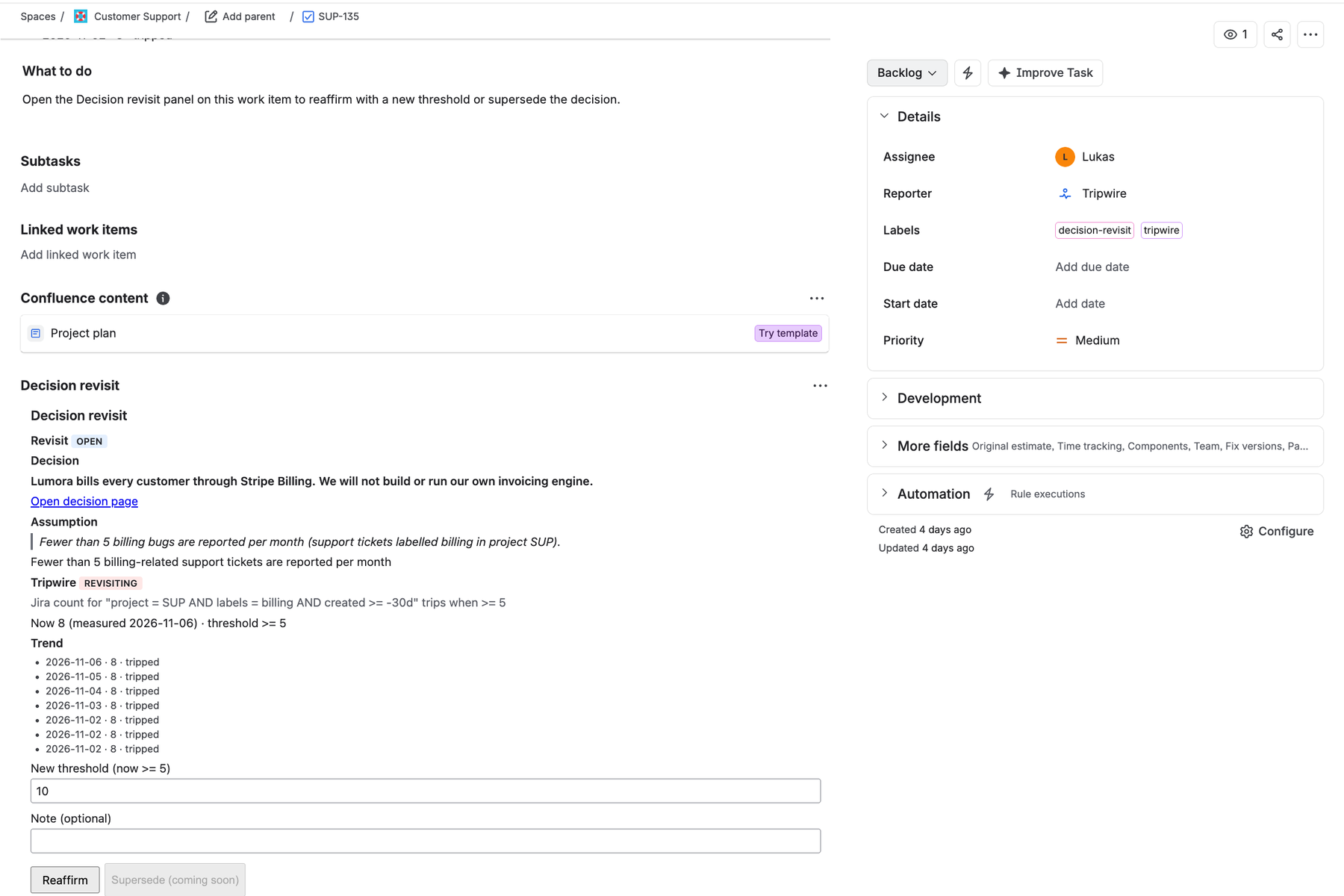
Jira: the "Decision revisit" panel on Revisit task SUP-135 shows the broken assumption, now-vs-threshold evidence and the trend.
-
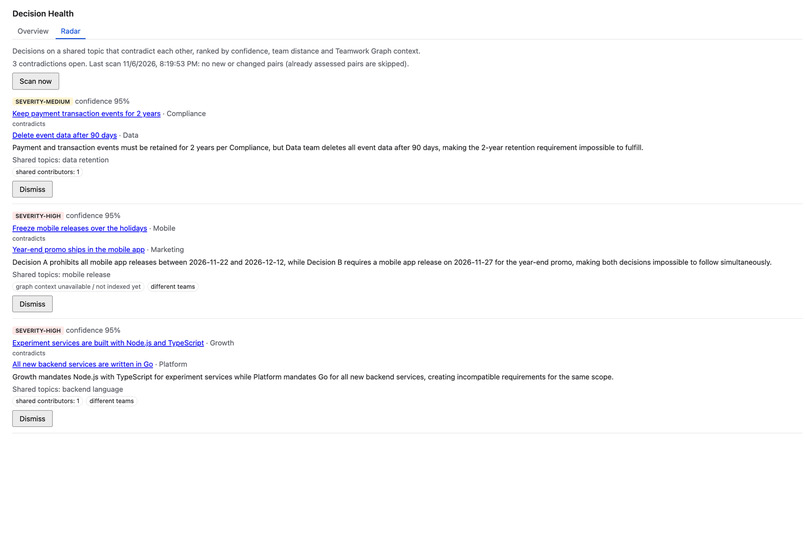
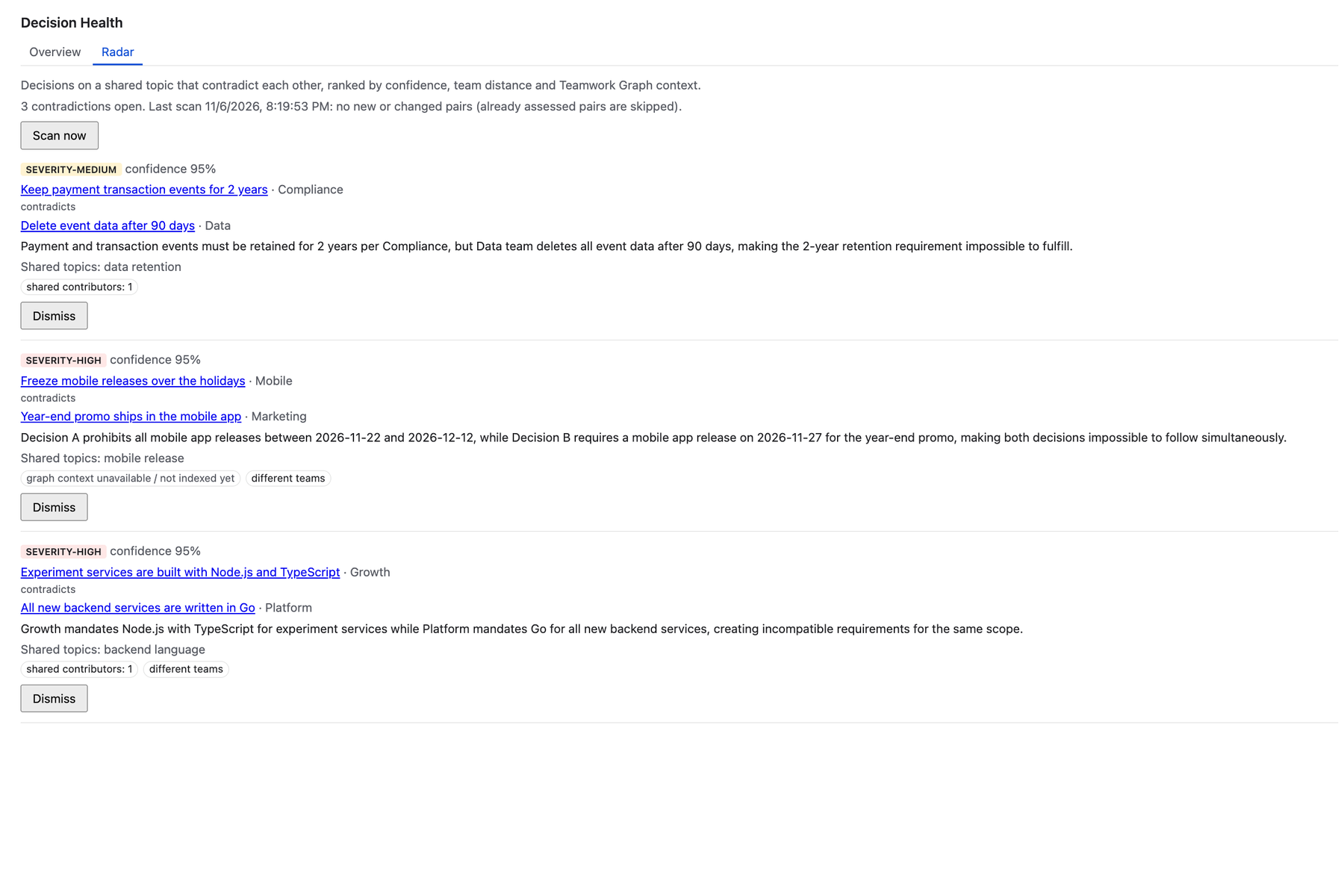
Decision Health Radar ranks contradicting decisions across teams by severity, with Teamwork Graph context (shared contributors, teams).
-
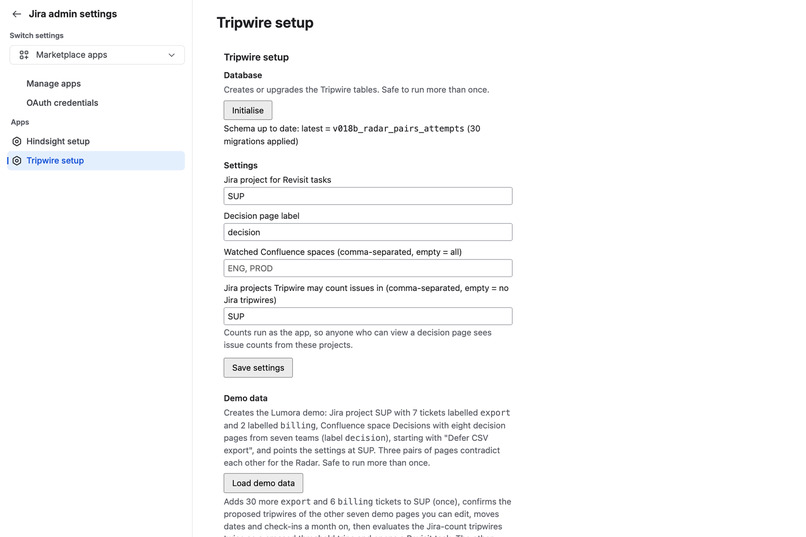
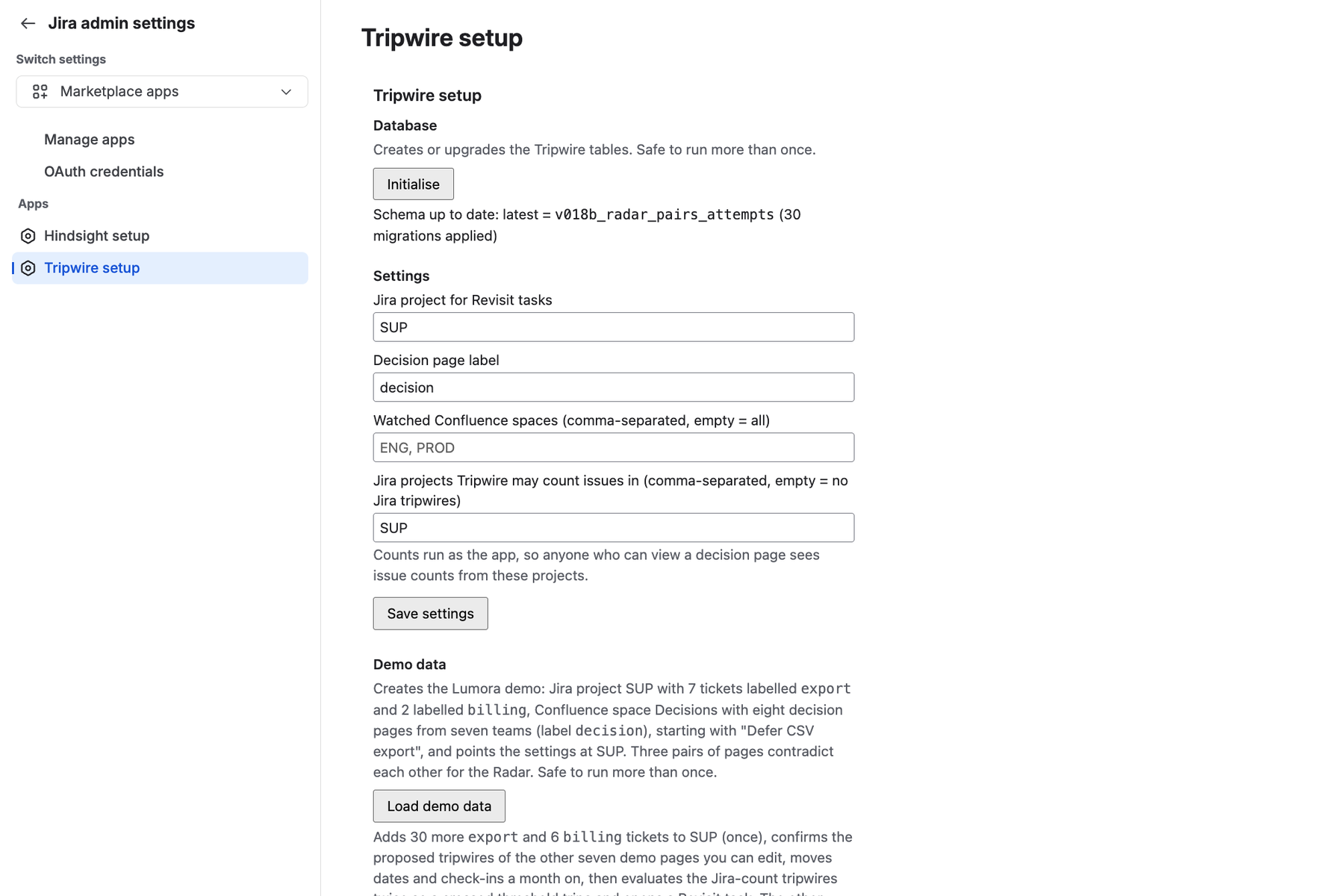
Tripwire setup in Jira admin: Revisit project, decision label, watched spaces and the Jira projects tripwires may count.
-
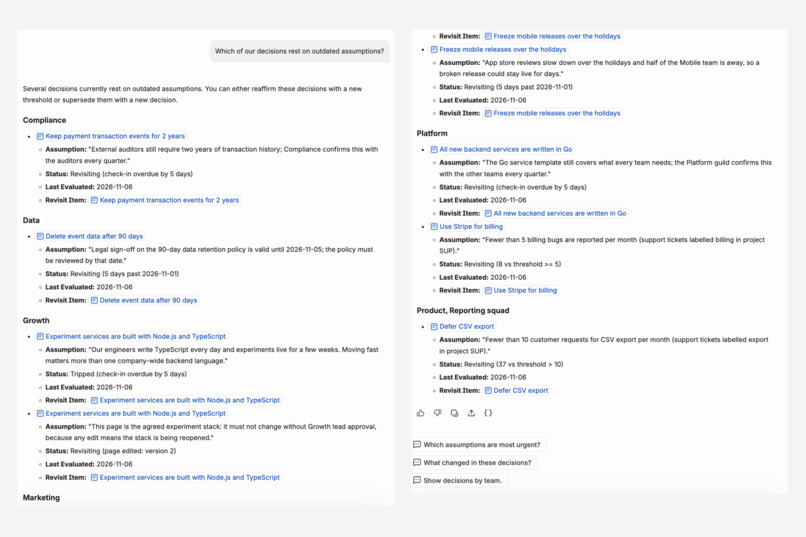
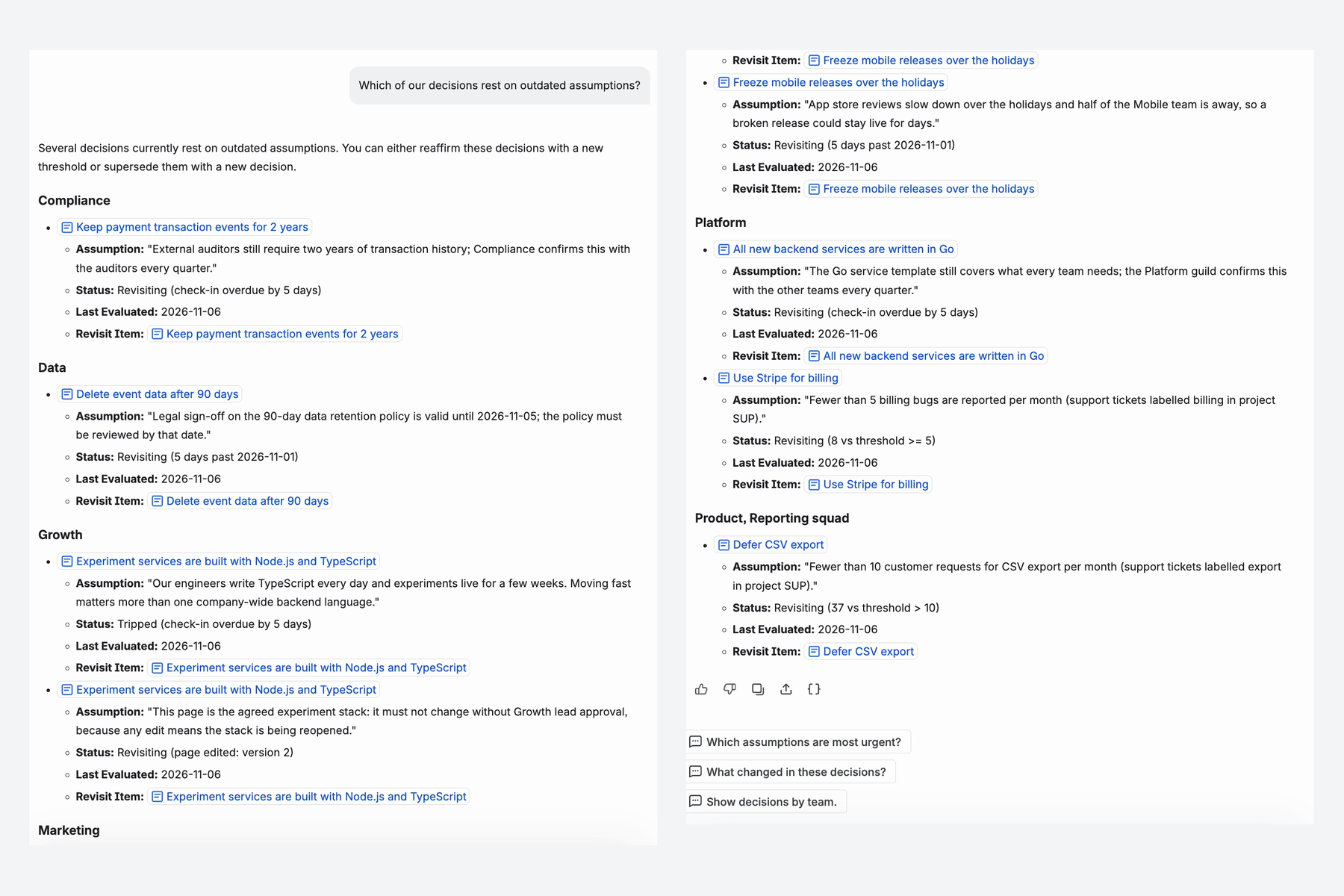
Rovo's Decision Steward agent answers "Which of our decisions rest on outdated assumptions?" by team, with status and reason.
Inspiration
Teams write decisions down, but rarely the conditions under which those decisions stop being right. "We'll defer CSV export because fewer than 10 customers a month ask for it" quietly becomes wrong a few months later, and nobody notices until it hurts. Meanwhile two teams that never talk make opposite calls on the same topic. We wanted decisions to carry their own expiry conditions, set by data instead of by the calendar.
What it does
- Reads decisions. Label a Confluence page
decision. Tripwire uses Forge LLM to extract the decision and its assumptions. Every assumption comes with a verbatim quote, and Tripwire checks that the quote really appears on the page. - Turns assumptions into checks. Each assumption becomes a trigger: a Jira query threshold, a date, a scheduled check-in, or a page change. JQL is limited to an allowlist of fields and to projects the admin has approved.
- Keeps a human in the loop. Nothing goes live until the decision owner clicks Accept.
- Evaluates daily, without noise. Query thresholds must trip on two evaluations in a row; dates, check-ins and page changes trip on one. At 80% of the threshold a check is shown as "near", but no task is created.
- Reopens the decision. When a check trips, the owner gets one Revisit task in Jira per decision (idempotent, never duplicated). The issue panel "Decision revisit" shows the evidence and the trend. Reaffirm with a new threshold, "Still true", or "Mark date handled" closes the task as Done.
- Contradiction Radar. Decisions on the same topic are compared pairwise by the LLM (up to 20 pairs per scan). Severity goes up when the decisions come from different teams with no shared contributors, using page contributors from Teamwork Graph when available, otherwise page labels; each card also shows the team that owns the decision space, read from Teamwork Graph.
- Rovo agent "Decision Steward". Ask Rovo which decisions have tripped. The answer uses real data, filtered to the pages the asking user can view, and fails closed.
How Tripwire differs from Ripple (our other Codegeist entry): both read the owning team of a Confluence space from Teamwork Graph, but for different jobs. Tripwire shows that team as context on a decision it is about to reopen; Ripple uses it to route a drifted copy of an official fact to the people who must fix it. Tripwire watches whether the assumptions behind a decision still hold; Ripple watches whether restated facts still match their canonical source.
How we built it
- Atlassian Forge app: Confluence (required) and Jira (optional), one installation link.
- Forge LLM (
@forge/llm, Claude Haiku 4.5) with a forced tool call for structured extraction and contradiction scoring. Page content is passed as data, never as instructions, to resist prompt injection. - Scheduled trigger plus Forge queues for daily evaluation, demo setup and long jobs, with progress shown in the UI.
- Forge SQL stores decisions, triggers, evaluations and Tripwire's own relationships (rests-on, invalidated-by, contradicts, superseded-by).
- Teamwork Graph, read-only, via
requestTeamworkGraphas the viewing user:atlassianTeamsBySpacegives the team that owns each decision space (shown as context on the Radar), andconfluencePageContributorsplusatlassianUserInTeamsare tried as a best-effort upgrade for cross-team severity. Every query logs raw edge counts, null nodes and GraphQL errors. - Rovo
rovo:agentwith thelist-trippedaction. - Permission checks: the user must be able to edit the page before scan, Accept or Reaffirm.
- No egress outside Atlassian: the manifest declares no external fetch or remote, so the app runs entirely on Atlassian Forge and no data leaves Atlassian.
Challenges we ran into
- Trusting LLM output. Free-form extraction can invent assumptions or produce unsafe JQL. We force a tool call, require verbatim quotes that we verify against the page, restrict JQL to an allowlist, and require owner acceptance.
- Alert fatigue. A check that fires on every blip gets ignored. Hence two consecutive evaluations for thresholds and a "near" state that never creates tasks.
- Teamwork Graph is in preview and read-only. We keep our own relationships in Forge SQL and use the graph only for team context. Newly created pages may not be indexed yet; the UI then says "graph context unavailable / not indexed yet" instead of guessing. In testing, user nodes from the contributor queries came back null on our dev site while team-by-space queries worked, so Tripwire treats contributors as best-effort and labels every chip with its real source. We reported the null user nodes returned by the Teamwork Graph curated queries to Atlassian, with a reproduction on two sites: https://community.developer.atlassian.com/t/teamwork-graph-confluencepageowners-always-returns-a-null-user-node-non-null-violation-contributors-partially-null-atlassianteamsbyspace-works/103766
- Demo time travel. Jira's
createdfield can't be backdated, so "Simulate a busy month" creates 30 real tickets and advances Tripwire's clock, letting the threshold trip for real.
Accomplishments that we're proud of
- An end-to-end loop from a Confluence page to an accepted check, a tripped Revisit task in Jira, and a Reaffirm that closes it.
- Every extracted assumption is traceable to a verbatim quote on the page.
- Judges can reach a working demo in a few clicks: Initialise, Load demo data, Simulate a busy month, Reset demo. Each is a single-click queued job with visible progress.
- The Rovo agent and the Radar respect user permissions and fail closed.
What we learned
- Constraining an LLM to a small set of trigger types and a forced schema matters more than prompt cleverness.
- Being honest in the UI about missing graph data builds more trust than filling the gap.
- Anti-noise rules are a product feature, not a tuning detail.
What's next for Tripwire
- Evaluate
graph_relationtriggers (already designed, not yet evaluated). - A Supersede flow that links the old and new decision.
- More trigger sources beyond Jira and dates.
Install and demo
- Installation link (Confluence + Jira): https://developer.atlassian.com/console/install/8d1eb26f-a9da-4d4e-81f3-1b2bf96a1726?signature=AYABePh55qyEGpc0%2Fds8A8ogu4MAAAADAAdhd3Mta21zAEthcm46YXdzOmttczp1cy13ZXN0LTI6NzA5NTg3ODM1MjQzOmtleS83MDVlZDY3MC1mNTdjLTQxYjUtOWY5Yi1lM2YyZGNjMTQ2ZTcAuAECAQB4CxqLTo9l4lqXuFjNim1xJM%2Bp%2F3TVP9xHS2BrU5DRRucB821x7TGad46AHAtPDliFjQAAAH4wfAYJKoZIhvcNAQcGoG8wbQIBADBoBgkqhkiG9w0BBwEwHgYJYIZIAWUDBAEuMBEEDLvC5ST3gLEH92lsngIBEIA7cbPU1q98Os1y38UWZN7zkrc1MCmZXpQM41Y0dDYGSQhu%2FUjkXd14IeOnQp09SzzP0avUGDDGvqWNa8cAB2F3cy1rbXMAS2Fybjphd3M6a21zOmV1LXdlc3QtMTo3MDk1ODc4MzUyNDM6a2V5LzQ2MzBjZTZiLTAwYzMtNGRlMi04NzdiLTYyN2UyMDYwZTVjYwC4AQICAHi9bVMAkme4qVQX1fQHo6ePw3H40A7cGfz7yrmSfBWMXgFVg1e0wH18fS53qAGf8iU8AAAAfjB8BgkqhkiG9w0BBwagbzBtAgEAMGgGCSqGSIb3DQEHATAeBglghkgBZQMEAS4wEQQMmo2pAo8MSCrnkSI%2BAgEQgDsWI4r3n1qXSnTtWGVJmJz15MZ%2BLNmG1gdP4P%2BGfq95VJJbZs%2F44WB8x%2F%2BbM51wrnRDS3FsOvkNtCfstwAHYXdzLWttcwBLYXJuOmF3czprbXM6dXMtZWFzdC0xOjcwOTU4NzgzNTI0MzprZXkvNmMxMjBiYTAtNGNkNS00OTg1LWI4MmUtNDBhMDQ5NTJjYzU3ALgBAgIAeDYASx0XCjkny4iLV6vz%2BKtEGSGT6kdt0QRpkn6D%2FlVEAbJjkaSsnPr1PTXtQd95ln0AAAB%2BMHwGCSqGSIb3DQEHBqBvMG0CAQAwaAYJKoZIhvcNAQcBMB4GCWCGSAFlAwQBLjARBAxnoRQiFh%2BL9NrL7P4CARCAO6F%2BpoBFH2j3v7u4grdBUh7%2B1VEZN27Nh8IpgNOclYHEuXd%2Bkgqmb4RYPgTJmsbLmqkqbVGn%2BvnvSCHrAgAAAAAMAAAQAAAAAAAAAAAAAAAAAGZ8cXyI87SIFpu6R9BDndf%2F%2F%2F%2F%2FAAAAAQAAAAAAAAAAAAAAAQAAADLebku2wJgkhNhUZxuTszZOfoyl6nr%2FOkoVeMbKY3wgBk75gUCu%2FBRkwtkNE%2BBSdhZS59vcROKYMp25NoBIHIdtoUY%3D&product=confluence&product=jira
- Repository: https://github.com/Akar-Samudra-Artifisial/Tripwire
- Video: https://youtu.be/r-HCGx84g60
Installing requires an organization admin, because Tripwire reads Teamwork Graph. To see the owning team on the Radar, link the decision space to a team (Teams, Team links, Add Confluence space).
Demo in 5 steps:
- Install Tripwire on your site (Confluence and Jira) using the link above.
- In Jira, open Settings → Apps → Tripwire setup and click Initialise. The page shows progress.
- Click Load demo data. This creates the fictional company Lumora: 8 decision pages, 7 teams, Jira project SUP, and 3 contradicting decision pairs.
- In Confluence, open Defer CSV export in the Decisions (DEC) space and click Accept on its tripwire.
- Back in Tripwire setup, click Simulate a busy month (30 tickets plus a clock advance). Open the Revisit task in project SUP to see the evidence panel, try Reaffirm, then check the Contradiction Radar and ask Rovo's Decision Steward which decisions have tripped. Reset demo clears everything.
How Tripwire differs from TraceGuard
TraceGuard and Tripwire are both our submissions to Codegeist 2026. They solve different problems for different people.
| Tripwire | TraceGuard | |
|---|---|---|
| Problem | Decisions going stale when their assumptions stop holding | Compliance traceability (requirement → design → code → test) |
| Users | Business and product teams | Software teams in regulated industries (e.g. medical devices) |
| Products | Confluence + Jira, no Bitbucket | Jira, Confluence and Bitbucket (PR checks) |
| Technique | LLM extraction with verified quotes, scheduled triggers, Contradiction Radar, Teamwork Graph reads, Rovo agent | Trace-chain checks and Bitbucket pull-request checks |
| Category | Apps for Business Teams | Apps for Specialized Industries |
Independent codebases: no domain code, data model or UI is shared between the two apps; only Forge boilerplate (project scaffolding, .gitignore) is reused.
Bonus prize justification
Best Agents - Rovo/Assignable agents. Tripwire ships a rovo:agent "Decision Steward" with the list-tripped action. It returns real tripped decisions, filtered to the pages the user can view, and fails closed.
Also uses Teamwork Graph (read only). Tripwire consumes data from the Teamwork Graph API: it calls requestTeamworkGraph as the user with the curated queries atlassianTeamsBySpace (owning team of each decision space), with confluencePageContributors and atlassianUserInTeams as a best-effort upgrade to find whether two contradicting decisions come from different teams with no shared contributors, which raises the Radar's severity. Access is read-only; Tripwire's own relationships stay in Forge SQL, and only aggregate numbers are stored.
Built With
- atlassian-forge
- claude-haiku-4.5
- confluence
- custom-ui
- forge-llm
- forge-queues
- forge-sql
- jira
- react
- rovo
- scheduled-triggers
- teamwork-graph
- typescript
