-
-
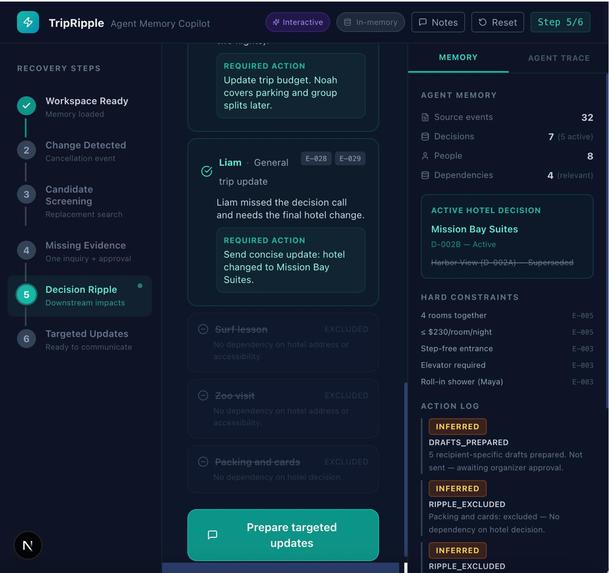
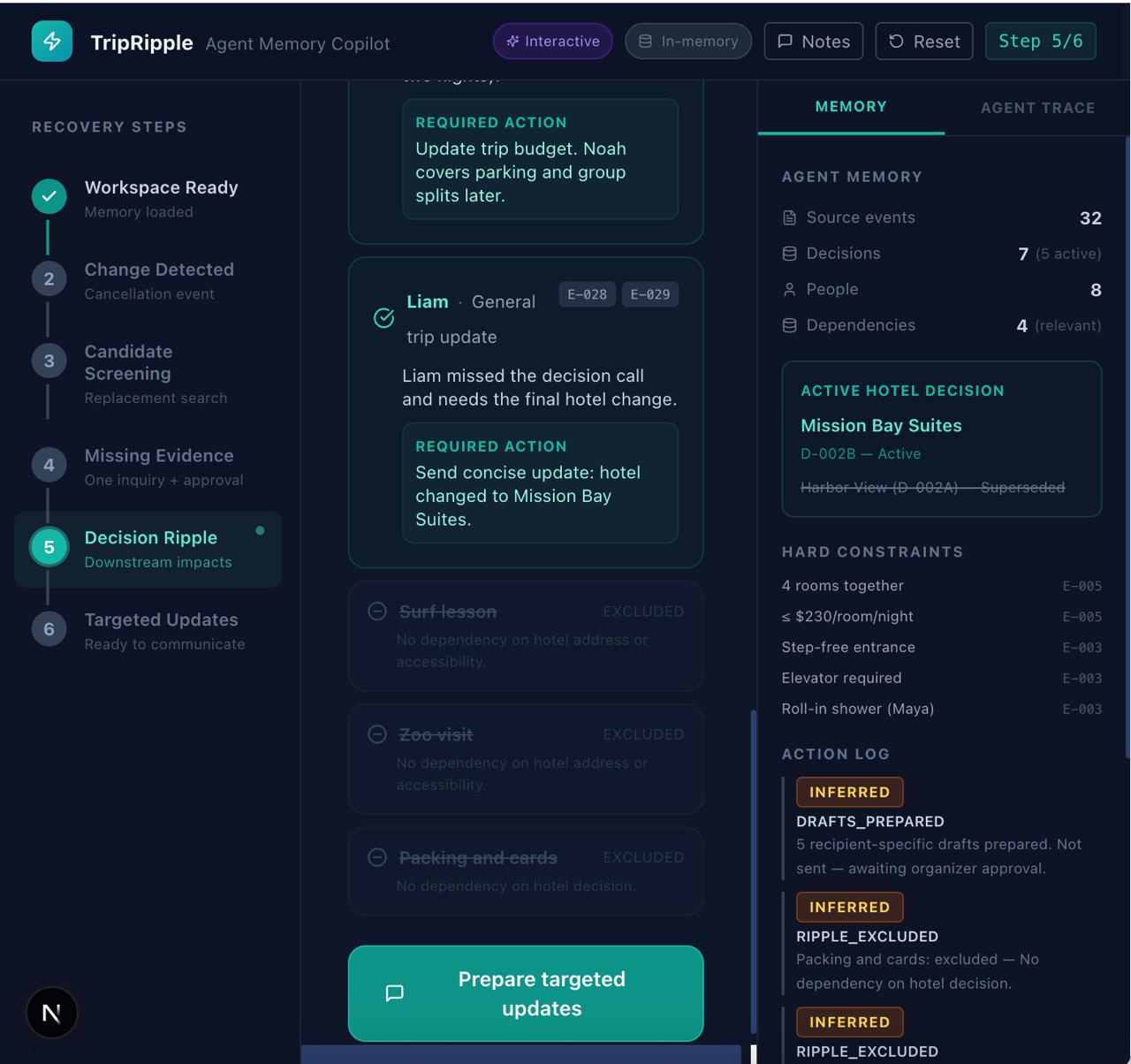
TripRipple traces a hotel change, identifies five affected plans, and excludes three distractions.
https://rawweights.com/usecase/tripripple.html
Inspiration
Group trips are planned across scattered emails, chats, documents, and calls. When one important detail changes, such as a hotel cancellation, the organizer must reconstruct old decisions, remember everyone’s requirements, determine which plans are affected, and contact the right people.
We built TripRipple to give an agent reliable memory of those decisions and help the organizer recover without losing context, overlooking accessibility needs, or sending unnecessary messages.
What it does
TripRipple is an agent-memory copilot for disruption recovery.
Our demo follows a San Diego group trip after the selected hotel cancels. TripRipple:
- Loads 32 source events and seven structured decisions from trip memory.
- Recovers the active hotel decision and the evidence behind it.
- Applies hard constraints such as price, room count, elevator access, a step-free entrance, and a roll-in shower.
- Screens replacement hotels before contacting anyone.
- Rejects two unsuitable properties with zero unnecessary outreach.
- Identifies one missing fact and asks one focused question.
- Keeps the original hotel active until the organizer approves the replacement.
- Preserves the superseded decision and its rationale as an audit trail.
- Finds five affected downstream plans while excluding three unrelated activities.
- Prepares recipient-specific updates without automatically sending them.
Every important fact is marked with provenance such as cached API response, synthetic event, inference, or human confirmation.
-How we built it
TripRipple is a Next.js and React application written in TypeScript and styled with Tailwind CSS.
We used Mastra to model the recovery process as a multi-step workflow with suspend-and-resume checkpoints for missing evidence and organizer approval. Elasticsearch provides structured memory for source events, decisions, constraints, people, and plan dependencies, with an in-memory fallback for demonstrations.
The hotel layer supports an Amadeus-compatible search flow and clearly labeled cached responses for reliable demos. A deterministic evaluation engine applies hard requirements so the AI cannot casually ignore accessibility or budget constraints.
OpenRouter powers interactive memory questions and event classification when credentials are available. The app also includes an interactive constraint editor, workflow trace, provenance badges, action logs, and targeted communication drafts.
-Challenges we faced
The biggest challenge was designing memory that records not only facts, but also decision state, evidence, ownership, dependencies, and supersession history.
We also needed to distinguish “false” from “unknown.” For example, TripRipple must not assume that a hotel has a roll-in shower simply because other accessibility features are listed. Unknown required information becomes a blocking question.
Another challenge was balancing autonomy with control. The agent can retrieve, evaluate, and draft, but a human must approve the decision before it becomes active. External messages are never sent automatically in the MVP.
Accomplishments that we're proud of
- Two hotels are rejected before any outreach.
- Only one focused inquiry is required.
- Hard constraints are evaluated deterministically.
- Five affected plans are found and three distractors are excluded.
- Five audience-specific updates are prepared.
- Superseded decisions remain traceable.
- Every important claim includes provenance.
- The estimated workflow falls from 51 manual minutes to approximately three minutes.
What we learned
Agent memory is more useful when it behaves like an evidence-backed decision system rather than a chat transcript.
We learned that strong agent workflows combine language models with structured state, deterministic checks, explicit uncertainty, provenance, and human approval gates. The model helps interpret context, while code enforces critical rules.
What's next
Next, we plan to add durable production storage, real email and chat connectors, live travel inventory, role-based permissions, automated evaluations, and approved message delivery. The same memory and ripple architecture can also support project management, procurement, scheduling, incident response, and compliance workflows.
Built With
- amadeus
- anthropic
- api
- css
- elasticsearch
- lucide
- mastra
- next.js
- node.js
- openrouter
- react
- tailwind
- typescript
- zod

Log in or sign up for Devpost to join the conversation.