-
-
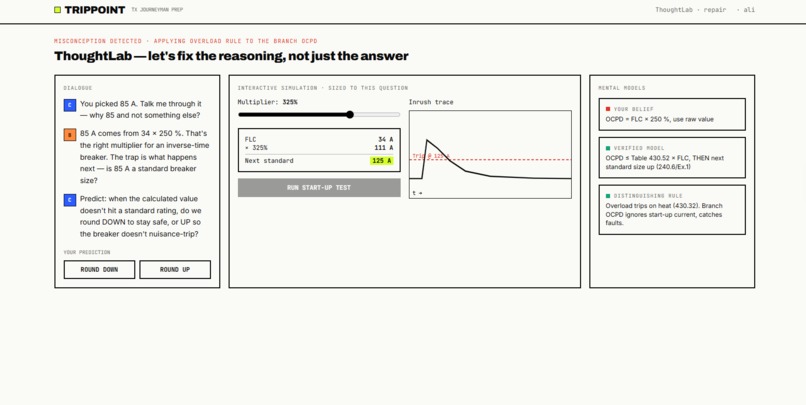
main page
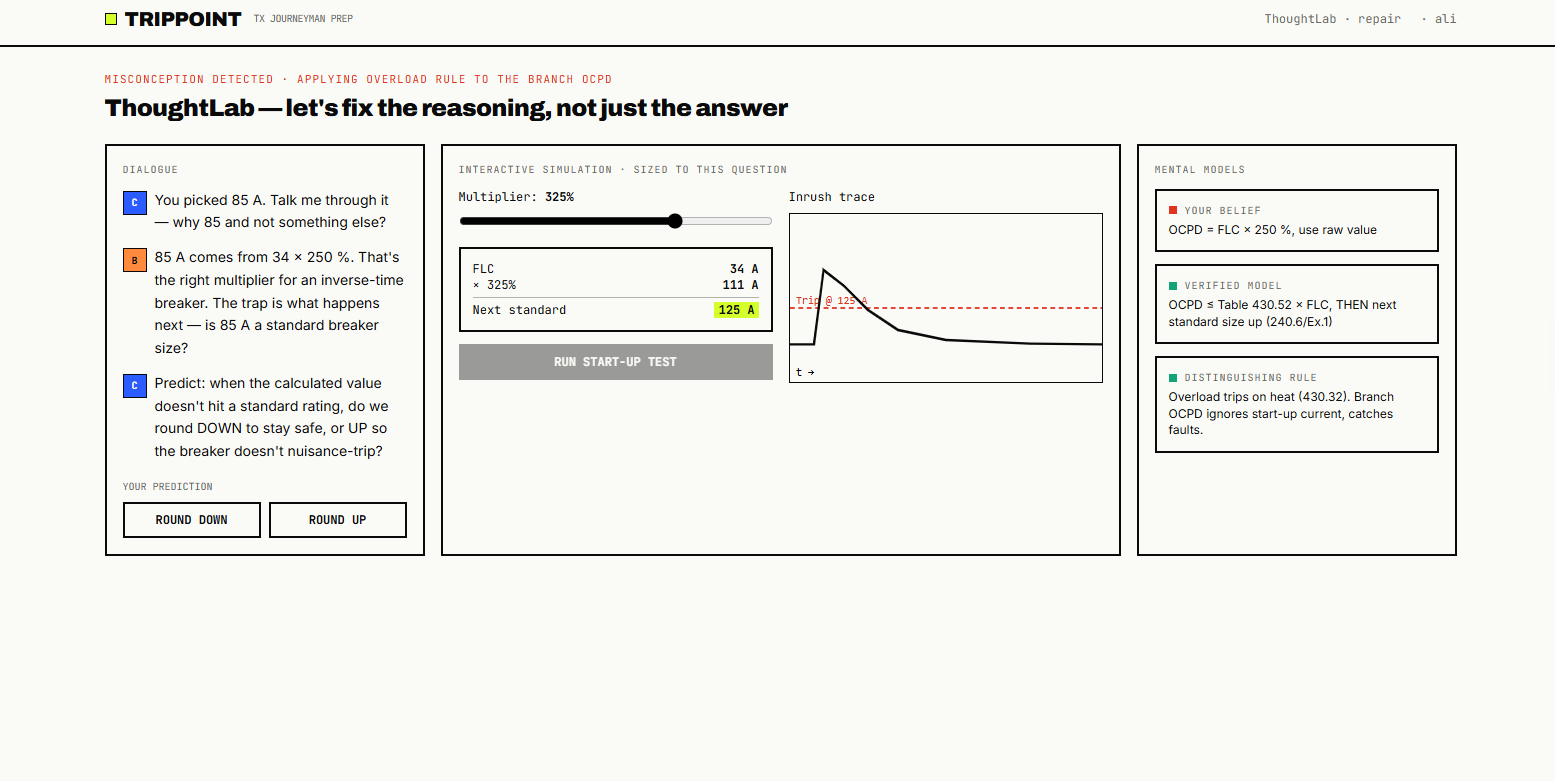
TripPoint Inspiration
I spent six years as an electrical engineer in oil and gas and mining. Long before that, I was a student who could repeat definitions I didn't actually understand, and when I got stuck, I did what everyone does: opened more videos, more PDFs, more explanations. The content was never the problem. The problem was a lack of a system to make me visualize the implications of every wrong assumption I made.
In the field, the stakes of that gap change. An electrician who misunderstands how a circuit gets energized doesn't fail a quiz, they follow the wrong isolation procedure on real equipment.
Texas made the problem easy to measure. About 70,000 electricians work there, and in FY2025 only 27.5% of Journeyman exam attempts passed. Calculations passed at 20.6%. NEC passed at 24.5%. Industrial passed at 15.7%. Every failed attempt is months of delayed licensure and lost wages in a trade the country is already short 80,000 workers for.
So we asked a simple question: what if exam prep could teach you using your own mistakes, by helping you visualize the implications and walking you through it until you actually understand it?
What it does
TripPoint is a visual exam prep tool for the Texas Journeyman Electrician exam, built around two topics: Motors and Generators, and Control Devices and Disconnecting Means.
You start with a real exam-style question. Get it right, and TripPoint keeps it short: quick feedback, then a fresh question testing the same idea, no hand-holding. Your time isn't wasted on things you already know.
Get it wrong, and that's where TripPoint actually starts working. It asks you to explain your thinking, then rebuilds the circuit you were picturing in your head. Before you see the correct version, you have to commit to a prediction: what do you think happens next? Then TripPoint shows you the real, verified circuit behavior side by side with yours, so the gap is obvious in seconds. You write what you now believe, in your own words. Then a brand new question tests it, with no help this time. Only a correct answer marks the misconception as fixed.
Most tools stop at telling you the right answer. TripPoint finds the idea in your head that produced the wrong one, and doesn't move on until you've actually fixed it. The full working example right now is a three-wire motor-control circuit: press Start, the motor runs; release Start, it keeps running; press Stop, it stops. Most learners picture that middle step wrong. TripPoint shows them exactly where their mental models break. The video below shows this happening live, from a wrong answer to a repaired one.
How we built it
TripPoint is built with Next.js, React, TypeScript, Tailwind, and Zod, with the circuit diagrams as native React SVG components rather than AI-generated images. All model calls run through server-only routes. No API credential or model SDK ever reaches the browser, and if the live service is slow or unavailable, TripPoint falls back to a reviewed, deterministic fixture path so a lesson never breaks mid-session.
The most important decision we made was where to draw the line between the AI and the truth. The AI mentor is only allowed to read your explanation, guess what you were thinking, and ask a good follow-up question. It is never allowed to decide what the correct answer is, change how the circuit works, calculate anything, or decide whether you actually fixed your misconception. All of that comes from verified, pre-built content and deterministic code that the AI can't touch. Every piece of data crossing between the AI and the interface gets checked against a strict schema, so a bad AI response can never reach the learner.
We built this with Codex as a full engineering partner, not just a code generator. We wrote an AGENTS.md file as its operating manual: what Texas topics are in scope, what the AI mentor is and isn't allowed to do, what "done" means for a task. For any real feature, we gave Codex a goal, the relevant context, hard constraints, and a clear finish line, then had it plan before writing code. Once the shared architecture was locked, we split work into owned areas (content, the learner interface, the AI mentor, and QA) so agents could build in parallel without stepping on each other. Every feature had to come with passing tests and a working demo before we called it done, and a final QA pass tested the actual release build end to end.
Challenges we ran into
The hardest problem was deciding where AI should and shouldn't be trusted. A model is genuinely good at reading your explanation and figuring out what you were probably thinking. It is not something we're willing to trust with deciding whether an answer is correct, since that's a licensing exam and a real safety question. We solved this by keeping the AI advisory only and putting every consequential fact, like circuit truth, correct answers, and grading, behind deterministic, human-verified code.
Second, we needed the content grounded in the real 2023 NEC without copying it. The code is copyrighted, so we built a pipeline that maps each topic to specific allowed sections, pulls only the relevant piece, and requires every claim to cite its source. If a topic isn't properly grounded yet, it stays labeled as unavailable instead of the app making something up.
Third, we had to design the mentor so it teaches instead of just answering. If it explains everything immediately, you never do the thinking. So the mentor can ask questions and challenge your reasoning, but it's not allowed to reveal the correct circuit behavior until you've committed to a prediction, and it goes silent completely during the transfer question.
Accomplishments that we're proud of
Most exam prep tools stop at telling you the right answer. We're proud that TripPoint doesn't stop there. It finds the specific wrong idea in your head, builds a picture of it, and doesn't let you move on until you've actually rebuilt your understanding and proven it on a new question.
We're also proud that the two working topics are grounded in the real Texas exam outline and the real NEC, not made up content, and that a wrong answer never slips through as "fixed." Only a correct, unassisted transfer answer counts.
What we learned
The biggest lesson was that AI is good at different things than deterministic code, and mixing them up is dangerous. GPT-5.6 is genuinely strong at reading your explanation and figuring out what you were probably thinking, that's real language understanding, not a lookup. But it is not something you want deciding what's true, especially when the truth affects whether someone passes a safety exam. So we kept the model advisory and put every fact that matters behind deterministic, human-verified code.
We also learned that asking someone to predict an outcome before they see it changes how they learn. When you commit to an answer first, seeing you were wrong actually means something. If we'd shown the correct circuit first and explained it, it would have felt like just another slide.
Finally, we learned Codex works a lot better as a real engineering partner than as a one-off code generator. Once we gave it a clear goal, real project context, and a way to check its own work, it planned before building, split independent pieces of the app into parallel work, and could tell us exactly what it had and hadn't verified. That's a different kind of collaborator than "write me a function."
What's next for TripPoint
Right now TripPoint covers two topics. Next, we want to add the rest of the official Texas Journeyman exam outline the same way: real NEC sources, a verified question, a known misconception, and working diagrams for each one.
We're also building out a motor-inrush simulation where you predict what the current will do before running it, the same predict-then-verify idea, just applied to a harder, more realistic scenario.
Longer term, we want to add more exams and license levels, Master Electrician, other states, other trades, and make TripPoint a one-stop practice tool for electricians everywhere, all built on the same engine: find the wrong idea, test it, and prove it's fixed.
Built With
- codex


Log in or sign up for Devpost to join the conversation.