-
-
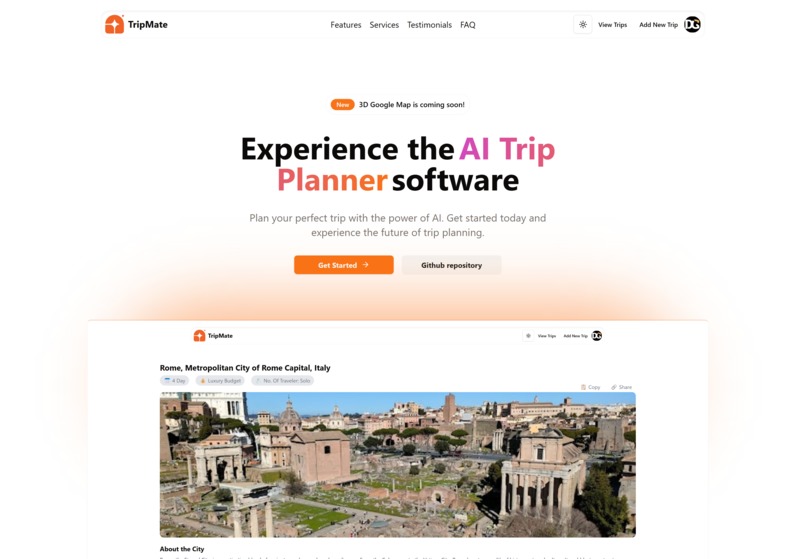
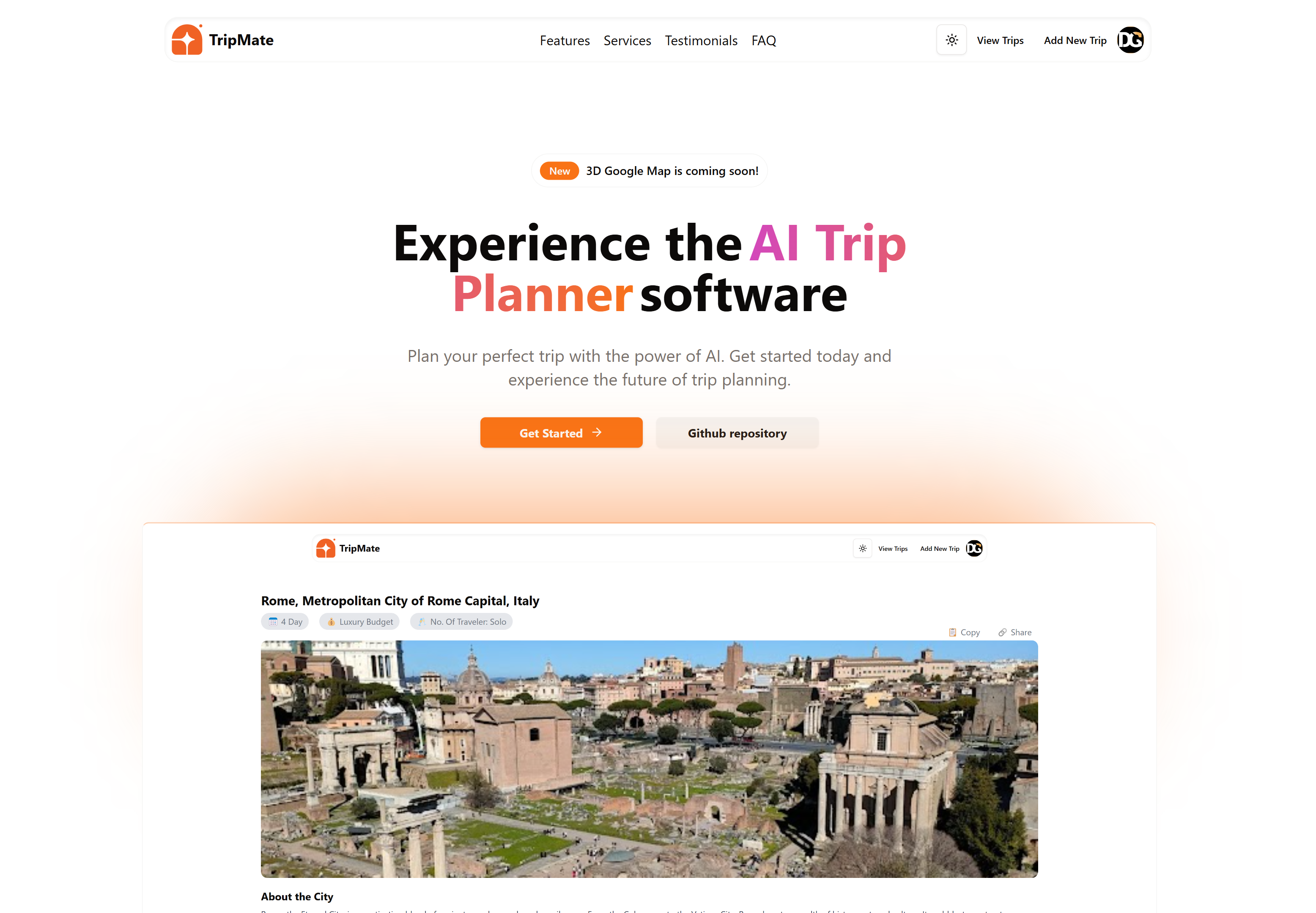
Home page
-
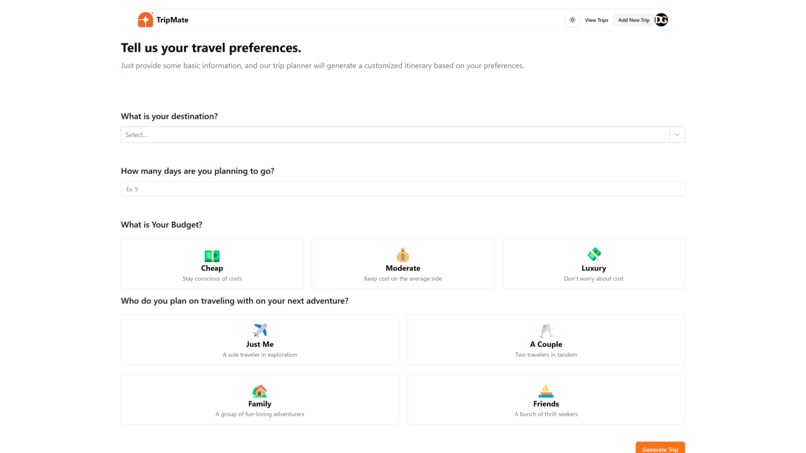
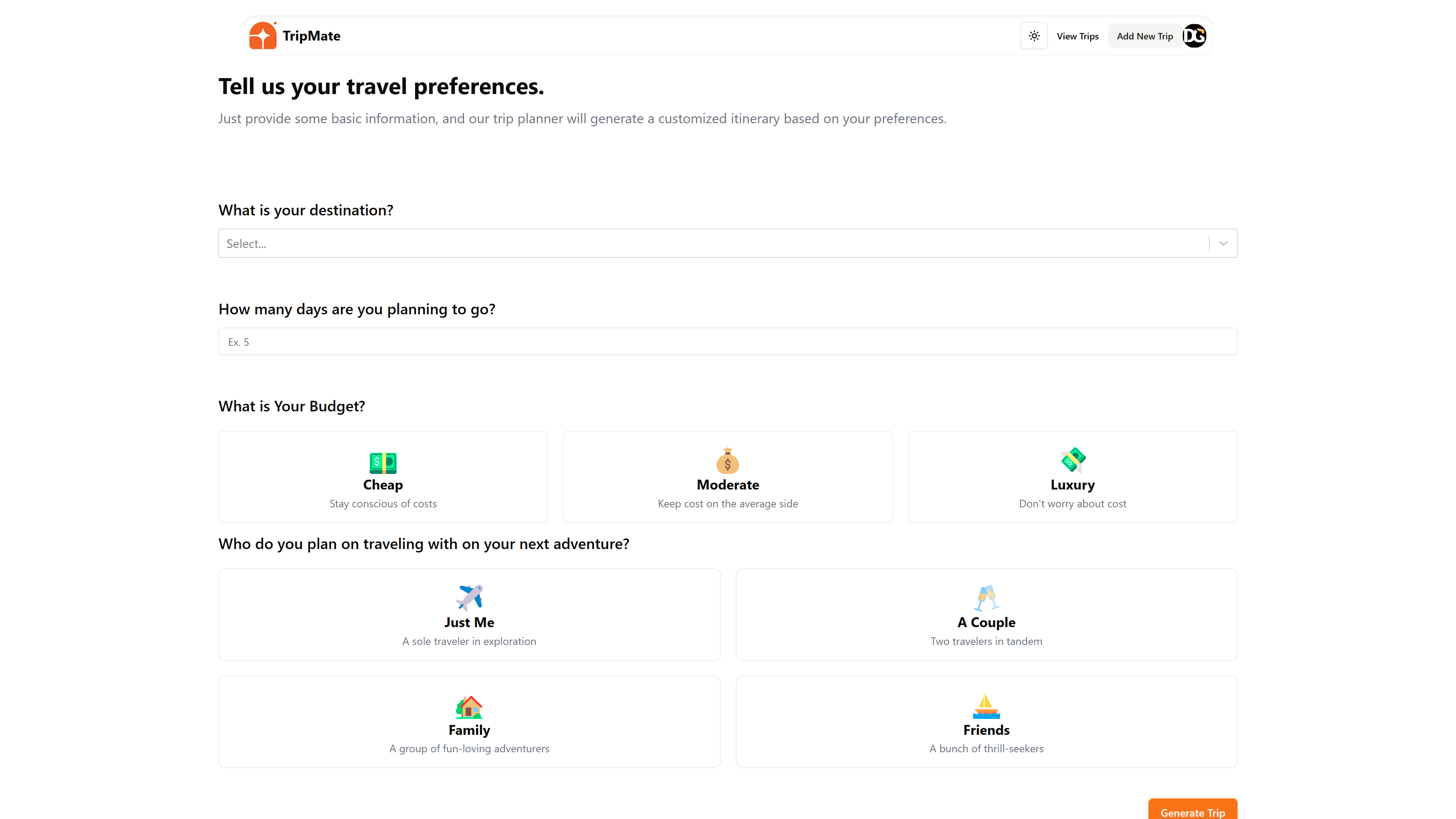
Generate Trip with your preferences
-
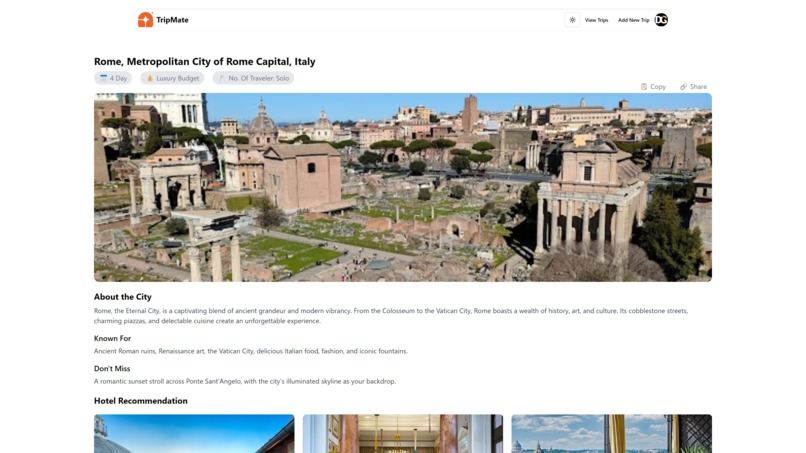
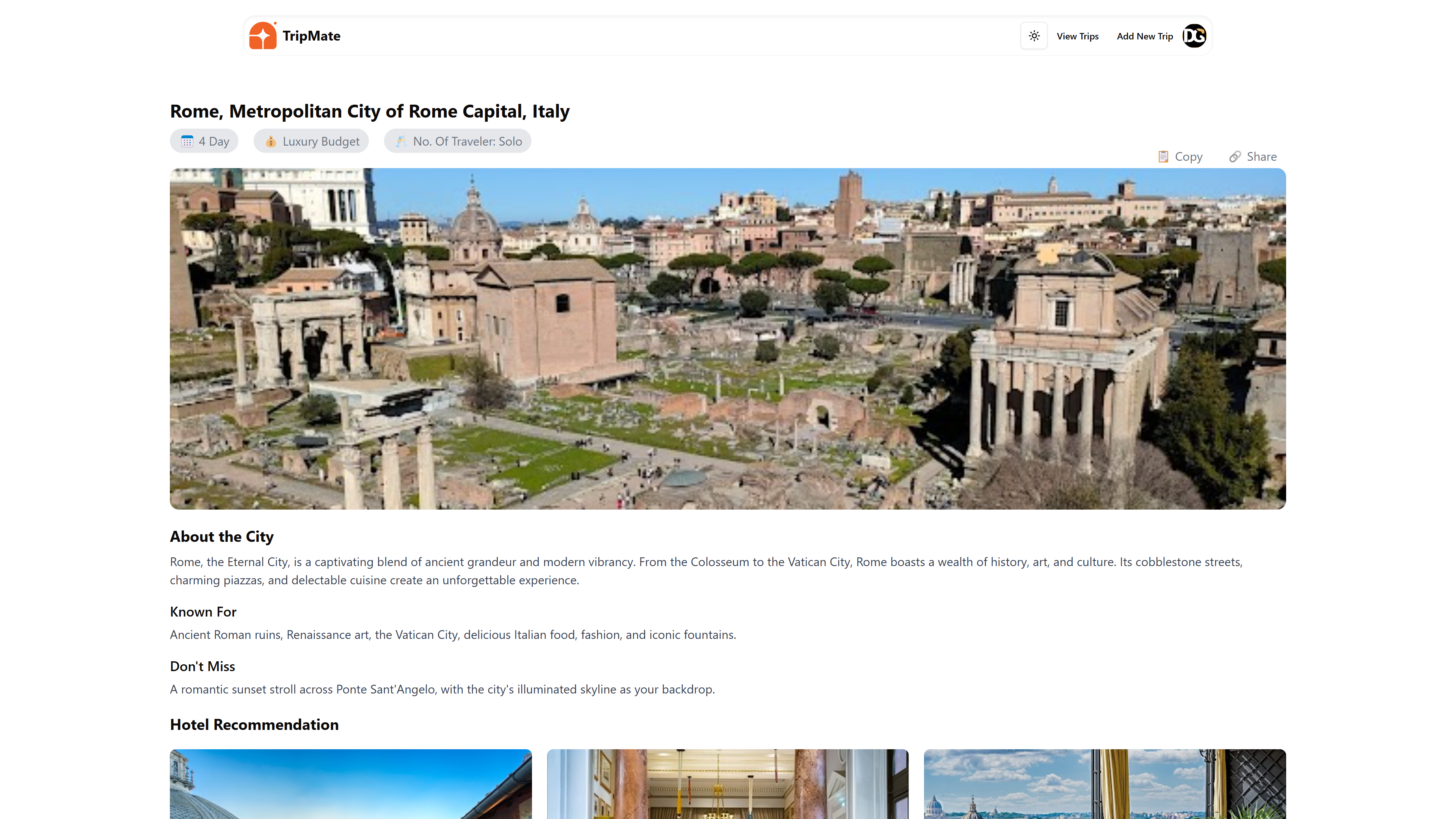
View your Trip details
-
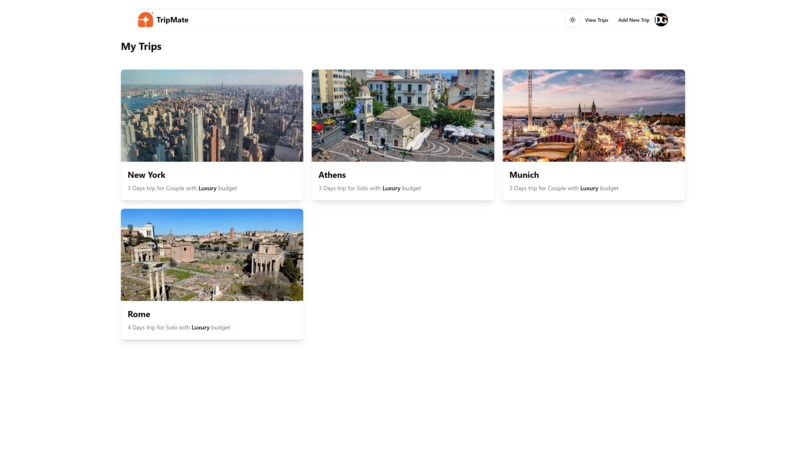
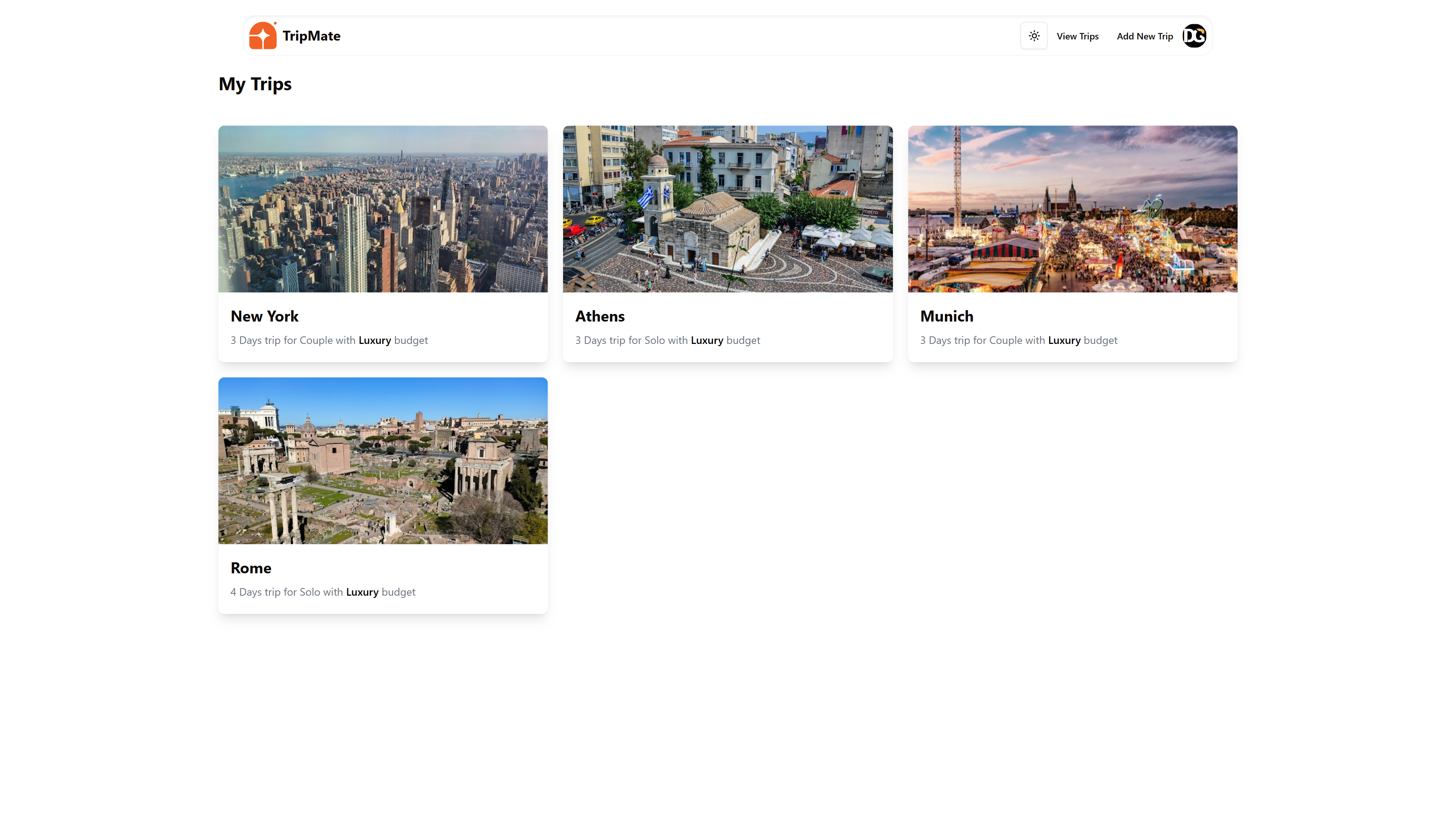
View all your generated Trips
Inspiration
Traveling can be one of the most exciting experiences, but planning a trip can also be incredibly stressful. According to Civicscience.com, 71% of people report feeling stressed about planning a vacation.
Each of our team members has experienced the stress of planning a trip, from finding the best hotels and places to creating an itinerary that maximizes our time and enjoyment. We often found ourselves spending countless hours researching and comparing options, only to feel overwhelmed by the sheer amount of information available.
We wondered, is there a more efficient way to plan a trip that takes the stress out of the process?
What it does
So we built TripMate. TripMate helps you easily plan your trips by providing personalized recommendations based on your preferences. It analyzes your preferences to suggest the best hotels, restaurants, and activities for your trip.
How we built it
We developed TripMate as a mobile-first web application using Vite, React, TypeScript, TailwindCSS, Google Cloud, Google APIs, and Firestore from Firebase for database functionalities. Our development process was strategically divided into three main parts:
Prompt Engineering and A/B Testing: We focused on determining the most effective methods for generating personalized recommendations for new locations. This phase involved critical thinking about what makes a recommendation valuable and how we could enhance the user's exploration experience.
Onboarding Flow: Motivated by our desire to push the boundaries of what AI can achieve, we experimented with using Gemini AI to automate the creation of user profiles during the onboarding process. We were pleasantly surprised by the accuracy of the AI's output.
User Interface and Experience: We designed an intuitive and user-friendly interface that makes it easy for users to input their preferences and receive personalized recommendations.
"My Trips" Feature: The final touch was the addition of the "My Trips" feature, where users can generate trips, save them, and share them with their friends. This feature not only fosters user engagement but also allows us to continuously improve our recommendations.
Challenges we ran into
We encountered several challenges during the development of TripMate:
Accurate Location Descriptions and Recommendations: One of the primary challenges was using Gemini AI to generate accurate descriptions of locations, as well as recommendations for hotels and places to visit. To address this, we utilized Google AI Studio, experimenting with various prompts, models, and parameters. This iterative process allowed us to refine our prompt engineering approach, ensuring that the AI-generated content met the unique needs of our application.
Finding Real Photos: Another significant challenge was sourcing real photos for the locations and recommendations generated by the AI. We needed to ensure that the images were not only relevant but also high-quality and up-to-date.
Providing Accurate Google Maps Locations: Ensuring that users received the correct Google Maps locations for their destinations was crucial for the usability of our app. We faced difficulties in accurately mapping the AI-generated recommendations to precise Google Maps locations. To overcome this, we implemented a thorough validation process, cross-referencing multiple data sources to ensure the accuracy of the location information provided to users.
Helpful Information: Lastly, we faced the challenge of presenting AI-generated content in a user-friendly manner. It was crucial to display information helpfully without being overwhelming or overly directive. Our solution was to utilize Gemini AI to generate probabilistic outcomes, providing users with suggested actions based on the provided data.
These challenges required innovative solutions and a collaborative effort from our team, ultimately leading to a more robust and user-friendly application.
Accomplishments that we're proud of
One of our key achievements with TripMate is the creation of an application that resonates not only with us but also with our beta testers (my friends), who were able to try it firsthand during development. The seamless integration with Google accounts enabled immediate accessibility, allowing users to effortlessly begin using TripMate. We are particularly proud of how we have effectively combined Google Gemini AI to generate accurate results and used the Google Places API to show real images.
The onboarding process, designed to be seamless and almost magical, has been a standout feature, simplifying user interaction while employing sophisticated AI technology. Our commitment to using only Google services has not only streamlined operations but also ensured that TripMate remains a robust tool for anyone deeply integrated into the Google ecosystem.
Lastly, we are proud of our commitment to adding a dark mode, enhancing the user experience by providing a visually comfortable option for all users.
What we learned
The development of TripMate provided our team with invaluable insights into the practical application of AI within web applications. One of the most significant breakthroughs we experienced was discovering that AI excels in pattern recognition. This insight led us to leverage AI to identify patterns and routines in user travel data, enhancing our app’s functionality.
We've become proficient in using Google AI Studio, which was instrumental in refining our AI strategies and understanding the nuances of prompt engineering. This experience has been instrumental in optimizing the performance and relevance of our AI implementations through trial and error.
Our exploration of various APIs within the Google Cloud Project significantly expanded our technical repertoire, offering a wide array of tools that enriched our development process. The breadth and variety of APIs available were both impressive and educational, providing us with numerous opportunities to integrate and experiment with different functionalities.
Additionally, encountering new technologies such as Firebase was initially challenging but ultimately rewarding. Learning how to implement these technologies not only added a layer of complexity to our project but also contributed greatly to our professional growth and satisfaction. This hackathon was an enriching experience, pushing our boundaries and enhancing our capabilities in developing AI-driven applications.
What's next for TripMate
As TripMate continues to evolve, our focus is on expanding its capabilities and enhancing its performance to better meet the needs of our users. Here's what's on the horizon:
Enhanced Exploration Features: A query field where users can input what they'd like to do on a given day, generating personalized suggestions for places to visit and activities to enjoy.
Technical Improvements:
- Improving Recommendations: Refining the accuracy and relevance of our recommendations by incorporating more sophisticated AI algorithms.
- Dynamic Suggestions: Enhancing the AI’s ability to offer unique and dynamic suggestions that evolve with the user’s tastes and feedback.
- Feedback Integration: Allowing users to give direct feedback on AI-generated suggestions for continuous learning and improvement.
- 3D representation: Allowing user to explore the city and the places with the help of the new 3D Google Map.
- Booking and Reservations: Integrating options for users to book hotels and reserve spots at popular attractions directly through the app, streamlining the planning process and enhancing convenience.
Expansion into New Use Cases: Exploring the potential of TripMate as a travel companion and a tool for evaluating travel destinations, transforming it from a trip planning app to an essential utility for travelers.
Built With
- firebase
- firestore
- gemini
- gemini-ai
- google-oauth
- google-places
- maps-javascript-api
- places-api
- places-api-new
- react
- tailwind
- typescript
- vite


Log in or sign up for Devpost to join the conversation.