Inspiration
Our team loves to go on vacations, but often when traveling from one place to another, we have a hard time finding the most optimal routes for required stops, like gas and restrooms, and for things to do, such as where to eat and tourist attractions.
What it does
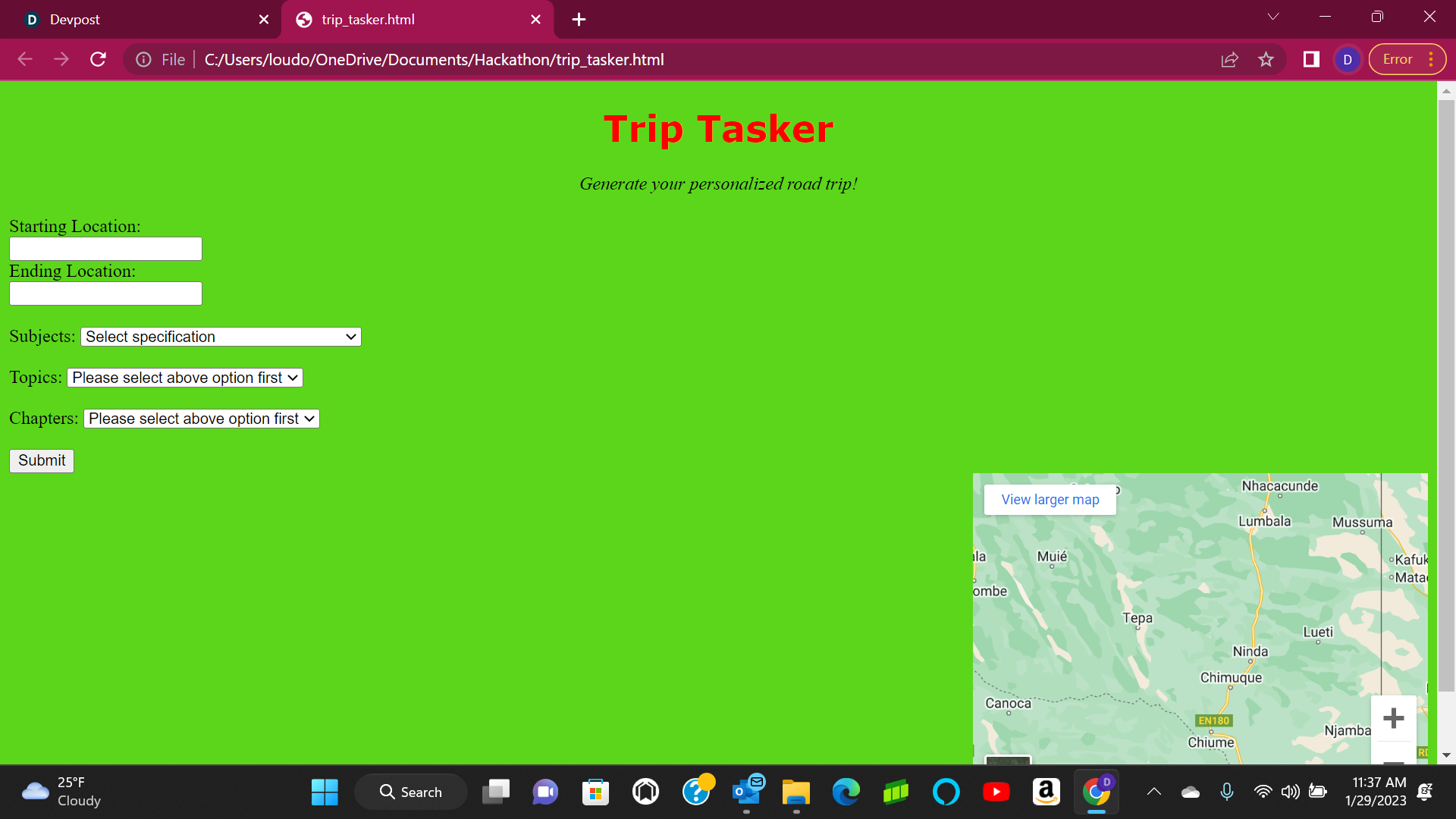
The program takes in user input from where you want to go and where you are coming from and asks how any stops they would like to make as well as what kind of stops they would like to make. In its prototype standpoint, it asks if they want to stop for gas, food, and/or tourist attractions, as well as how far away they would like to stray from their shortest route. The user input, with text fields and drop down me menus, then fills out the form, submitting it to a new page where an AI takes data from the Google Maps and finds what are the best places to make stops due to the preferences of the user.
How we built it
The website was built with HTML and styled with JavaScript and CSS. Dijkstra's Algorithm, which was used to determine the fastest route from point A to point B, was created in python. The form was written in HTML but stored and used in PHP.
Challenges we ran into
A big challenge the fact we only had two members for our team, despite originally having four and them dropping out after everyone had already settled in with their teams. Working shorthanded, we were up against the clock and did not have the time to implement features that would describe our project better, such as the resultant map from the data and getting the php to work within the HTML.
Accomplishments that we're proud of
We were able to learn a completely new language on the fly (PHP) and get a very solid understanding on how map services like Google Maps are able to calculate the most efficient route possible with Dijkstra's Algorithm.
What we learned
We learned being able to use multiple languages all onto project is quite difficult to manage. However, we feel we learned we had a lot more in us than what was perceived. With dedication, we were able to come up with an innovative idea and be able to develop the base code in languages that we were all not too familiar with.
What's next for Trip Tasker
Trip Tasker will be able to take in more specific input of what types of stops are wanted, such as what type of restaurants, outdoor/indoor sightseeing (or any other types of tourist attractions), and how many days/nights the trip will last. With more time and funds accessible, we can access the API to Google Maps and get a functioning map that entails the auto generated stops the user would be interested in.

Log in or sign up for Devpost to join the conversation.